Scam Victims Struggle To Recover Money Amid Fragmented U.S. Response
The U.S. government is not doing enough to fight the surge in cyber scams, an investigation into the global scam industry led by the Joint Economic Committee of the U.S. Congress has found.
October 27, 2026
Share
In partnership with:

The U.S. government is not doing enough to fight the surge in cyber scams, and partnerships with the private sector remain fragmented and voluntary, an investigation into the global scam industry led by the Joint Economic Committee of the U.S. Congress has found.
The government does not even have a unified accounting of how much money has been seized from overseas scam compounds, nor how much has been returned to victims, according to the report, released Tuesday by ranking Democrats Sen. Maggie Hassan and Rep. Don Beyer.
Citing findings from a year-long investigation into global scams by The Associated Press and FRONTLINE, the report called for greater collaboration across agencies, support for victims, and deeper private sector engagement.
“Transnational criminal organizations run massive compounds that exploit U.S. technology, including AI, to carry out scams against Americans with devastating consequences,” Sen. Hassan said in an email. “The scale of this exponentially growing challenge requires Congress, the Administration, and the private sector to all strengthen their efforts.”
The report, which AP obtained before its release, made clear how hard it is for scam victims to get their money back, despite the quickening pace of seizures announced by a variety of U.S. government agencies.
The FBI told the committee it returned $336 million to scam victims in 2025.
The Federal Trade Commission reported that it had returned $1.83 billion to fraud victims in fiscal year 2025 but could not determine how much of that money had been lost to overseas scam compounds.
The U.S. Secret Service returned more than $770 million in seized assets to fraud victims in fiscal years 2024 and 2025 but noted the money had come from a range of fraud schemes.
The U.S. State Department said foreign law enforcement agencies that receive State Department support had seized proceeds “in the low hundreds of millions of dollars” but told Congress to ask the Departments of Justice, Homeland Security and Treasury for details.
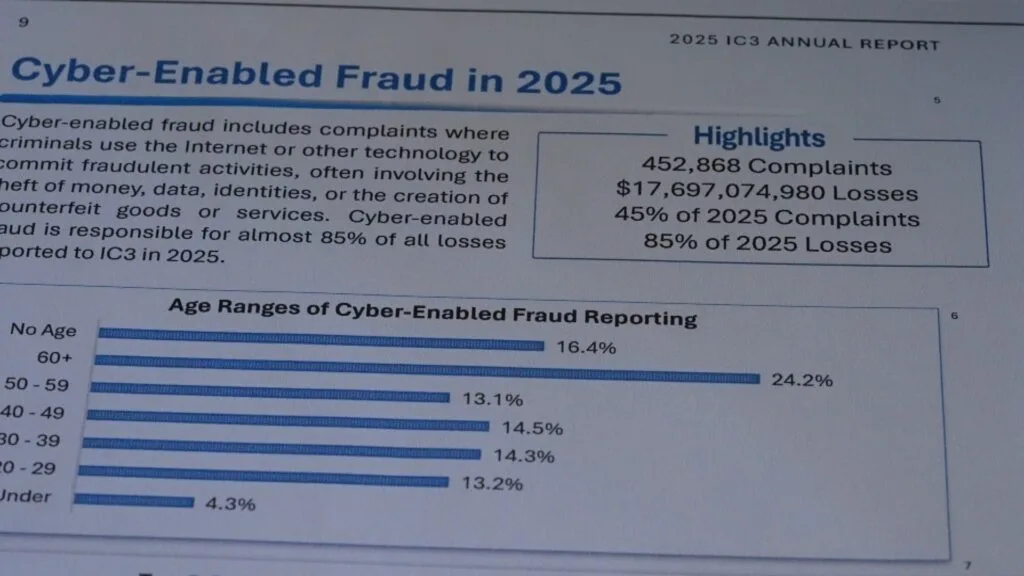
Taken together, that only adds up to a fraction of what victims have lost. Americans reported cyber fraud losses of nearly $18 billion — that’s more than $2 million an hour — last year to the FBI. Many don’t even report the crime.
The report also expressed concern that even as criminal scam networks expand into more countries, State Department cutbacks eliminated at least one anti-scam program in Bangladesh, which had been training local law enforcement to conduct cyber fraud investigations.
Bangladesh is an emerging hub for global scam operations, according to a report last month by the United Nations Office on Drugs and Crime that was funded by the European Union.
The State Department, which said it has 60 employees in the U.S. and Asia who dedicate significant time to fighting overseas scam compounds, told the Committee that it “has the tools it needs to combat the threat internationally.”
The report urged Congress to pass pending legislation that would mandate a unified federal strategy to combat scams and establish a central location for victims to report losses and seek help. The White House has also advocated for greater federal coordination.
Several Justice Department officials told Congress that private-sector companies should focus more on scam prevention, but U.S. regulators and lawmakers have so far not created clear incentives for them to do so. Unlike the European Union, the United Kingdom, Australia and Singapore, the United States has stopped short of holding technology, telecom or financial services companies potentially liable if they fail to do enough to protect consumers from scams.
Kate Griffin, a director at the Aspen Institute’s financial security program, said there has been important progress but the U.S. still lacks “durable, sustainable scam prevention.”
“We don’t that showing up yet in reduced victimization,” she said. “And that’s what really needs to happen.”
This story is part of an ongoing collaboration between The Associated Press and FRONTLINE (PBS) that includes the documentary “Scammed.” Watch the documentary at pbs.org/frontline, in the PBS App and on FRONTLINE’s YouTube channel.
Watch the documentary
Scammed
How online scams steal billions of dollars and ruin victims’ lives
Journalism powered by your support — and accessible to all.
Watching our “Scammed” documentary revealing how the global scam industry operates? Exposing the truth is where accountability begins. Help keep reporting like this paywall-free for everyone with a gift of $5 or $10 today.
Investigative Reporter, The Associated Press, The Associated Press
Support provided by:
Learn More
Related Documentaries









Latest Documentaries







Related Stories

Inside the Scam
Related Stories
Inside the Scam
Explore
Policies
Teacher Center

Jon and Jo Ann Hagler on behalf of the Jon L. Hagler Foundation
Corey David Sauer
Koo and Patricia Yuen
FRONTLINE is a registered trademark of WGBH Educational Foundation. Web Site Copyright ©1995-2025 WGBH Educational Foundation. PBS is a 501(c)(3) not-for-profit organization.
Funding for FRONTLINE is provided through the support of PBS viewers and by the Corporation for Public Broadcasting, with major support from Ford Foundation, and Fialkow Family Foundation. Additional funding is provided the Abrams Foundation, John D. and Catherine T. MacArthur Foundation, Park Foundation, Heising-Simons Foundation, and the FRONTLINE Trust, with major support from Jon and Jo Ann Hagler on behalf of the Jon L. Hagler Foundation, and Corey David Sauer, and additional support from Koo and Patricia Yuen. FRONTLINE is a registered trademark of WGBH Educational Foundation. Web Site Copyright ©1995-2026 WGBH Educational Foundation. PBS is a 501(c)(3) not-for-profit organization.