U.S. Senator (D-MN) and Judiciary Committee Member
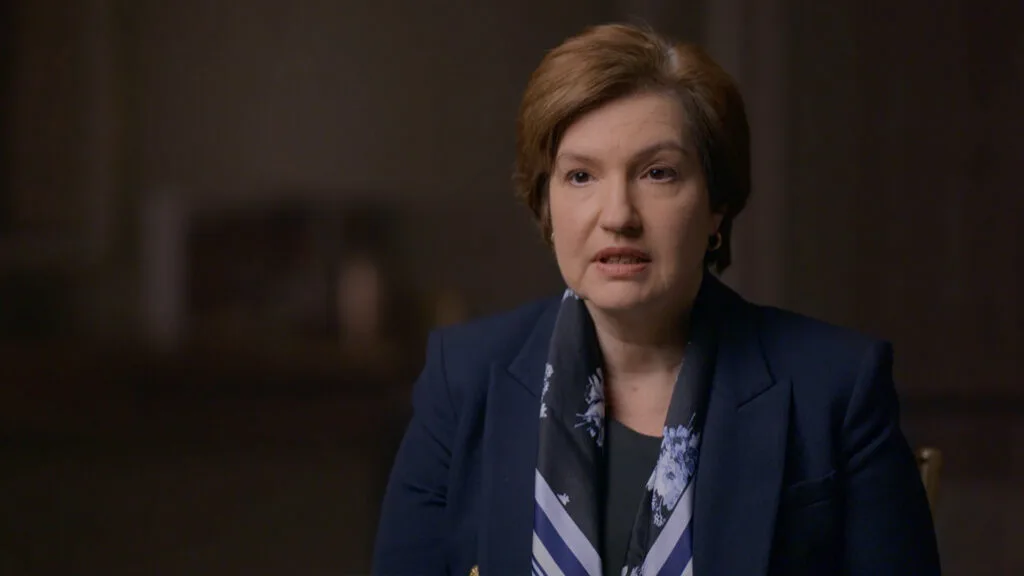
Amy Klobuchar, a Democrat, is a U.S. senator from Minnesota. She is a member of the Senate Judiciary Committee and gained national attention during Brett Kavanaugh’s Supreme Court confirmation hearings.
This interview was conducted by FRONTLINE’s Michael Kirk on December 12, 2018. It has been edited for clarity and length.
The part of this film that you're in begins with the death of Justice [Antonin] Scalia and [Senate Majority Leader] Mitch McConnell (R-Ky.) deciding fairly quickly that President Obama is not going to get a nominee for the Supreme Court.When you hear that, tell me what you think.
Well, first of all, I have always believed in a fair judiciary.I grew up in Minnesota.I'm a lawyer from there, and I saw our judges that were appointed on both the district level and the state-court level under an independent governor—that would be Jesse Ventura—under Tim Pawlenty, a Republican who ran for president, and under Mark Dayton, a Democrat.For the most part, those judges were fair and good, and we had this sort of good government way of looking at our judiciary in terms of the people that should serve.And you certainly don’t leave positions open.
So I was shocked to find out that the Republicans’ plan after Justice Scalia died was to simply leave it open and wait and see if they could wait us out, basically.And so for that entire year, we worked very hard to get such a good man on the bench in Merrick Garland.That’s someone who is known as a moderate judge, a consensus-builder judge.That was just an eye-opening experience for someone like me, who had grown up in a legal system at home where fairness ruled, and whether you were a Republican or a Democrat or an independent, you would make sure that we were filling judicial spots with fair-minded jurists.
Tell me what that tells you about Mitch McConnell.
Well, he clearly saw it as a political moment and a time where instead of seeing the judiciary as independent and separate with our purpose to advise and consent and make sure that the people being put on the bench would do the job fairly, he saw it as more of a political moment.And in this case, sometimes that meant, as we later learned with President Trump, putting on people that were sometimes unqualified, were sometimes just way too partisan.
Back after Justice Scalia died, you could see that the Republicans viewed it as just a moment to wait and a moment to keep someone off the bench that deserved to be on the bench.
The Kavanaugh Hearings
It’s the beginning of the Kavanaugh hearings.Everybody’s in the hallways and walking up and down.Talk to me about the protests.Why were they there? What were they protesting?
Well, first to clarify, are you talking about before Dr. [Christine Blasey] Ford, kind of that? Right.
Yes, so that's not happened.
OK.Well, we had already just been through the [Neil] Gorsuch hearing, and there was someone who clearly had extreme views and has shown that since he’s gotten on the court.For anyone that thought that wasn’t true, they should look at some of the decisions that he’s already been part of.But then you move into the nomination of Kavanaugh from a president who is mired in the middle—his administration is—of an investigation of another country interfering in the election, comes this nominee who literally appeared to have been handpicked because of his views on expansive executive power.
So you ask why were there protests.Well, there were protests because of that, because you literally had a nominee who had written opinions that said that a president, on his own or her own, should be able to declare law unconstitutional.You had a nominee who the president had put forth who had literally said that the president should be able to fire an independent or special counsel.This was a person he picked.Like, literally found the one guy that had this expansive view of executive power.So that was first why there were protests.
The second reason was just his extreme views when it came to a number of issues and concerns about Roe v. Wade and the importance of that; concerns in his opinions, which looked like they were literally—some of his opinions were, “Hey, look at me; I'm writing conservative opinions.”I mean, one of them threw out the Consumer Protection Bureau, the financial protection bureau, the bureau that had saved Americans millions and millions and millions of dollars based on fraud.And he literally wrote an opinion that found it unconstitutional, and it was later overruled.
Or what he had said about net neutrality when he was just way off in his own dissent there, saying that those rules should be struck down.You just go through the march of consumer cases.Antitrust—something I care a lot about—his two opinions in this area were more conservative than the [John] Roberts court.So there were a number of areas where he showed extreme views.
And so you ask me why you saw protests.I could give you about 10 reasons that were unrelated to what later happened with Dr. Ford.But the primary ones: expansive view of executive power; anti-consumer tilt down the road when it came to antitrust; net neutrality; and then of course, throwing out the Consumer Financial Protection Bureau.
Politicizing the Nomination Process
Now, the old truism used to be is Republicans care a lot about the courts.They’ve always cared a lot more about courts than Democrats have.Democrats have cared about a lot of other things.But suddenly, or maybe not so suddenly, but absolutely these protesters and what's about to happen in the Kavanaugh story indicate that maybe Democrats are in this game now, in this fight now?
In a different way, yes.And I think part of it was the lead-up to this where you had judges that had been nominated, blue-slip process thrown out for circuit nominees where you had cases like the guy that wasn't able to answer some pretty straightforward legal questions by a Republican senator on the Judiciary Committee.That was one nominee, [Matthew] Petersen.Then you had other nominees that had been actually—their nominations had fallen because of some extreme views on race and voting and other things.
So the public had started to get more and more interested in this, and I think because of the Trump era, they were out and about and more engaged in politics than we’d ever seen before.So it’s not that far a step that when in the past, even in the Gorsuch hearing at the beginning of the Trump administration, they were less engaged, much more engaged by the time it gets to this one.
So I watched the videotape last weekend in anticipation of coming here of that first day where you're all sitting there.Kavanaugh comes in, Chuck Grassley (R-Iowa) is tapping his gavel, and within seconds, the room erupts.It’s just a microcosm of partisanship and everything else all at once.
Well, no, no, I mean—
So what was it?
—I really look at it a different way.I think I was the second one to speak.Again, I go back to my belief in process and fairness, and we had a situation where literally 42,000 documents had been dumped on us, 42,000 pages the night before.There were still over 100,000 documents that they were saying were privileged that we couldn’t see.There were hundreds of thousands of documents that we could see, but the public couldn’t see.We couldn’t see any of the documents from his time as staff secretary, and they literally rammed that nomination through, which is part of the reason that you saw all this late-breaking information coming out, because they were trying to go at rapid speed so they could get it done before an election.That's what they were doing.
So that was so unfair that a number of us chimed in immediately and said: “We just want to see the documents.Could you let us see the documents?”And even the one, if you note during the hearing, the one person that Sen. Grassley, the chairman, kept commending was me because I had gone through a process for a limited amount of documents, were the campaign finance documents.
And I actually got kind of a little jewel that we found because of that, which showed that he had basically put forth some questions when he worked in the White House about the constitutionality of campaign finance laws.That was a pretty big deal when you look at the public’s hatred of Citizens United and all this dark money that's coming into politics.You’ve got someone that you may put on the bench who ultimately did get on the bench who didn't like the campaign finance laws.
So that one document that I was able to get through going through this detailed process was actually a jewel.Imagine how many other jewels were out there that we could have used to make our case.But we didn't have those documents, and that is why we responded so quickly at the beginning of that hearing, pleading with the chairman to delay this until we could get the documents.It was unheard of not to get that many documents.
Now, if you're McConnell, the clock is ticking, because you want to get this done as fast as possible, right?
Sure.You can see the motivation.It’s pretty easy. It’s pretty easy why—
What is it?
—you know, they picked—remember, he was not that in favor of this nominee because he was worried about all these documents that were out there.Well, so what's the solution?Ah, we just don’t see them.And so that's what they did.They were shoving it through, ramming it through, didn't care what the rules were, didn't care that we didn't see the documents.And that is why we responded that way.
Because what is looming on the horizon is the midterms and the opening of the session, right?He's got a clock ticking.He knows if it slows down very much at all, he's in big—
Exactly. He has every motivation to try to speed it up.
Allegations by Christine Blasey Ford
OK. Kavanaugh testifies.It’s back and forth, but it’s kind of standard procedure in lots of ways.When the information about Christine Blasey Ford comes forward, it’s a weekend…So Sen. [Dianne] Feinstein (D-Calif.) has a letter.Some of you, some people on the committee I've talked to, read it over the weekend, a redacted version.
Not me.
Not you?
I didn't get the letter until Sept. 12.I didn't hear about it ever until that night.And that was a weekday night, and we had been called to a special meeting in the President’s Room, which is a room right off of the chamber.It was during a vote.And that was when I first heard about the letter and then first saw the letter, and that was the first time I’d ever heard of Dr. Ford or knew about this allegation.And I’d never seen it before.
What did you think, Senator?You’ve already talked about the paper trail that's being denied, and now this comes forward.What did it feel like to you?
Well, this was, as you know—and you should talk to Sen. Feinstein about this.
We will.
But the reason that she had not come forward with it is that Dr. Blasey Ford had asked for confidentiality, and she respected that.And then she didn't show it to anyone or give it to the FBI.And so that was one of the reasons.So mostly I thought that I might have given it to the FBI, but I completely understand how she came to a different conclusion.But I thought, well, we just can't sweep this under the rug; this looks like a serious allegation; it looks like something where we have to allow for investigation.I thought it should be first by the FBI before it got to a hearing.And then, of course, they went back and forth on that.
But that was my reaction, is—having been a prosecutor for eight years, having seen similar cases to this, especially involving younger people, is that you have to look into things.You have to figure out what happened.So that was my immediate reaction when I read it.And then the second one was, well, we're going to have to open this up so we can figure out what happened here, because, again, I never found out about it, that it even existed, until Sept. 12.
So she testifies.The stakes for her and the stakes for the hearings and the stakes for all of it—how did it feel to you that day when she came in?
Well, it was, of course, a larger-than-life moment.In some ways, I kept putting myself in the head of my old job as a prosecutor, thinking about the victims that I had met that came into our office.We had 400 people that worked in our office, so we handled multiple cases, and sometimes with multiple prosecutors.But I would meet with some of the toughest cases, the victims in those cases.I had been at meetings where we told them we couldn’t move forward on a case and had to explain why.
So I tried to put it in that mind frame instead of the mind frame of, oh, this is this big political media spectacle.And I did that out of respect for her, but also because I think that’s what people wanted to understand, the facts.They wanted to sync what he said was happening with what she said.I had never met her before; I didn't know how she was going to do.So I came up with some questions with our staff and actually talked to some of the former prosecutors that worked in my office back in Minnesota about what would be the appropriate cases as you're trying to get to the bottom of what happened.
You've got the fact that she had taken a lie detector test, and while that's not admissible in court, it certainly is admissible for establishing credibility when it comes to law enforcement and other things.So I just looked at all the facts, and they seemed to make a case.But I had no idea how she would do as a witness.
So when I got there, I literally had separate sets of questions and statements depending on how she did.And like everyone else, I was very impressed by the grace and dignity and how she handled this difficult situation.I thought it was strange my colleagues had outsourced their work and that there was just this whole row of men that I looked at every day that had given their work to a woman prosecutor.That’s their choice.But I thought it was really important to show the American public that we were doing our job, and that our job was to assess the credibility and give her a chance to tell her story.
The Optics of the Kavanaugh Hearings
Let’s talk about the optics of the Republican side of the thing.What's up with that?
It was a lot of guys.As you know, most of the women in the Senate, not all, but the majority of the women in the Senate are on the Democratic side, and we've tended to be the ones that have had the Democrats on the Judiciary Committee.That being said, when I first got here for a long time, just in the last decade, there were just two women on the Judiciary Committee: Sen. Feinstein and myself.And then we were recently joined by Sen. [Mazie] Hirono (D-Hawaii) and Sen. [Kamala] Harris (D-Calif.).But other than that, it was just the two of us and like 20 men.
So that's what we had.That was, I guess, normal.And I’d actually done some research.When Anita Hill testified, there were no women.And then you go back decades, there was one woman, and then there was maybe one more woman.But it was very bleak in terms of women on that Senate Judiciary Committee, which is a powerful committee.
So it felt like, in a way, it was normal for the Judiciary Committee, but it was not normal for the country.
And 20 million Americans are watching it at any given moment.
Exactly. And they're getting to see what I see, which is why we're excited that more women were elected over in the House and why we're now up to over 20 women in the Senate, which is the all-time high for us.I was once on the ["The Daily Show with Trevor Noah"] and said that in the history of the Senate there’d been something like 2,000 men and 52 women, and he said, “If a nightclub had that ratio, they’d shut it down.”So that's kind of what we've been dealing with.So that was, I’d say, emblematic of that.
But the bigger thing was really her and what grace and dignity she had.Colleagues on both sides of the aisle were talking about that.So I really aimed my questions at letting her speak.I didn't give some long speech.I thought it was important, just like any lawyer would do, that you let her speak for herself, and that’s why I pointed out to her that for so long, claims like this have been swept under the rug.And now, they used to think that things that happened in the house should never go in the courthouse.Well, that's not the word anymore.That's not how people handle these cases.I asked her a question similar to what Sen. [Patrick] Leahy (D-Vt.) had asked, and that was what she couldn't forget from that night.And she of course talked about the staircase, and she talked about his friends laughing.It was just so evocative of this horrible thing that had happened to her that she couldn’t forget.
How do you think the Republican men reacted?You must have felt the vibe from them.
Yeah. I think that they were surprised at what a dignified person she was.While she didn't remember everything, which you would expect after all those years, she clearly very strongly remembered certain things about that evening.I think overall, people felt that she had just done an excellent job in explaining what happened to her when there was—I always say when a victim testifies, they have to go before a jury box of strangers looking at them.Christine Blasey Ford had to go before the eyes of a nation and the world.
Kavanaugh’s Response to the Allegations
It’s then his turn.… It must have been incredible to be in the room as he comes in.How did you think he was going to react?You’ve met one Brett Kavanaugh in the first sessions, and now facing these allegations, formidable allegations.
Yeah, I was really surprised, because I had sat through nearly that entire hearing, the first hearing, and he would answer the questions like a normal nominee.I didn't agree with his views.And then I’d also met with him, and that was fine.In fact, when I asked my questions, he led by saying that he respected me, which he had said a few times.
But what I was surprised by was, one, of course how he treated people on the committee.But two, how he immediately went to the jugular when it came to partisan politics, talking about Hillary Clinton, defining people by their political party.You know, maybe I’m naïve, but growing up in Minnesota, that's not how judges talk, and that's not how a lot of them even think.
So the disturbing part of that was just how it politicized the whole proceeding and the judiciary, which is why I think you've seen Justice Roberts since that time, including in a discussion he had at the University of Minnesota and then later in a statement, defend the judiciary and basically say that you can't say that there's Democrat and Republican judges.I think just reading the tea leaves, since I haven’t talked to him about it, Justice Roberts, I would say he’s very conscious of the fact that you don’t want to have the court go down to base politics.And that's what it felt like the statement of Kavanaugh was: It was just base politics.
And the Republican men across the room from you?How were they handling that?
I couldn’t really—I was so fixated on what the nominee was saying that I didn't really notice them until they started talking.Oh, and then I noticed them.And especially Sen. [Lindsey] Graham (R-S.C.), who was really echoing the same rhetoric that you heard from Kavanaugh.And I just, in my mind, all I kept thinking—and I’d said it the next day—Exhibit A, Merrick Garland.Exhibit A, Merrick Garland.We sat through nine months without a justice.We tried so hard to get this done, and you guys kept saying, “Oh, no, you wait until the election,” and now we have an election coming up, and you're saying the opposite.None of it made any sense to me, and I think it just added to the divide and the partisanship.It felt like they were all acting in the same way.And I said the next day, “How can you say that you respect Dr. Ford if you're then going to act like this in the afternoon?”
The interaction with you around drinking and all of that, very unusual.I'm looking for a better word.
Well, yeah.So I really approached it thinking, what's really going on here?And I focused my questions on drinking for a reason.I really felt that explained a lot.How do you sync his statements with hers?How do you explain as you heard other things surrounding her case with his behavior in college and other things?
…That's why I brought up—you know, I know a lot of us have had experience in our lives with alcoholism or binge drinking.And I don't know if that's what got it going, but then I asked him if it was possible that he had blacked out and that's why he didn't remember it.And then he went back at me and asked me if I blacked out.And I thought—my first reaction was, boy, if I had done that in your courtroom—I thought this in my head—you would kick me out.But then I decided, that's not what I'm going to say.
I had a split-second to decide, and I decided I'm not going down there with you, because I've got to uphold the dignity of the Senate, the dignity of Dr. Ford and really the dignity of the country.So I didn't go down there with him.And it also reminded me a little of being a kid of an alcoholic remembering those moments where you’ve got to take the keys away when they're driving.I thought, I'm going to take the keys away here; I'm not going to go with you in that car.
Do you think that, aside from the things he said, aside from invoking the Clintons and the equivalent of the vast left-wing conspiracy and the back-and-forth with you Democratic senators, was that disqualifying in your mind?Does that disqualify him from the Supreme Court?
Well, remember, I already was voting against him based on so many things: the expansive view of the executive power, the consumer issues.But this was a side of him I hadn’t seen, and this was a major demeanor issue, which for a number of my colleagues who hadn’t made a decision yet, that was for them disqualifying.And of course it was, because it was so political, and it was so angry.But I wouldn’t say just because he had a back-and-forth with me that that would be the only reason.
No, sure.
And also, he did apologize, which I said I appreciated, and I did when he did that.But for me, it’s just the whole package of his views, and I can't really separate out the independence issue from the White House, and then his views on consumer issues.But this was—yes, this was a big surprise.
Jeff Flake and the Kavanaugh Vote
By the next—by that night and the next day, protests are forming all over the building in even a bigger way than I think at the very beginning.Everything is getting pretty intense.You guys are all intense in the room there.The Republicans are.[Jeff] Flake (R-Ariz.) has announced that he’s going to vote, … and it felt like there were a few people on the bubble at that time.Susan Collins (R-Maine), obviously.When McConnell is counting heads, he’s got Collins; he's got—
[Lisa] Murkowski (R-Alaska).
Murkowski; he’s got [Joe] Manchin (D-W.Va.), maybe, over on the—[Heidi] Heitkamp (D-N.D.) maybe.Whatever he’s going to need to get there.The clock, as I remind both of us, was ticking for them.That morning when Flake and [Chris] Coons (D-Del.) go out, and all of it seems a little bumpy in advance of the FBI decision, what were you thinking when you were sitting in that room?What was actually happening in that room?
Well, first Sen. Coons and I had had dinner, the two of us, with a few of our staff the night before kind of talking through this and talking through if there was a possibility of an FBI investigation, that that would really at least get us some facts.That kind of was the cart before the horse.It should have happened before the hearing.
Well, that was your early argument, right?
So we talked about that.And then we went in there, and as you know, some people were leaving in protest of how the hearing had been handled.I decided to stay.Again, I'm thinking of this as what do I do as a prosecutor?Stay in the courtroom, no matter how unfair it feels.And so I stayed there, and I thought that some of the remarks that we gave, and not just me but also Sen. Coons, Sen. [Sheldon] Whitehouse (D-R.I.), Sen. [Dick] Durbin (D-Ill.), I thought that was pretty meaningful, because we were looking at our colleagues, including Sen. Flake, and saying: “You know what?Yeah, this is messy, but the question is,” is what I posed to them, “what do you do when it’s a mess?Politics is always messy.The criminal justice system is messy.Do you just shrug your shoulders and pretend it didn't happen?What matters is not that something went wrong.What matters is when you have power, how do you react?How do you handle it?”And our job was to at least get an investigation going.
So after we gave those talks, Sen. Flake got up and turned around, and Sen. Coons and I sit next to each other; we're good friends.Tapped him on the shoulder and he went out, and then actually I went out, and then we ended up in this hallway.And at some point, those two went into this little phone booth to keep talking.They went in; they were talking in the bathroom.Then more senators came out, which was good because it was kind of a joint decision.
And pretty soon I noticed all the senators were in this really narrow, hot hallway, and the staff was in the big room at the table.I'm like, “You guys.”And I realize the staff didn't really want us to be alone.And so some of them then cleared out so there was a little more room so the senators could talk.
And then at some point, Sen. Flake made that decision.And I felt one of my jobs when we got back in there, which you'll notice I say publicly, is there was some confusion about whether or not there was actually agreement.There really wasn’t an agreement like, “Oh, hey, this is how you do this,” because if we’d made an agreement, we would have probably wanted to cross a T and dot the I on how they were going to handle this investigation and get the White House on the phone.And none of that was possible in terms of happening.And really, it was Sen. Flake’s decision, because we were all voting against the nominee anyway.
So that's why I clarified this wasn’t really an agreement.This was us supporting Sen. Flake in his efforts to get an FBI investigation; that that was a good thing and that he and Sen. Coons being friends and talking it through was a good thing.But we didn't have some set agreement, nor could we.We had no leverage to do that because the White House would have had to agree with us.They weren't going to do that, about what this investigation would have looked like.So all we could do was try our best to push for an investigation, and then Sen. Flake really had the leverage to determine what it was, because he and just a handful of members were going to decide whether or not that investigation was enough for them to make a decision to vote.
They go to a meeting at McConnell’s office that night. There's a—
I wasn't there.
I know.There was a lot of them there.
One meeting I wasn’t at.
… So they're in there, and McConnell, it sounds like, is trying to shape the nature and scope of the FBI investigation to make it quick and to make it as narrow as possible.I can't tell where Flake and Collins and others were.
Yeah, I really don’t know—
Yeah, and I'm not asking you to know.
—the details on this one.I just know that the scope of the investigation was in the hands of the White House, and they were, unlike a normal criminal investigation where the FBI can kind of go wherever they want, this was a background-check investigation.So the White House were the ones, from my perspective, that narrowed it.
And was it enough, from your point of view?When did you know that it was as narrow as it was?
No, I would have made sure that every lead had been followed and a number of people were interviewed.But it was what it was, and there was nothing that we could really do about it.Because Sen. Flake was requesting it—we had already made a decision we were against the nominee.So all we could do was talk about the fact [that] there were, without revealing what was in the classified documents, there was huge piles, a stack of sort of FBI leads and things like that.
That they didn't pursue?
You know, I actually don’t really know.We only had one day to look at everything.
So what does that feel like? It feels like—
Those weren't in the report; I’ll put it that way.
What does it feel like?Does it feel like everything’s being kind of really kept in a box, in a tight box?
It was literally we were sort of in a box, because we were in a room with some boxes, and that's how it was.But it just was so difficult, because I really felt that there were people that could have been nominated that would have been more in the mainstream, that wouldn’t have put the country through this, and it’s just not what happened.
So when Susan Collins announces that she's going to go, were you surprised that she was going to vote yes?
No, I didn’t really know how she was going to vote.I kind of—she's independent in so many ways, including just this month she voted with us on the dark-money issue.And I've known her; we're friends.I also knew that Justice Kavanaugh had worked with the Bushes, and she's very close to the Bush family and would always see George H. W. Bush up until the year he died.And so I thought that might have been an influence.It’s been public that George W. Bush was making calls.And so, you know, not saying it’s evil or bad; it just was part of the factors here is that Justice Kavanaugh had worked in that administration.
And then I also thought that she would, as she always does, thoroughly look at things and make a decision.No one always wants to be the last person making the decisions, so I think she legitimately had not decided.
So when you look back on it, Senator, what do you tell yourself happened?
Well, I think that the first lesson to me was that you should always do thorough investigations of these nominees.I hope this never happens again, where something comes out at the end like this.I personally would have, as I've said before, given the letter to the FBI just because I think it should have been—more time would have been helpful.But I completely understand Sen. Feinstein looking at it a different way.She looked at it as that she promised confidentiality to Dr. Ford.
The second thing is that I think that the more we can have dignified proceedings, which this wasn't—it, to me, was an embarrassment, the second one.The first one was more of a normal hearing.We should, and it's incumbent on all of us—I tried to keep my dignity, and I think I did, through the proceeding, because I think sometimes these things are bigger than partisan politics.They're about our history and our country of having an independent judiciary and having a Senate that works.
I wrote a book once called "The Senator Next Door," and it was really about how when you come to Washington, you are there to represent your neighbors.And you don’t always agree with your neighbors, but you’ve got to treat them with dignity.And that's what really bothered me about the way this hearing went down and how he acted at the hearing.
But again, you’ve got to ask, are we going to go down to that level?And I wasn't, and I think it’s really important as we go forward that we avoid having this kind of situation with a nominee.So I think we’d better be looking at their demeanor; we’d better look carefully at anything in their background not after the hearing but before it.And I think you'll see members much more interested, which I think is good, beforehand in looking at some of the information about a nominee than just their court decisions.
Is the court in some peril, like it’s changed in some important way?Politics has finally invaded it in a really obvious way?
I hope not.There have been a few decisions here and there, like the decision to uphold the Affordable Care Act when Justice Roberts actually wrote that opinion.That was a good moment, in my mind, for the court.There have still been those moments where you see someone getting out of their partisan corner, and I think the more we can see that, the better.