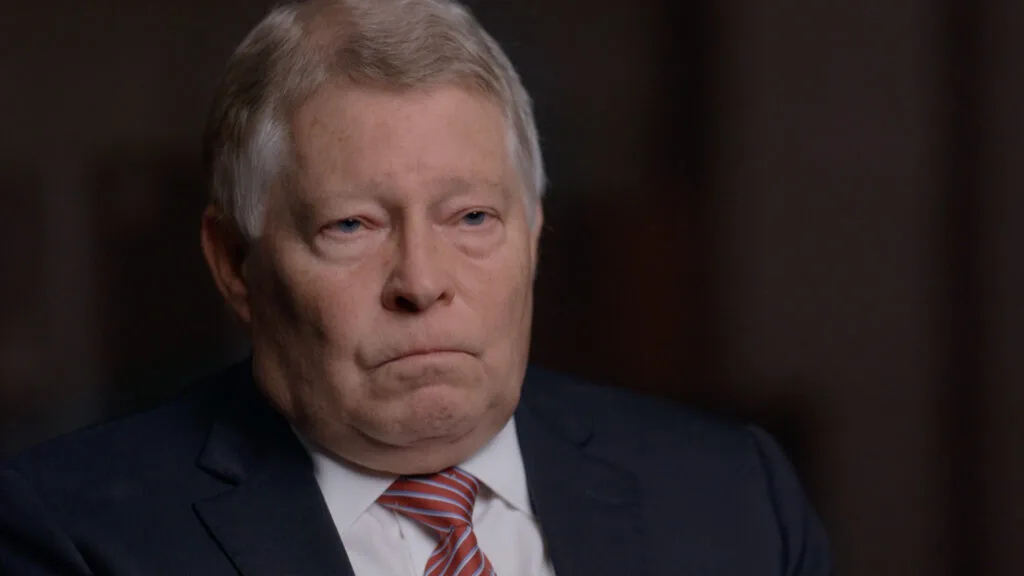
Daniel Ziblatt is a professor of government at Harvard University. He is the co-author, with Steven Levitsky, of How Democracies Die.
The following interview was conducted by the Kirk Documentary Group’s Mike Wiser for FRONTLINE on May 6, 2022. It has been edited for clarity and length.
One of the first moments that stood out to us was the Iowa caucuses.And Trump loses, and Ted Cruz wins, and Trump's response is that the election was rigged.And we've talked to people who know and have studied Donald Trump and say that he said that about the Emmy Awards; he said that about other elections.How important a moment was that, and was that a warning sign all the way back in 2016 about what Donald Trump represented?
I think it was.One of the hallmarks—to be a democrat means to know how to lose elections.To be small-d democrat means to know how to lose elections, and a democracy can't survive if politicians and political parties don't know how to lose.And sometimes people have even said democracy is for losers.It's a system that allows losers to come back and fight another day.And so if the losers deny that they've lost, the system can't endure.So that's really a lesson that one can draw upon lots of other democracies in the world.And so this certainly was a moment that set off alarm bells for me.But in some ways, I think at the time I already had the impression that he was the kind of person that might do this, but this really confirmed it.And, you know, it was a primary; it wasn't a general election.But still, it was clearly an indicator of where things were going.
What were some of the other things that you were seeing during that primary process that were setting off alarm bells for you about what he represented?
I think one of the things that really frightened me was his relationship with the crowd and the degree to which he fit the kind of basic criteria of what we think of as a demagogue.
So the word "demagogue," of course, means somebody who's rooted in the notion of a "demos."He has a relationship with the people, and that's what democratic politics are.But there's a kind of demagogue, a politician, a democratic politician, who seems to have no core and adjusts his message as he sees the crowd respond.So Donald Trump's relationship with the crowd, and the nastier he got, the more excited the crowd got, and rather than trying to clamp that down and sort of pull back, he egged on the crowd further.And that dynamic of the angry crowd and the demagogic leader fomenting anger and using violent rhetoric was a sign that this is somebody who had no democratic core, liberal democratic core, and it was not clear what the limits of this kind of style of politics were.So I think that was very frightening.
How unusual was that in modern American politics, to see what you were seeing?
Yeah, so it's interesting because of course, democratic politicians do this all the time.I mean, this is the nature of democratic politicians is to try to win votes and to win the appeal of or try to find an appealing message to an audience.And all democratic politicians, to some degree, love the adulation of the crowd.That's why they get into the business.And so democracy is, in some sense, a kind of fragile construction in this sense.But what made this different—and this was unusual—was his willingness to use violent rhetoric and obviously hateful rhetoric towards immigrants and others and to not step back.This was very unusual.
There are other instances in American history.I think George Wallace is somebody who comes to mind immediately as someone who tries to kind of embody the anger of his crowd and has a good sense of it and is a performer.And so this was unusual.But what was particularly unusual was the idea that somebody like this—again, there's been other figures in American history: Huey Long, George Wallace, Joe McCarthy—to have somebody running for the nomination of one of our two major political parties, and then ultimately winning it, was an incredible sight, and it was something that we had never seen before.
But again, I would want to emphasize that there's always been an angry strand in American political life.There's this notion that there's the liberal tradition in America.There's a famous political scientist, Louis Hartz, talked about the liberal tradition in America.That is certainly real, and it's enduring, and it's been there.But alongside it is this illiberal tradition, a demagogic tradition, and Donald Trump was very much in that tradition.But again, what was different was this is somebody on the verge of gaining the White House, and ultimately gaining the White House.
As we get towards the convention, there's a choice that Republicans have to make.One of them who has to make a choice is Ted Cruz, who decides he's not going to explicitly endorse Trump and goes to the convention, and he gets booed.How important is a choice for a Republican like Ted Cruz in that moment, or like the other Republican leaders as they're going towards the convention?
What's so fascinating is that we normally think of democracy, or the way I've always studied democracy, is that it's the outgrowth of how wealthy a country is or how robust the civil society is.But what I never realized until this moment was the degree to which a strong civil society, a strong economy, all of these things bring democracy because we rely on the fact that political leaders in those kinds of societies make the right choices, and that democracy hinges on politicians and political leaders making the pro-democratic choice, putting the democracy ahead of their partisan interest, or even more narrowly, their own personal ambition.And so these choices were decisive.… Choices don't always matter, but there's certain moments of opening, moments of choice where political leaders' actions really make a big difference.And unfortunately, that was one of those moments, and we have a lot of political leaders making the wrong choice.
What Pence Offered Trump
One, let me ask you about just in particular—and you can explain what he might have given to Trump—is Mike Pence.And when an establishment, evangelical politician decides to join a ticket with Donald Trump, what choice is he making, and what's his role in what would happen in making that decision to join the ticket?
Well, he certainly was latching his personal fate to Donald Trump and was using his relationship with Donald Trump as an ambitious politician, as somebody who wanted to be in power, to rise to the second highest office in the land, the vice president.I don't know what was in Mike Pence's mind, but I do know, having studied other politicians in other places in other times, that when politicians latch themselves to a figure like Donald Trump, they often do so with some questions.They think, you know, this may be risky.But they often rationalize it to themselves and say, "Somebody like me needs to be here in order to keep things under control.We need somebody responsible.And I don't want to resign, ultimately, because if I'm not here, I'm the last kind of guardrail protecting democracy," which is ultimately a very self-serving argument.And we often see throughout history political leaders who may at first glance seem reasonable coming up with these after-the-fact rationalizations for why they absolutely need to be there and ultimately end up, though, contributing to damaging situations for democracy, because what they're doing is giving legitimacy to a political leader who actually doesn't deserve any legitimacy.And in the process they tank themselves, and they ultimately often get sidelined.So it's a kind of devil's bargain that gets made out of personal ambition, but with the kind of rationalization that they're doing something good.And I think that—what's so remarkable is the degree to which that repeats itself throughout history.And yet it seems that people often don't learn.And that's, again, a kind of tragic thing about democratic politics.
I mean, do they have a choice at that point?I mean, we won't go into it.Your book explains changes in the primary process.And, you know, he has won these delegates at that point.I mean, does it matter what they do, by the time you get to that summer?
Yeah, absolutely it would have made a difference.It's a hard, big ask, I guess, to say that some leading Republicans could have, after Donald Trump won the nomination, could have endorsed Hillary Clinton.That seems like an unrealistic ask.And at the time, it seemed like, why would anybody ever do this?Why would we put—we despise Hillary Clinton; we despise the Democrats.And as much as we don't like Donald Trump, this is just too much to ask of us.But I think one of the lessons of history is that politicians have often been in that situation, very analogous situations, and it's exactly that decision to put party ahead of democracy that gets democracy into trouble.And there are instances—rare instances, certainly—where politicians act out of self-interest, but … a longer term self-interest, or self-interest rightly understood in a way, as Tocqueville might have called it, where instead of thinking about what's going to happen in the next six months, you think about what's going to happen in the next 10 years, because if one is not living in a democracy in 10 years, it doesn't matter what kind of choice one makes that seems to be in one's short-term interest.And so to ask for politicians to have endorsed the other side, or even to not have endorsed Trump—but I think more was demanded of them—that this could have made a difference.It would've demanded a lot of them, but I think it was absolutely necessary and continues to be necessary.
It's interesting, because when we've talked to people about why did they actually make these decisions, and we've talked to reporters and others, and one of the things they say is they thought Trump was going to lose; that it didn't matter; that the stakes weren't that high because Trump was going to lose.
Which I think is the height of recklessness.You know, this is playing a game with our democratic politics.… There's multiple miscalculations involved in that kind of decision where, number one, you—so this is one of the things that I've discovered looking at similar situations throughout history, is that the establishment politician possesses a level of hubris and sees the outsider and thinks, aha, this is somebody I can use for my own personal ambition.And this is a trend that repeats itself over and over, is this complete overestimation of one's own capacity as a mainstream, experienced, old political hand and an underestimation of the outsider.
This happened in Italy in the 1920s with Giovanni Giolitti and his underestimation of Mussolini and his cooperation with Mussolini.This occurred also with German conservatives in the late 1920s, when they saw Hitler on the horizon and decided they needed to align themselves with Hitler in order to bolster their own party.And I think we saw something analogous happen in the United States, where mainstream politicians overestimate their own capacities.
Anti-Democratic Tendencies
When you watch the convention speech, the "I alone can fix this," and there's the "Lock her up" chants at the convention, what are you thinking as you're watching that moment?
I think the "Lock her up" chants were the things that really made an impression on me, because … one key hallmark of a democratic politician is accepting election losses, which was something that Trump had already clearly shown that he had real ambivalence about.But a second key benchmark of democracy is the rejection of violence as a means of gaining power or holding onto power.And a third key feature of being a democratic politician is to treat your rivals as rivals and not as enemies and not as criminals.And the idea that you would treat your rival and encourage your supporters to treat your rival as a criminal who you're going to lock up is clearly an anti-democratic, anti-pluralistic kind of stance that, in the past, in other countries, has indicated—politicians tend to do what they promise, surprisingly, or they try to do what they promise.And in this case, if you kind of use this rhetoric about your rival, then this is something that somebody's going to do when they're in office.Politicians end up—if they advertise themselves as authoritarian, they'll be as authoritarian as advertised once in office.
So this was something that really left a strong impression.And again, it was the kind of demagogic game, where the audience was behaving in this reckless way on national television.There's no secret about it.This is not happening in some backroom on recorded camera.This is on national television.And rather than tamping down on this or condemning this, of course, candidate Trump encouraged it.
… I think it's worth asking at this point, because we've been talking about what—the anti-democratic tendencies and these elements.What does it mean to be a democracy?What does it mean for America to be a democracy?
Democracy is a political system in which you have full participation—voting, participation in political life on the one hand, and on the other hand, it's also a system in which you have robust competition for power.And then the third big pillar is a system of civil liberties that protects individual rights.So democracy is a system in which you have participation, competition and civil liberties.Anything that reduces the amount of participation or that tries to exclude people is anti-democratic.Anything that hinders competition is anti-democratic.And anything that takes away civil liberties from individuals is anti-democratic.And so in some sense, it's pretty straightforward.So efforts to repress the vote are anti-democratic; efforts to tilt the playing field to one side are anti-democratic, because they're constraining competition; and efforts, again, to restrict basic civil liberties—freedom of association, freedom of religion, freedom of the press and so on—are anti-democratic.
Thank you.I mean, so at this point, you're watching, and you're seeing alarming trends.And on the other side, a lot of Democrats are talking about these issues.They're maybe not as explicit about the authoritarianism.There's some talk of that.There's a lot of talk about the "alt-right."At one point, famously, Hillary Clinton talks about the "deplorables."As you're evaluating this moment in American history, how do you see the Democrats' response, their role, whether they understood what they were responding to and whether they were responding the correct way?
Yeah, let me think about it for a minute.
Yeah, I guess my impression is that people didn't know how to behave, because in the United States, until 2016, we never had the experience of confronting somebody who was clearly an anti-democratic leader running for president, and so we simply didn't know how to behave.And that's one of the motivations to have written our book, was that we saw that there were other places in the world that had confronted this before and that there were appropriate ways to respond.And certainly facing an anti-democrat in a political system that's premised on tolerance poses a dilemma, because on the one hand, we have a system premised on tolerance, and the question is, should we not tolerate the intolerant, or should we tolerate the intolerant?Do we condemn them in harsh language and call them anti-democratic and describe them as we see them, or by doing that, are we participating in the same kind of politics they are?So that poses a very hard dilemma for which there's no easy answer.
Trump and the Establishment
So as Trump is moving towards the nomination, there are people who are very opposed to him.Ted Cruz is one of them, who is going to switch to endorsing him, and then that is going to play a role in Trump's presidency of amplifying—some people told us he acted as an enforcer inside the party for discipline, somebody who'd been the opposite of that before.How important is it, a decision that somebody like a Ted Cruz makes to endorse Trump and then to work with him?
Really very important, because somebody who's an outsider like Donald Trump, who doesn't have the same network of allies that are necessary to govern, depends upon the establishment.We sometimes think historically that fascists came to power by overturning political systems and sort of the revolution, marching on Rome and overthrowing the political system.But historically that's not how fascists came to power.Fascists came to power using that kind of rhetoric but very much working hand in hand with the establishment.They have an uneasy relationship with the establishment.They need the establishment in order to gain power and to govern, especially to govern.
So I think in analogous fashion, Donald Trump the outsider relied on lots of establishment figures.And again, there's a mix of motivations, certain of these figures.People who want to play an important role or are flattered by this sense of power, who are in some ways sympathetic to the agenda and increasingly convinced that this is maybe the future and convince themselves they're doing the right thing.And without this, it's hard to run a massive federal government, so having allies as part of the establishment was a key part of the strategy of governing.
Some of them—I'm thinking, one of the people we're doing a profile in the film of is Mitch McConnell, who wants judges out of Donald Trump and who is very careful not to weigh in on some of the controversial things that he says, and occasionally he issues a statement condemning the president on something but largely stays silent on it, as opposed to, say, a Cruz, who becomes more of a voice for him.How hard is it for the people who are in the party, who just decide that they're going to work with him but be quiet, not encourage him, but they're going to be quiet?
Yeah, I think it's really important to shine a bright, bright spotlight on those who remain quiet and thereby abdicate and hand power to somebody who—help consolidate power for somebody who's in power.You know, there's a term for these kind of figures.The great Spanish political scientist Juan Linz called these leaders "semiloyalists."These are political leaders who, if there's a democrat in office, they’ll work alongside the democrat, a small-d democrat.They'll work alongside the small-d democrat.If there's an authoritarian who comes to office, they'll work alongside the authoritarian.And these are the fence sitters in politics.And the fence sitters, we might think, are really not the most important figures.They're not the loudest, not the most vocal, but these are the figures who help pull the regime together.
So the fact that on one day, they criticize the behavior and say this kind of rhetoric and behavior is outrageous, but the next day quietly, tacitly endorse it or remain silent, this ambiguity, this very well-crafted ambiguity, is an essential feature of an authoritarian project.And so it's really critical to kind of shine a bright light on that and to not say, "Well, these guys aren't so bad because they're not part of the crazies."But actually, they're enabling the crazies, so I think these types of figures are really absolutely important.
… Lindsey Graham is so explicit about why he decides to be close to the president, somebody who's very critical of him in 2016.And the argument he says on the record is that, by being close to Trump, he can manage him; he can prevent his worst instincts; it's better for him to be in the inside of the circle rather than outside the circle.As you look at the story, where does somebody like that fit into what would happen?
Yeah, it's better to be inside the circle rather than outside the circle.Better for what purpose?I mean, if the aim is to protect our democracy, I think there's no argument that being inside the circle is not—it's enabling.It's enabling the wannabe autocrat.It's not constraining.… I'm not sure what kind of theory or what historical record that sort of theory is based on, because most of the evidence around the world and from history shows exactly the opposite: that by doing anything to enable somebody with authoritarian instincts, you actually do more damage.And there's a collective-action problem here.Each individual thinks, well, I'm not going to make a big difference by being outside.I'm just going to be the outsider.I'm going to be like Jeff Flake and kind of be excluded from debate.I'll have no impact.It makes no difference if I stand up and say something.And in fact, while I'm in the game, I'm in the arena. I can make an impact.But it's a collective-action problem because everybody thinks this, and certainly that's right.But if in fact you'd had a whole wave of prominent political leaders drawing a strong line, then this could have had an impact.
Trump and Charlottesville
When you see Charlottesville happen, there's a racial element of it; there's a political violence element of it.And we know now from some of the reporting that Trump was telling Republican leaders, "Those were my people."That was why he didn't—he told that to Paul Ryan; that that was why he didn't want to be overly critical of them.How much an alarm was that?Was that something you would have expected to see, based on what you'd been studying, or was that a surprising moment?
Yeah, in some sense, it wasn't a surprising moment for me.I think, at this point, I knew who Donald Trump was, and I knew who his base was, his core base.I think the one thing that surprised me was the speed with which this all happened.I have to say, going back to, let's say, 2010 and the Tea Party movement—began to see these trends and criticisms of Barack Obama, racist criticisms, challenges of Barack Obama's citizenship that are really rooted in a kind of deep racism.And I saw these trends, and having studied these kinds of dynamics in other places, I sort of thought, wow, American politics is certainly moving in the wrong direction.And it was a little bit of the feeling one has about climate change.You know, this is a problem that's off in the future; that our democracy is not in a great position, and if things continue on the way they do, we're going to be in a very bad situation 10, 20, 30 years from now.
And so when I saw something like Charlottesville, I realized we are at the moment that we're fearing, and it has come really quickly.And so I think that was really more my reaction … that the logic of the demagogue and his base was there, and it was moving very rapidly in a really bad direction.
Let me ask you something, which would fit just as well in 2016.These people—because Trump says, "Those are my people," and there's people who like the things that you're talking about, the anti-democratic, the anti-media, sort of the violence at the rallies, the "I alone can fix this"—is he winning people over?Are those people already there?What is the dynamic of his appeal with these things?
I think a big part of this phenomenon is what political scientists sometimes call "norm erosion," which is essentially when politicians speak, when important political leaders speak, they give permission.They change the permission structure, and they allow people to express things that they privately thought before, but they wouldn't have ever dared publicly say.So Daniel Patrick Moynihan had this wonderful phrase of "defining deviancy down," and that's kind of another way of saying norm change; that what's publicly allowable to say changes, and people begin to think what previously would've [been] thought as deviant is actually acceptable.And I think that's what we began to see.And actually there's really good social scientific evidence, too, that the way politicians talk shape how voters think.And they may think something, but they kind of suppress the idea, but once they see that this is actually something that is politically acceptable, when they see that this is something that is rankling the kind of standards of the establishment, then this turns into a bit of a game. …
What Trump Offered Voters
And that's part of what he was offering, I mean, because people always say, "Trump doesn't have an ideology; he doesn't fit on the political spectrum."Was he offering to be the strongman?
Yeah, so there's this incredible thing about Trump, where he lies all the time, but people think he's more honest than other politicians.That sounds like a complete contradiction, and I think part of what that captures is that even though he lies all the time, he's saying what we really think.And so he's saying what we all think, and he's just willing to say it, and that's what makes him honest.Of course he's not saying what we all think.He's saying what some people think, and it's beyond the pale.
Trump and Authoritarian Leaders
… There's this image during the Trump presidency of him talking about authoritarian leaders and exchanging love letters with Kim and Putin and talking about, you know, democracies in Europe and NATO in a certain way.When you're watching that, was that also a warning sign, or was that just going along with who he was?
Yeah, it's interesting because I think it, in many ways—I regarded it initially as a kind of childish fascination with something he didn't really understand, but I think clearly, actually, that was incorrect.I underestimated him, because I think what we've seen is the emergence of a global set of very opportunist alliances of political leaders without much in common ideologically who carry out—who have a very similar kind of agenda domestically.And, you know, I think Donald Trump's embrace of these kinds of figures also changed the contours of American politics, because you had increasingly the emergence of some segments of the Republican Party who became fascinated themselves with Viktor Orbán and Putin, and increasingly began to have public support for these kinds of leaders.
And the reason this is so worrying—I mean, first of all, it's a threat—it suggests a kind of indifference or animosity towards democracy.But I think, more seriously, it represented a genuine national security threat.I mean, one of the things that this brought to my mind, when I saw this, was in the late 1930s, the French Third Republic, which was France's most robust democracy—or, I'm sorry, when France was Europe's most robust democracy, had been around since the 1870s, with Hitler on the horizon, the French right, French nationalists hated Germans.They'd just fought World War I against the Germans.But as they grow increasingly angry at their own socialists and disaffected from their own democracy, they began to become fascinated with Nazism.And the French right—when the Nazis invaded, 1939, 1940, the French right welcomed the invasion, and this explains in large part the strange defeat of France in a very short period.The French democracy imploded in the face of an onslaught.So I think this embrace of international demagogues and authoritarians represents a genuine national security threat to the United States.
For Democrats—we talked about them in 2016.And in this period, there's some—among some elements, there's talk of impeachment from the very beginning, and there's hope.There's the dossier, and there's "Russiagate," and there's a world that exists on left-wing cable television.As you're watching that, as you see that, does that play a role in the story and where we end up, and how were the Democrats responding, and were they responding effectively?
Yeah, there was this debate that I remember taking a stand in sometimes.But it was only one side of the debate.I mean, there was this debate that was taking place in this period, which is: Do we imitate the style of—do we need to fight fire with fire?Do we need to imitate the style of the Republicans in order to defeat Donald Trump, or do we stand by and stand by our norms and abide by our norms and risk participating in a boxing match with one hand tied behind our back?These were the kind of two positions.And my own view in this period was very much that Democrats need to continue to abide by democratic norms and to not engage in violent rhetoric, to not accuse the other side of being traitors.
And one of the great lessons of Juan Linz, this great Spanish political scientist, he says you can't treat your rivals as enemies or as agents of foreign powers, he said.But then the dilemma emerged: Well, what happens if your rival and your opponent is an agent of a foreign power?And I realized that, you know, the key issue is you can't baselessly accuse your rival of being an agent of a foreign power.… If your opposition is genuinely an agent of a foreign power, you have to call it out.So I increasingly came to the view that if somebody's an authoritarian, you need to call them out as an authoritarian, and we can't sort of stand by and engage in normal politics.And, you know, and often I found that the people who were most concerned with engaging in normal politics were doing so not out of great concern for the country, but much more out of great concern for their own reputations and being kind of regarded as even-handed and impartial.
And I've become more and more convinced that that's very dangerous.And I think the Democratic Party increasingly pursued a more aggressive stance, and I think that was the right thing to do.
The First Impeachment
I mean, part of that is the first impeachment, and the thing that we really are struggling to understand is—because we're focused on characters—is Liz Cheney, who will go on to become quite outspoken after the election and then especially after Jan. 6.But in that period, she and every single member of the Republican Party in the Congress except for Mitt Romney are going to vote against the impeachment and vote to acquit.And I guess the question is, when you look at it, having studied history and polarization and this period, how do you understand the first impeachment, and what does it reveal?
Well, a couple of points.Number one, the partisan nature of the impeachment—that is, the fact that Republicans rallied to the defense of Trump, most Republicans—does show the depth of the polarization, because I think it was pretty clear that evidence was coming out that the charges were based in fact.So polarization was, in some ways, I think, blinding more people than ought to have been blinded.And what it also showed in many ways, I think, was some frailties of our political system as a whole, which is that when we have a political leader who's clearly a threat, who's done many things wrong, we don't have a mechanism for removing the leader except through elections.So in most political systems in the world, you have votes of no confidence.If we had a system of a vote of no confidence, there might have been a vote of no confidence, and Donald Trump might have been already removed from office early on.But because we don't have that, we have these fixed four-year terms, and we have this institutional device of the impeachment, which requires—it's been described as a gun so large that it can never be used.It requires these overwhelming majorities that basically, as the historical record has shown, can never be achieved, and so it's a weapon that really doesn't—a political weapon that doesn't have much use except as a device to weaken your opponent.And so, you know, at the time, the question of, "What if I supported the impeachment or not?," I'm not sure.I think so, because the evidence became pretty clear that there was stuff that was going on that was inappropriate and illegal and so on.But again, I think this is a very crude device to try to provide some accountability in our political system, and it was ineffective.
… I mean, and we've talked to people who have reported on Trump and have written books on him and say that that acquittal was a turning point for him, that he was unleashed, that he felt suddenly that the system didn't have a check.I mean, is he accurate in his understanding of that moment and of a system that isn't?
Yeah, I mean, he's not entirely unconstrained, but significantly unconstrained.I think that's right, because you combine high levels of polarization with these intense requirements, these supermajority requirements to impeach, which may be justified, and you have a system that basically can't operate.It can't operate as it was ever imagined to operate.And so it's a kind of toothless tool on some level, at the end of the day.
Trump and "Domestic Enemies"
… He's acquitted in … February of 2020, which is just the moment that COVID is starting in China, and it arrives here a couple of weeks later.And there will be the George Floyd killing and the Black Lives Matter movement, which all happens within short order.I want to ask you about that period, especially the Black Lives Matter movement and the description of an enemy that he describes, which is antifa, which is the radical left, which is taking over our cities.Can you describe where that idea of an internal enemy fits into the story?
Yeah, I think I was increasingly worried that the strategy of identifying domestic enemies, whether antifa or Black Lives Matter, would be effective.And my concern was that this was a clearly recognizable strategy that Nixon had used.This was a strategy, of course, that authoritarian-minded leaders have used throughout history, the kind of threat of disorder, the threat of chaos, to try to pull reasonable voters back to your side.And it's a tried-and-true strategy.So it made me very worried, because I could imagine that it could be effective. …
So this is kind of a protection racket.So this kind of talk about antifa in the streets and Black Lives Matter in the streets as being this existential threat to democracy, and then the offer of a solution to this by somebody like President Trump to say, "I'll provide order; I'll bring everything back under order," is like a mafioso boss' use of a protection racket.You kind of help create the chaos; you scare people; and then you say, "I'll solve this problem."And this has worked.It worked with Richard Nixon.So I was very worried about this.
But I have to say, over the course of the year, it became increasingly clear that the American electorate had changed since 1960, that the American electorate of 2020 wasn't the American electorate of 1960.First of all, the American population is much more diverse.Racial attitudes are much more liberal.And between these two facts, this was a strategy that suddenly was showing itself to be pretty hollow.I mean, he could rally his base; he could rally his true-believer supporters.But most Americans, in fact, supported the Black Lives Matter movement.The opinion polls are pretty clear.Especially at the height of the Black Lives Matter movement, most Americans thought that African Americans are not treated fairly in our society.And so it suddenly became clear that he was working on an outmoded model, and so I began to think, aha, there's something that's changed here.And that gave me hope, I would say.
… When you see the Lafayette Square moment, what do you think of that?
Yeah.I have to say, somehow that moment, of everything we've talked about, that moment was the most frightening moment to me because of the deployment of troops, of troops without nametags on them, with masks over their face.I suddenly had this feeling that this was a situation which is totally out of control.Unlike anything else that I'd seen over the four years, that was really a moment where you see, aha, this is the sinking feeling that I had.This is the feeling that you have when a political system is completely off the rails and out of control, and it's unclear who's in charge.So I found that utterly frightening.
I mean, by that point, were you surprised at the response of Republican leaders?
No.I mean, I think it was, at this point—I don't know at what point I decided the game was up on Republican leaders, but it's, I guess, an incremental lowering of my expectations.But, you know, I think it was pretty clear that Republican leaders were all in with Donald Trump at this point.
The 2020 Election and Early Claims of Fraud
… The election happens.Donald Trump walks out, and he says, "Frankly, I did win this election."How important was that moment, and how important was the choice that Republicans were faced with, in how to respond?
Well, here was a moment where a break was possible.And, you know, I think I now suddenly fell victim to this thing I had accused others of being guilty of, which was I thought, he's lost; everybody sees he's lost; why is anybody going to rally to his defense?He's just talking.And I had always thought this slogan, again, of "Don't take him literally; take him seriously." I applied it.I thought, he's just saying this; he's going to leave.And at this point, we were meeting with different people, and people would say, "Well, you know, are we going to have to withdraw him?Are we going to have to send troops in to make President Trump leave the Oval Office when it comes to the transition of power?"And I kind of laughed this off.Of course not.That's not going to happen.The game is up now.The whole thing has come crumbling down.But of course that was not the case.He really meant it.
And overall, how important was it?I mean, because one of the things we've seen is that there's a two-day period where it's sort of the president, it's Don Jr., it's Alex Jones amplifying the election fraud allegations.And by the end of the week, Ted Cruz, Lindsey Graham, Kevin McCarthy are on Fox News at least raising questions, if not more, about the election.And how important was the role that they played, the people who went out and actively raised questions about the election?
You know, I think to me, what reassured me in this period was Fox News' immediate declaration that Joe Biden had won the election.And I think that's the thing that reassured me; that if Fox News says it, these guys are working for the Fox News entertainment complex, most Republican leaders.So I, in some ways, discounted all of the leaders continuing to talk about this.I had thought that Fox News was more powerful than I guess it turns out to have been.
But is it important?I mean, is there a difference between the president saying it and a Ted Cruz and a Lindsey Graham?
Yes, of course, because the president was—I think at this point, most people thought the president has very little credibility.He's lost the election; he's a sore loser; this is the stuff he says.And once again, it's the semiloyalists that matter.It's those who can go either way.And who they side with, the fence sitters—who the fence sitters go with, that's who's going to win the game, potentially.They have incredible power.So in retrospect, it's clear that we should've been paying attention to this, because what this suggested was the post-Jan. 6 Republican Party, which continued to regurgitate this idea that there was a big stolen election.
And how do you evaluate the role of, say, a Mitch McConnell, who congratulates Joe Biden, but in the middle of December, six weeks after the election, and who says in the period before that, "I'll let the process play out.There's no harm in letting the courts weigh in on this"?
Yeah, totally reckless.It was totally reckless.And it was obvious who had won.And somebody like Mitch McConnell, who was never a true believer, presumably, was gauging the political winds.And this is, again, the height of political recklessness.And it's one thing to kind of play both sides of the game when somebody's the incumbent president in office in the midst of the term, but there's sort of certain moments in the life of a democracy where it's most vulnerable, and those are moments of succession, when there's an election, when there's a change of power.And to play recklessly with this is going to get a democracy into trouble.I mean, the moment in which you have military coups, the moment in which you have attacks on parliaments throughout history is in transitions of power.And none of these guys clearly knew this, or if they did, they seemed not to care, because by doing this, they were laying the seeds for a crisis, which is what happened.
I mean, what they say, or what they would say, is we've been a democracy for 200 years; we have courts; we have an independent judiciary.It doesn't matter what I say.We can indulge this and let the president—he needs time to process this.
Yeah, but they were wrong, because in fact, by engaging in that game, this led to the assault on the Congress on Jan. 6.So it's a factually incorrect statement that they made, that oh, our system is old enough; it can endure.And the fact that they were overestimating the resilience of democracy, they're underestimating the nature of the treat, and so they were behaving recklessly.
Pressure on Pence
One of the people that Trump, the president, puts a lot of pressure on is the vice president, Mike Pence, who plays this role of certifying the election.And the lawyers were saying he didn't have any—therewas no option.But he does, you know—at least according to people we've talked to, he had the ability to throw everything into chaos.When you look back at that moment and the pressure that was on him, the decision he made and the role he could have played, what does that tell you about what was happening and about what could happen?
I think we need to step back for a minute and step back from the individual personalities involved with this and realize that our system contains this incredible vulnerability.Several months between the election and the certification, the entire Electoral College process is this completely confusing process that most Americans don't understand.It's a little bit like a plumbing system in your house.You don't pay attention to it until it breaks, and suddenly you realize we have no idea how this system works.We're sending electors, and who are these electors?Has anybody ever even met an elector?Nobody knows what this is all about.So I mean, what kind of way is this to run a democracy?And I think the broader point here is that we have this system that is incredibly vulnerable, and it experienced near-breakdowns at earlier points in American history, in the 1870s, 1820s the 2000 election.
And I don't know what it takes for us to realize that this system is broken, and it requires heroic selflessness in order for it to work smoothly.And you know, as Madison said, "If men were angels, we wouldn't need government."But men aren’t angels, and so we need a system that is a little bit more robust.So I think one of the big lessons I took away from this is that this is something that's going to happen, and the moment you have some political leaders who are not willing to abide by basic unwritten rules of the democratic game, the democratic norms, then the system is incredibly vulnerable.
These nooks and crannies of the Electoral College process will be exploited in the future.I think the experience of this particular period has been even made worse by the fact that people saw how close they came to succeeding.So once you learn a lesson like that, it's hard to unlearn that lesson.So I think the big lesson to take away from all of this is less the cowardice of the political leaders and the petty ambitions of the political leaders involved and more the broader point that this is a system that needs to be reformed if we don't want to have a next national emergency.
Jan. 6 and the Aftermath
… So on Jan. 6, when you're watching and you see—by this point, Pence has issued his letter that he's going to just play his ceremonial role.The president comes out and speaks to the crowd, and there's a lot of talk about fighting, and he's naming individuals in that moment.When you're watching that, what are you thinking?What are you thinking of it, as you look back on it now?
Well, I called my co-author Steve Levitsky on the phone, and I said, "Hey, look at the TV.There's not many people there, but this is scary.This is bad news."And one of the things that I think we kind of forget about that day, Jan. 6, is what happened 12 hours before, Jan. 5, where you had the election of two senators from Georgia, which was a moment of incredible democratic optimism; where you had, in a former Jim Crow state, you had a Jewish American and an African American elected.And so people were feeling a, kind of, moment of optimism.And so to have this moment of Jan. 6 crash into that was very striking, and I think speaks to the, kind of, two sides of American democracy.
These two—Jan. 5 and Jan. 6—represent the two features of American democracy, which are part of American democracy, one of a kind of promise of multiracial democracy; the other, a very authoritarian reaction to it.And so, as the day proceeded, a little bit like the Lafayette Square moment, there's an increased feeling that this is a crisis that's out of control.Nobody knows how to deal with it; nobody knows how to think about it; nobody knows how seriously to take it.And it, again, brought to mind these moments of transitions of power in other countries—where Spain, in 1981, as ballots are being counted for the new Spanish prime minister, some officers run into the parliament building with guns.Again, it's this moment of fragility in a democracy.And, you know, getting through it was a major achievement, but how we talk about it after the fact, I think, is almost as important.So that's something else really important to talk about.
Absolutely, which is my next question.But before I do that, we've been talking about all these decisions going back to 2016 about how to deal with Trump.Was there a moment that could've prevented Jan. 6, or was it a culmination of lots of decisions when you look back at what we've been talking about?And was the Republican Party responsible?
Yeah, I think one of the important parts of the reality of the last four years—and I think it all culminates in Jan. 6—is the degree to which reckless talk and rhetoric and behavior by people in power activate a base of people who believe those political leaders and chip away at democracy.And then suddenly on this one day, we have not a chipping away but a single moment where there's an assault taking place, where people are thinking that they are doing the right thing.Some of them think they're doing the right thing based on what they've heard their president say.And so I think we can't understand this simply as a kind of out-of-control mob, on the one hand.
And we can't understand it. I think it's not simply a story; it's like an orchestrated assault from above.It's clearly both.Both things are happening simultaneously, where political leaders have created the moment in which this assault can take place, and it seems like a reasonable thing to do for some people.
So there's this moment after Jan. 6, and Lindsey Graham comes out, and he says, "I'm done."Mitch McConnell hints that he's maybe open to impeachment.Kevin McCarthy says the president is responsible.He says we now know stronger things in his internal leadership discussions.Was this another moment of choice, and how important was that moment about—how do we respond to Jan. 6?How do we understand it?How important was that moment?
Very important moment.Yeah, it was the moment where everyone thought that the turn against Trumpism and MAGA anti-democracy movement would finally take place, where this is simply a bridge too far.And Republican conversations at the time suggested that was the case, where they understood—and I think Republican leaders clearly, as the evidence is coming out, were shocked by this, and they were acting with a high level of uncertainty.They didn't know how the American public or how their own supporters would view this.And so their initial reaction seems to have been that this is too much; we can't go along with this.But my impression is that over the next several weeks and months, they began to kind of reevaluate the situation and realize that there's a core constituency which wasn't going to punish them by staying with Trump and Trumpism.
And so they began to recalculate.And so I think they were assessing the political situation and continuing to behave with a normal political calculus in an extraordinary time.And that was, again, totally—it's a major threat to democracy.Continues to be a major threat to democracy.And one of the lessons that I've taken from looking at similar events in other countries at other times is that how the history is written is a predictor of how stable democracy will be in the future.And that in a moment of crisis like this, if one has—if there's a kind of bifurcated history that emerges, where there's some who are saying, "These guys attacking the Congress or the Parliament, they weren’t a danger to democracy.They were heroes of democracy."You have some people saying that and trying to rewrite the history through—the first draft of history, as we always know, is journalism.
Journalists were counting this kind of story and coming up with an alternative set of facts.And then on the other hand, you have another group of people who are saying, "No, no, this was an assault on democracy."If you have this bifurcated history, it's both an indication of the polarization of society, and it also further exacerbates the polarization, because these kind of traumatic moments, people look back on them.Everybody remembers this moment.Whatever side of the issue you're on, it's a traumatic moment.It further weakens democracy, and it creates a constituency on those who kind of believe that this really wasn't a threat to kind of try it again another time, whether in that form or in some other form.So I think the bifurcation—the writing of the history of this moment is absolutely critical for helping protect our democracy.
We're especially interested in the moment with the story of Liz Cheney, who won't stop talking about it.And at first, it seems like she can stay in, and by the end of the spring, they've voted her out of the leadership. …Is this moment a more profound moment, this post-Jan. 6, where they've seen it—they've seen Jan. 6, and they're making a calculation that Liz Cheney doesn't belong in the party?
Yeah, I think what is so worrying about the Republican reaction to Jan. 6 is what we've seen actually in the leaked tapes that have come out immediately after, where we see—Republican leaders genuinely seem, at least act, as if they seem genuinely concerned about what's happened.And yet they’ve now gone back on that.And so why that is so worrying is that what that suggests—it could pose the question: What would be necessary for political leaders to separate themselves from this kind of movement?If they recognize—see, it would be one thing if they said, "Well, it wasn't that big of a deal," if that was their initial reaction. "So we're not going to separate ourselves from this kind of movement."
But they responded to this with shock and disgust and said, "This is outrageous; this is unacceptable."And yet they’ve gone back on it.So that just raises the question … how much damage has to be done, how much violence has to be carried out for political leaders to say, "OK, no, I can't continue on with this"?And what it suggests to me is that it's going to be very hard to find that bottom.It's going to be very hard to find that point, because the kind of continued normal electoral calculus will take place, and no matter what terrible thing happens, there may be a short-term reaction of disgust and outrage, but if it seems to be in their interest to continue to play this game, they will continue to play this game.
So you wrote the book about it that a lot of people are reading throughout this.And as you watch it after Jan. 6, has your mind changed?Has your understanding of democracy or of American democracy changed as you've seen it play out?
Yes, in a couple of ways.Number one, when we wrote our book, we were mostly focused on Donald Trump and the threats posed by Donald Trump, and the degree to which he had these kind of parallels to autocrats who tried to entrench themselves in power, like Viktor Orbán, Erdoğan in Turkey, Hugo Chávez in Venezuela.And in some ways, the rot was at the top.What's become clear is the rot is much more endemic, and it's the entire Republican Party.So when the rot's more endemic, it's more serious.
A second point is that the threat to American democracy, I've become increasingly convinced, is less a figure—as frightening as the events of Jan. 6 were—is less this kind of assault or the creation of a perfectly, smoothly running dictatorship on the model of Putin or Orbán—you know, there was an election.Democrats did win.There was an alternation of power.There is a strong opposition.So I think it's very unlikely that we end up in that kind of scenario.But I'm much more concerned about our set of political leaders, who show no commitment to democratic rules, trying to rig the rules in such a way to use our Constitution to entrench themselves in power, so rather than working against the Constitution, using the Constitution in a way to try to entrench themselves in power, finding the nooks and crannies of the Electoral College process, of using the process by which judges are selected to try to entrench a particular ideology in power.And what all of these events teach us is that, in the face of these obvious assaults on democracy, people were not willing to stand up for democracy.And if people are not willing to stand up for democracy in a moment of crisis like Jan. 6, how will they behave in normal politics?
And I think that's what actually frightens me, is how these same politicians who have stood by in the face of this obvious assault, how are they going to behave in everyday politics?I think how they’ll behave in everyday politics will continue to do such damage to our institutions and our political system that we won't be able to respond to the genuine problems that we face: climate change, inequality, pandemic and so on.We simply won't be able to respond to these kinds of crises.
… Do you think that this moment—even though Republicans are not in power; Democrats are controlling the White House and the Congress at this moment—do you think this moment is more dangerous than it was during the Trump—how dangerous is this moment to American democracy?
I would say that we underestimated the threats facing our democracy.And what I mean by that is that it's not about a single individual.If it's about a single individual, you can vote that person out, and you move on.But the reason the current moment feels so dangerous, I think, is that there's a growing view among Democrats that each national election will be an emergency, is a national emergency; that if our side doesn't win, it's possible our whole system will collapse.Many Democrats feel this way.Many Republicans feel this way.And when you have both sides feeling this way, that it's a national emergency if the other side wins, these are the sort of key ingredients for a really bad situation.And so as long, I think—I think the Democratic Party has behaved as a democratic, small-d democratic party.The Republican Party, by and large, with some exceptions—not a lot of exceptions, some exceptions—is not behaving as a democratic party.So as long as the Republican Party behaves in this way, we're going to feel like we face a national emergency every four years.And you can't survive as a democracy in any way that any of us expect if you think—if each national election is an emergency.