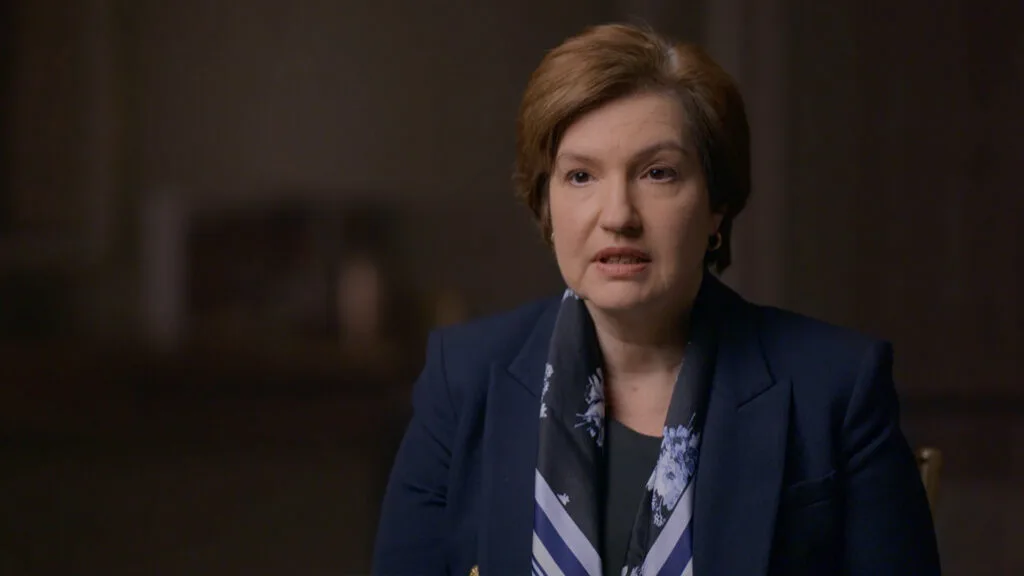
Elyse Goldweber is an attorney who runs a practice specializing in family law and business partnerships. She began her career as a trial attorney for the Justice Department’s Fair Housing Section in the Civil Rights Division, where she worked on a federal housing discrimination suit against Donald Trump and his father, Fred, for refusing to rent to African Americans.
This is the transcript of an interview with FRONTLINE’s Michael Kirk conducted on May 23, 2018. It has been edited for clarity and length.
Let’s start with the facts of the case.What are they?
In 1974, what happened was I was a staff attorney at the Department of Justice.There were about 25 of us in the housing section, and you would be assigned different cities.And I was from New York, so they gave me New York.I came to New York, and what you were supposed to do was to make contact with all of the advocacy groups in your city, whether it was Manhattan; Brooklyn; Tulsa, Oklahoma.
There was a great not-for-profit called Operation Open [City] , and I met with Betty Hober, and she said they had done some testing there.That means they would send out a couple of black couples, African-Americans, and a couple of white couples that would have substantially equivalent resumes, backgrounds, jobs, earning power.And when they sent them to Trump Village, which was a very, very big housing project out in Brooklyn, none of the black people would be shown apartments or were told there were any vacancies.Their application would be accepted, but they would never get an offer.The white people, immediately they were shown vacancies and were able to take apartments there.
So that's pretty strong testimony.And during that period in the early ’70s, that kind of testimony from testers, people sent out from groups, was being accepted by the courts.Then it was my job to find out whether we could really build a case against them.So I went through Trump Village, which was huge, interviewed probably 70 or 80 tenants.We couldn’t find any African-American people or people of any other groups of color, so that was helpful.
We spoke with the supervisor out there.Through discovery, we were able to find later on that if you came and you were a person of color, your application would be marked with a big “C."I found that personally really, really shocking, because I went: “Oh, my God.It’s 1973.Is there really discrimination left?"I was pretty young and naive.But that was a really strong thing, finding the “C” on people of color’s applications.
Then we started to interview former workers there, and they were a source kind of restating, once again, that there were never any people of color.And if people of color showed up there at Trump Village, they would send them to Patio Gardens, El Patio, which was on Flatbush Avenue, which at that time was an area of a lot of people of color.That's where they’d send them.
So that was how we found it.I went back—I lived in Washington, D.C., because I worked at the main DOJ. I came back seven, eight times and would interview more and more people.Then you would come back to the Justice Department; you have to write up your case.It would have to go through all the channels, and then it was approved.So that was very, very exciting.and that was the first case I ever worked on.
We filed in the Eastern District of Brooklyn.… As soon as we filed the lawsuit, the Trumps, mainly Donald, hired Roy Cohn, who was quite infamous even at that time.
… How do you discover that it’s Roy Cohn?Does his name show up on a piece of paper?
Well, what our practice was at the Department of Justice, they knew we were looking at them.I mean, we had requested documentation.By the end they knew I was there, etc.And then the FBI helped us and interviewed other people for me.So we called them and told them they were being sued.That was our standard practice in civil injunctive actions.
Then the next thing we knew was that Roy Cohn, the older Mr. [Fred] Trump and Donald Trump, appear in The New York Times, and they sued the government.… Now, you can't sue the federal government; they have sovereign immunity.That's how we found out about Roy Cohn.
What was your reaction when you saw the story at the Times?
“Oh, my gosh, this is going to be really, really interesting,” because I was very interested, just personally, in the Army-McCarthy hearings, so I knew a lot about that, and I knew more than—because I was interested in that more than, I guess, the normal person about Roy Cohn.
What did you think of Roy Cohn?What were your thoughts?
Well, they weren't good.They weren't good.I mean, I thought he was a terrible guy.
And the idea of them countersuing even though there was sovereign immunity?
Right, right.It’s always upsetting.
But it seems almost frivolous, right?What were they doing, a publicity stunt?
Right, correct.And that got them a lot of attention.That was Page 1 of the Times.
And your strategy?
Our strategy was just to continue working hard.They made a motion to dismiss, and so our first court appearance was in front of Judge Nair, who was a Republican judge.Really at that time, certainly because you were a Republican or a Democratic federal district court judge… —I mean, it was a very prestigious job, and it was sort of irrelevant what party they were from.
How old were you?
I was the same age as Donald, so I was 27.
And Donald's aspect?What was he like when you first saw him?
Well, the first time I saw them was our first court appearance, where it was pouring.I had a hard time getting to court.The subway was broken; I had to take a cab.And we're in court, and because it’s their motion, they get to argue first.And Judge Nair let him speak uninterrupted for 45 minutes, of which of course I'm having a heart attack.Am I going to live through this?
What do you mean?Why?
Well, the guy, Roy Cohn, is just talking for 45 minutes uninterrupted.That's not what usually happens in court.People just don’t get to speak for a long, extended period.There are lots of questions, etc.
What's he saying?
Just how this is a horrible thing; that the power of the state to bring this to tell people who they can rent to, who they can't rent to, the usual.… Then I got up, and I was very nervous.But what turned out to make it a lot better, he—I didn't get to talk for two minutes uninterrupted.He asked questions, and that is easier to respond to.
The judge asked questions?
Yes.So he asked questions for about a half hour, 40 minutes.
And here you are, up against—
Yeah, my first job, my first court appearance.I mean, it is remarkable.
You're up against Roy Cohn.
Yeah.It was very exciting.
So what happens next?
What happens next is something that is unusual, that doesn't always happen, is the judge ruled from the bench, and he denied their application for dismissal of the case.Then we set what's called the discovery schedule.The way I recollect it is we took the depositions of Fred and Donald Trump maybe two or three days later.They were made available.So my boss—of course we thought at that time that Fred was the more important guy, so he took Fred, and I took Donald.We also had croissants on the side, and coffee and water.
So take me there cinematically.Describe from the beginning to the end what it felt like.
We're at the U.S. Attorney’s Office in Brooklyn.We're in a big conference room.There's Roy Cohn; there's a helper for Roy Cohn.There's me, and I think it was—to the best of my recollection, it was a two-day deposition, and my boss was there the first day.Wasn’t there the second day.
What is Donald like when he comes in?
I've thought about this a lot, and in a way, he was a mini version of himself.He would make comments when we were off the record.And we've tried—I know other people who I've talked to—we've tried to find that deposition.We cannot find that deposition in the federal archives, but we tried.
When he would talk off the record, was he boastful, bragging, bigger than life, sarcastic?
You know, “You wouldn't want to live with those people either."
What do you mean?
Well, I took what he meant to mean is that you wouldn't want African-American neighbors.
In what context?
That was just off the record, like a coffee break.But we didn't have a lot of chatter.
How did the Trumps react?
They fought.I mean, I would say at that time, 95 percent of the people fought for a period of time.It wasn't that everyone ended up having a trial, but there was a period of time that there was litigation, mostly through the discovery stage.
Cohn [was] there for the deposition?
For the depositions, yes, those two depositions.
What was he like?What did he do?
To the best of my recollection, he wasn’t that active during the depositions.It wasn’t like he would object to every question.He was sort of well-behaved during the depositions.
How long were the depositions?
The deposition of Donald was two days.But they're not 9:00 to 5:00 days.[They’re] like 10:00 to 4:00, and people take lunch.
And what kind of questions were you asking him?
Well, I asked him about everything starting when he started in the business.What was his role there?Did he go out to the properties?What did he instruct the people[ to do]?How did the “C” get onto the applications?Because you see, when we had discovery and we asked for the production of documents, we got back documents, and on those documents, that's when we learned about the “C” for “colored."
So you went to trial on this case?
This case never went to trial.They ultimately settled.I left the Justice Department, and it was very hard to leave that case after three years, because I got married and moved back to New York City.But two of my close friends in the housing section took it over, so I kept up with it, and ultimately they settled the case.
And there were a lot of problems.There were hearings after that.But ultimately, you know, they complied.
And it was integrated?
Not hugely, because I wouldn't say there was a rush of black people wanting to live at Trump Village.But yes, yes, ultimately.
… They after the fact, as I remember, basically declare victory.
Yes, yes.
Tell me about that.
Well, even when he talks about the case, and there was a great article a couple of years later by, I think, Nat Hentoff in The Village Voice which talked about it.But yeah, it was just like it didn't matter what the facts were.This was a victory.We beat the government.It had nothing to do with reality.
What they did, they were winners.
Absolutely.
And how did you feel when you heard what their reaction was?
I think I thought it was just typical of who they were after having been with them in this litigation.
… Could you tell what the relationship was like between Trump and Cohn?Everybody talks nowadays about how he became his mentor.What was the relationship like?Was he being led by Cohn?What could you see?
I wouldn't have that feeling.You could tell they got along well, but I wouldn't really have much to say about it.
One of the other things … Cohn was claiming in the courts, … that the language that's been recorded is that he was claiming that you guys and the government [were] conducting a Gestapo-like interrogation and described the DOJ agents as descending upon the Trump offices with five Stormtroopers?
Yeah, none of that's true.
Talk about the language they were using and how you viewed it.
Well, I mean, it was shocking back then, and I was inexperienced.Now, my boss … would say: “Don’t worry about that stuff.It doesn't matter.It doesn't impact anyone here."
What stuff?
You know, when they would say things like that, about Gestapo techniques; “How can you work for the government?"And I was proud to be there.
Why were they doing that?
I guess for the publicity.I mean, I was sort of shocked by everything then.It’s 40 years later; I'm no longer shocked by that kind of conduct.And in a way, they’ve succeeded.He’s become president of the United States.