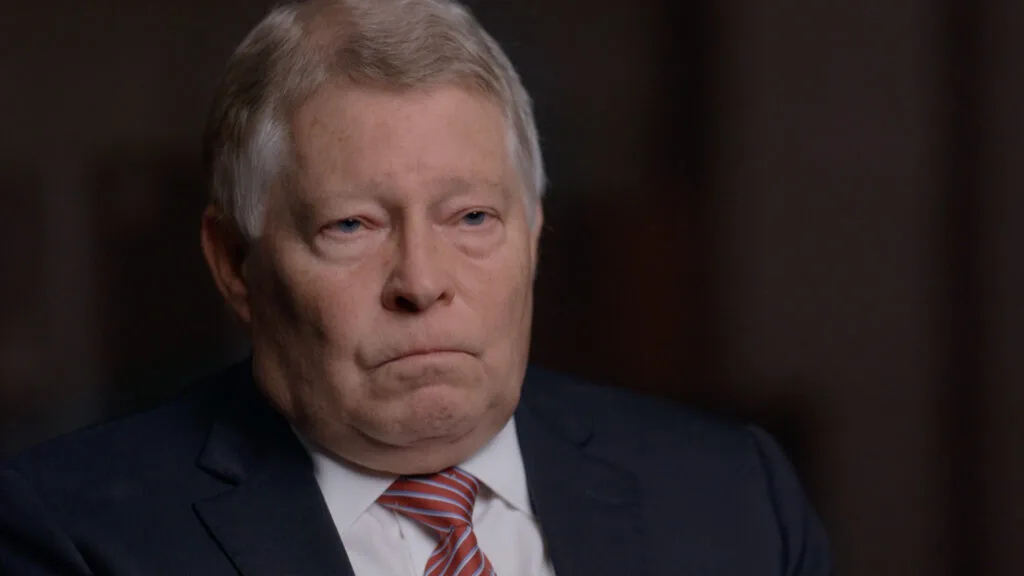
Garrett Graff is an author and journalist who writes about politics, technology and national security. He is a former editor of Politico Magazine and editor-in-chief of Washingtonian magazine and wrote The Threat Matrix.
This is the transcript of an interview with FRONTLINE’s Jim Gilmore conducted on July 25, 2018. It has been edited for clarity and length.
Where we’re going to begin is the background behind how the president views the law from his New York days, … and that it is different—in our film we’ll look at “Trump’s law,” whatever that is, that he came to Washington with.… Describe a little bit about the president’s view, maybe his relationship with Roy Cohn and how that might have been important in defining how he came to view the law.
I think the president views everything as a real estate developer, so every single transaction is a negotiation, and that there are no hard and fast rules, there is nothing that is black and white, and that every rule, every law is a starting point for negotiation rather than a fixed line.
When he comes to Washington, there’s a very different view toward the law in Washington.Talk a little bit about that, about that difference and why it matters.
Yeah, I think President Trump came to Washington probably having been embroiled in more legal scrapes over the years than perhaps any president we’ve ever had, but it’s always been on a very different level for him.These are municipal disagreements or personal defamation or business disagreements, and not federal, criminal law in the way that the U.S. government deals with it, or the intelligence standards and legal statutes that guide executive power that have been built up over generations and hundreds of years by the 44 presidents who came before President Trump.
The rule of law and how it’s viewed from the Constitution in Washington is a sacred thing in some ways.
Yeah, absolutely.The Department of Justice is a collection of people who view the rule of law as sacrosanct; that this is the highest, most important calling in the U.S. government, because we are and have been since our founding a nation not of men, but of laws.
And how does [President Trump] view that?
I think it is a mental framework that is almost unimaginable to the president.He just at a fundamental level doesn’t understand the personal character of people like Jim Comey, [Special Counsel] Robert Mueller, these other lifetime Justice Department prosecutors who have come up to expect that fidelity to the Constitution is the highest calling in the land, not the service of any single president or single executive.
“Trump’s law” is more based on loyalty to him, not to norms which a lot of times, if it’s not a legal basis, it’s the norms of what has developed?
Yeah, much of Washington operates on sort of norms and traditions that are not written down in any formal document necessarily, but have been abided by presidents and congressional leaders of both parties for decades and even centuries.[Then] Donald Trump comes into this and has no attachment to the institutions, has no attachment to these traditions and in many ways feels I think that he’s been elected specifically to trample over them, to sort of shake up the Washington establishment and the “civility” that has reigned here for so long.
But this is a guy also who—I think the president thinks he understands the law better than those in Washington.He was involved in around 4,500 cases when he was in business in New York, so he’s not—though he doesn’t believe in the rule of law, he certainly has an attitude and a use for lawyers.How does he see the lawyers that are around him, what their role is?
I think the president sees the law primarily as a cudgel, as a tool that he can wield against others to bend them to his whim, whether that’s on a real estate deal or whether that’s trying to attack someone for defamation or slander, and not in the way that most people in the Washington establishment view the law, which is as a tool and guidepost for how to have a great society.
… On the campaign trail, how did you view, when you were looking at it, this constant railing against judges, Justice Department and institutions in general that the president was using, and was so successful at selling to his crowd?Did that set up any potential red flags about how he would deal with the norms of Washington?
Every day of the presidential campaign was a red flag for people who care about the rule of law, the separation of power, the checks and balances in the constitutional system.I mean, this is a president who really his only experience in executive management is running a family business, where everyone around him is either a family member or totally beholden to him, and that there’s sort of only one law, and that’s Trump’s own personal feelings.
That’s not how our political institutions operate.That’s part of what is so fascinating and so wonderful about America, is that we don’t have the normal trappings of a monarchy.We don’t have bejeweled thrones or crown jewels.What we have are the institutions and traditions that we have handed down since 1776, 1781, and that in many ways, the only thing that binds our generation today together with the founders is life under the Constitution.
I’m going to go through some of the stories that we tell, and give us what you can.The [former National Security Adviser] Michael Flynn story.Early on, you’ve got Sally Yates coming up to the White House and talking to the president’s lawyer, [Donald] McGahn, and telling him about the concerns and what was happening, and then the intercepts and such, and the lies.… This new president is seeing this story develop on one of his most trusted people that throughout the campaign was so important to him and was going to be so important to his development of foreign policy.What’s going through his mind?How is he viewing that?
I think one of the things that the president has never really understood is that so much of the foundations of the FBI’s Russian probe and the counterintelligence investigation into Michael Flynn’s comments and conversations with Ambassador [Sergey] Kislyak were started really to protect the president, both in the campaign and during the transition; that what the FBI is concerned about is these people who are around the president who are in compromised positions, and that they are trying to investigate that and sort of figure out what the ulterior motives are and what the positions of possible compromise are for someone like Mike Flynn.
And Donald Trump doesn’t see it that way.He sees it as the FBI digging around on his people and not understanding that this entire investigation really began as a way to protect Donald Trump, both during the campaign and then in the White House, from possibly being influenced by people who didn’t have his own best interests at heart.
And how did, in fact, checks and balances work in that situation?
I don’t—
… In the beginning, it seemed that the system was working, the fact that they decided this and the administration was forced to go along.Was there an element there that the system seemed to be protecting itself?
Yeah, and I think, at a very simple level, almost every battle of the Trump presidency is Donald Trump personally versus the system.What I think is so strange about that is that the president views the system as a hindrance, whereas so many of these processes have actually been put in place over the years, either by statute or by tradition, as a way to protect the president, to help a president make good decisions to ensure that people around the president can be trusted and are worthy of the public trust and confidence that’s necessary to work in the White House.
Donald Trump sort of sees all of this as basically bureaucrats trying to keep him from doing the things that he’s supposed to be doing or that he wants to be doing, whereas in many ways so much of this is really an attempt for the president to be protected from a non-rigorous process.
So then comes James Comey and the famous dinner for two in the White House, where the president asks for his loyalty several times, and he makes quite clear that he’s demanding loyalty from his head of the FBI.How does that help to define both positions on the rule of law, a position that people in the Justice Department and the FBI are supposed to fit, according to the president, and how does James Comey view this?
I think that the dinner at the White House between Jim Comey and Donald Trump was a meal between two people speaking entirely different languages, not just people who didn’t understand one another, but couldn’t possibly fathom each other’s worldviews.I mean, Donald Trump just can’t understand that some people, like Comey, have a calling or a belief that’s higher than personal loyalty, whereas from Jim Comey’s perspective—this is someone who has stood up to multiple presidents when he feels like he’s being asked to do things that are not in keeping with the proudest traditions of the American justice department, and that he really sees himself as an independent force, not as someone who swears personal allegiance to the president.
In Comey’s book, he defines the attitude of the president toward loyalty, something more attuned to what a mobster would have.Explain that.
Well, you know, Donald Trump comes from a family business, so he sits atop a hierarchy where he can reach out and touch almost every single person who works for him on a daily basis at the Trump Organization, and people whose first, last and only loyalty is to serving Donald Trump and the Trump Organization.
Jim Comey is sitting there, meanwhile, as someone who at multiple times through his career has sworn an allegiance not to the presidency, but to protect the Constitution against all enemies, foreign and domestic, and that at a core bedrock belief, Jim Comey sees the most important thing that he can do is serve the Constitution and the rule of law beyond and above any individual president or any individual executive.
And that’s not what New York real estate folk, how they view the law, basically?
Yeah.As a New York real estate person, you’re coming from a deeply rough-and-tumble world where every single thing is a negotiation.You start out with the most outrageous starting bid that you can and then negotiate back from there.
The next event that we look at is the president’s meeting in the Oval Office when Comey is there, and the president shoos everybody else out, including the attorney general, out of the room because he needs to talk to Jim about something.And this is where he talks about whether Director Comey can back off of Flynn.Describe that event and what’s essential to understand about it.
Yeah.To understand how strange that White House meeting is, you have to understand the historical traditions of the Justice Department, which is part of, but separate from, the executive branch; that the Justice Department and the attorney general are really unlike all of the other Cabinet offices in that their ultimate goal is to serve the Constitution, not the presidency, and that their job and prerogative is to be the government’s conscience, to ensure that the government is following the Constitution and the rule of law beyond simply the whims of any single president.
From Donald Trump’s perspective, he’s a businessman.He looks at Jim Comey as one of his employees, someone who I think he feels he can order around at his leisure to serve his own whims, whereas Jim Comey views the president not necessarily as his boss, but as someone that he needs to serve to the best of his abilities without compromising that independence and the constitutional rule of law that’s so sacrosanct at the Justice Department.
And here the president is asking him, or he thinks that he’s asking him, to basically pull punches on an investigation of the FBI.How important is this issue?Now, the White House afterward says—it’s like a couple of friends talking—says, “Go easy on the guy; he’s a nice guy,” right?There are two different points of view there.Just get into that a little bit for us.
If you’re the FBI, you don’t take orders from the White House in terms of opening investigations, in terms of closing investigations.There’s even a very fine line about when you even tell or inform the White House about cases that might have national security implications.The FBI and the Justice Department, their entire mantras, their entire ethos is that they pursue crimes and investigations “without fear or political favor,” and that that is one of the bedrock principles of a rule of law nation.And Donald Trump just doesn’t get that concept.I mean, he views every aspect of the federal government as something that he should be able to direct personally, whether that’s the FBI investigations or the military’s policies of who is allowed into the military.
Why would the president be worried about the Flynn case, do you think?
Well, I think part of what makes the meeting so fascinating is we don’t know why the president was as concerned as he was about Michael Flynn.Part of what is so challenging about so much of reading the tea leaves of this entire Russia probe is that only Donald Trump knows what Donald Trump is guilty of, and maybe we can amend that now to say only Donald Trump and Robert Mueller know what Donald Trump is guilty of.
But, you know, you look at a meeting like Jim Comey and Donald Trump, where he says, “You know, I hope you can see your way toward looking past Mike Flynn."We don’t know whether that was Donald Trump saying, “You know, cut my buddy a break; he didn’t really do anything that wrong,” or whether that was Nixon saying, “Forget about the Watergate burglary, because I don’t want you turning over that rock."
Red flags that would go up in Comey’s head, and later in Mueller’s head: Why does that meeting become so interesting?
Part of what makes all of these threads so interesting, is that the president and the presidency have all sorts of inherent powers that are unquestioned.The president can fire an FBI director at any time for any reason, and there’s no debate about that.
Where it gets interesting, though, is that the president has all of these powers that he can exercise theoretically as long as he doesn’t have a corrupt intent; that the moment that he begins to do things that he’s legally allowed to do but for corrupt reasons, then he crosses over a line, and then that does become a crime.So we’re sort of stuck with this conundrum of knowing what’s in the president’s mind when he makes individual decisions.
So the actual firing.As you said, he has the legal right to do it.How does Washington view it?What are the ramifications of that?And why doesn’t the president understand the possible ramifications?
I think this is one of the classic examples of the Trump presidency of what happens when you ignore a rigorous normal process.There were all sorts of legitimate, legal reasons to argue that Jim Comey should be fired.[U.S. Deputy Attorney General] Rod Rosenstein wrote this memo outlining how the FBI’s actions in the 2016 election were not in keeping with the proudest traditions of the Justice Department, and in the year-plus since, that has been backed up by a nearly 500-page Inspector General report that found that Jim Comey violated traditions and norms and standards, and was even insubordinate in his actions in the 2016 campaign.
You could see scenarios where outgoing President Obama or a President Hilary Clinton could have fired Jim Comey for precisely the same documented reasons that Donald Trump and Rod Rosenstein say that they fired Jim Comey, but because there is this backdrop of the Russia investigation which we now know [as] codename Crossfire Hurricane that was sort of swirling around the president and his aides, and the questions of their 2016 campaign activities, it lends a very ominous cloud to Jim Comey’s firing, a cloud that sets in even the night that Comey is fired and within just a couple of days appears to be getting darker and blacker as the president tells the Russian Foreign Minister Sergey Lavrov and Ambassador [Sergey] Kislyak in the Oval Office, the day after Jim Comey’s firing, that firing Jim Comey lifts this great weight of Russia off the president’s shoulders, and then the next day he goes on TV with Lester Holt and flat out admits: “I fired Jim Comey because of Russia.I want Russia to go away."
That begins to raise these questions and put pressure on the Justice Department to appoint a special counsel to ensure that this investigation going forward is not going to be tainted by the president’s actions.
Rosenstein’s writing of the memo: Why does he do it, and how it puts him basically between a rock and a hard place, basically.Some people will say that it leads him toward some decisions that he makes afterward, because he feels that he’s used.
I think the short answer is we don’t know enough about why Rosenstein wrote that memo.He was relatively new to the job.I think it was something like his eighth day as deputy attorney general.It’s sort of hard to know, at least at this point, what he knew then, what he had been read into; what stage the Russia investigation was at; whether he knew anything about any of Jim Comey or FBI Deputy Director Andy McCabe’s concerns about the president; and the president’s actions and behaviors up until that moment.But certainly, history—a year and a half later doesn’t look kindly on Rosenstein’s memo, … and it appears, and we have subsequent reporting to know, Rosenstein feels badly used by the president, set up for a political fall by Attorney General Jeff Sessions and President Trump.
And Bedminster, [at the Trump National Golf Club in New Jersey], the meeting that took place that weekend before the firing, and [adviser Jared] Kushner’s part in pushing the fact that it would be a good idea to fire Comey—what do you know about that meeting?Why is it in some ways revealing?
Well, I think the decision to fire Comey, placing aside any questions of whether or not it amounts to obstruction of justice, is a really signal moment in the political naiveté on display by Trump and his administration.Jared Kushner is sitting there at Bedminster, based on reporting that we have seen, arguing that Democrats will warmly embrace the firing of Jim Comey because they so hate his actions against Hillary Clinton in the 2016 campaign, which is just stunningly politically naïve against the backdrop and the swirling questions already at that moment of the Russia investigation and the behavior of the Trump administration during the campaign and the transition.
And the fact that if the president doesn’t consult with many more of his aides, and the evaluation of this monumental decision says what?
Well, the lack of foresight and forethought in the firing of Jim Comey, it’s probably more clearly on display that when he fired Jim Comey, they don’t even know where the FBI director actually is.You know, they dispatch [Trump’s bodyguard] Keith Schiller down to the Hoover Building on Pennsylvania Avenue with the firing letter in a manila envelope, not really realizing that Jim Comey is actually out in Los Angeles.So Jim Comey finds out about this because he’s watching a TV screen behind his remarks in Los Angeles, where he starts seeing a scrolling CNN headline saying the FBI director’s been fired.
Jim Comey first thinks it’s a joke.He thinks someone is playing a prank on him in the Los Angeles field office of the FBI.
I’m going to jump out of chronology here for a second in case I forget this later.But Comey eventually becomes a very political player in this whole story, and he’s making decisions—his book, his press tour, his statements just yesterday or the day before, very unlike his past involvement, certainly while he was the head of the FBI or before back in 2004 when he was involved in the pressure on the Bush administration to change their politics on the surveillance issue.How do you view that, and how interesting, how important is that?
I actually don’t think it’s different at all.You know, Jim Comey has in many ways thrived and advanced in politics by always being oppositional to power.He has always been very outspoken and has never hesitated to put himself at the center of the story.Many people forget this now, but he had had actually a very intense relationship with Barack Obama for much of his time as FBI director, including his remarks on the “Ferguson effect” and coming out against the president on the racial bias in policing in the wake of the shooting in Ferguson, Mo., and the riots there, and then also picking a very public and arguably ill-conceived fight with Apple over encryption issues that was again sort of not a fight that the administration really wanted to be having.Even that whole hospital incident is something that we only know about because Jim Comey told us, and that he had told us about it at a very precise moment when it was seen in the end of the Bush years, effectively the final nail in Alberto Gonzales’ coffin as attorney general in the wake of Gonzales’ reportedly partisan firing of U.S. attorneys.
So why?What does that say about Jim Comey?The president calls him a “showboater."How do you see it?What do you think that says about Jim Comey?
Boy, I have a lot of different answers to that one.
Pick the best one.
I think the challenge of a lot of the controversies that Jim Comey has been wrapped up in throughout his careers is that he sees himself as the white knight, the person who is protecting the bedrock principles of the rule of law sort of above and beyond and better than anyone else.
So in May of 2017, Mueller gets a phone call, as you write about, from Rosenstein asking if he would, again, serve his country.Describe that.Describe why it’s taking place and why Mueller.
It seems very quickly Rosenstein realizes what a mistake his memo was that was used to justify the firing of Jim Comey and the political firestorm that that touches off.He moves very quickly to try to appoint a special counsel.We actually know from Jim Comey’s book and subsequent speeches that he actually was very actively trying to box Rosenstein in to appoint a special counsel in the days after his firing.Really, Rosenstein turns to probably the only person in Washington capable of fulfilling the biggest hot potato that you could hand someone in Washington right now: Robert Mueller, this deeply respected, former FBI director appointed by presidents of both parties to high senior Justice Department and national security posts; someone respected on both sides of the aisle whose two-year extension as FBI director was confirmed by the U.S. Senate by a vote of 100-0.
There’s no one who is as bipartisanly trusted to be nonpartisan, to follow the facts wherever they may lead, without fear or favor in Washington as Bob Mueller.
You say for Mueller this was probably the third hardest job he had ever had.Talk a little bit about his bio.Talk about his background and the man that it made him.
Bob Mueller is a fascinating character who seems, in some ways, like he stepped right out of a history book, someone who belongs to a bygone era of American history [who] comes from a proud tradition of public service that we just don’t see that much of in American life anymore.He grew up outside Philadelphia in a wealthy enclave and was put very early on a path by his father of public service.He went to prep school at St. Paul’s.Went on to Princeton, where in both places he was sort of inculcated with this ethos of public service and almost noblesse oblige that we just don’t see in American society anymore.
[He’s] educated and comes of age in the final years of the postwar, blue-blood, East Coast establishment before it’s rendered and torn asunder by Vietnam.
And Vietnam?How important was his service in Vietnam?What [in] your writing about him shows why that’s so important?
Bob Mueller makes this incredibly momentous decision as he’s graduating from Princeton in 1966 to enlist in Vietnam, to go fight with the Marines at a time when the war was not as political as it was even actually by the time he arrived in country, but was still at a moment when people like Bob Mueller didn’t need to serve.It was sort of before the draft lottery took off and that he could have very easily avoided service, as many people coming from Robert Mueller’s background at that time did.
Instead, at every juncture he picked the harder path.He wanted to join the Marines.He wanted to fight in combat.He went to the infantry.He does so well going through Officer Candidate School, he’s sent to Army Ranger School, one of the only Marines in the military, in the branch, that gets sent on to Army Ranger School.
He arrives in Vietnam in the fall of 1968 against this backdrop of one of the most tumultuous years in American history.As he has been going through Marine training, you have the Tet Offensive.You have Lyndon Johnson decide not to run for re-election.You’ve had the assassinations of Bobby Kennedy, Martin Luther King, the riots of the 1968 Democratic Convention in Chicago.And Bob Mueller is just sort of chugging forward on his way to Hotel Company, 2nd Battalion, 4th Marine Regiment right in the DMZ, where Bob Mueller will lead a combat platoon, fighting the North Vietnamese army in some of the toughest combat that American forces ever saw in Vietnam.
Highly honored due to his service.Now compare the two men.You’ve got two guys that are both about the same age, that have gone through the same era, the Vietnam era and all, some from very wealthy families.Compare Donald Trump to Mueller and what one learns from that.
Yeah.Part of what makes the Bob Mueller-Donald Trump showdown so Shakespearean is how similar these two men are on paper: that they were just born just two years apart; raised in wealthy families in the Northeast with very strong father figures; sort of star prep school athletes; Ivy-educated.The moment that their paths diverge is Vietnam, that Bob Mueller volunteers to serve, actually is medically ineligible at the start and takes a year off to heal from his athletic injuries to allow himself to be deployed to combat, and goes and serves honorably in combat, decorated Bronze Star with valor, Purple Heart.He’s wounded, shot through the thigh, which brings his time in combat to a close.And Donald Trump takes one student deferment after another, and then takes a permanent medical deferment for bone spurs that years later Donald Trump can’t even remember which foot he had the bone spurs in.
To move beyond the Vietnam era, then you’ve got the diverging of which each man does.Mueller was prosecutor, FBI, and always public service, the president going into the world of New York real estate and such.Just continue the story on there.
Bob Mueller is someone who has dedicated his entire life to public service and has been actually sort of remarkably unhappy during the brief periods of his career where he’s working in private practice.You have here two men who have just taken entirely divergent paths and have divergent worldviews, Robert Mueller dedicating himself to a life of public service, Donald Trump dedicating himself to a life of private profit, never seen more clearly than when Robert Mueller leaves the Justice Department in the George H. W. Bush administration as the assistant attorney general for the Criminal Division, the head prosecutor for the entire federal government, goes off, spends about a year in private practice, and is so unhappy serving private clients that he sort of re-enlists and calls Eric Holder, then the U.S. attorney for the District of Columbia, and convinces Holder to let him come back as a junior homicide prosecutor, a job normally done by someone who’s two or three years out of law school in Washington.It is the actual military equivalent of a three-star general retiring and then re-enlisting as a second lieutenant to begin his career all over again.
I’ve talked to numerous people who worked with Bob Mueller during his stint in private practice, and they all have a version of the same story that goes something like this, which is, they brought Bob Mueller in to meet with a new client, and Mueller sits there, listens to the client present the problem, and Bob Mueller says something like, “Oh, well, if that’s what you did, you should plead guilty and go to prison”; that Bob Mueller can’t bring himself to defend guilty people; that he’s just so driven by that pursuit of justice that he needs to be on the side of putting people in prison, not keeping them out.
In his years in government and his view on the rule of law and the importance of the institutions that defend the rule of law, explain.
Bob Mueller has dedicated almost every minute of his career since coming back from Vietnam to the Justice Department and is an institutionalist of it, a creature of the traditions and the unique mission of the Justice Department, which is not merely to prosecute but to seek justice, which is something, sort of a nuance that many outside the department don’t really understand just how seriously the people inside the department take that; that they see this as a calling—and perhaps America’s most important calling, in many ways, the preservation and the protection of the foundational principle of American democracy, which is that we are a nation of laws, not of men.
And again, Trump’s attitude toward this is rule of law is not as important as Trump’s law.
Yeah.I mean, these are two men with just an entirely different mindset about the approach to the rule of law.Bob Mueller sees everything as black and white.He is not someone who has ever played in the gray.His belief is that you always stay a solid step or two inside the chalk marks, to use a sporting metaphor, whereas Donald Trump sees the law as just a negotiating tactic, something that you can bend or break or get around if you have the power, the money and the resources to afford good lawyers.
The recusal of Sessions: How does the president view that?
From what we know publicly, the president has been deeply upset by Sessions’ recusal, because he sees it as a betrayal of the personal loyalty that Jeff Sessions and the attorney general should owe him as Donald Trump and as the president, and not in the way that the Justice Department views it, which is a necessary mechanism to ensure that political bias or even the appearance of a political bias doesn’t interfere with pursuing an investigation without fear or favor, wherever it might lead.
When Mueller is announced, there’s that famous scene in the meeting at the Oval Office where the president is told that Mueller’s been appointed, and by Rosenstein’s phone call to McGahn.And the president goes after Sessions.He berates him because he blames him.What is the president’s view, do you believe, at that point when Mueller is announced, how he probably understands immediately that it was due to the firing of Comey, but Sessions could have been the firewall?
Yeah.I think there are two things there.It’s probably a little bit of column A and a little bit of column B, and we don’t know which one.On the one hand, I think the president—and he’s been very vocal about this—actually views this entire thing as a “witch hunt”; that this entire Russian investigation is an attempt to undermine the legitimacy of his presidency and to hamstring the MAGA [Make America Great Again] movement by the stodgy Washington establishment.
On the other hand, one of the things that make this so complicated is that the president just has a different view of his relationship to the law.So it seems, and it appears, that the president doesn’t think he necessarily did anything wrong; that it doesn’t matter why he fired Jim Comey; he had the power to do so, and that in the president’s mind, when the president does something that makes it legal, the Oval Office equivalent of, “When you’re a star, they let you do it."
You write so well about the dogged, very quiet investigations that Mueller is now involved in, the team that he pulled around him and how behind the scenes—all behind the scenes, because nothing ever leaks—he’s building his case; he’s building his team.Talk a little bit about that.
Bob Mueller has been a prosecutor for effectively his entire life.He’s a dogged and tenacious investigator.The clearest example that I point to is after his time as FBI director, when he was in private practice, he was hired by the NFL to investigate the [Baltimore Ravens’] Ray Rice domestic violence incident and how the NFL responded to the receiving of the videotape of Ray Rice beating his girlfriend in the casino elevator.
What’s so fascinating about that report is the way that it tells you how Bob Mueller operates.That final report, what used to be known as the Mueller report on the Ray Rice incident , contains four pages about how the NFL mailroom signs for packages.I mean, that’s just how deep into the weeds Bob Mueller got in that investigation.I assume that there are things in that report about the operations of the NFL mailroom that the employees who work in the mailroom couldn’t have told you before Bob Mueller showed up to document and investigate how they operated.
So what does that say about what he’s doing now, do you think?
I think that that’s exactly what we can expect from Mueller’s investigation going forward.It’s hard to look at his indictments as anything other than sort of investigative tours de force; that every single investigation and indictment that has come down so far has been deeper, broader and more detailed than anyone in the public imagined before Bob Mueller filed the court documents.
Why should that worry people in the White House?
Well, part of the challenge in this is under a normal administration, Bob Mueller shouldn’t worry [people] in the White House.I’ve said from the start that Bob Mueller is in some ways the best thing that could have happened to the president if the president is innocent.If there is no there there, and this is all a series of strange coincidences and wacky characters surrounding the campaign who actually did nothing fundamentally wrong, Bob Mueller is probably the only person in Washington who could come back, conclude that, and be believed by both parties, because Bob Mueller is not a partisan figure.He is someone who has no personal agenda and has never demonstrated a personal agenda in politics, even as he has operated at the highest levels of the Washington establishment.
But on the other side?
On the other side, if there is anything that the president or any of his aides have done that is wrong or criminal, Bob Mueller will find it.
In fact, there is a reaction from the president early on where you start hearing for the first time the term “witch hunt."The fact that he brings on his old lawyer, Marc Kasowitz, who has a—the tactics that are being used, and the philosophy that’s being used, is one must undercut Mueller, must undercut those around Mueller.… It’s a personal fight; one personalizes.Something that Trump has been doing his entire career, and certainly during the campaign, was a very important part of how he, one by one, killed off his opponents.Talk about that.
Donald Trump’s ultimate goal in every step of this investigation has been to muddy the waters, to make this not a question of rule of law, but a question of partisan politics.That this is something where both sides are guilty of all sorts of different things, and they’re just trying to nail me, the president, for trying to fight for you, the little guy, even when they’re just as guilty as everyone else.
It’s successful and always worked for him.So why not do it here?
Well, it is the way that he has conducted his business for many years, and something, by the way, that I think the president honestly believes.I don’t think he’s being disingenuous in—I think that Donald Trump just sees everything as gray.He sees everything as—you know, all of his experiences are that rules are there to be bent or gotten around, not as black-and-white lines that you can’t cross.
The Trump Tower meeting in June 2016, with Don Jr.: Why has that become such an important moment that the investigation is looking at, that has gotten so much press?Talk about the importance of that meeting, what you see are the most important elements of it.
I think that there are three things that really make the Trump Tower meeting in June 2016 interesting and intriguing to investigators.The first is that it happened at all, that here you have people purporting to be operating on the behalf of the Russian government coming to offer help.The Trump campaign not only doesn’t tell the FBI, doesn’t warn investigators or law enforcement or intelligence, but is happy to take the meeting and attempt to keep it quiet, which in and of itself is sort of an odd moment.Anyone in politics would tell you one of the reasons you don’t take a meeting like that or that you promptly report it to the law enforcement is you assume you’re being set up for a dirty trick.You know, when Al Gore got his opponents’ debate briefing book in the 2000 campaign, he promptly turned it over to law enforcement and the FBI because he didn’t want to be seen as attempting to cheat in the election.
Second, what makes this now interesting to us is that that meeting in June 2016 takes place at what we now understand was a very key moment in the other threads of Russia’s attack on the 2016 election, where you begin to see the Russian government both at the Internet Research Agency and the intelligence service GRU ramp up their efforts in terms of the cyberattacks on the Clinton campaign and the DNC [Democratic National Committee], as well as their information operations on Twitter and on Facebook and on social media, and that there’s a marked increase in operational tempo that takes place against the backdrop of that particular period in June where there’s that Trump Tower meeting.
It’s almost as if either the Russian government was testing the Trump campaign to see if they would turn over evidence of that meeting to the FBI, or would it in some way attempt to reject it, or maybe even there was some sort of explicit conversation that took place in the meeting that might have led to that increased operational tempo by the GRU and the Internet Research Agency.
That’s Mueller’s interest?
That’s Mueller’s interest.And then the third thing that makes that meeting particularly interesting is the cover-up.That’s, as it comes out, the president, as we now understand it, personally drafts, and is involved in drafting the statement, effectively lying about what the meeting was actually about, writing it off as this low-level, unimportant, uninteresting meeting about Russian adoptions, which is code for the sanctions that the U.S. has put in place as part of the Magnitsky Act that Russia retaliated against by its blocking the adoption of Russian children to the United States.
Why do you think Trump agreed to allow White House officials to go and testify and allow the massive amount of documentation to be delivered, and the cooperation with his own lawyers with Mueller?
I really think at the end of the day, the president just doesn’t think he’s done anything wrong; that he’s exercised presidential authority that was legally his to exercise, however he wanted it, and that if he’s done anything wrong, well, by golly, it’s the same thing everyone else is doing wrong, too, and no need to hold me to account for it.
Right.Now, as you say, late fall, November, the investigators, the Mueller team is not doing exactly what his lawyers, Trump’s lawyers, were promising.You’ve got the [former campaign chair Paul] Manafort raid, and you’ve got the [former foreign policy adviser George] Papadopoulos arrest, and you’ve got Flynn pleading guilty to lying.Where is the investigation going at that point?Despite what had been promised to the president, what’s actually really going on?
I think almost every step of Mueller’s investigation has been an unpleasant surprise for the American public and the president himself.… These are incredibly damaging charges that Robert Mueller is handing down against the campaign chairman, against the national security adviser, against other campaign aides; now more recently, Russians involved in trying to influence the 2016 election.I mean, the totality of these charges is stunning.
To have the president’s national security adviser, both during the campaign and then the man who [he] brings into the White House as the national security adviser, admit in court documents that he was working at the same time as an unregistered foreign agent, in this case of the Turkish government, being paid while on the campaign staff of Donald Trump to advance the interests not of America first but of Turkey is a tremendous historical charge.
And Donald Trump is sort of sitting there trying to write off each of these as some sort of super strange anomaly of people that he doesn’t know particularly well: “Oh, George Papadopoulos.He was barely a foreign policy adviser.He’s just a coffee boy."“Oh, Paul Manafort.He was just campaign chairman for such a brief period of time we didn’t even pay him."“Oh, Michael Flynn, the national security adviser.He was only national security adviser for a couple of weeks in the White House."
Instead, I think a lot of people look at this and say, “We’re seeing a lot of people real close into the presidential campaign who are out there doing things that were pretty bad at the time that they were purportedly serving the presidential candidate, or the president of the United States."
Then on April 9, you’ve got the office, home, hotel room of Michael Cohen raided, of course a very, very close assistant to the president, [who we] know was there for a decade involved in business dealings in New York, which is, you know, not the cleanest of businesses; attempted Russian deals even into the campaign; a man who is, as we know now, is the guy who would pay off the women for their silence about affairs that the president supposedly had had.
How pivotal a moment is that?And how would the president have to look at it and understand it?
There’s two answers to the question.One is, we have no idea how pivotal it is.I mean, we’re still in the midst of this.… The second way to look at it … is the Cohen raid changes everything.It changes the president’s concern.It takes one of the president’s closest and longest and deepest business partners and allies and turns him against the president.It infuriates President Trump as he sees federal investigators figuratively kick in the door of one of his most trusted partners.… It’s the moment where I think this tips over into there will only be one of two outcomes—President Trump is brought down by the investigation, or the rule of law collapses in the United States—and that it becomes this deeply fraught and politically pregnant moment where we don’t know how the story ends, but the outcomes are reduced dramatically.
Why do you say that?Explain.
I believe that before the first agents knocked on Michael Cohen’s door, Robert Mueller and Rod Rosenstein knew how this investigation would end; that before they would have ever taken such a dramatic and politically perilous step as raiding the home and office of the president’s personal lawyer, that they had to believe that there was deep and broad criminality involved that they could prove beyond any reasonable doubt, and that they had to have known that that step would put them in tremendous personal jeopardy in terms of the president in anger that day or days down the road of firing Rod Rosenstein or Robert Mueller, in trying to shut down the investigation.At the same time they had to know that they would find something that was worth taking that risk, that that was a necessary and important step in an investigation, and one where they presumably already knew the answers about what they would find.It’s significant that Bob Mueller didn’t take on that case personally, that he handed it over to the Southern District of New York.It makes it seem much more likely that it’s not directly related to the Russian investigation, but is instead a deeper and broader investigation into the president’s business history and dealings than anything that we’ve understood thus far.
And of course you’ve got Michael Cohen deciding that he’s going to be much more cooperative; he’s no longer going to take a bullet for the president.
Yeah.Part of this is, again, the FBI federal prosecutors can bring enormous pressure on an individual when they want to.So if you're Michael Cohen, and particularly if you're Michael Cohen and you know you’ve done something wrong, and you're sort of staring out both at the reputational harm of that but then also the family harm, the possibility of a long prison sentence staring you down, there are all sorts of very good reasons for people in Michael Cohen’s position to cooperate.And very quickly, many people who seem loyal at first glance can question that loyalty when confronted about a mountain of evidence from the FBI.
So we don’t lose the thread, the Kushner connection, the fact that he’s a person of interest early on in the investigations, why do you think that is, and again, what pressure that brings on Donald Trump?
Well, one of the challenges here is that Donald Trump and Jared Kushner have both tried to hold onto their business empires in government in a way that is literally unprecedented, so have been trying to run both private profit businesses while in these positions of public trust, and that that has created an opportunity for leverage by people, for good and bad, who seek to influence the president or the aides around him or the policies of the White House, and that the president and Jared Kushner’s unwillingness to take the very basic steps to protect themselves from even the appearance of influence have meant that there is absolutely the opportunity for actual influence by foreign governments or other private-sector businesses, to apply pressure or remove pressure from the president’s and the son-in-law’s business empires.
Back to the case of the Southern District of New York and the Cohen investigation.Explain to us why you see this puzzle as being perhaps simpler and possibly more dangerous to Donald Trump than even the larger Mueller investigation.
The challenge always with the Russia investigation has been that it could be just very complicated, that it could involve a lot of smoke without necessarily there being single actions that rise to the level of a definable criminal charge that a prosecutor like Robert Mueller feels confident that he can prove in a U.S. courtroom, beyond a reasonable doubt, whereas it’s quite possible that that does exist in Donald Trump’s past business dealings.In fact, Michael Cohen has all but stated that it does, and that there might be much more straightforward criminal charges that could be brought against the Trump business empire with the knowledge and cooperation of Michael Cohen than some sort of amorphous question about whether some Russian oligarchs may or may not have funneled money through Cyprus shell companies to Alexandria rug stores that may or may not have led to specific actions by the president or his campaign or his transition aides.
In this game of chess that you're describing, in some ways, even if you found stuff in the Michael Cohen case of illegalities by the Trump administration, by the Trump Organization, you can't indict a president while they're president, so it becomes more of a political ploy?
Under existing Justice Department guidelines, a president cannot be indicted while in office, but those guidelines could be, at any time, waived by Rod Rosenstein.And the Justice Department might have already concluded that its past guidance was wrong.There is no clear law or standard that says that the president can't be indicted.What there are are sort of advisory opinions that came about during the Watergate and Whitewater investigations that are believed to be the operative guidance inside the Justice Department.But others who have looked at this, including [Independent Counsel] Ken Starr on the other side of the Whitewater investigation, have held, and do believe that a president can be legally indicted.
But then the president would say that yes, but he could pardon himself, or he can end the investigation at any moment, or he could fire anybody that he wants because of the executive powers given to him by the Constitution.I guess the question I'm asking is, … does this bring us more to a political sphere?
Any investigation of the president, this one or another, is always more of a political question than it is a criminal one, because an investigation into the president is a political problem long before it necessarily becomes a criminal one.… Sally Yates, the former deputy attorney general, has spoken very eloquently about this.There are all sorts of behaviors of a president in a democracy that would fall short of a provable felony that we as citizens should be troubled by and that we may politically conclude constitute a high crime or misdemeanor in an impeachment proceeding, even if it is not necessarily a definable criminal charge that could be brought in a criminal courtroom.
Right.All right.So at this point, the president takes on a new strategy.Ten days after the raids of Michael Cohen’s home, office and hotel room, an old friend, Rudy Giuliani, is back on the payroll, his bulldog from New York.Why the change in the policy?
Yeah.I think Rudy Giuliani’s arrival on the scene is a clear indication that the president sees this as a political problem, to be a battle to be fought on cable news rather than as a courtroom problem to be fought inside a courtroom; that there's only one battle of public opinion to be fought, and that’s the one for national public opinion, rather than trying to influence a judge or a jury.
And he’s very specific.On television, he says, on the Sunday morning shows, “This is a political fight, and we've got to prepare for the possibility of an impeachment, and to do that, yes, we have to undercut our opponents who are fighting this political fight against us,” which means Mr. Mueller.
Right.
Explain how clearly he defines what the strategy and the philosophy is, and what it is.
Rudy Giuliani doesn’t beat around the bush in this.He comes right out and says, “This is a political fight, and it’s going to be won and lost effectively with Republicans on Capitol Hill;” that is, “As long as I as the president’s spokesman can shore up the Republican right flank and ensure that they won't turn on the president, the president is going to be untouchable, and that as long as we can paralyze the Republican Congress and ensure that they don’t get cold feet and don’t waver and don’t allow an impeachment process to move forward, the president will remain in office, and ultimately could even run for re-election."
… Meanwhile, as Giuliani is fighting the fight on the airwaves, Trump is back out again on the campaign trail doing rallies, talking about the witch hunt, talking about how the whole system is corrupt, talking about the sin of what the FBI is doing and Mueller and Spygate and all of this.
And Jeff Sessions is leading chants of “Lock her up” at high school leadership rallies.You know, this is an administration and a presidency that if they could somehow figure out a way to impeach Hillary Clinton as a private citizen, they would do it tomorrow.
Talk about Donald Trump back out on the campaign trail, what he’s doing and the effect that it has.
Well, I think Donald Trump is waking up every day and going out to do battle and ensure that his base doesn’t slip away from him; that he understands that he is only as powerful as the people behind him, and that as long as Republicans on Capitol Hill continue to fear his supporters, that they are going to stay loyal to him, and that he needs to fight that fight every single day, because he’s actually in a very perilous political situation, even before we get to any questions about the criminality involved.
And he seems to have already had a great effect on the GOP. ...Explain what's going on with the GOP in Congress.
Yeah.I think what’s so fascinating is when you look across American politics today, the true opposition party is not the Democrats; it’s the prosecutors.If you look at who in the modern political tradition is the closest to Ronald Reagan’s vision for the Republican Party, law-and-order, anti-Russia political group, that’s the prosecutors and the Justice Department.It’s not the modern Republican Party, which is in many ways the polar opposite of what Ronald Reagan envisioned the Republican Party to be in the 1980s—and that the Democrats don’t have a coherent message.
Instead, the one group out there hammering law and order, rule of law, anti-Russia, it’s the prosecutors; it’s the Justice Department.It’s the people like Jim Comey and Robert Mueller and Rod Rosenstein who, not insignificantly, came of age during that time.These are lifelong Republicans who represent a different Republican tradition than anyone on Capitol Hill right now.
So the hearings.The GOP embraces Trump’s view of the FBI.Describe the hearings and how fascinating they are in many ways, and what they represent and what you were thinking when you were watching them.
I think the Republican oversight hearings of the FBI have just been an embarrassing debacle.At every stage, you have the president’s supporters like [Reps.] Jim Jordan (R-Ohio) and Mark Meadows (R-N.C.) trying to envision and make real this deep-state conspiracy of people at the FBI who were hell-bent on helping Hillary Clinton and defeating Donald Trump, even though there's really been no evidence whatsoever that that conspiracy existed at all.And in fact, quite the opposite.I mean, [former FBI agent] Peter Strzok , during his congressional hearing, made the point that through the fall of 2016, he possessed knowledge of the Russia investigation that would have instantly changed the outcome of the election.
If he had just picked up the telephone and called any journalist in America, Hillary Clinton probably would have won the presidency.And he didn’t, and that’s just remarkable.It undermines every single thing that the Republican allies of the president have said about the FBI for a year and a half.They just have no answer to it, and are instead sort of continuing to flail where it’s quite clear, from things like the Inspector General’s report, from the testimony of [former Director of National Intelligence] Jim Clapper, of Sally Yates, of former Department of Justice Chief of Staff] Jim Rybicki, of the FBI’s general counsel, of Peter Strzok himself, that the only thing that really mattered in the fall of 2016 was actually the anti-Clinton conspiracy inside the FBI in New York, that they felt put pressure on them to confront and reopen the Hillary Clinton email investigation in the final days of the campaign, that in many ways appears to have, in fact, influenced the outcome of the election and tossed the election to Donald Trump.
Great.A day later, Rosenstein is out in front of the press, announcing the 12 indictments.
God, that was like 1,000 years ago. (Laughs.)
You write this is quite significant.Explain.Explain what happened and why it’s significant.
I mean, that really was only like 10 days ago, right?
Yeah.
Rosenstein’s press conference announcing the indictment of the 12 Russian intelligence officers from the GRU probably was mostly coincidental, but it’s almost impossible to not view it as a repudiation of the previous day’s congressional witch hunt of Peter Strzok, because it’s the very investigation, the very charges come out of the investigation that Strzok was leading in the summer and fall of 2016 as the campaign unfolded, an investigation that we knew nothing about at the time, but we now understand not only had tremendous basis for it, but was politically larger and more tightly connected to the Russian government than we had ever imagined.
In some ways, it also defines the witch hunt allegations of the president [as] not true.
Yeah.You could say, if you look at that, that the day after the Peter Strzok hearing, Rod Rosenstein says: “We found 12 witches as part of our witch hunt.Here they are, and here are they are, name, rank, serial number.Here's their work address in Russia."It is an incredibly clear message from the special counsel’s office, from the Justice Department and from Rod Rosenstein personally that he came out, stood alone at that podium, and announced these unprecedented historic charges against intelligence officers of a foreign military for influencing and attempting to influence our elections.
Those indictments are unbelievably detailed about facts and events and dates and times and names.Rosenstein says that he briefed the president before he left for his trip, so the president would have had all that information along with everything else that has been told.How then does he stand next to Putin and say what he says?
The most charitable view, which is not particularly charitable, is that the president, in his own mind, is unable to draw a distinction between Russian meddling and Russian collusion; that he thinks anything having to do with Russia undermines the legitimacy of his election.It’s the only thing that can account for his continued obsession with explaining to world leaders his electoral vote count in almost every single meeting that he’s had with a foreign leader.
But at the same time, at the same time, the president’s own behavior is so inexplicable that this tough-talking sort of pugilist who has never met an ally or an adversary that he is not willing to insult has stayed so far away from criticizing or critiquing anything that Vladimir Putin has done, during the campaign, during the transition, during his presidency, [it] is just baffling.And it seems increasingly hard to believe that there are entirely innocent explanations for the president’s affinity for Putin.
And describe the blowback that the president gets once he comes back from Helsinki.
You know, it’s hard not to see that 48 hours after Helsinki as the darkest moment of the Trump presidency since the Charlottesville rallies of the previous summer; that everyone, ally or adversary, White House staffer or cable news pundit, their jaws are on the floor when the president leaves the stage in Helsinki.It’s amazing to think how low the bar and how low the expectations were for the president’s time with Putin, and yet somehow it was so much worse than anyone imagined.
And he comes back, and really, he gets on the plane in Helsinki and thinks it was a triumphant summit, and instead faces this almost universal blowback, including even from his normal allies on Fox News, that sort of help push him to, 48 hours later, coming up with the idea that he actually just misspoke, and he meant to say that he probably did think it was Russia that had meddled in the election, instead of saying that he didn’t think that Russia had meddled in the election.
You’ve also got this belief by some people that what has happened to the opponents of Trump is that they're now using Donald Trump’s own tactics.You’ve got [former CIA Director John] Brennan saying, “This is traitorous behavior."You’ve got the pundits on CNN and elsewhere, and the media in general, having much more editorial positions, very forceful.You’ve got the leaks coming from the deep state.What's happened here?Have the other side, the people, the rule of law people actually decided they have to play ball according to the way that the game is being played today by Donald Trump?And what's the dangers of that?
I guess I don’t agree.I think the rule of law thus far is holding and proceeding as we would hope that it would.Mueller’s investigation is proceeding.In the Southern District of New York with Michael Cohen, the Trump-appointed U.S. attorney recused himself as he should have and turned that investigation over to career prosecutors; that in many ways, the U.S. institutions are withstanding perhaps the toughest test that they have ever had, or one of the toughest tests they have ever had in American history, and that yes, there's sort of Sturm und Drang around and heated rhetoric on all sides, but that that, so far, the rule of law is exactly where we would hope it to be.
So you don’t see Trump’s law superseding the rule of law at this point?
I don’t [see that happening] at this point.The challenge is, the rule of law is going to hold until it doesn’t, and we just don’t know yet when the system will receive its ultimate test and what the outcome of that test will be.
Meaning what?What could happen?
It could be any number of things.It could be the firing of Rosenstein.It could be the firing of Mueller.It could be the president trying to pardon himself.It could be the president trying to pardon everybody involved and freeze every aspect of the Russia probe.We just don’t know how the nation will react at that moment.We don’t know how our institutions will react.And we don’t know how the Republican Congress, or even if there will be a Republican Congress at that moment, will react.
Legitimacy is ultimately important to Donald Trump?I mean, here is a guy that went after Obama, his legitimacy, by leading the birther movement at one point.How does he see all this, and why is the core thing to understand is his attitude toward what he sees as the other side, the deep state trying to take away his legitimacy?
I think it’s sort of simple.It’s simple ego.You know, Donald Trump has always thought he didn’t get the respect that he deserved from the establishment, whether that’s the establishment in New York, whether that was the Republican Party in 2016, or whether that’s the nation today, and he wants to make sure that his legitimacy isn't questioned, that he thinks he [is] the sort of historical figure—and he certainly is in some respects—that has been tremendously successful without ever getting the due that he should.I think that Donald Trump, Donald Trump’s entire presidency, his entire presidential campaign, can be viewed through a pretty simple lens of him wanting the power and the respect of the establishment, and continuing, even in the White House, to feel like he is under siege and being looked down upon.