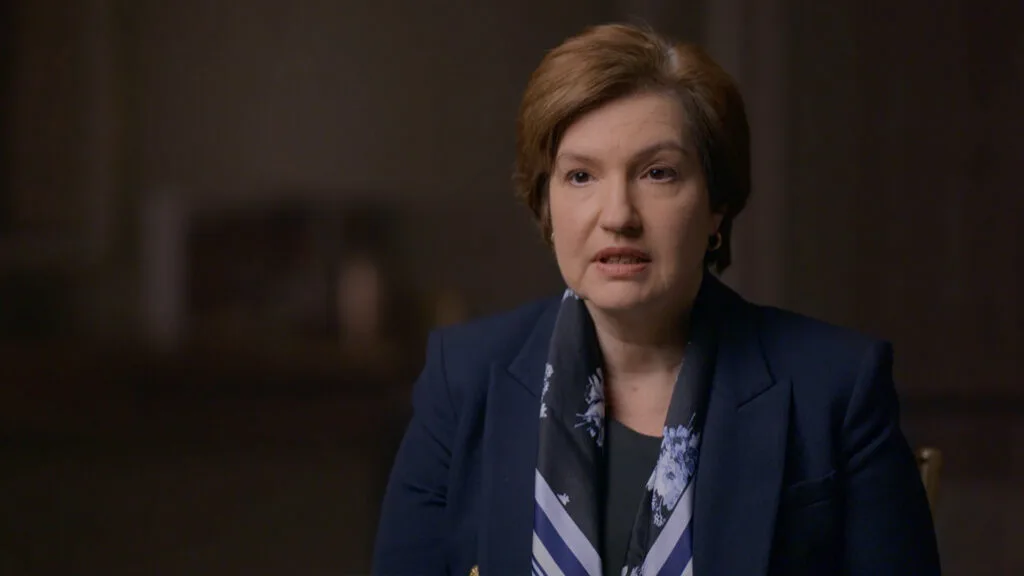
Ilya Somin is a law professor at George Mason University. His writing on constitutional and property law has been published in the Yale Law Journal, the Stanford Law Review, TheNew York Times, and the Wall Street Journal.
This is a transcript of an interview with FRONTLINE’s Michael Kirk conducted on January 10, 2019. It has been edited for clarity and length.
…[Mitch McConnell (R-Ky.) is] very much a politics guy, not so much a policy guy.But what I'm interested in is what was being discussed in that inner sanctum during what was the [Earl] Warren court aftermath through the [Warren] Burger court.What are conservatives concerned with, judicial conservatives, concerned with at that time that he might have been hearing about?
Yeah.So I have no idea what he heard, but I can certainly tell you the broader issue at that time, some of which were similar to what we're dealing with today, but some of which are quite different.
Fabulous.So tell me.
OK.So both [Robert] Bork and [Antonin] Scalia served in the Ford administration and in Bork’s case also the Nixon administration.And I think Bork specifically, and other conservatives generally at that time, were animated by a number of issues.One is, many of them were very angry at the Warren court on a number of fronts.They thought it gave too many rights to criminal defendants, that [it] engaged in judicial activism of various kinds, or what they thought was judicial activism, on many different fronts.They also really disliked the Roe v. Wade, in some cases much more than just disliked which happened in 1973 under the Burger court, but still in the immediate aftermath to Warren court.
In the case of Bork and Scalia specifically, I think also they were concerned about that the Congress in the aftermath of the Watergate scandal had taken a variety of steps to constrain executive power in ways that these people thought was unwise, and in some cases also unconstitutional.Obviously, the aftermath of the Vietnam War and the CIA scandals of that was also significant.So I think these people on the one hand thought that there was way too much judicial activism or what they thought was activism, and too much constraint on executive power imposed by Congress, and sometimes the courts.So they wanted the courts to butt out of a lot of areas that they were going into.
But it was also the case that Bork and Scalia and others of this ilk at this time were originalists, and even then, there was the beginnings of the sense that in some areas, originalism actually requires more judicial intervention rather than less.Already in the 1970s, William Rehnquist, whom Nixon appointed to the Supreme Court and who had also served in the Nixon administration, had written opinions saying that the court was not protective enough of federalism, and was not protective enough of property rights, and he defended that partly on the basis of textualism, but partly on the basis of originalist considerations as well.
So even though the conservative legal movement in the ’70s was largely focused on combating what they call judicial activism, there was also really beginning the sense that maybe in some areas the problem with the courts was that they weren't active enough.
Democratic Response to the Robert Bork Nomination
Bork is, by all accounts, a superstar to people who are conservative, young lawyers who are learning and thinking about another path besides the conventional liberalism of the day, certainly judicially, and he is raised up by the Reagan administration and nominated to fill an important seat in the Supreme Court, and immediately—I'm going to use the word “victim”—a victim of Ted Kennedy (D-Mass.), a Democratic war room which has been manufactured TV ads featuring Gregory Peck, lots of anger, something aimed at him.When you look back at it, what was it about Bork that caused this reaction from the Democrats?
I think there are several things, some complaints that had reasonable justification and other ones that did not.One big thing was that he really was a hard-line conservative on a wide range of issues including adopting a good many positions that most conservatives today would reject.For example, he thought that freedom of speech should only get a very narrow range of protection.Only political speech should be protected, not artistic speech.He thought that there was virtually no right to privacy in the Constitution, which most conservatives today, and certainly most libertarians, would take a more nuanced view than that.
And he had even gone so far as to say that he thought the decisions applying the Bill of Rights against state governments were probably incorrect, which again is a position that very few mainstream conservatives and certainly no libertarian legal theorists today hold.So, on those issues and some others, I think the left had legitimate complaints.
But it is also the case that a lot of indefensible and just totally out-there accusations were thrown at him, such as claims that he wanted to bring back the days of segregation and slavery, as in a famous TV ad that said that, and a lot of other scurrilous attacks that were made as well.
More fundamentally, a lot of conservatives felt that, in some justification, that what happened with that nomination went beyond what was then the accepted norms of judicial nominations, where in that period, there was still a norm of at least relatively considerable deference to the president.And also while there had been contested nominations previously, this one was fought out in a full-scale, no-holds-barred political war of a kind that at least hadn’t been seen in a long time with judicial nominations.So from the perspective of many conservatives, ironically including even some who don’t agree with key precepts of Bork’s jurisprudence, the Bork nomination was sort of the original sin in which, from their point of view, Democrats broke the norms of the judicial nomination game, and therefore that would justify in the future retaliation by Republicans of various kinds.
It wasn't really about character and his preparation for the court.It was really political.
I think almost nobody could deny that Bork had solid professional qualifications, and certainly he was a great legal thinker.Even those of us who disagree, I think, recognize that.And similarly, there was little if any reason to think that he was somehow unethically not qualified or whatnot.It was all about his judicial philosophy, and obviously there was a political dimension as well.To my mind, it’s legitimate to oppose nominees based on judicial philosophy; I've done it myself.But at the same time, there are many who think that it’s not legitimate so long as a nominee is sufficiently “mainstream.”And obviously, even if you do think it’s legitimate to oppose based on judicial philosophy, there were a good many attacks made against Bork that just had no foundation and went beyond any reasonable norm of political combat with respect to judicial nominations, at least at that time.
Why?
As I said earlier, I think there were some attacks that were made against him that just had no foundation in reality and were totally scurrilous, such as claims that he wanted to bring back segregation or that his jurisprudence was the equivalent of bringing back slavery and so forth, or that he wanted to forcefully sterilize women and other things that were made.The latter was a distortion of an opinion that he had written.So I think there were plenty of grounds for legitimate disagreement with Bork’s judicial philosophy, and I think senators were within their right to say, “I think his judicial philosophy is just wrong; I'm going vote against him on that basis.”But I also think that there were attacks that were made that were utterly unjustified and that did certainly poison the well, not just for that nomination but for later fights over judicial nominations as well.
The Origins of the Federalist Society
So this group that he and Scalia had been advisers for on campuses, …it’s fueled in the post-Bork era like so many other things are.But it’s almost like an activation moment.Is that your reading of the evolution of the Federalist Society?
I think that's at least partly true.The Federalist Society was a small and relatively nascent group back in 1987 when the Bork nomination happened.It had been founded only five years earlier.Bork was at that time and to some extent still is a hero to many legal conservatives.And obviously, when his name got dragged through the mud, so to speak, people were angry not just for partisan and ideological reasons, but also because this is a person they really looked up to and admired, and therefore they were mad for that reason as well.
But also, this was one of a number of signs, including many that went back long before the Bork nomination, that they, in fact, would need to mobilize more aggressively in order to get what they thought of as more conservative or more originalist judicial nominees; that they couldn’t take it for granted that that would happen even under a Republican president; that that would require mobilization.Just as in previous eras, liberal groups had successfully mobilized to get judicial nominees that they wanted, to get outcomes in court that they wanted.And there, too, it was not enough that liberal Democrats won presidential elections.There had to be active mobilization that went beyond that.And I think conservatives had already begun to learn that lesson before the Bork nomination, but obviously the Bork nomination drove it home even further.
I've read some things where people say it was just great to get together with other conservatives who knew about the law and cared about the law.A lot of people felt so isolated on various campuses, and suddenly you had a group of people who shared not only a strategic view but began to share and develop a tactical approach to changing the relationship to the court.
Yeah, so I think that’s definitely true.Both then and even today, to a large extent, conservatives and libertarians were heavily outnumbered at elite law schools and in the academic world generally, both in the faculty and in the student body.So they saw themselves as sort of a small minority resisting a much more powerful and aggressive majority, and therefore, there was this sense of being able to get together with likeminded people in a way that they normally didn't have the opportunity to do.
There was also the case that the initial founders, people like Steve Calabresi, Lee Otis and others, were people who were deeply interested in these ideas for reasons that go much beyond sort of immediate political needs, and therefore, they enjoyed coming together and discussing the ideas for its own sake, which was the case at these small gatherings they held back in the early ’80s, but is even the case today at the much larger gatherings that the Federalist Society has now.
So I think there was both a sense of intellectual excitement, but also a sense that this is an opportunity to mobilize this minority that up to that point had been largely powerless, both within the academic world and also within the legal profession more generally.If you look outside the law schools, at groups like the American Bar Association, by and large, with some exceptions over the 20 or 30 years prior to the founding of the Federalist Society, had been, for the most part, on the left.I think the ABA is still on the left on the majority of issues.
So there was the sense that conservatives and also libertarians, groups that have disagreements among themselves, but they were united in the sense of both were on the outs with those who dominated legal academia and also the legal profession more generally.
How hard was it to be a conservative at law school in those days?
I don't know for sure.It was obviously before my time, and it probably varied from school to school.But I think it was hard in the sense that if you're a conservative academic, and this part is true today, on average it’s, other things [being] equal, harder to get hired than if you're a liberal with comparable credentials.If you're a conservative or libertarian student, I don't think there was much in the way of discrimination in admissions or the like, but there was the sense, often, that your views might be weird or strange, or a good many people might even think they're beyond the pale of legitimate discourse.So that atmosphere was certainly there in at least some schools.To some degree, it exists even now, though things have changed in a good many places as well.
So when Bork goes down at the hands of Ted Kennedy and Joe Biden (D-Del.), that's a spark that ignites something inside the group, yeah?
So as I said before, I think it certainly made a lot of them angry, and it also made them sense even more than they had realized before that in order to successfully get judges of the kind that they wanted and to prevail in important legal battles, they would have to mobilize; that they couldn’t just take for granted that that would happen whenever a Republican might be in the White House.
The original tactical idea was a sort of networking, almost an employment agency, headhunting organization?
I don't think so, actually.As I understand it, and you can check with those who were there, the original idea was not about employment or networking, but was rather just about getting together to debate and circulate ideas.Now, it is inevitably the case that when people who are interested in similar ideas and are also, in many cases, in the same profession, when they get together, networking happens, and eventually it builds upon itself.But I don't think that career-oriented networking was one of the main goals of the original group.
The Nominations of David Souter and Clarence Thomas
…
In the George H. W. Bush presidency, he has picked [David] Souter to fill the first seat, a choice that I think was not exactly applauded by the beginning Federalist Society, but also by many conservatives, …and that it’s really the Federalist Society, by now five years out, started to form enough clout and have enough pressure available to it inside Washington that said when Thurgood Marshall decides to walk, “We have to have — and you, Mr. President — have to give us a judge who’s more likely to pass our litmus test of a certain kind of judge.”And such a judge who had been a member of the Federalist Society and on the D.C. Circuit for a couple of years, Clarence Thomas, fit that bill in the African American aspiration that I think that president had.Is that the case?Is that what happened, from what you can tell?
I'm not so sure.When Souter was nominated, Bush was assured by his advisers, including John Sununu, who knew Souter well, or thought he knew Souter well at least, that Souter was going to be a conservative.But at the same time, he had very little paper trail, and therefore it was thought that he could get through a Democratic-controlled Senate.A few Democratic senators, including Ted Kennedy, nonetheless voted against him because they suspected that he was a wolf in sheep’s clothing from their perspective.But it turned out that even though he was called the “stealth candidate” on the theory that, like the Stealth Bomber, he would fly under the radar but then still hit the target, it turned out that Bush had actually outstealthed himself rather than stealthing the Democrats.
I'm not sure that was fully evident already only a year after Souter being nominated when the Clarence Thomas nomination came up.I think Souter’s liberal tendencies in the court became more fully evident two or three or four years in, and his first couple years on the court, he actually voted in a more conservative way on at least a number of issues.So it took a while for conservative Republicans to figure out that they had screwed up on the Souter nomination.
With the Thomas nomination, I think it certainly is true that conservatives wanted to make sure there was a conservative nominee, but it was also the case that for political reasons, everybody, or almost everybody, recognized that Thurgood Marshall, who was the first African American Supreme Court justice, would have to be replaced by another African American, and the pool of people who were both African American and Republican and also had plausible credentials for a Supreme Court nomination was a pretty narrow one.So I'm not sure they had a lot of options other than Clarence Thomas at that time, though it is also true that Clarence Thomas was well liked by conservatives, though at that time, his reputation was probably somewhat less conservative than came to be the case when he was on the court.
And a member of the Federalist Society, even though it wasn’t 75,000 members in those days.
He was a member, but both then and now, there's a considerable range of views in the Federalist Society.So while almost everybody in the Federalist Society is in some sense either a conservative or a libertarian, there's enough diversity that I don't think that alone would mean that it could be taken for granted that he would be another Bork.And in fact, in some ways he was not another Bork, because there are actually a number of key issues where he and Bork differ.
Applying the Lessons of Bork Nomination to Thomas
Leaving aside even the ideological differences, the method of comparing him and moving him, pre-Anita Hill, moving him through the process was a response in lots of ways to lessons learned from being perhaps asleep at the switch during the Bork nomination by Republicans and by conservatives; that is, not being prepared for the onslaught of Democrats against Bork—for example, not having a long paper trail for Thomas, and Thomas himself not really wanting to address challenges from the panel.
I think that's right, that Bork, I think in some ways to his credit, spoke very openly about his views, and he had a big paper trail.So on many issues, it was very clear what his views were.Thomas did have some paper trail, but not as much as Bork.And also, as you say, Thomas was prepared by staff and by the White House for the kinds of questions about substantive issues that might come up.And while I don't think the goal was to deceive people into thinking that Thomas was actually a liberal—everybody knew, I think, that he was not—certainly he was more careful and guarded in his answers than Bork was.
And while it’s hard to assess a counterfactual like this, I think had not the Anita Hill issue come up, he would likely have been confirmed by a substantial margin.He would have gotten more opposition, I think, than most pre-Bork nominees got, but he would not have squeaked through by 52-48 as actually happened.I think a good many more Democrats would have ended up voting for him but for Anita Hill.
…Something fundamental seemed to change in the way people were confirmed and the confirmation process over those ’87-’92, over those years?
I think there was certainly some change, though there was still, I think, some question about whether what happened with Bork would be the new normal, because on the one hand, the Democrats really did break some norms in the way they opposed Bork.But on the other hand, it is indeed the case that Bork had some very troubling views.
Allegations by Anita Hill
…
So Anita Hill is raised just as it seems like he's going to get confirmed.… What are the lessons learned by the Federalist Society members from those hearings?
I don't know that Federalist Society members as such learned specific lessons from the Anita Hill incident.I think what happened in that case, as also in the [Brett] Kavanaugh case, is that people on both left and right allowed their judgment about particular factual questions to be dominated by ideological and partisan bias.That is, it was striking to me then in the Thomas case, as also later in the Kavanaugh case, that almost everybody who thought that Thomas should be rejected on ideological grounds also thought that he was lying, Anita Hill was telling the truth.
And on the other side, almost everybody who thought that Thomas was otherwise a good judge and should be confirmed also thought that he was telling the truth about the Anita Hill charges, but that Anita Hill was lying.And when you see a split like that over a narrowly factual question, that in and of itself has very little to do with ideology, and that split winds up with people’s ideologies.You see yourself sort of in the presence of partisan ideological bias.I think that happened in the Thomas/Hill case.It also later happened in the Kavanaugh case we might talk about.
I do think that the issues there were a bit distinctive in that even if you credit what Anita Hill said, and perhaps she was telling the truth—I don't know—what she alleged happened was not nearly as serious as the assault that was alleged in the Kavanaugh case.And she herself did not claim that Thomas tried to coerce her either in a direct physical way or in a quid pro quo way of saying, “If you don’t go out with me, I will fire you,” or anything like that.What she essentially claimed is that he engaged in boorish behavior by persisting and asking her out and whatnot even when she made clear she didn’t want to do it.
And it seems to me that the gravity of that probably doesn’t meet the legal definition of sexual harassment, although it would be bad behavior if it occurred.It is not as serious as what happened with Kavanaugh.Nonetheless, I think it became intertwined both with partisan bias and with the very real issue of sexual harassment in the workplace which at that time had just begun to become a significant issue in American society.So I think that those issues became intertwined with that as well.
As to any lessons that were learned, I think sadly both the right and the left interpreted this incident with sort of their ideological blinders on.The right thought that the left had at the last minute raised scurrilous charges against one of their nominees for purely political reasons.And the left, on the other hand, thought that this guy clearly had done what Anita Hill had alleged and that conservatives had pushed him through because they just didn't care about sexual harassment or even despised women generally.
Thomas’ Confirmation Energizes the Political Left
It's also interesting, the political fallout as a result.This was the year of the woman, where a lot of Democratic women ran for office and won, in some cases, four female senators.There had never been that number before elected.And maybe those ramifications survive even today with women in the Senate who are going to be involved in Kavanaugh.Something to say about that?
Yeah.I think there was definitely left-wing political mobilization in response to what happened with this nomination, just as there was right-of-center mobilization response to the defeat of the Bork nomination.I think it’s pretty obvious that the confirmation of Thomas made the feminist left angry, and it also made a good many women out in the country generally angry.And that had an impact in the ’92 election, though it should be said that the ’92 election was just a bad election for Republicans in general because of the recession that was going on which helped defeat George H. W. Bush and probably also hurt Republicans in Congress as well.
Growth of the Federalist Society
…The growth and development of both power and prestige of the Federalist Society during this period, during the rest of the ‘90s through George W. Bush and even into the Obama administration, can you help me understand when I look at a picture of the Federalist Society in 1992 and I look at it in 2016, what I will see happen?
I think the organization obviously grows, both in terms in the number of people involved and in some respects in their influence.I also think, obviously, that this is a period during which American politics, both on legal issues and on other issues, becomes more polarized.And therefore, it would be naïve to imagine that doesn’t affect the Federalist Society.It affects a lot of other groups.So there was more hostility between right and left.
Another thing I think happens in the Federalist Society during this period is that the influence of libertarians within the group begins to grow relative to what had been the case before.And there was more of a sense, certainly among libertarians but even among conservatives, that an originalist judiciary, one that enforces the Constitution, is not necessarily one that just lets the political branch of government do what they want.It’s one that in many cases needs to be more active rather than less on issues like federalism, property rights, protection of freedom of speech, enforcing the Bill of Rights against the states and a number of others as well.Gun rights is another example.
I think some of these tendencies were already evident in the 1970s.I mentioned before William Rehnquist’s belief that the court had not done enough to protect federalism and to enforce the property rights under the Takings Clause.But obviously, this was a more significant trend in the ’90s and in the 2000s than previously.
Finally, I think the issue of wartime executive power obviously became more important with the Bush administration and the war on terror.And this, I think, creates a little bit of a division in Federalist Society circles in that many libertarians, myself included, are very wary of broad assertions of wartime executive power.On the other hand, conservatives tend to be more favorable to it.And I think you saw that in splits over some of the issues that happened in the Bush administration: the Guantanamo cases, but also the warrantless surveillance situation.And of course you see it in some issues that have come up probably moving ahead to Trump where I was heavily involved in opposing Trump’s travel ban.I wrote amicus briefs about that, whereas obviously many conservatives were just fine with it, or at least thought that it was constitutional.
How many people would you say are actively in the Federalist Society by the time we hit 2016?
I don’t have the numbers ready to hand in my mind.I suspect it’s much larger now than it was in, say, 1992.There's a little bit of also wiggle room on the question of what counts as an active member.Obviously there are many people who are members, because all you have to do is—I think it may be $50 a year or something to be one.But there are a smaller number who are active.But there's no question that probably people who are more than just members on paper, it’s still probably thousands of people.And it’s certainly the case that I think if you look at prominent conservative and libertarian legal thinkers, either in academic or in the public-interest world or think tanks and the like, probably 70, 80 percent or more of those people are members of the Federalist Society, as I am myself, though I should add that the Federalist Society doesn’t exercise any real control over what those people say or think and that there are important disagreements among them, including particularly disagreements between libertarians and conservatives, which are, if anything, more important in the Trump era than they were before.
If you wanted to gauge the health, the vitality, the direction, whatever, of the Federalist Society, where would you go?...
I think there's a number of metrics that you could look at, some of which show the Federalist Society as being very important, other ones potentially less so.There are a number of standard indicators that say it’s extremely important, such as if you look at federal judges appointed by Republican presidents, George W. Bush and Trump, to some extent also Reagan, George H. W. Bush, over time an increasing percentage of them have at least some Federalist Society ties in the sense that they were members of the group.And an increasing percentage, I think, are influenced by legal thinkers who are themselves members of the Federalist Society, which is not to say that their thought was somehow determined by the Federalist Society.But there is an increasing consciousness among conservative and libertarian judges and legal thinkers of greater theoretical sophistication, a greater understanding and acceptance of originalism and textualism and other such methodological innovations.
So if you look at the kinds of people who are members of Federalist Society and the positions they have in government, in the judiciary, in academia, in public-interest groups and other organizations, the Federalist Society is doing great.It has more influence than ever from that perspective.
On the other hand, I think there's a troubling sign, which is that if you look at Trump and how he became president and the sort of movement he represents, you quickly find that he and many of his core supporters care very little about any constitutional or legal principles, to crudely generalize, but I think accurately in some ways nonetheless.He and his core supporters are much more nationalist than they are conservative, and certainly they're not in any significant way libertarian.
And therefore, if you look at the long run, a party which is primarily nationalist and not conservative or libertarian over time will show less and less interest in the kinds of things that the Federalist Society has traditionally cared about.Many, I think, members of the Federalist Society underestimate the extent of this particular danger, but it seems significant to me, particularly when you look in history [at] judicial nominations over time.Ultimately we have a connection to the agenda and the ideology of the party that nominates them.There's often a lag.Judicially we shift much more slowly than political parties do.But over time, the one catches up with the other.
And I think therefore while the Federalist Society has had an enormous intellectual influence and people associated with it have, and they’ve influenced judicial nominations and other things of this sort, at the same time the political trends within the Republican Party of the last several years are ones that I think in the long run, and maybe even in the medium run, are ones that are very troubling for people who care about constitutionally limited government, and certainly, in particular, for libertarians.
Donald Trump’s Nominee List
In the aftermath of the death of Scalia, as the seat is being held open by Mitch McConnell and Donald Trump is in that last lap of the primaries, and he needs conservative votes, he thinks he has something he can deliver to them that will earn their trust.And one of those things is the seal-of-approval list of candidates from the Federalist Society that is delivered at the Jones Day meeting that we've all read about and heard about.Can you talk to me about how you felt about all that?
So I think here it’s important to be clear what we're talking about.There's no such thing as the Federalist Society creating a list.In fact, many people in the Federalist Society, including myself and others, at that point didn't want to have anything to do with Trump.Rather, particular individuals who were Federalist Society members but who were acting very much on their own, were involved in creating that list, including—I'm blanking out—
Don McGahn, Leonard Leo?
Leonard Leo, yes.So Leonard Leo was definitely involved, and he’s a high-ranking person in the Federalist Society.But it’s by no means the case that everybody, or even necessarily a clear majority of other people, in the Federalist Society agreed with what he was doing, particularly at a time when most people thought that Trump was going to lose the election anyway, but also in part for principled reasons of opposing many other things that Trump was saying and doing.
It is nonetheless the case, though, that in a very close election, I think this move worked out for Trump.In a certain sense, you could say it worked out for the Federalist Society members as well in that they did get a good many judicial nominees that they like.But I think it’s also the case that they helped exacerbate this long-term danger of a party that over time will be nationalist rather than conservative.Had Trump lost the 2016 election, this nationalist trend would have been more likely to have been stopped.
So nonetheless, he has a list.Leo and Jim DeMint from the Heritage Foundation helped construct it for him.On that list are a number of people who are Federalist Society members, understanding that by now there are 75,000 members of the Federalist Society.… People we talked to said the most significant thing that happened to Donald Trump’s run for the presidency was the fact that he got so many conservatives as a result of him being able to wave a list and say, “I have here a list of people I will nominate to the federal bench.”
So the 2016 election was an extremely close one, and when an election is that close, you can easily point to a dozen things which if they had gone the other way might have changed the result of the election.You can point to the Jim Comey letter, to the DNC hacking, to the timing of various kinds of revelations about Trump, Hillary Clinton and so forth.So people who—I have not studied the survey data on this very closely.Professional political scientists like Nate Silver and others who do study it, they're not at all sure that this judicial nomination question was really decisive in that the people who most cared about it were also people who were very partisan Republicans who were likely to vote for the Republican candidate if only because they really hated Hillary Clinton and Democrats.
Nonetheless, it’s certainly possible that this was decisive in the sense that if everything else had been held constant but this had changed, the election would have gone the other way.But my guess is that on that list of a dozen or more factors, there are probably several that swayed more votes than this one did.But that's just a guess, because to really know, you would have to delve into the survey data in great detail.And even then it’s tough to know for sure, because there are so many different variables that are correlated.I deal with public opinion research and some academic work, so figuring out which factor was truly decisive in an election that was this close with this many variables jumping around is not an easy task.
So let's go to at least this point, which is Trump the president, …and Don McGahn, member of the Federalist Society, member of his staff who creates a shop inside the White House Counsel’s Office of other young lawyers, many more qualified than he, out there digging around looking for judges, people to populate the judiciary.
And Trump has taken kind of his hands off of that, other than a final vetting.That is a formidable group, a pool that is being drawn from that as far as anybody we've talked to—maybe you know more than we do—says that the primary credential coming up is this idea of membership in the Federalist Society.
I wouldn’t say that’s the primary credential.I think what the judge pickers were looking for were people who, a, had the necessary professional qualifications, and b, were generally conservative in various senses in their traditional philosophy.And in this generation, that is people who are now, say, between 35 and 60 or whatnot.A very high percentage of the people who fit that bill are also Federalist Society members.Now, you could say, “Well, if you just know the person’s a Federalist Society member, that's all you need to know about the rest.”But I don't think that's the case.Realistically, when they choose even circuit judge nominees or district nominees, they get a much more thorough investigation than just, “Are you a Federalist Society member or not?”
So I think the Federalist Society did have some influence.But to some extent also, correlation is not the same thing as causation; that Federalist Society membership correlates with the things that they're looking for, but that's not entirely the same thing as it causing that.So, equally, it’s also the case that when you look at liberal judicial nominees, almost all of them are members of the American Bar Association, which indeed tends to be liberal.But that's not to say that when Democratic presidents nominate people, all they care about is whether the person was a member of the ABA.It's just that being a member of the ABA tends to correlate with the other things they look for.
From Bork to Kavanaugh
Let’s talk about Kavanaugh and lessons learned and applied.It seems like that's the kind of ultimate example, from Bork to Kavanaugh, of preparation, of learning lessons from the past, and having a candidate who is absolutely prepared in every way by a process.He served his time on the D.C. launchpad court, and in so many other ways seems to fit the bill of the new creation.From Bork to Kavanaugh is a line that says what to you?
So it’s interesting in that when we think about the Kavanaugh nomination, our perspective is inevitably altered by the sexual assault accusations that came up.So it’s worth thinking back to that point when Kavanaugh was nominated and we didn’t yet know that there would be this accusation.At that time, yes, he was a Federalist Society member.He was well liked by conservatives and supported by them in part for that reason.But it’s also the case that he was broadly popular within the legal elite in general.A number of prominent liberals like Akhil Amar from Yale Law School, one of my law school professors, even testified for him at his nomination.
So while he was definitely a Federalist Society member and definitely a conservative, he was also definitely a member of the traditional legal elite of a kind that could have been nominated not just by Trump or by George W. Bush but by any Republican president that had been there in the last 30 or 40 or 50 years.And had the nomination proceeded in the absence of the sexual assault accusation, I think he would have been perceived that way and would have gone through and would have been seen as a conservative judge, but not as any kind of crazy radical.And I say that even though I have some significant reservations about parts of his judicial philosophy.
Obviously with the sexual assault accusation, he’s perceived, at least for the moment, in a very different way.But if you look back before, I think there's a big difference, actually, between him and Bork in that Bork really did have a number of positions that, for his time and even now actually, perhaps more so now, were out of the mainstream, so to speak.With Kavanaugh, even on those issues where I think he’s significantly wrong, it just isn't the case that he’s had these radical views or that other legal professionals thought that he was strange or weird or anything like that.To the contrary, he was a highly respected and well-liked member of the legal elite.And even many big-name, left-of-center lawyers and legal scholars thought that as well.
Legacy of the Kavanaugh Confirmation Process
So when we get to the end and we see him confirmed, despite the sexual allegations, and even in some ways despite his appearance following Blasey Ford, where he’s really feisty on one level and on another level has the Clinton conspiracy as part of his argument, what has happened to the court and the confirmation process over this time?...
I think we won't know for sure until a number of additional years have passed and we have more of a historical perspective on it, but it’s definitely the case that battles over these issues have become more polarized and that both parties in various respects have taken off the gloves.We talked earlier about the Bork nomination, the Merrick Garland situation, and obviously the battles over both Anita Hill and Christine Blasey Ford and so forth.And I think it’s possible that things will settle down over time and that the court will continue along a trajectory where it’s a conservative court, but its legitimacy is not greatly eroded.But it’s also possible that we will see further escalation in these judicial battles.And I find it significant that Democrats are talking about doing things like packing the court, or perhaps other aggressive steps against the court.
And if, say, a Democrat becomes president in 2020, and they also control Congress and they do try to pack the courts, I think that will be an additional further escalation, I think a very dangerous one.You can also imagine scenarios where a Democratic president just says: “This court is illegitimate in some sense.It has a person on it that from our point of view lied, committed perjury about his sexual assault accusations in order to get on the court.It has this person, Thomas, who we feel is a sexual harasser.”From their point of view, whether he actually is or not.“And therefore, if they issue rulings that we think are badly wrong, we're just not going to obey them,” just as there is precedence for that in presidents like FDR threatening to disobey Supreme Court decisions that come out in a way that they object to.
So this kind of escalation, I think, is a real risk, and I think both parties deserve some blame for it.I think some aspects of the way that the Kavanaugh nomination was handled increased the likelihood that such a thing will happen.But we don’t know for sure if it will.If it does happen, I think it will be very bad for the institution of judicial review.But my hope is that perhaps it can be avoided.
So how we remember this era and its long-term significance will in part depend on what happens in 2020, 2024 and so forth, and it may depend on other kinds of political developments as well.
Filling the Swing Seat
When Kavanaugh is nominated, it’s the [Anthony] Kennedy seat.How important is that, especially for the conservative legal movement?What does he represent for the court?
So I think both conservatives and liberals saw Kennedy as a key swing voter on a lot of issues.Obviously he had voted with the right on some questions but with the left on others.And on some issues, conservatives were very angry with Kennedy, like his votes on abortion I think is the biggest example, but also one of the votes he cast on affirmative action and some other issues.
At the same time, it’s worth noting that there is considerable continuity between Kennedy and Kavanaugh on a number of issues.Both of them, for instance, are skeptical of the so-called Chevron doctrine.Both are very strong on freedom of speech.Kennedy had voted with the conservative majority on Citizens United, for example.And Kennedy was a great champion of federalism.In every case, with one important exception where these issues came up, he voted to limit federal power.We don’t yet know where Kavanaugh stands on those questions.He has very little record on them.But it’s important to recognize that while in some respects Kavanaugh might be a break with Kennedy, there are actually a good many areas where it’s possible there will be a lot of continuity.And interestingly, of course, Kavanaugh clerked for Justice Kennedy, which does not necessarily mean they have the same views on everything, but it does suggest that their views are not simply completely alien to each other.