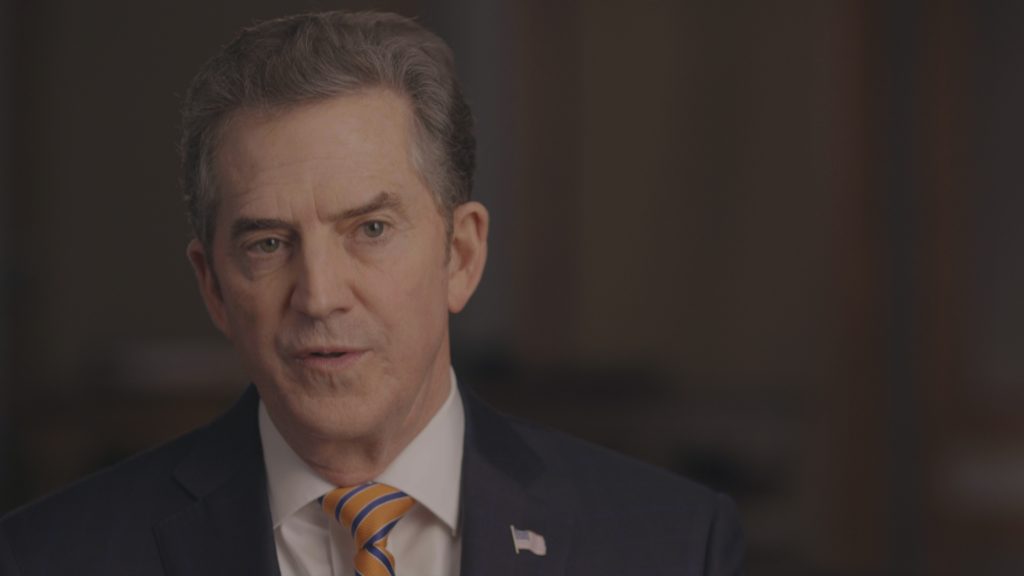
Jim DeMint is a former United States representative and senator from South Carolina. A Republican, Sen. DeMint was a leader of the conservative Tea Party Movement and resigned his seat to become president of the Heritage Foundation in 2013.
This is a transcript of an interview with FRONTLINE’s Michael Kirk conducted on January 9, 2019. It has been edited for clarity and length.
The Death of Justice Scalia and Mitch McConnell’s Gamble
Let's start with what a lot of people think of as maybe one of the most important moments that have ever happened in the history of the Senate and the Supreme Court, and that is the moment after Justice [Antonin] Scalia died, and Leader [Mitch] McConnell (R-Ky.) stepped up and said, “Mr. President, we're not going to be considering a nominee from you since it's the last year of your presidency.”Take me there, and how you felt about that decision—by the leader?
Well, actually, it followed precedent in lot of ways, because there was a rule established by several Democrat senators for years that in that last year, but it often didn't start until May or June.I'm not sure if we ever had the situation where it was that early in the year.So it was reasonable, from our perspective.Of course, I was looking at it through partisan eyes at that point.But I think the courtesy of the Senate, if you'd been talking that same language 30 or 40 years ago, it would have been assumed that you would have waited for the next president.But it certainly was contentious when it happened during the Obama years.
Why?What was so shocking about it?
Well, it's because there was already such a great divide between the Republicans and the Democrats.There was a lot of fighting between the Obama administration and the Republican majority in the Senate.Obama had already put two what we considered very liberal judges on the Supreme Court, so this was something that was, from a Republican point of view, very reasonable.It followed precedent, at least reasonably closely, that the last year of a president, that you did not get a Supreme Court nominee.
It happened on the afternoon of a Republican debate, that night in South Carolina, a lot of people saying what Mitch was doing was setting a standard, so that somebody like [then-presidential candidate Ted] Cruz (R-Texas) or somebody else can kind of get out in front of what was happening and pick other kind of nominees.And what he wanted to do was seize that control and hold onto it until they could figure out what should happen.
Yeah.Well, for McConnell to do it, [it] should have given everyone a little bit of comfort, because he is very protective of the Senate and in keeping the Senate in some kind of a traditional role.And I think he would have—he’s shown a lot of deference to Democrats in our opinions.You know, Mitch and I did not always end up on the same page of a lot of things, but he did protect the traditions of the Senate.And I don't think he would have done that if he thought it was out of character of the Senate.So again, no surprise.And he was certainly shocked about Scalia.He was a model, a strict constructionist constitutional justice in a lot of our minds.But that set up a big fight for when the next president made his nominee.
Let me ask you this, Senator.If he hadn’t done it, and Obama had had a pick for that seat, Scalia's seat, and even if it was Merrick Garland or somebody else, how different would the court be today?
Well, it would be very different than it is now, because Obama, in our minds, as conservatives, where he was picking a kind of litmus test, left, progressive justices, you know, [Sonia] Sotomayor, [Elena] Kagan, these were activists politically in our minds as much as they were jurists.So another pick like that on the court would have been so different than [Neil] Gorsuch.So it was a huge swing.It was a big decision.And I agreed with McConnell’s decision there.I think in retrospect, if anyone had respect of our democratic process, when we're expecting a new president, and a decision that large, I don't think it's out of character with the Senate or the American way that you have a pause in those last few months of a presidency.
Donald Trump’s Nominee List
It's in March of that year, 2016, that candidate Trump comes to Washington.You guys meet at Jones Day, the law firm.The discussion of the list occurs.We've all heard of the discussion.We all think it's probably one of the most important things that ever happened for Donald Trump's candidacy.Can you take me there?Tell me what the event was, what the occasion was, and what it was like.
Well, it was interesting, because Trump had not yet won the nomination, but he was the presumed winner at that point, had a lot of momentum.He came to Washington hoping to meet with conservative leaders to get their input, and very few would even go.It was somewhat controversial where I worked that I would go at all.And when we arrived, there were a few congressmen who had supported him, endorsed him.Weren't very many conservative leaders.
He was very open about what he wanted to do.I had been with him a couple of times before.We had bumped into each other at different events.But at this first time I had really had a chance to talk to him.But at some point in that discussion, he said he wanted to produce a list of 10 Supreme Court nominees, prospective nominees, to show America the type of judges that he would nominate.It was very important to him, and I could tell a lot of his advisers—and he didn't have that many—were thinking that's not a good thing to do.People can scrutinize them; they can criticize; they can find fault in what you do.
But he was insistent.And I'm an old business consultant, and I've worked with a whole lot of CEOs—actually more comfortable with them than with politicians, because you generally know what the CEO wants.And he said he wanted a list.He said, “Can anyone get one?”And I just raised my hand: “Yes, sir.”And he said, “Can you have it by Thursday?”I was sitting next to Leonard Leo of the Federalist Society, and worked with him.We got the president a list of judges.And that's the Federalist Society's business, to look at, to screen who were the best judges that stick to the Constitution.
But Trump, to his credit, he wanted the list.He wanted people to know who he would nominate.He has picked from that list.And to his credit, he has been probably more insistent on keeping promises than any politician I've ever worked with.
Tell me something.What was his urgent need?I mean, from the way it looks like from the outside and some people we've talked to, he really needed a kind of conservative blessing [on] something like this.
Yeah.And I don't know how much of this is intuitive for him or thoughtful strategy.It’s hard to tell, but he knew, I mean, that just by the attendance at the meeting that a lot of conservatives were not supporting him.And it wasn’t—I didn't feel like it was my job to judge the candidates.We were trying to help any of them who wanted to help with policy advice, anything we could do.So if he wanted a list, it didn't matter if Hillary Clinton had asked for a list; I’d have gotten it to her.But he wanted it.He wanted it quickly.
And I think it was very decisive, because conservatives were sitting back wondering if they could vote for this guy.They didn't know much about him.He didn't seem to come from any kind of philosophical point of view that was consistent.And I think he was trying to change that paradigm, and for the courts, that could have been very decisive in the election, because a lot of people who weren’t willing to go with him on other things said, “The courts are pretty important.”
So that list, and the fact that he was willing to make it public, it was a very Trump thing to do in retrospect, because I don't think anyone else would have done it, because his advisers were right.People could criticize them, talk about them, say they were too conservative, that this would make Trump radical.But for conservatives in America, a lot of them looked at that list and said, “That could change.”
And the importance of the list coming from Jim DeMint in the Heritage Society and Leonard Leo in the Federalist Society, what was the meaning?What was the power of the fact that you two got together on the list?
Well, I think we're known to conservatives all over the country.We actually published a list publicly so that it would not be seen as some kind of particular favor for one candidate.Every candidate had the list at the same time Trump did.But I think the Federalist Society, particularly in the legal community around the country, and I guess I was somewhat known as a senator, the fact that we were supportive of this list, and the president said he was going to choose from it, that added, I think, some credibility to the conservative movement for Donald Trump.
The Growth of the Federalist Society
Can you give me a sense of the growth of the Federalist Society?I mean, I remember back in [Robert] Bork, Bork and Scalia were the advisers to the beginning, the very first efforts at the convention of the very first get-together.But by then, from ’87 to ’16, tell me just a bit about the growth and what they were and what their power was at the moment in 2016 when you guys get together.
Well, they've been real factors for just over 20 years.But the Federalist Society are a big part of the story today.What is called polarization and sometimes blamed on Trump actually has little to do with Trump.For years, for decades, the left, as we call them, progressives, a lot in the Democratic Party were getting a lot of their agenda passed through the courts.They were getting a lot of it done through the bureaucratic state we now call the swamp.
And they got some things to legislation.But after the ’60s, it was very difficult.But we saw the courts, whether it was prayer in school, whether it was abortion…And that was why, through the ’80s until Bork, there was hardly ever even a vote on judges in the Senate.It was all unanimous consent.Even they were deferential to different parties.But for the most part, the folks being put on the courts were what we would call liberal, not constructionists, and even from Republicans in a lot of ways.
So Bork came as a very well-known constructionist, conservative intellect.And he was one of the first, maybe the first at the Supreme Court level that was really viciously attacked and destroyed, and it was because so much had been vested in the courts by the left to drive their agenda.We saw that developing over the years.You saw [Clarence] Thomas then come along in the ‘80s.And Thomas, partly because he was conservative, but he broke the paradigm because he was black…Things were starting to get more contentious, but a lot of the tension here goes back to —too much power has gravitated to Washington in all branches.The courts particularly have been driving a lot of the agenda, and the Federalist Society came in and began to change that, because the Republicans were taking their recommendations from the same place the Democrats were up until that point, the American Bar Association.The Federalist Society began to look at it differently, [at] what the Constitution says, what we call strict constructionist, originalist type of thinking, and started developing and supporting a list and meetings of good lawyers and judges from all around the country, and they've been doing that.And it's created a whole different group of people to be put on the court.
And now when you have someone like Jim DeMint and the Federalist Society working on a list, we were pulling it from a group of conservative constitutional judges, which is an affront to the agenda of the left, and some in the Republican Party.But this has changed the dynamics.So now there's much more at stake.
And so what people think now—oh, the Democrats are obstructing because it's Trump—are not true.They're obstructing more because of the list and the fact that he is picking from a list.And it's gone from just obstructing—and again, people don't need to know that a lot of judges and the lower-court judges right now, they might be filibustered.The Democrats make use of them all the time.And then the vote will be 90-10.It's not like they have anything against them.It's just that they're trying to slow that process down.
…But a lot of it goes back to the amount of power that's gravitated to Washington, the amount of a political agenda that's being driven through the courts, and the fact now that there are two distinctly different pools of jurists to be pulled from.And Trump, I guess, maybe without meaning to, actually spotlighted that difference by pulling a list that had been worked through by the Federalist Society and other conservative groups like ours.
Well, where else could he have gone, you know what I mean?He had to go.This is the thing.This is the great idea about the Federalist Society.It's like the minor leagues in baseball, working your way to the majors, right?And you think about somebody like [Brett] Kavanaugh, who’s the perfect example, [Neil] Gorsuch, too, I suppose, and even [John] Roberts.But these are people who have been—you're not going to get any surprises.You're not going to get a David Souter out of the Federalist Society, right?
Sure.And you never, never really know.Roberts has surprised us a few times, and Kavanaugh is not what we would have considered some kind of far-right judge.I mean, he’s pretty basic down, some of his opinions have given conservatives some pause.But he has been vetted.He's written a lot of decisions.He's on the record.We know he's a very well-qualified judge, and he has not been politically engaged in any way throughout his whole life.And that's the only thing that really gave me pause during—there were a few judges nominated by Obama that I opposed, but it was not because they were Obama judges or even that they were liberal.It's just they did not appear to be judge-type people.They appeared to be more political in what they wanted to accomplish.But that's my partisan opinion.
But things have definitely changed now.But [it’s] somewhat of a distraction to blame all of this on Trump, because in effect, it really goes back to there are two distinctly different pools of judges representing two distinct, different sides of things.
Mitch McConnell and the Brett Kavanaugh Hearings
I know you've had your differences with Leader McConnell, but how much of the success of all of this—Kavanaugh through the Senate in a hurry from basically July, knowing the clock is ticking with a midterm election in October, how much of that is McConnell's management of the process?
Well, a lot of it comes back to the nominee.A lot of it comes back to outside support and pressure.I'm very involved with that today, getting the groups behind people like Kavanaugh.I know Leader McConnell.He’s going to listen to what folks say.If support on the outside started to deteriorate, you might see a change of mind.But it goes back to Leader McConnell cares about the Senate and how it works, and just how people view the Senate.And he feels like he's guardianof that.
And so through this process, he's tried to keep it fair.I think some Republicans, not only like Mitch McConnell but people like Lindsey Graham (R-S.C.), who are often seen working with the Democrats, were actually offended by how much this man was abused by this process.We saw Lindsey Graham erupt with some righteous indignation there by his friends, which showed, I think, a lot of us that things are really, really changing when Lindsey Graham goes after the other side.
But Mitch McConnell has been a guardian here.He has been steadfast on the judge issue, not just at the Supreme Court.I think we could have done a lot more, and still can, with Republicans in the majority, to move past the obstruction, because these confirmations are happening at an extraordinarily slow process, which would not be happening if Leader McConnell was asking the Senate to work through the weekends until we got through this group of judges.
So I think there are ways to improve.But right now, I think the country needs to thank Mitch McConnell for sticking with Kavanaugh, despite all the noise.But fortunately, most of the noise was coming from the other side.
When that first hearing happens, that very first day—I've watched this on videotape—and [Chuck] Grassley (R-Iowa) walks Kavanaugh in, and the reporters and photographers get out of the way.And suddenly he raps the gavel, and not 13 words or so into it, the Democrats are just on him, right?What was up with that?What is happening?
Well, I saw what was more coordinated in centralized control than we often see.I mean, we’ll often go and bandy about at these hearings, and people come in with their concerns and things.But this was well coordinated.It was scripted.The themes were all the same.We could tell right away it was it was an ambush.And so that sense of dread fell over a lot of us.I frankly thought Kavanaugh would likely sail through.He was replacing someone who could sometimes be conservative.It wasn't like he was replacing a real liberal on the court.
His record I thought was moderate in a lot of ways.But when I saw a very well-coordinated personal destruction campaign, it was very chilling, not good for the Senate, not good for the country.And it was partisan in a sense.But it goes back to what I talked about before, that there's a whole lot of power at stake here.And to have someone on the court who might rule from a constitutional, more traditional perspective than a progressive is a big threat, not only to the political side, but a lot of the funders of the left right now.
I think that's where a lot of this was coming from.It was clearly acting in a lot of cases.I know I've worked with these folks.We all know when we're acting; we know when we're sincere.And I could just see it was acting.It was folks who were acting like they were upset and worried, and I knew they weren't.And the things they were saying we knew weren't true.
So it was a hard one to watch.At first, just knowing how hard politics is in the first place and what it does for your family, but to see his wife and daughters sitting there, and all of this going on, it really hurt me for the country, for the Senate, certainly for Kavanaugh.And it hurt me for my Democratic colleagues, because I know a lot of them.I've worked with them.And I think when either side goes to those kind of lows, it’s not good.
Allegations by Christine Blasey Ford
When the information starts to come out about the allegations of sexual abuse, why was that happening, in your mind?Why did that erupt after?Because he was very close to confirmation, and then that happens.What does that tell you?What do you think was going on?
Well, it's going to sound cynical to you, but I'm pretty sure it's true that again, a lot of the big players on the left had communicated there had not been enough of a fight at that point.And I think part of it is to send a signal to the next nominee of just how bad it could get.And these accusations, of course, all of us just took a breath.When you go back to high school annuals, and you think, oh, man, if they can do that, all of us are in trouble.So it was clearly something that was not legitimate.
And I don't know.I mean, I was just—my breath was taken away by the accusations there at the end, I think apparent to almost anyone, it wasn't true.And the fact that it was being taken so seriously on the Democrat side, and even we even had a Republican or two who said, “Let’s delay and look at this,” and by the time so much noise has been made about it, then you almost had to say, “OK, we’ve got to look into it,” even though the FBI had looked into it before.So I'm almost glad they went through the process and looked at it again.But I just don't think people should be able to come in and make those kinds of accusations if they can't prove them.And if they can't prove them, there should be some recourse, because, you know, Brett Kavanaugh will never be the same.I mean, he can be a judge for 20 years, but I know it still stings for Clarence Thomas.So this is something we've got to figure out how to fix.But as long as we put so much power in Washington and so much power in the hands of the court to decide little issues at the state level and personal level, as long as we allow that to happen, people are going to put a lot of money in this kind of thing, into changing the outcomes.
Brett Kavanaugh’s Response
When he came out and sat at that table and fought back, knowing, I think, that the president was sitting in the Oval Office watching it as well, a little wobbly on Kavanaugh by then, he’s thinking, like—Kavanaugh was worried that he's gone, especially after that Fox News interview.He comes out, and he's spewing coals at that moment.What did you think?
I was proud of Kavanaugh for doing that.I don't think any of the Democrats on the panel deserved any respect.I frankly—I don't want any judge that’s so milquetoast that he's not going to push back against things like that.I think at that point Kavanaugh wanted to tell it like it was.Whether he got the nomination or not, I think at that point he didn't care.But he wasn't going to go out without defending himself.
And I think that kind of strength was helpful.I know some of the Democrats tried to use it against him, say he did not have the right temperament.But frankly, the right temperament to me would be slugging a few noses at that point, so I thought he handled it really well.And I was glad to see him still ready to fight—but not just [for] himself.I think he was fighting for something much bigger at that point, that people should not be able to be destroyed that far along in the process, after he had been a judge for that many years.He'd been in public life for so long.Until the last couple of days of his confirmation to try to destroy his life, I'm glad he was angry about it.
That déjà vu sense about Clarence Thomas saying, “This is a high-tech lynching,” those words kept echoing in my ears as I watched it.
Even higher-tech this time, and a lot further back.You can't defend yourself 30 to 40 years before.There's no way you can.So again, I don't know if we can change this so much in the Senate.I think we do need some leadership in America today which would just kind of put this—say, “Let’s calm down, folks.”
But again, it gets back to we have moved power from the people, from the local to the states, and now to the federal government.There is so much control that there's so much at stake, and so everything matters now in Washington.
So the idea that—we’ve talked to Republican senators and many others about the idea that maybe he went too far by alleging the Clinton conspiracy and actually brought politics into a process that a lot of people say you shouldn't bring politics in.Forget the temperament issue even.… Has he brought an identifiable political perspective to the court, like a clearly identifiable “What side is he on?"—forget conservative/liberal—that he's political?And that's what a lot of people are telling us they're worried about about him.What do you say about that?
Well, I think if you want to know whether he is or not, you can look at a lot of history of him being a judge, dealing with federal issues for years, 300 opinions.There's no politics in that.In fact, you see him moving fluidly around, and nothing that you would identify, “Oh, that's Republican or Democrat.”What he was responding to was all the politics that were being thrown at him, and being in that kind of political environment—so I don't blame him for responding in a political way.
But if you want to know what he really thinks, I mean, we've got a lifetime of history from the guy.Never can see a time in history where he was involved in politics.I don't even know if he was in a Republican club in college.Probably not, at the college he went to.So again, I think we can just be more rational about this.A few moments in a hearing, one or two things that someone says in an environment that's hotly political and all aimed at him, to come at him saying he responded in some kind of political way is—I mean, that's just a complete setup in my mind.I mean, I know he’s probably not going to be conservative enough for me if I look at all his years on the bench, but I think he's going to try to look at things in a way that reflects what the Constitution intends for our country to do.And we won't always come to the same conclusion on that.But I'm not worried about him being political, particularly after his confirmation.The guy probably won't touch politics for the rest of his life.
Politics and the Balance of the Court
So you think, at the end, we're not in a constitutional crisis; we're not in a Supreme Court-in-deep-jeopardy kind of moment here.
I'm not worried about the Supreme Court being too conservative, if that's what you mean.I think it's going to be years, if ever, that we can go back to the original decentralized political intent of the Constitution.My hope is—and I'm working on a number of fronts to get states more engaged in the republic idea.I mean, that's what the Constitution lays out, is you've got states who pulled together at federal government for mutual defense and some other things.But all of that has changed, and that's created the polarization because of the immense amount of power and money that have come to Washington.Every little decision can shift billions of dollars one way or another.
And we're going to have fights.We're going to have incivility as long as we have that much power in Washington.So I think the court right now, if you've seen some of the decisions that they've made in the last few months, there's nothing to suggest that things have gotten one way or another.You see Roberts going, in my mind, to the left.Sometimes Gorsuch has not been, I mean.So I think it's acting like an objective court for all I can tell.
Now, if Donald Trump gets one or two more nominees, and if he’s there a second term and has even more than that, then, you know, things could change if he sticks to his list and works with the Federalist Society on getting constitutional—I'm not talking about Republican judges or even conservative judges.I'm talking about judges who are trying to reflect the constitutional construct of our country.That could fundamentally change not only the courts, but the balance of power in America.
So describe that world to me.
The republic, the idea of 50 states making more of their own decisions about education, about health care, the federal government limiting itself to more of the constitutional responsibilities of defense, making sure that a trade and foreign policy is working, commerce between the states, but not trying to micromanage all aspects of people's lives and what the state should do.
The reason we have so much debt, so much division and everything, is because of the gravitation of power.We need states competing for the best education system.How do they cover pre-existing conditions?And the federal government can facilitate those things, but I think we go way past constitutional bounds and common sense when we're trying to manage the lives of 300 million people from Washington.It's clearly not working.
So I hope we'll begin to look at a different design.I can’t imagine a court or anyone that is going to come in there and start talking about devolving everything out of Washington.But there—my hope is more flexibility for states, more states being able to opt out of programs, try things differently, creating a little different dynamic that creates more choices for people, hopefully more affordability.That’s not going to all happen from the courts.But as long as the courts are overriding the executive branch and Congress, it's going to devolve back to huge fights over the next nominee.
Sure is.What did we miss?
…What's your thoughts on Chief Justice Roberts’ statement a couple of weeks ago that he feared that the public was starting to see the courts, and I guess the process of nominating judges, as being partisan, that that would be very dangerous to the court.
Well, I think it's always been partisan in the sense that whoever is in power is going to make the nominations.I think what's changed is that there's very little deference now, at least coming from the left, to conservative nominees.Now, I don't think the left would be opposing just because Trump was nominating someone who was known to be a liberal.I don't see this totally as a two-way street, because I can't think of any situation in history where Republicans have done to a nominee what was just done to Kavanaugh, or what was done to Thomas, or Estrada, or [Robert] Bork, because the right, by its nature, does not think the courts should be driving the agenda.And in a lot of ways, conservatives have abdicated the court responsibility for years, because we didn't see it as it should be a player.
But I think the Federalist Society has come along because we realize that we were losing so much ground as conservatives, because the left was using the court to advance an agenda.That’s created the fight, because now both sides are engaged in the process.I don't know how it can be civil as long as they think they can win by the personal destruction in the things that were brought up.Hopefully, the fact that Kavanaugh went through anyway will diminish that a little bit, but I'm afraid not, because I do think mostly that was a warning for the next one.I don't think anyone in the Democrat Party thought they could stop Kavanaugh.They wanted to damage him and set the stage for the next nominee.And they certainly have.I'm not sure I would take a nomination for the Supreme Court.