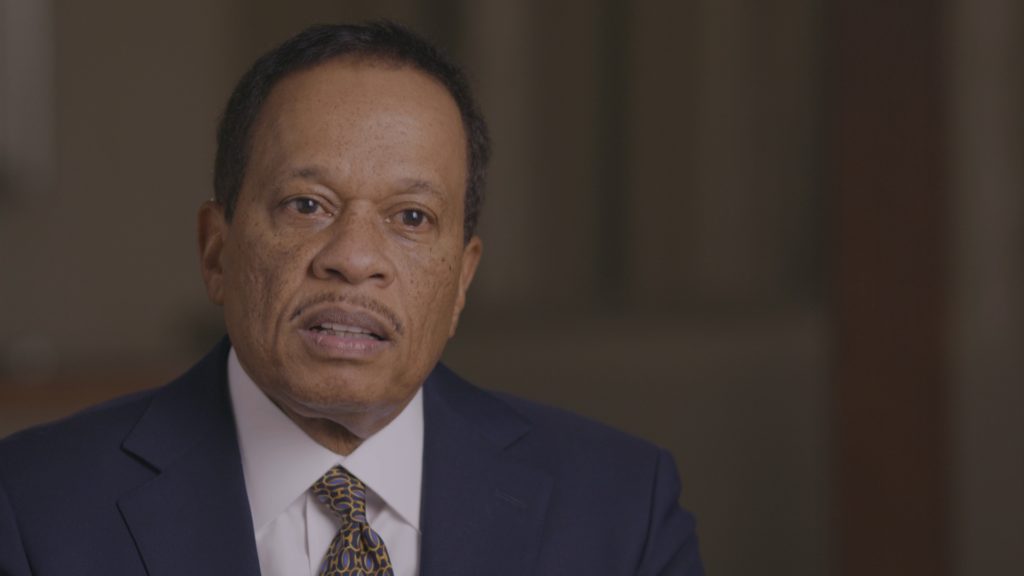
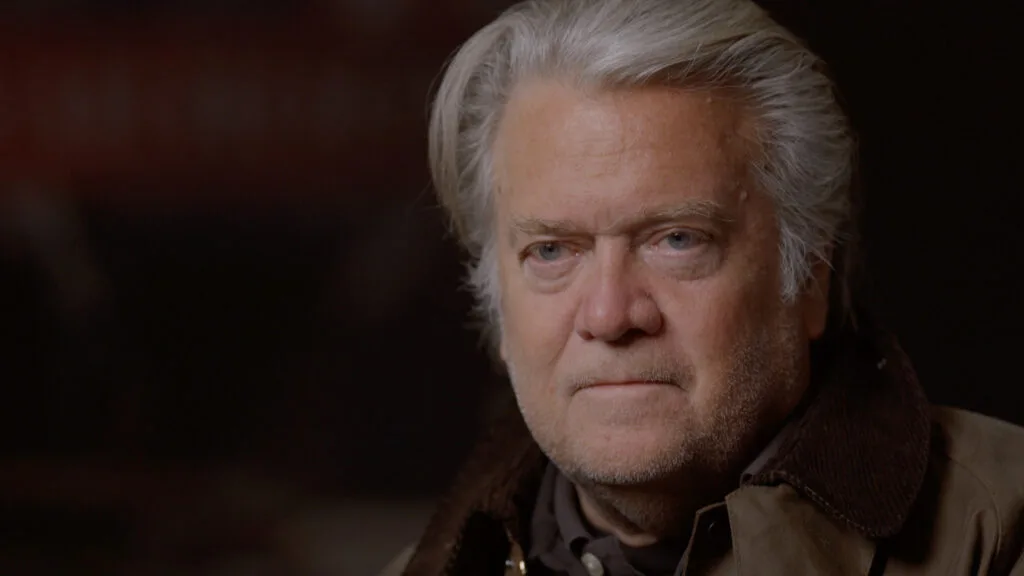
Political Analyst and Author of Thurgood Marshall: American Revolutionary
Juan Williams is a journalist and political analyst who has reported for Fox News and NPR. He is the author of Thurgood Marshall: American Revolutionary.
This is a transcript of an interview with FRONTLINE’s Michael Kirk conducted on January 26, 2019. It has been edited for clarity and length.
So, Juan, let’s start by sort of talking about what, for decades, was the process in Washington about selecting or about confirming nominees for the Supreme Court, the advice and consent idea, and how easy it had been for the vast majority of people who were going on the court to get in until a certain time and a certain kind of person, whatever that is, defined however you want to define it, ran into some trouble.
Well, the way I would think of it, in my lifetime, the ones that didn’t get in that got attention typically had to do with race, and I'm thinking here that people like, you know, going back, obviously you had some trouble with people like Abe Fortas when he was trying to become chief justice.But if you come forward, then you get into people like—I think it's Clement Haynsworth, and I'm blocking on the name.
Carswell.
And Harrold Carswell.Clement Haynsworth and Harrold Carswell.And again, both were Southerners with highly controversial records.And what you see is that the whole process then slows down.But remember, they're the exceptions.It is major news at the time that you have these nominees refused by the U.S. Senate in terms of the advice and consent function.And again, it comes back to race and their record on race and what they had done and said.And at the time, coming out of the civil rights movement and the civil rights era of the late ’60s, there was a heightened level of sensitivity to these issues with regard to the high court.
And I might add here, I wrote a biography of Justice Thurgood Marshall.And Marshall—and this again comes back to race—when he comes up for confirmation, having served on the federal court, then as solicitor general of the United States, his confirmation process is extended by charges that he has had associations with everything from communist groups to radicals.And the Southern segregationists, the Dixiecrat Sen. [James] Eastland of Mississippi, really tries to stop this confirmation, even people like Sam Ervin of North Carolina.And they raised really silly questions about the law in order to try to demonstrate that this black guy really is not qualified, doesn’t have the intellectual capacity to serve on the high court.
So where you see cases like—you know, in most cases, nomination to confirmation and hearings taking about a week to two.In the case of Thurgood Marshall, it goes on for two-and-a-half months, and it’s an incredible period for a guy who had argued, I think he argued 32 cases as an NAACP lawyer before the Supreme Court, and then an additional 20-plus as solicitor general, and won the overwhelming majority.He’s like the, you know, Babe Ruth/Hank Aaron of lawyers before the court.And he, as I say, over this issue of race and the division in the country, has to go through the prolonged and difficult hearing in which they intend to embarrass him for his lack of knowledge—I think it was the 13th or 14th Amendment that they wanted to get into the weeds on.
But these are exceptions to what is commonplace.And what's commonplace, for most of the history of the court, is that the confirmation of the president’s nominee is kind of, you know, ordinary and common and taken as not controversial if the person is viewed as qualified.And I say qualified not meaning that they have served on the bench somewhere.You have many instances where people had no prior experience on the bench.Earl Warren would be a classic example of this—had been governor of California, but never served as a judge, much less a justice.And then you come to the highly controversial Robert Bork.
The Nomination of Robert Bork
Exactly.So let’s start with Bork a little bit.It feels like Bork is what a lot of people called “the original sin moment” in the advice and consent argument in this sense.Pretty much Reagan had done Sandra Day O’Connor; he had done [William] Rehnquist.He sort of, even though people were very worried about a conservative president and what he might try to do to the court, it really wasn’t until he named Bork that all the candles and all the lights lit up, right?And Ted Kennedy (D-Mass.) went out on the floor and just reamed him.So take me into that beginning stages of when it began to feel like there was going to be a real fight over Bork.
Well, when Bork was nominated, I remember thinking to myself, rhis is an interesting choice, because he had played a role, if you’ll remember, back in the Saturday Night Massacre.So there was immediately a lot of political static attached to Bork.What I didn’t appreciate, because Bork was on the D.C. Circuit and had a reputation as a very bright man, was that, in fact, his qualifications would be judged differently than anybody I’d ever seen, and that was because he had written so much as an academic that there was a volume of his work that you could examine, take notes on, and then recite to him and say: “Do you really believe this?And what does it mean in terms of your record that you would question things like, you know, Civil Rights Act?What does it mean that you have questions about Roe v. Wade and abortion and how the law applies or should apply to these polarizing controversial issues?”
And the problem is, he answered at great length.
At great length, right.And he responds to them.I mean, he engages them in debate over these issues.So I hadn’t anticipated that in any way.What I just saw was, “Oh, gosh, you know, I wonder how this Saturday Night Massacre part is going to play out as he comes forward.”But again, the impression was, this is a highly qualified lawyer and a bright man, if not brilliant man, so why wouldn’t he end up getting on the court?
The other part of it was that—again, I didn’t appreciate this—that his views on originalism, which is this theory that, you know, you have to go with the explicit writing of the Founding Fathers in terms of the Constitution to understand the law, again, would put him in a position where he saw the Constitution in a way as defending conservative principles in his mind, as opposed to the living document, which had been the argument post-the Warren court, about justices becoming involved in interpreting the Constitution in the 20th-century framework.
So now Bork becomes highly politicized in a way, you know, that I hadn’t anticipated.I anticipated the Saturday Night Massacre part of it.I didn’t see how the politics around the court, the conservative grievance that the court had become so liberal and so—justices were making law from the bench as opposed to applying the Constitution without regard to political perspective, would come to the fore.
Well, now in Bork, it is full bore.It is just bubbling over.And Bork’s defenders, of course, especially on the right, are saying: “He is being unfairly treated.He is being pilloried by the left because he disagrees with them, but he is thoroughly qualified.”And I think that there are lots of people who would say, “Yeah, he is qualified, but we’re very interested in the fact that he seems to be on a different page with regard to women’s rights and civil rights.”
Boy, and they loaded up.The Democrats, it’s amazing, they were kind of ready for him, or ready for somebody like him.I think they probably knew that it was Reagan’s last year, he’s going to roll Bork out here eventually.It’s been on the list every time.They create a war room.Norman Lear comes to town and builds ads with Gregory Peck in them.
I forget this, OK.
Yeah.And Kennedy himself goes out to the NAACP and other civil rights organizations and says, “Get behind me on this.”He delivers this speech that says: “You're anti-woman.It’s back-alley abortions.”
Yes, I remember that part.I remember Kennedy—I mean, Ted Kennedy becomes a warrior on this, and mostly in terms of women’s rights, by the way, but there was also the civil rights angle to it.But the idea, again, is now you're starting to see the kind of political factionalism, left versus right, become prominent in the confirmation process.And when Bork is defeated, the right is absolutely inflamed.It’s sort of insult to injury, and the injury has been that they have, since the years of the Warren court, felt that the court was not properly attentive to conservative bromized traditions, principles; that they were pushing the country in a direction of more liberal activist philosophies, especially on race and women’s rights.
And so here comes Bork, and they feel now: “Oh, my gosh.You have denied a qualified candidate a seat on the court because of his politics, as opposed to whether or not he is a qualified jurist.”
The Rise of the Federalist Society
…There's another thing that happens as a result, of course.And I was wondering—I was reading that you had gone to a meeting of conservatives in San Francisco.
Oh, yeah, the Fairmont Conference.
Right.Now, was that the early days of the Federalist Society?Were those the Federalist Society conservative students and others who were talking back then?
There were some people there who I later associate with the Federalist Society.But remember, this meeting in San Francisco—and this would have been 1981—was put together by Ed Meese, later, of course, to be the attorney general, but a leader in terms of conservative legal organizing more so than legal thought for the Reagan administration.So there were a number of people who would later be active in the Federalist Society.I didn’t know of the Federalist Society at that time, so I did not make the connection.
Clarence Thomas’ Conservative Philosophy
OK.… So Bork loses.And of course, one of the reasons I ask you this is because it does so energize this brand-new group, just on college campuses, called the Federalist Society.And they say exactly what you said, which was great.They say: “Now politics is part of the deal?OK, you want to play that game?We’ll play that game.”And it will, of course, come to play when they create a war room for Clarence Thomas and all of that.
Let’s go to Thomas now.Who is Clarence Thomas at that time?
So who is Clarence Thomas as we begin these hearings?
…I was fascinated by this young black guy, who was quite engaging and willing to join the debate, so to speak, Clarence Thomas, and very much in touch, not with some intellectual perspective, but kind of on the ground: here is the life I live as a black man in America, and why conservatism is an alternative.
And what was fascinating about him was this is a guy, as I would later learn, who could quote Malcolm X and black radicals by word, you know, could quote speeches, whole sections of Malcolm X speeches, and was really radical in so many ways.But he applies it in terms of black self-responsibility, independence, right to make their own decisions and says, “You know, this is what I see in conservative principle, including in conservative principles of law.”
I came back and wrote a column for the Washington Post editorial page, ...… and Clarence Thomas in this piece is quoted as saying that he can't believe that his sister has to wait for the mailman, because she’s waiting for the welfare check, and that that kind of dependence is debilitating.And he just thought this was evidence of the breakdown of black America.And that quote, that whole comment then stirred controversy for him, because people viewed him as insensitive.Not only was he subjecting his sister to public ridicule, but here he was, acting as if somehow he could have changed his sister’s life, or he knew what was best for his sister.
And this was more evidence of kind of conservative insensitivity on the part of a black man working for Ronald Reagan.And he had gone from working, by the way, for Sen. [John] Danforth (R-Mo.) in the U.S. Senate.He had, you know, gone to Yale Law School.First went to Holy Cross undergrad, then Yale Law School.Had difficulty getting a job with a major law firm, although he was quite the brilliant law student.Goes to work for Danforth, who promises not to treat him as a black guy but just as a qualified lawyer, after leaving the Missouri government.And then goes from Danforth’s staff to the Department of Education under Reagan, and then from the Department of Education to the Equal Employment Opportunity Commission as the head of EEOC under Ronald Reagan.
My impression was that the Reagan people had read your story, identified him as exactly something they seemed to be looking for, and it had helped elevate him in his progress.
Well, I can't say who reads the paper, but yes.My impression is that the article, that column that I wrote about Thomas out of the Fairmont Conference in 1981 raised his profile, but particularly raised his profile among conservative leaders in the Reagan administration who were dealing with race issues right from the start of Reagan’s campaign.And the whole issue was, how do we develop black conservative voice in a way to protect us from regular attacks coming from the left wing of the civil rights movement?
…You talk about a moment which is just stunning to me, which is, when they're swearing him in, and [William] Bradford Reynolds is there; I think Meese is there; and of all people, Strom Thurmond (R-S.C.) is there.Can you tell me that story and how Thomas reacted?Do you remember it?
I do.So boy, there's so much in my mind about this.But Thomas is being sworn in, and there are toasts afterward.And there is William Bradford Reynolds, who had been the assistant attorney general for civil rights.But you should know, he had been, in so many ways, kind of an antagonist with Clarence Thomas; that Clarence Thomas had been one who had said, for example, that the Reagan administration had erred when they gave a tax exemption to Bob Jones, a segregationist school.And on other issues, they had said, you know: “Why isn't Clarence tougher?Why isn't he more conservative?Why isn't he more out there fighting with us?”Because they want a black conservative voice and face on their side, they say he’s insufficiently orthodox in his position.
And then you have this moment where now he’s gone through this tremendous and difficult moment, and there is Brad Reynolds now saying, “You know, you think about Clarence Thomas, and he’s the right kind of affirmative action.”And Clarence Thomas, his face—I mean, it just looked like his whole spirit had just dropped, you know, because so often he would say, you know, that if he had gone into a job that dealt specifically with racial issues—and this was his hesitation even in taking the job as chairman of the Equal Employment Opportunity Commission—that race would always be like a monkey on his back; that he would always be defined as “the black guy,” as opposed to “Clarence Thomas, the human being, the intellect, the man of experience.”
And so he didn’t see himself, certainly, as anybody’s affirmative action hire, anybody’s token.He saw himself as having earned his place, and he was disappointed that here is William Bradford Reynolds, nonetheless portraying him just as another black guy.
The Nomination of Clarence Thomas
…I mean, after his name is raised by H. W. Bush in what I thought was an amazing moment, standing at Kennebunkport, [Maine], with Thomas behind him, and sort of saying—you know, not wanting to say: “Here is the black person who’s going to fill the Marshall seat, OK, everybody?Let’s be really clear about this.We do not like the idea of a Supreme Court in America that’s all white people, all white men with Sandy O’Connor, right?We want a black person.Our ideology is to be politically right.We found this guy.He’s really good.He’s had a great, successful life.”So he overstates it.The best lawyer, the most qualified, the whatever, like a lot of white people would do in a moment like that, I guess, right?It actually implies their racism more than they even know.
Well, there's a deep history here that I happen to be aware of, because I wrote the biography of Justice Marshall, where you have Jimmy Carter, a president who never had a Supreme Court appointment, pressuring Thurgood Marshall to step down, with the promise that, “I will put another black person on the court, and I’ll put a black person on the court who shares your philosophy, your liberal perspective, your civil rights view of the world.”And he has in mind a man who held Marshall’s former job as solicitor general, a man named Wade McCree.And he sends the attorney general and others and Marshall, who had been through traffic accidents, some serious health problems, pneumonia and the like, basically tells the attorney general and others that are sent as emissaries from the White House, to get blanked; that, you know, this is a lifetime job, and I intend to serve it.
And so this position then becomes all the more tenuous, as Marshall gets older, and his health becomes even more difficult for him, because you have President Reagan, and then you have President Bush, so you have these Republican presidents.And kind of the proper way of thinking about this is, from the Republican view, is, “OK, we are not going to eliminate the black seat on the court, but we will put a conservative black person into this seat on the court.”And the question is, who is this conservative black person going to be?
I remember that, you know, lots of people were saying that—they were people like Bill Coleman, who was a Republican, had been, I think, secretary of transportation for Gerald Ford and others, but a leading light, in terms of Republicans, black Republicans, and he had actually even been involved with Thurgood Marshall on the Brown decision as a young lawyer.But instead, and I think it was to the surprise of many, Clarence Thomas, as a young person, who could stay on the court a long time, gets the choice from President Bush.And again, it was a surprise to me, as someone who had written about Thomas and knew about his fights with the Reagan administration’s points of difference, and the fact that he had some really black radical ideology in his mind, but it’s just that he applied it in terms of independence from the civil rights orthodoxy to say, “I'm my own man; I'm my own person.”
And that then extends into the idea that I'm nobody’s token; I'm not for affirmative action; I don’t see affirmative action in that light.Clarence Thomas is someone who had written in the Howard University law journal that Thurgood Marshall was mistaken in his pursuit of Brown, because he should have emphasized quality schools for black children, not integration of black and white children, and all the difficulties that had ensued from massive resistance to busing and all of that, he said, you know, that’s an indication that that was an error.And it would have been better to simply say, “We insist on quality schools for black children.”
This lights up, by the way, as you point out, the civil rights leaders.Of course they want an African American man in that job. All right, it’s a Republican president; maybe he’s the best we’ve got, so we've got to stick with him.But it doesn’t seem like they're going absolutely full-throttle thrilled with him at the very beginning.
No.So Thomas, by the way, Justice Marshall’s response—because I asked Justice Marshall about, “Hey, this young conservative, Clarence Thomas, says you made a mistake in terms of what you argued in Brown by saying that this was simply about race as opposed to quality education,” and Marshall’s response was: “You know, I wasn’t involved in some fantasy about black children seated next to white children next to Asian children in some sort of Norman Rockwell picture of Americana and diversity.No, I was looking at the political realities, which is that you had all-white school boards and political structures, and what I wanted was for them to realize that their children could have to go to the same school, and therefore, they would fund and support those schools and the teachers and all the extracurricular activities at equal levels.
This wasn’t about some fantasy about, ‘Oh, I've got to have white children next to black children next to Latino and Asian children.’”So this was an ongoing point of interaction debate in black legal-thinking circles, and Thomas is therefore known.But I think he’s better known as the guy who’s over at EEOC and then advanced from EEOC in a surprise to the D.C. Circuit, which is, other than the Supreme Court, the highest court—the second highest court in the land.
It’s the launching pad.
And for a Supreme Court nominee.So I remember seeing him sworn in there, and thinking, boy, this is a real surprise.You know, I just don’t know if people see him as a Supreme Court justice quite yet, because he’s so young, and he had no prior experience on the bench.But George H. W. Bush makes this pick.And what surprised me was the way that George H. W. Bush discussed and talked about Clarence Thomas, because he was effusive in talking about Thomas’s qualifications.
This takes place not in the Rose Garden at the White House, but at Bush’s summer place in Kennebunkport, Maine, so it’s kind of this very, you know, patrician, elite setting, and you’ve got this young black man sitting there, trying to look very earnest and the like.But the whole pitch from the president has nothing to do with: “Oh, you know, he’s pretty young.And no, he has limited experience on the courts of any kind.But I want to preserve the black seat so that I don’t cross that boundary and incur that kind of anger.”But he talks about Thomas as being so greatly qualified.
And that, of course, then sparks an immediate response from people who say, “Hey, this young guy is not overly qualified and not the most brilliant lawyer and all the rest.”It reminded me a little bit of the attacks on Thurgood Marshall and on his intellect.And, of course, the attacks on Marshall came from the right, about, oh, who he had associated with, how he had ties with people who had communist ties and all this kind of madness.Now the attacks come from the left against Clarence Thomas, and it’s like, “Well, he’s not that qualified.”
But you should know, the NAACP and people who had dealt with him initially endorsed the Thomas nomination, because they do see it as: “Well, this is a conservative Republican administration.It’s kind of an extension of Reagan-Bush—the Bush first and only term.And this is the best we’re going to get is a Clarence Thomas.”
The Opposition to Clarence Thomas
…The Bush people decide to build a war room that will match up with the war room that was used by the Democrats against Bork.So we’re fighting the last war.And they encourage Thomas not to talk specifics.You know, “Don’t do what Bork did.You’ll get borked,” right?
Oh, yeah.Well, I don’t know where to start here.
I know.
The reaction to Thomas and the way that he was introduced by President George H. W. Bush is very interesting to me.The civil rights community that had dealt with Thomas at EEOC does not have a kind of instant opposition to Clarence Thomas.They see Thomas as potentially the best you're going to get from a Republican president who’s an extension of Ronald Reagan.And they have some familiarity with Thomas from his work at the Equal Employment Opportunity Commission dealing with issues of race, equality, civil rights and the like.
And while he has been critical of some civil rights leaders talking about how, “Oh, they just whine, whine, whine, moan, moan, moan, bitch, bitch, bitch,” all that kind of stuff, at times coming out—to them, he’s not Clarence Pendleton, who had been a really harsh kind of black conservative and someone who had been oftentimes forced, put in the front in terms of conservative arguments against the likes of affirmative action or special set-asides and the like, areas where they wanted Clarence Thomas to be more prominent, and, “Why aren’t you coming along, Clarence?Why don’t you have a louder voice?”
But now here he is, as the nominee, and so to a lot of people in the civil rights community, it was like: “Well, OK, you know.No Clarence Pendleton.We’ll take Clarence Thomas,” right?But what you see build is that there is strong opposition now from other parts of the civil rights community.Here I'm thinking about the feminist groups.I'm thinking about some in the union movement who are saying: “Wait a second, you know.Potentially this guy is a fifth vote against abortion.We can't let the fact that he’s black and would occupy Thurgood Marshall’s seat or the black seat blind us to the reality that conservatives are stacking the court.”
And so now you start to see the bubbling of opposition to Thomas.At the same time, remember, you can't forget that the Bork hearings and Bork’s defeat has energized the right and fed their sense of grievance that they can't get conservatives who will uphold their way of thinking onto this court that for too long, in their mind, going back to Earl Warren, has been an activist court.
So they create their own war room to oppose Clarence Thomas.And elements of the black community that were kind of like, “Well, this is a kid who came from Pin Point, Ga., and you know, didn’t know his dad and is raised by his grandfather and goes to Catholic school, and then someone who was considering ministry, goes to seminary before going onto Holy Cross, someone who strikes them as having persevered to beat the odds,” now he is portrayed as someone who has gone over to the other side, gone too far, and potentially sold out.
And so now they are being told: “Wait a second.Take a second look at Clarence Thomas.He’s not the guy that you think he is.Look at him from our perspective, as someone who’s being used as a beard by conservatives to achieve their very conservative agenda, not only on civil rights, but on things like abortion.”
So suddenly you get a turnaround, and Leadership Conference on Civil Rights, which initially looked like it was going to back Thomas, endorse the nominee, switched.And you see the heavy, heavy pressure coming from all directions.And I can attest to this, because I was back in the U.S. and back at my job at the Washington Post, and boy, the phone calls just came pouring in, people, staffers on the Senate Judiciary, but also organizations, liberal organizations, just asking, you know, what do I know about Thomas?Because I had written about Thomas.What do I know about Thomas and his first wife?What do I know about Thomas and South Africa?Expense accounts?I mean, this was unbelievable.Clearly, they were looking—they wanted to know about if I had preserved tapes even of interviews with Clarence Thomas.
So this means they're heading for his character.They're not talking about qualifications, you know.They're going for character, which may be another word for “race.”But they're going for him.
Well, I think they were going for him.But you know what?I think that part of it was that this was about politics, so whereas historically, people would say, “Is this person recommended by the American Bar Association found to be highly qualified?,” I guess would be the top of the measure.In this case, it was now we are in a political fight where people on the right talk about their past candidate having been “borked,” a new phrase, you know, that the left had defeated a qualified candidate.Now they're saying, “We are going to preserve and protect our candidate.”In this case, it’s a black man, Clarence Thomas.“And we will do all we can.”
But on the left, you have them now saying: “This is not about qualification; it’s about the idea that the court is being stacked by the Republicans, and they're putting this man on there who could be there for very long, because he’s so young.And we are going to go back at his record and change this story that he is this kid from Pin Point, Ga., who beat the odds, made good, Yale Law School, such an outstanding individual.”And they're going to ask questions about his character in a very political manner.And the whole confirmation process now, you can see it being turned on its head.The qualification is not the measure; it’s the person and their views on cutting-edge legal issues, and here in specific I'm talking about abortion.
Allegations by Anita Hill
They always tell us if you're at the table, you're 90 percent of the way there as a nominee.But then Anita Hill comes along.You know him; you know the circumstances; you know the politics of Washington.You know where the civil rights community is; you know where Kennedy is; you know where Biden is.And now this starts to emerge.Tell me your thoughts, your concerns and your feelings about it.
Well, I remember, for some reason I remember it was a Sunday afternoon.I was over at my in-laws’, and I was looking through the paper and saw this story starting to come up about Anita Hill.And I said to my father-in-law, now deceased, “What do you think about this?”And he was sort of a strong liberal and very much would become infuriated easily at me in anything else, but he just said, you know, “This is so much nonsense.”That was his out-of-the-box older-black-man kind of view.And he was no conservative.
And I thought to myself, though, I think this is powerful, because I think that now, instead of Thomas being presented by the Bush administration and supporters as sort of a Horatio Alger-in-black story, we’re going to see now this man attacked as someone who had abused an employee in terms of sexual harassment.But I don’t know if it’s going to stick, because what I also was aware of was that Washington Post people had talked with Anita Hill previously, and would later learn FBI had talked with her, and there was no hard evidence or suggestion of harassment, more of kind of bad behavior at times, with asking her out aggressively or something like that.So I was like, you know, I understand why my father-in-law wants to dismiss this out of hand.But boy, this could be big stuff.
In political terms.
Yeah.
Because it goes to character, and it goes to him: Is he lying or not?Once he answers her allegations.
Well, actually, I didn’t even appreciate that aspect of it, although I think you're right.But what I saw right from the start was that there are certain landmines in American political life, and obviously race is a huge landmine.If you trip over that, you could blow up.But abortion rights, huge landmine.And also, if you trip over that one, boy, it will blow you up.And an extension of that is the growth in terms of the influence and power of women as a voice, in terms of protecting their rights, and the argument over privacy and women’s rights versus being under the thumb of men and the law, and told what they can do with their bodies and the like.
So there was lots sort of buried into this idea that there was this woman who might say something about Clarence Thomas’ misbehavior.So it again struck me that people were seeking dirt.And I didn’t know how far this would go or if this would stick.Of course it becomes hugely controversial, hugely.It is much more like, looking back on it, like soap opera than it is Supreme Court confirmation hearing, and the way that it is treated in the media is less as a news story than as a sensational account of difference of opinions and different memories and histories, and who might come in and change the story for one side or the other.It becomes absolutely absorbing for the whole country.People who I don’t think ever paid attention to a Supreme Court confirmation hearing, not even Bork, are now on, you know, waiting for the next word and the next change in this amazing story.
So the things that we've watched nationally as civics lessons on television are McCarthy hearings, Watergate, Bork and now this.And you look at the optics of it, and you see that table with all those white Republican men, septuagenarian white Republican men, and Kennedy, and [Joe] Biden (D-Del.), and all the white men on this side.Not a woman, not anybody of any color up there, and sitting in judgment over this battle between this African American woman and this African American man, for one of the great jobs, most important jobs in the country.
You know, again, sometimes you are at a disadvantage because you are in the fishbowl, and you don’t realize you're in a fishbowl.But yeah, the Senate Judiciary Committee is all white men.But on television, the image, again, I think struck the country as: “Wait a minute.But look at the nominee.He’s black.Look at the woman who has charges against him.She’s black.Look at all the people coming.”And it was a variety of people, but largely black people who had something to say about this.
And don’t forget the backdrop, which is that you have a strongly white Republican administration seeking to put a conservative on the court, and someone who is increasingly in this environment, in this very antagonistic environment, seen as being used by the white conservatives for their purpose.So there's lots of angles and dynamics that inform the presence of Clarence Thomas seated there before the Senate Judiciary Committee.
And the idea that he would then say that this was basically an electronic lynching of a black man, again now raises the stakes.We’re not talking qualifications.We’re talking about race.We’re talking about gender and sexual relationships.We’re talking about caricatures of black men, not only as insufficient intellectually, but sexual monster, and the whole thing is there in one package and put before you nightly on the TV screen.As I say, this is soap opera writ large.It’s unbelievable.And it’s so dynamic, so powerful, children are talking about it.It’s not just the adults.
Clarence Thomas Alleges a “High-tech Lynching”
When you hear him say—he doesn’t just say it, and he doesn’t shout it.He says it with such vehemence.… … But when he says “high-tech lynching” of a black man, how did that resonate with you?
Well, when you say the word “lynching,” obviously it has tremendous emotional power, I think especially for black Americans, but for anybody who’s familiar with the sordid history, you know, post-Civil War, even early in the 20th century, of how black people were treated.But the idea that he said it was, you know, electronic “high-tech lynching,” this becomes an instant phrase in the American dictionary.I think now it is associated with that moment in American history, “high-tech lynching.”
But “high tech,” by the way, is about the television part.It’s about the fact that his reputation is being destroyed on television.That’s the high-tech part.This is not the world of social media, Facebook, Google and all the rest that we know today.This is about the fact that it is a television soap opera.
Right.
And you understand in that moment, when he uses that phrase, that he is now doing a bit of jujitsu in that he is saying, “This is in the tradition of how black people are diminished and denigrated by white people throughout American history; that if you don’t kill our bodies, you kill our reputations.”
They—that is, the Republicans—really surround him.… They're asking him to do what you said their criticism of him was.“You're not fierce enough.You're not enough of a fighter.”And he does come out and do what they wanted him to do, which is let it fly, play the—what some people called the race card.
Yeah.That’s why I say it’s jujitsu-like, because up until that point, it was like, well, you know, Clarence Thomas is being attacked by the left.But he says: “Now, you know what?I'm the real black person in this room who’s connected.And you can see the connection of the history of how black people are denigrated by whites, and in this case, now, going after me in this way, on national television, is really an attempt to ruin my character, as well as my reputation, for all the world.
Politics and the Court
…So Juan, from Bork to Thomas, to [Brett] Kavanaugh, and the changes you’ve witnessed in your lifetime as a reporter, …give me an assessment from 20,000 feet, as you’ve watched it all and thought about it all, what does the Kavanaugh hearing, and what happens there with [Christine] Blasey Ford and everything else, yield, in terms of how people feel about the Supreme Court now?
You know, I was just thinking about Clarence Thomas for a second and the fights going back and forth nd how a lot of people on the left, who would suddenly find themselves voicing strong opposition to Thomas in the course of that confirmation hearing, had previously had nothing to say about very conservative legal minds being put on the court, like [Antonin] Scalia, [Anthony] Kennedy, [David] Souter I think, right?
Yep.
They didn’t say a word, again, because it was coming from a conservative president and was, in their minds, the best they could expect.But you see something different post-Bork, and in specific with the Clarence Thomas hearings, how politicized the confirmation process becomes; that the veneer of impartiality based on the nominee’s qualifications is now peeled back, and what you see laid bare are the bones of political conflict, and, at times, explosive political conflict, over the idea of who controls this court; that the scales of justice, Lady Liberty, are not equal and blindfolded and, you know, delivering justice for all.
But from the conservative perspective, that justice is being denied by people who want to make the law on the court, and make the law in such a way as to expand the purview of what is considered rights in this society—rights for black people to go into any establishment, or hold jobs; rights for women to have abortions; rights for people in terms of employees to sue employers; or rights for people to have set-asides for previously advantaged groups—where is this in the Constitution, and why is the Supreme Court involved in this, as opposed to leaving it to either the legislative branch, the people who make the laws, or the president of the United States, to determine if there is, in fact, some violation?But why is the court getting involved in making law, from their perspective?
So coming out of the Clarence Thomas experience, then, you come forward in time, and you would think, “Oh my gosh, things are going to be equally explosive.”But actually, we go through some fairly calm waters with regard to confirmation hearings where the issues of race, the rise of women’s rights, etc., are somewhat diminished.
But then you get into a situation with Merrick Garland and Barack Obama, the first black president of the United States.So he, Obama, puts Elena Kagan and Sonia Sotomayor on the court, two women, and he now has an opportunity, with the death of Justice Antonin Scalia, for a third appointment.And what is critical here is that, from the right’s perspective, you are replacing a conservative member of the court associate justice potentially with a liberal.And the White House is sensitive to this as well, and they get someone who is senior on the D.C. Circuit, again, the second highest court in the land, someone who is well respected by left and right almost unanimously confirmed—I think he was unanimously confirmed when he was put on the D.C. Circuit—
Yes, ’99.
—and someone who doesn’t have any clear political pedigree in terms of left or right.Very widely respected.And I would go beyond respected with Merrick Garland.He is widely admired.So they think that they are putting forward a centrist candidate who would be sort of Teflon, impervious to any kind of political assault.But they don’t anticipate the stand that’s being taken by Mitch McConnell, the Senate majority leader and a man who has been in the Senate going back to the Bork hearings, and someone who really nurses that sense of conservative grievance, that we do not have our people getting on the court.
And he is not about to allow Scalia, who was, you know, viewed as kind of the conservative flag bearer on the court, to be replaced by someone nominated by a left-of-center president, if possible.And so he takes what is a radical, radical step of saying he’s not going to fill this seat, not allow hearings for a Supreme Court nominee until the next election, which is almost a year away.And so you now have a setup, again, for laying bare the bones of how politicized confirmation hearings for U.S. Supreme Court justices have become; that it is really now about the politics of Republican or conservative judges versus Democratic or liberal judges, more so than any sense of qualifications for people who would sit in judgment and offer their wisdom to all the American people.It’s like, “I want to hear opinions that affirm my pre-existing opinion from my justices, and I don’t want anybody shifting alliances or blocs,” which, by the way, was the case with Justice Souter, famously, who was put on the court by George H. W. Bush and then would oftentimes vote with the liberal bloc.I think there was this sense, they want people who will stay in line, even as they refuse to answer questions about their positions during confirmation hearings, on the basis of saying, “Well, I may have to consider this issue.”So there's so many lies, so many veils, so many deceptive tactics being used, this has now become political theater in a way that I had not anticipated possible for a confirmation hearing.I mean, it takes you back to, you know, that famous novel Advise and Consent, where you start to see something that seemed the province of fiction become reality in American life.
And Leader McConnell says this was the most important political decision he ever made, that decision to stop the Garland nomination.Fantastic.So we’re really done.