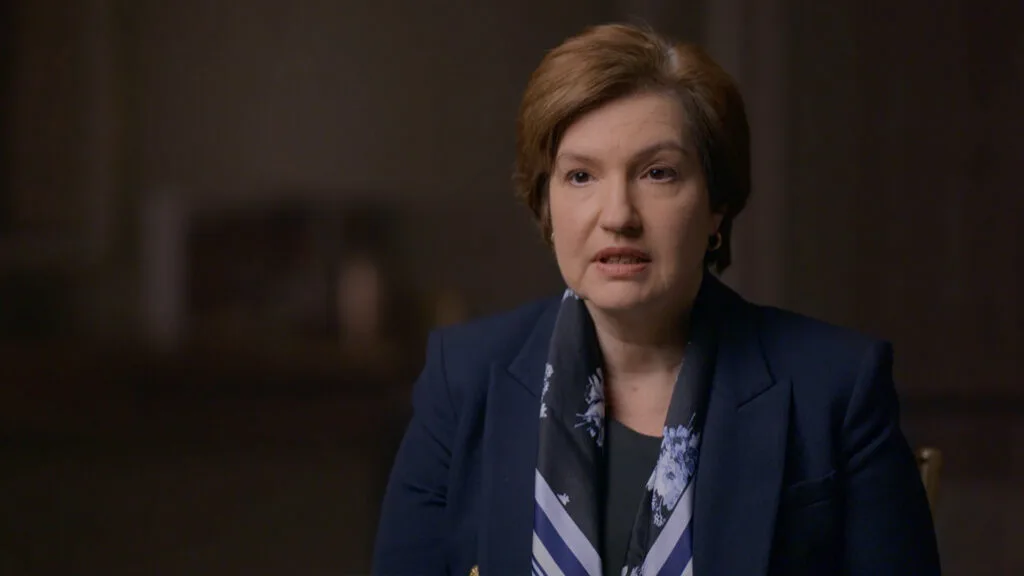
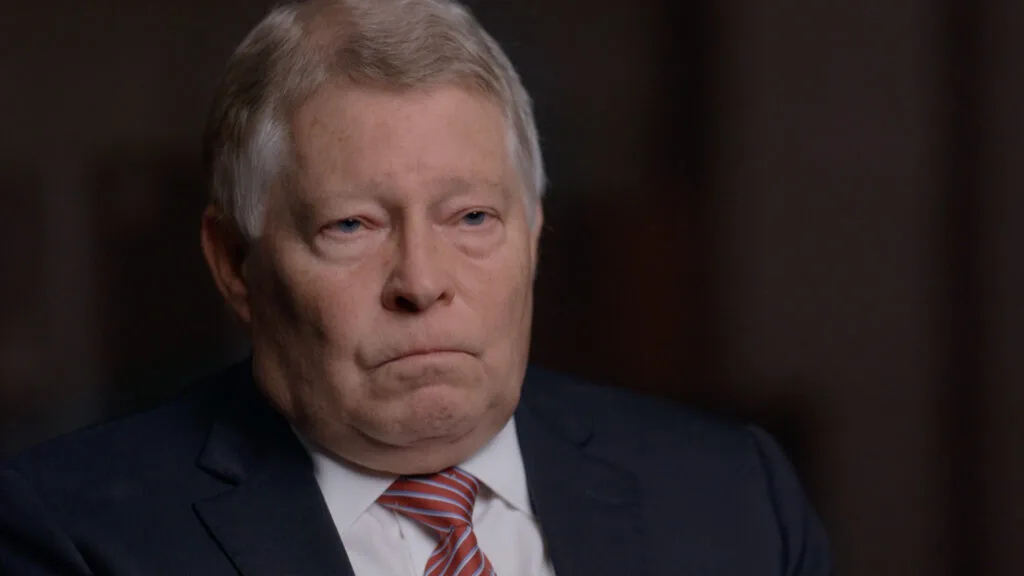
Mark Gitenstein served as United States ambassador to Romania from 2009 to 2012. He was the chief counsel to the Senate Judiciary Committee from 1987 to 1991. Gitenstein is the author of "Matters of Principle: An Insider's Account of America's Rejection of Robert Bork's Nomination to the Supreme Court."
This is a transcript of an interview with FRONTLINE’s Michael Kirk conducted on January 8, 2019. It has been edited for clarity and length.
So let’s start with, you get a phone call from John Bolton.
Yes.
Take me there.
This was where John Bolton calls to tell me it’s [Robert] Bork, right?
Yeah.
Actually, the first phone call I recall—I'm just thinking back to the book—was he wasn’t sure.He knew it was going to be Bork; we didn’t want it to be Bork.And I was trying to convince him not to take the Philadelphia Inquirer quote literally, which it wasn’t meant literally—it certainly had nothing to do with the current circumstance—and that he should be very careful about whether or not the administration chose Bork, because we were not—that is, the Chairman [Joe] Biden (D-Del.) and myself and those of us around Biden were not looking for a fight.We did not want it to be Bork, and we were afraid that the Republicans, [Ed] Meese, et al., assumed that Biden would end up supporting Bork, and I was not sure about that at all.So that was the communication.And John and I had a good relationship—I mean, as professionals we didn’t agree on very much—so I was pretty blunt with him.
What did you say?
I said: “John, don’t misinterpret The Philadelphia Inquirer quote, and don’t assume that Biden will support Bork or that this will be easy.And indeed, I think if you nominate Bork, this is going to be very ugly.”Something to that effect.
I heard the word “Armageddon” somewhere.
Oh, Armageddon?Yeah, yeah.I could have used that word, yeah.
In what sense would it be Armageddon?
Well, because I knew that there was so much at stake here.I mean, the way I viewed the [Lewis] Powell vacancy was that for, what, 15 years, Powell had been the swing vote on the court.And I knew, from what the right was saying, that they wanted to change the direction of the court.They had failed, on numerous occasions, to pass constitutional amendments in some of the areas that they were most interested in—abortion, school prayer, affirmative action, other areas—and I knew that they weren’t going to succeed.And the easy way for them to succeed was to get a fifth vote that would switch the direction of the court.And I knew, if they went with Bork, that’s where they were headed.And I knew that would be an ugly, difficult fight.
So not very long after you hear from Bolton, when does Sen. [Ted] Kennedy (D-Mass.) hit the floor and start—
Oh, within a day or two.Yeah, right after that, yeah.
Ted Kennedy and the Case Against Robert Bork
Tell me the run-up to Kennedy’s presentation and what he said and what the intent was and how you felt about it.
Well, first of all, it was a surprise to us.I don’t recall any consultation with us between the Kennedy folks and us.They just went out and did it.Biden and I had a decent but difficult relationship with the civil rights community, and I immediately assumed that they were behind this, that they had decided to go to Kennedy because they knew Biden wouldn’t do something like this, and go as far as possible in discrediting Bork, etc.They claimed they didn’t do that.Ralph Neas, who was head of the Leadership Conference on Civil Rights, was a good friend and claimed they did not coordinate it.I believed Ralph.That’s quite possible that the Kennedy folks decided to do this on their own.
Kennedy went out, gave a speech.And my recollection—and you know, it’s 30 years ago—is that Biden and I talked about it immediately.I think Biden may have been on a plane at the time, and landed and called me.And I told him what had happened, and he said, “Oh, this is going to be a problem.”And the reason we thought it was going to be a problem is because we wanted an open and fair fight.Biden had not decided, at that point, where he was going to be, but I was pretty sure he was going to end up being against Bork.
But in order to win that fight, I knew that we had to bring moderate Republicans and moderate Democrats along, and having Kennedy take the lead on this, with a very extreme version of Bork’s jurisprudence, or explanation of it, would be counterproductive.… Dick Shelby then was a Democratic senator from Alabama, …and he said, “You know, if Kennedy takes the lead, we’re not going to be able to oppose this nomination,” because, you know, we—Biden and Kennedy were very close.But Kennedy was a lightning rod in those days.
What did he say?
He took every Bork position to the extreme, you know: only back-alley abortions, I think his line was going to be; you know, and the end of civil rights, etc., language like that.I don’t remember the exact words, but it was a very extreme statement of Bork’s positions.Now, it was not totally without justification, you know, but it was an extreme position that they were probably able to rebut, at least you know, prima facie matter.But, you know, in the long run, his positions were very extreme, Bork’s positions were.
You know, in part, it was as much the messenger as it was the message.Having it come from Kennedy just didn’t help us at this point, I didn’t think.Now, there is an argument for why they did it that is not totally invalid.It was actually an argument I heard once from some of the civil rights folks, which was, they wanted to quote/unquote “freeze the linebackers.”And what they meant by that was they didn’t want anybody to take a position on the Bork nomination in the Democratic fold, or even the moderate Republican fold, without knowing that there would be a really aggressive response if they positioned themselves in favor of Bork.That was probably not going to happen anyhow, but it’s not an illegitimate argument on their part, that that’s why they did it.
Robert Bork’s Judicial Philosophy
Help me with who Robert Bork was at that moment.
Well, Robert Bork was, as I think USA Today quoted a conservative jurisprudential politico as saying, “He was the philosopher king of the right and of conservative jurisprudence, of originalist jurisprudence,” you know, which was the new mantra of the time based on the speech that Ed Meese had given.And he was brilliant, and he was very articulate.I had actually met Bork once at a judicial conference, where he had taken, actually, a position which was very helpful, which was against legislation, which was called court-stripping legislation.I was actually in a meeting with him.I was very impressed with him, and I was open to the fact that he might be a little more complicated than he appeared on paper.But I had not read a lot of his writings at the time.And once Biden and I began to dive into what he had written, it was—he was right at the edge.
What do you mean?
Well, the most famous of his pieces was a law review article in the Indiana Law Review from 1971, I think, which I later learned was based on a speech, in which he attacked all of the pillars of the [Earl] Warren court: one man, one vote; you know, holding unconstitutional racially restrictive covenants; attacking Griswold v. Connecticut, which was the famous contraceptive case; even attacking cases from the ’20s and ’30s on whether or not you were allowed to teach your kids German, OK, or whether you were required to go to public school and couldn’t go to private school—there were state laws that actually prohibited that—or whether or not you could sterilize prisoners, OK, whether any of those were unconstitutional when they were all held unconstitutional.And he criticized all of those decisions.
I was stunned when I saw that list.It was about six or seven cases which he, in the most strong language, called them unscrupulous, irresponsible, you know, inappropriate, illegal—words to that effect.And I was stunned by that.I, you know, was like: “Wait a second, you know.That’s pretty strong.”
Advice and Consent and the Balance of the Court
…A lot of people say it is, at this moment, that what unfolds, signals a real change.This is certainly, Republicans would say, signals a real change in the way the advice and consent business got started.
First of all, the premise of that point is wrong.Historically, that is not the way the advice and consent clause operated.Going all the way back to George Washington’s first Supreme Court nomination fight, Judge [John] Rutledge to be chief justice of the Supreme Court, who was opposed by the opposition of Washington at the time because of his position on the Jay Treaty, which ended the Revolutionary War.It has nothing to do with the Supreme Court.It was pure politics.
The other two great examples of this struggle was Andrew Jackson and his struggle over the future of the [Second] Bank of the United States and Franklin Roosevelt’s struggle over the New Deal, where, in both cases, the Supreme Court was going in a direction that Jackson and FDR did not want it to go, and they set out to change the direction of the Supreme Court.Bruce Ackerman, a professor at Yale, wrote a very eloquent law review article in the Harvard Law [Review] in 1988, after the Bork fight, in which he talked about the role—that a president can try and transform the Supreme Court.That’s what Jackson and FDR tried to do.They both succeeded.
It was clear to us at that point that that’s what Reagan was trying to do.He was trying to transform the Supreme Court.If you have a …president who’s trying to transform the Supreme Court, he politicizes it.… If the president wants to do that, he or she certainly can do it.But when that happens, the Senate has to respond, because the Senate, under Article II, Section 2, has to decide whether to consent on behalf of all the American people to that transformation.And if they decide they don’t want to, they have an obligation to respond and to fight it.That’s not politics; that’s politics in the Aristotelian sense, not the partisan sense.
That was the point of my book.And that was what we saw happening.And that’s why I told John Bolton, but more importantly, Chairman Biden told Ronald Reagan directly, and Howard Baker, who was then his chief of staff: “Don’t do this.Don’t start the process down this lane.”
Because?
“Because, if you do, we will have to fight you.We’re not looking for a fight.We would like a standard.You know, you nominate Sandra Day O’Connor; we look at her qualifications, and we approve it.That’s fine.”
His political director, I think, Patrick Buchanan said: “One more justice on the Supreme Court, and we’ve got what we want.We've got our agenda.”What did he expect us to do if we disagree with that agenda?If you were a New Deal senator, and Franklin Roosevelt wants to put, you know, five justices on the Supreme Court who want to reverse the effort to block the New Deal, that’s fine to vote for him.But if you don’t agree with that, you have to vote against him.And the purpose of the hearings was to lay that all out.What's at stake here?
Joe Biden Questions Robert Bork
…But when you look back at it, where there's a kind of show quality to it.This is a civics lesson for Americans that’s going to take place on television?
Well, that was deliberate, OK.Biden felt it, very strongly, that this fight should be about substance, and the American people need to understand what's at stake for them in their lives.That’s why he seized on the Griswold decision.The Griswold decision affected every American.There's a scene in the book, which we talk about, in which he finally comes to understand what Bork’s position was on Griswold v. Connecticut, and he says: “Wait a second.You mean he believes that it’s unconstitutional to limit, you know, your right to buy contraceptives, you know, or your right to buy contraceptives”?So that what Bork is saying is that there is no right to privacy, that you don’t have a right to buy contraceptives.So if I went down to Gerardo’s, which was a famous little Italian place, after a softball game, and told those people, “Well, Bork’s confirmed; you might not be able to buy contraceptives,” which is, you know, not far from where he was, what do you think they would say?And this wasn’t about abortion; this was about the right to privacy.
Now Bork’s position was not an unprincipled position.His position was, there's no right to privacy in the Constitution.There's the Fourth Amendment; there's the due process clause.But it never says you have a right to privacy.Therefore, if you want to buy contraceptives, you have no constitutional right to buy contraceptives.Biden’s position was—and, by the way, supported by a long line of cases, going back to the 1920s and’30s—was that there were unenumerated fundamental rights under the Constitution, and that that’s what the right called a living Constitution, and what we called the Constitution.
So that was what this was about, and the hearings were designed to tell that story.That’s why Biden’s questioning of Bork was so important, because he sort of got Bork to lay—and Bork conceded all of this.
A Coordinated Campaign Against Robert Bork
…There was a formidable Democratic war-room kind of strategy to deal with Bork—the Gregory Peck ads, lots of other things.… I understand that People For the American Way were involved.
…You know why the ads became important?Because the right attacked the ads, and the national networks showed the ads as news.So a lot of people saw the ads.It was an incredible tactical error by the right to make a big deal out of these ads.They probably wouldn’t have had any impact at all, or very little impact.
Why did they attack the ads?
Because they were losing, and they wanted to attack the process.And I think they thought, by attacking the process, they might bring some of the moderates back over.But toward the end, their basic approach was to attack the process.They were so stunned that Bork couldn’t handle himself in the hearings, you know.
Lessons of the Failed Bork Nomination
The lesson for the Republicans from what happens to Bork is what?
Don’t answer any questions.Don’t assume that you can win this substantive fight.That’s why, by the way, when George H. W. Bush becomes president, who does he choose as his first nominee?David Souter.And the reason he chose Souter was because Souter knew how to answer that line of questions.And he agreed with it.And the reason Tony Kennedy was approved was for the reason, if you listen and read the answers to the questions, and he believed there were fundamental rights, there were unenumerated rights in the Constitution.That’s, by the way, why Kennedy voted for gay marriage, and why he supported Roe v. Wade, because the doctrinal underpinnings of Roe v. Wade is Griswold v. Connecticut, which is that there are unenumerated fundamental rights in the Constitution.
Once you cross that Rubicon, you're probably for Roe, and, you know, the gay marriage decision is not a stretch.So that’s a totally different view of the Constitution, which the right didn’t like.That’s why they didn’t like Souter or Kennedy.Now, why did George H. W. Bush choose Souter?Because he didn’t want a fight, and he wanted someone who could get through and who would answer—and who was not as extreme as Bork.
So that’s the lesson from what happens to Bork.Now, that’s the lesson you hoped they would receive.
Well, that was the lesson I hoped they would take away, and they did for the first nomination, for Kennedy and for Souter.But with [Clarence] Thomas and thereafter, they just stopped answering the questions.They took the position, you know, “If I answer the questions, it will prejudice my ability to be objective in the future,” which in my mind undermines the advice and consent clause, because the advice and consent clause, and the consent process, is particularly important with a potentially transformative nomination, because the American people are entitled to know how their court is going to be transformed.And if people won't answer the questions, and the fight is not about that but is about something else, it’s sort of, the process doesn’t work.And, you know, in a sense, that’s what's sad about what has happened.
Is there a moment or two or three that really stand out for you in the back-and-forth with Bork where his goose was cooked?
Well, to my mind, it was his answering the first line of questions with Biden on Griswold v. Connecticut, you know, where he goes, finally, to the statement he made that the decision about—I'm paraphrasing here; I don’t have the exact words.—but the decision of a married couple to have contraceptives was no different than a utility to, you know, violate the environmental laws.In other words, it’s just a matter of black letter law, and what the Constitution says, that there is no underlying principle involved in terms of the human rights and the validity of unenumerated rights, and this notion of justice and compassion, but those notions don’t influence a judge, and shouldn’t.
The other is Sen.[Alan] Simpson’s (R-Wyo.) famous question to Bork when he says, “Why do you want to be on the court?”And instead of saying, “I want to do justice and show mercy and protect the rights of individuals,” he says, “It will be an intellectual feast.”And most people said, “Who’s the dinner?”He thought he was teaching a Yale Law seminar, and what he was doing was talking to the American people.
You know, after it was over, there was polling done that showed that something like 60 or 70 percent of the American people said they had sat through all the hearings.Well, that was impossible.They weren’t covered gavel to gavel, and they watched on national television.So they watched summaries of them.And you could say, well, national media was unfair to him.That’s possible.But most people thought they saw it, and their opinion of Bork was very negative after his testimony.
His nomination was dead when he stopped testifying.It was over.I knew that because of my conversations with two swing votes, with the [Dennis] DeConcini staff, moderate Democrat from Arizona, and with the [Howell] Heflin staff, moderate Democrat from Alabama, and Arlen Specter’s staff, moderate Republican from Pennsylvania.
When that testimony was over, I think it was, his goose was cooked.So in that sense, there was Bork himself.I think the other major factor, although I don’t think this would have changed anything, was Bork really wanted Reagan to come out and lobby hard for his nomination, and Reagan wouldn’t do it.Reagan was in California on his ranch, didn’t give a speech until early September and didn’t fight for it.That’s the difference between Reagan on the one hand and FDR and Jackson on the other.They were passionate about this issue.… Reagan cared about it, but he didn’t care about it that much.And in that sense, Bork was right to be angry at Reagan.
When you walked away from the Bork hearings, what did you make of what the legacy was going to be for that event?
Well, what I hoped the legacy would be—and it is only partially true; it’s the reason I wrote my book—is that the legacy of the Warren court was legitimate and popularly supported; that the Constitution should not be read strictly in terms of the way an 18th-century lawyer would read it, but in the way a 20th- and 21st-century lawyer would read it, same principles, same underlying doctrinal notions about equal protection, etc., but reflecting what the real world is like in the 20th century.That’s what I hoped, which is why the Supreme Court, you know, everything from Brown v. Board to Griswold v. Connecticut to Baker v. [Carr] to, you know, to the famous mixed-marriage cases that, you know—…If you would have asked an 18th-century lawyer or even an 1860s lawyer who wrote the Civil War constitutional amendments, they might not have ended up at the same place.
But the court, the Warren court tried to understand the underlying principles at stake and bring them up into the 20th century.The Meese-Reagan approach was to go back to the literal words.If the literal words didn’t say this result, couldn’t get there.
The Legacy of Robert Bork
What does the phrase “borked” mean?
Well, to the opposition, it means he was treated unfairly.To me, it’s a meaningless concept.
And that’s what Mitch McConnell (R-Ky.) et al.walked away from that experience.They still invoke it.
Yeah.
Why?
Because Robert Bork was the philosopher king of the right.And he was, quote/unquote, to their view, “smarter than us, and should have been able to run circles around us,” and he didn’t.And their view was that the Warren court decisions were not supported by the American people.They were wrong.The American people did support those decisions.
…You know what?Under the Constitution, there are unwritten rights.Indeed, there is a Constitution amendment, the Ninth Amendment, that basically says that there are unenumerated rights in the Constitution, and the due process clause of the 14th Amendment, and the Constitution itself, the main Constitution, the original Constitution, incorporate that notion.And that notion goes all the way back to the Magna Carta, that there are certain rights, the law of the land, that judges are supposed to find.And that’s a risky thing to be against.
…One of the things we’ve seen is a piece of videotape with Mitch McConnell right after Bork goes down, and McConnell steps up and goes to the microphone and says, “All right, Democrats”—I'm definitely paraphrasing here, but “All right, Democrats, you just wait.You know, you're going to do this to this man, this great man.Wait until we get our hands on you.”
Well, my response to that was, this was not personal.This was because of what the president and the right was trying to do to the court, OK?And it was very clear—you read his writings—this was what Bork believed, OK, and this was why Bork was being nominated, and this was our responsibility to respond.So that would be my response to that.There's nothing illegitimate about that.Indeed, it is more consistent with the full history of the advice and consent clause than to sit back and say: “Well, can the guy read and write English?And can he read a law book?”That was not the issue with that nomination because of the reason for which it was made.So that’s number one.
And number two, you say, “Well, look, they set out to change the direction of the court.”They did a very good job, OK, you know.The Federalist Society did an extremely disciplined job of screening their applicants.And the political apparatus inside and outside the Senate, Mitch McConnell’s effort to block the Merrick Garland seat, you know, it was a masterfully executed political and intellectual strategy.The failure was on our side.We didn’t respond.We didn’t make this as big an issue in our elections as they did in theirs.And in that sense, they succeeded for the reason that Reagan failed.Reagan didn’t make it a big issue in the ’86 campaign, in the midterm elections, and indeed, to the extent he did, he failed.That’s why these senators didn’t feel like they had to vote for Bork, because he had not gained salience with the American voters, which would have been perfectly appropriate.
Franklin Roosevelt was much better at this, and he succeeded, OK?He didn’t get to pack the court with his change in the composition of the court in terms of the structure of the court, but he got his nominations through.And there, they didn’t hesitate to vote for them, because they knew they had to, because the American people supported that.So to the extent that that’s what they did over the last 30 years, one argument I've made, they’ve finally won the Bork fight.
How?
They won the Bork fight by carefully selecting their nominees, prepping their nominees, making it an issue in every presidential race after that so that the Republicans and those who voted for the Republican presidents who succeeded knew what they were voting [for] and what they were getting, and then the senators who were elected in those elections knew they had to vote for these nominations.We failed.We got distracted by other issues—not unimportant issues, but we didn’t make this a big enough issue for the American people, and for Democrats and progressives in particular, we took the court for granted.That’s why we lost.
Yeah.
And we deserved to lose, by the way.We deserved to lose.
So when you and Biden walk away from the Bork moment, how is he feeling about what took place?Because he got a lot of guff in lots of directions during all of this.
I don’t know.I think he’s proud of what we did on the court.We shaped the direction of the court for 30 years.That’s nothing to be ashamed of.You know, if we had not won the Bork fight, we not only would not have gotten Anthony Kennedy, we would not have gotten David Souter.And we kept that majority in place, and basically the Warren court consensus on the court, on a lot of these issues, in place for 30 years.Nothing to be ashamed of.Very, very important.We would never have preserved Roe.We never would have gotten the gay marriage decision.We, you know, the Boumediene [v. Bush] decision on habeas corpus for the people held at Gitmo, which was a majority decision by Tony Kennedy.We wouldn’t have gotten those decisions preserving affirmative action.A lot of those decisions would not have happened but for this fight.So, you know, we feel proud of it.What we feel sad about is that we couldn’t keep it going.
The Nomination of Clarence Thomas
When Thomas is nominated, let’s go a little bit—I know you're not there at the time.
I was not there any longer, yeah.
But you, by then, are an expert at watching and noticing…How did the Republicans address what they learned from Bork as they walked?
Well, to be blunt about it, what they did is they made the issue about race and about Thomas being an African American, or Thomas did as well.He didn’t particularly.He was not very explicit in the way he answered the questions.And he didn’t have a record like Bork’s that you could sink your teeth into, that sort of laid out where he was going with his positions.And I think that was very clever on their part.
And we couldn’t make the fight.I was no longer part of it.But the progressives could no longer make the fight over this direction of the court issue, because we just couldn’t seem to gain traction on that.And they were tactically faster and smarter than we were.
They created a war room in response to what they thought you had, which was a war room back on Bork.
Yeah.Well, we, the staffers, you know, we didn’t have much of a war room.I think what I honestly believe that what won the Bork fight was the prep the senators had undertaken and their ability to question Bork, and Bork’s failure as a witness.That’s what worked.Thomas was an OK witness.He followed this new strategy of the stealth nominee.He just didn’t answer many questions.And then, when the Anita Hill thing came up, it all became about Anita Hill.It was totally off the subject of the direction of the court.
Indeed, Ron Klein, who was my successor at the time, once told me he thought we would have gotten more votes against Thomas if we had made the fight over substance than if we had made it over Hill, because the problem with the Anita Hill fight, whether where you come out—and I actually believe in Anita Hill—is that it sort of became an issue over this sort of “high-tech lynching” notion, you know, that he was being mistreated as an African American.
And then there was, you know, I'm sure there was some perception that that was the truth.If you polled African Americans, even though they intellectually agreed with us on the direction of the court, they were sympathetic to Thomas.And that was, you know, once that happened, it was over.
…He’s the stealth candidate.He’s not saying very much.He obviously doesn’t have much of a record.He’d only been on the D.C. Circuit for a couple of years, and very—they help him pitch his—what's the name of the town?Pine Pin?
Pin Point.
Pin Point, his hometown.
Well, by the way, it’s an incredible story, his story, coming from Pin Point, Ga., to, you know, nominated to the Supreme Court.That’s an incredible story.By the way, I knew Clarence Thomas.He was a very impressive guy.
At the time?
Well, I had known him a little before that, you know.By the time he was nominated, we were not seeing each other, you know.But he worked in the Senate, and that’s how I knew him.
…And Kennedy and Biden and others, neutralized by the blackness of Clarence Thomas, going for the Thurgood Marshall seat, gets a little complicated for them, I would assume.
I don’t know.Both of them were clearly going to vote against him.They did vote against him, even before the Anita Hill thing came up.So they were against him.
But manhandling him in public seemed unlikely, right?
Well, I don’t know how much that had to do with him as it had to do with her, how to handle that issue.It was the first time—the committee is a very imperfect place to do an investigation like that.We saw that in the [Brett] Kavanaugh case.It’s very hard to do this on national television, in front of, you know, with 18 members.Each wants to be the prosecutor.It’s pretty hard to do.
The Death of Justice Scalia and Mitch McConnell’s Gamble
…Let’s talk about Merrick Garland.So [Antonin] Scalia dies.McConnell, by the way, is now—we think of this, in some ways, as a McConnell revenge moment, if he’s been harboring grievances and resentments since Bork.But I’d be very happy to hear your—
No, I don’t agree with that.I don’t know McConnell well.I knew McConnell when he was a staffer in the Senate, and a decent guy, smart guy, very good tactician.I think he was doing his job as leader, and his job as leader was to preserve the court, and he wanted to transform the court just like Reagan did, and he helped the next Republican president—he didn’t know who it would be; it turned out to be Donald Trump—to be able to do that.That’s why he did it.It’s the same issue.
And he was very effective, because he kept the seat open, because if—you know, clearly, if Obama had succeeded with Merrick Garland, the court would have basically stabilized, OK.It would have been harder to transform the court, because Merrick Garland was clearly not as far right as Antonin Scalia.So if he took the Scalia seat, it would have been one more seat that they would have to take in order to gain control of the court.So that’s what it was about, the same issue.
This is the same fight, from the day Lewis Powell was nominated, in 1971-72, to 2018.It’s the same fight, because it’s over the same seat.And it’s the same issue: where the court is going to go.
And that’s the swing seat.
In effect it was, yeah.Now, the Scalia seat was not the swing seat.But obviously, if you took the Scalia seat, it was not 5-4; it was probably 6-3, you know.
…I think what President Obama was trying to do, at least what people tell us, was he was trying to make it hard for the moderate Republicans to close down Merrick Garland’s position, understanding that Hillary [Clinton] was probably going to win and would want somebody more progressive.But others say he should have pushed it really hard—
I have no idea what was in their mind at the time.I'm not sure it would have made too much difference who they nominated; they were not going to allow anybody to replace Antonin Scalia except Antonin Scalia’s clone.That was just a fact, OK?I mean, if he’d have nominated [Neil] Gorsuch, you know, I guess yes, they would have confirmed him.But Obama was not going to do that.
What did you think when you heard about McConnell saying we’re not going to go forward on this?
You know, hardball.You know, hardball.You know, he was going to do, in his direction, what [Andrew] Jackson did in his direction.You know, when Jackson couldn’t get his way in the 1820s in terms of who he was going to put on the Supreme Court to abolish the Bank of the United States, he was not going to fill the position until he got enough votes in the Senate to confirm one of his buddies who was against the court, against the Bank of the United States.The Bank of the United States in the 1820s was the Roe v. Wade.Very, very political.Andrew Jackson, Donald Trump’s hero.
The Nomination of Brett Kavanaugh
…Let’s talk about Kavanaugh now, just from your position as an observer of it all.What do you see in the way that Kavanaugh is handled by the Trump White House and McConnell that resonates with the other experiences we've been talking about?
He’s really no different than the way [John] Roberts handled it, or [Samuel] Alito or Gorsuch, very careful about not replicating the Bork fight.They did not want to get into the fight over the legacy of the Warren court in those jurisprudential issues.They didn’t want to do that, because they knew they might lose that fight, because they had lost that fight once before.So they basically ducked it…
The fact is that Kavanaugh is a product, a direct product of something that happens right at the beginning of Bork and grows in the aftermath, which is the Federalist Society, which you mentioned.It’s almost like he’s punched every part of that ticket, getting himself onto the launchpad of the D.C. Court, to be ready to be a Supreme Court justice.
They are much more disciplined and serious about this than we are, unfortunately.And you know, I don’t fault them for that.I fault us for not getting our act together.
And Kavanaugh is the representation of that seriousness.
Absolutely.Kavanaugh is a smart guy.He’s a principled guy.He just happens to be incredibly conservative.And he is a transformative nomination.I've said he’s a walking, breathing constitutional amendment, OK?Bruce Ackerman, in his law review article, makes a very interesting point, which is the right way to change the direction of our jurisprudence is to amend the Constitution, OK?That's a pretty hard thing to do.The easier way to do it is to get five members of the Supreme Court to take your view of the Constitution, pretty important decision.
Now, if a constitutional amendment is a pretty important decision, that fifth vote is a pretty important decision.And the Senate’s role in deciding who that person will be is very important.And they figured that out.And their basic approach is, nobody here but us chickens, OK?Nothing to us, you know.We’re just calling balls and strikes.That’s what that’s all about.They try and diffuse the argument, OK?And they're very good at it.And they choose people they know will be in the right place, but who have not said that explicitly.
By the way, you know who was a perfect example of that kind of nominee?Antonin Scalia.You look at his writings before he went on the Supreme Court; there was nothing, very little there that would have told you where he would take the Supreme Court.There was plenty on Bork.
So what does that tell you about the kind of person it needs to be?
Well, I think the Bork fight is a better fight to have, because I think we should duke it out and decide which direction the court should go instead of pretending like nothing is going to change.And it would be better if we argued this out rather than do it via stealth.That’s what bothers me about the process now.
There were millions of pages of writings from Kavanaugh.They didn’t—
But they didn’t say—you know, they were not that controversial.There were a few controversial things, but not very much.He was really careful.He knew that he wanted to go on the Supreme Court probably, and he was very careful about what he said, I guess.I don’t know.I don’t know the man.
And when you saw the allegations rise up from [Christine] Blasey Ford, did you have a sense of déjà vu there?
Yeah, and I was very disturbed by them.I believe her, by the way.But, you know, it is what it is, you know?
What does it tell you that he, even after that, walked through it all?
I think it shows you that this Republican majority is determined to change the direction of the Supreme Court.I think that’s what it tells you.And they did.
Questioning Robert Bork
Going back to Bork, how carefully coordinated was the questioning of Bork by the various senators?
Less than I would have liked.But the thing that was really impressive is the senators took it very, very seriously and spent hours and hours.We produced reams of briefing books and materials for the senators, and we provided experts for them to talk about where Bork’s views were and where they came from.So I'm not surprised they ended up where they did.There was a little bit of coordination about what topics they would talk about.
I can remember DeConcini was particularly interested in talking about gender discrimination and focused on that.Specter was really interested in First Amendment, you know, censorship issues and, you know, issues of political dissidence, because he had been a prosecutor in Philadelphia in the ’60s and knew a lot about that.So, you know, but if a senator wanted to question him, we didn’t stop them, you know.We said, “You know, that’s their prerogative to decide what topics.”I think we covered the topics very well.We covered every possible area of controversy.
Questioning Brett Kavanaugh
Let’s just skip ahead to the first Kavanaugh hearing, when the Democrats are questioning him.As somebody who had been through it, did they seem to be coordinated or effective?What was your evaluation of their strategy going into those hearings, before the Blasey Ford?
I thought they did a good job. I thought they did a very good job. You had some very competent questioners.So Kamala Harris (D-Calif.), Cory Booker (D-N.J.), you know, Pat Leahy (D-Vt.), they're former prosecutors; they're used to cross-examining witnesses.Amy Klobuchar (D-Minn.), they did a very good job. You know, look, the difference between Kavanaugh in 2018 and Bork in 1987 was a pretty significant one.The Democrats controlled the committee in 1987.They didn’t in 2018.Now, they did in the Thomas fight.The Democrats were still the majority then, because Biden was the chair.But for the most part, it does make a difference who has the most votes, you know.
…Somebody told us that we interviewed that when you're there, and you're in that chair, at that table, when you're Kavanaugh, you're 90 percent of the way there nowadays, because there's not the kind of bipartisan, there's not a lot of people in play.McConnell had essentially three votes that he was worried about.But other than that, there were no surprises about where the Democrats were or the Republicans were.
Yeah, but it was close.There were two or three votes that could have changed the direction of that outcome.
But that was not going to happen in the question-and-answer, right?Or was it?
Well, you know, senators don’t just vote purely on politics.They have to have a reason for why they vote the way they did.And, you know, the question was, what did that transcript say?When they said, “I want to read the transcript before I make the decision,” they're not kidding.If you were sitting there, you’d want to do the same thing.Notwithstanding what the cynics believe, OK, people in the Senate don’t make decisions simply because the civil rights groups say you have to do it, or, you know, some liberal lobby group says you—you know, it has an impact.Of course it does.But in the end, you're a senator, OK, and you have to make a decision based on what you think is the right thing to do, and you have to base it on the record.So the questioning was really important.
Mitch McConnell and the Courts
Back to the Bork fight: When Mitch McConnell was a freshman senator, is he on your radar at all?Do you know that he’s somebody who cares about the composition of the court?
Yeah, only because I knew him.He was the most junior member in the Republican Caucus at the time, so I didn’t know that he was going to be majority leader someday, but yeah, he was a smart guy.I respected him.
Did you know about his interest in the court?
Yeah, he gave a speech.I remember him debating Biden about this.I think there's a speech in which he, on the Senate floor, he and Biden go at it, probably during the Bork nomination fight.
…And what, they go back and forth at each other?
Well, I just remember McConnell laying out a conventional position about the court and about what the appropriate role of the Senate was, etc.You know, ironically, this notion that the Senate should not consider the policy, quote/unquote, “positions of the nominee,” is the complete converse of what their position was in the ’60s.You know, Strom Thurmond (R-S.C.) was the strongest advocate of considering the policy positions of nominees, so he was in sort of an awkward spot in the Bork hearings to say, “You can't do it,” because when Thurgood Marshall was nominated to the Supreme Court, he didn’t want to say he was voting against Thurgood Marshall because he was an African American.He wanted to say he was voting against Thurgood Marshall because he was, quote/unquote, “too liberal,” OK, which he did, and he thought it was totally legitimate.
And the other person who had written a beautiful, eloquent, powerful law review article on the right of the Senate to consider someone’s quote/unquote “politics” or “ideology,” was William Rehnquist.So it was a little awkward for people like McConnell and others to say what Biden had done was totally illegitimate.It’s not true.It’s totally consistent with the history of the court and the Senate’s role in confirming nominees for over 200 years.
Now, whether you should do it is another question.
Yeah.
And what your position should be, it should depend on where you think the court should go.It’s the one democratic moment with respect to the court.It’s the one moment when the people and the democratic process has an influence, a direct influence on where the court’s going to go.That’s what the framers—they clearly intended that.That’s why it says “advice and consent.”It doesn’t say “advice”; it says “advice and consent.”
The Growth of the Federalist Society
Just two follow-up questions, Mark.You talked about the Federalist Society, the growth and what they became.How were they affected?Did they grow out to some extent from what happened in Bork?Did it give them energy?How do you view what the Federalist Society has done and who they are and why they exist?
Well, the Federalist Society existed before the Bork fight.It was actually founded, in part, by Bork and Scalia, when they were professors.So it was before even the Reagan administration.They were upset with the direction of the court.They were all bright, young, conservative law students at the University of Chicago, Yale, Harvard, and they wanted to learn more about it, and get involved in it, and talked to the conservative legal scholars and put together a think tank.They eventually grew into a real network of operatives who not only placed people in clerkship positions on the Supreme Court, but then went about working with administrations to select nominees, who they were sure would make the decisions in the right direction.
I mean, look, it was Republican nominees or judges who decided many of these cases.[Harry] Blackmun, [John Paul] Stevens, Kennedy, Lewis Powell—these were all Republican nominees who were deciding these cases.They recognized fundamental rights that, you know, were not willing to reverse Roe v. Wade.These were Republican nominees.These guys were not going to let that happen again.And they were going to get a bunch of judges and give them some experience in the Court of Appeals level, give them the credentials they needed to get on the Supreme Court, and then change the direction of the court.It was very deliberate, and it was very well executed.
Mitch McConnell’s Strategic Leadership
…Some of your sort of overview of McConnell and the chess player he has become and how his game plan has been played?
Look, he’s a creature of the Senate.He had been a staffer in the Senate.He’s a very effective leader.I don’t fault him for that.We just needed our own strategy.And we did have something of a strategy.It’s just, I think, in the end, the problem was we did not make this as big an issue in our elections as they did in theirs.Any Republican who was elected in 2016, certainly any president that was elected in 2016, knew what he or she was supposed to do when it came to these decisions.That was not necessarily the case among Democrats or progressives or—there are very few moderate Republicans left.