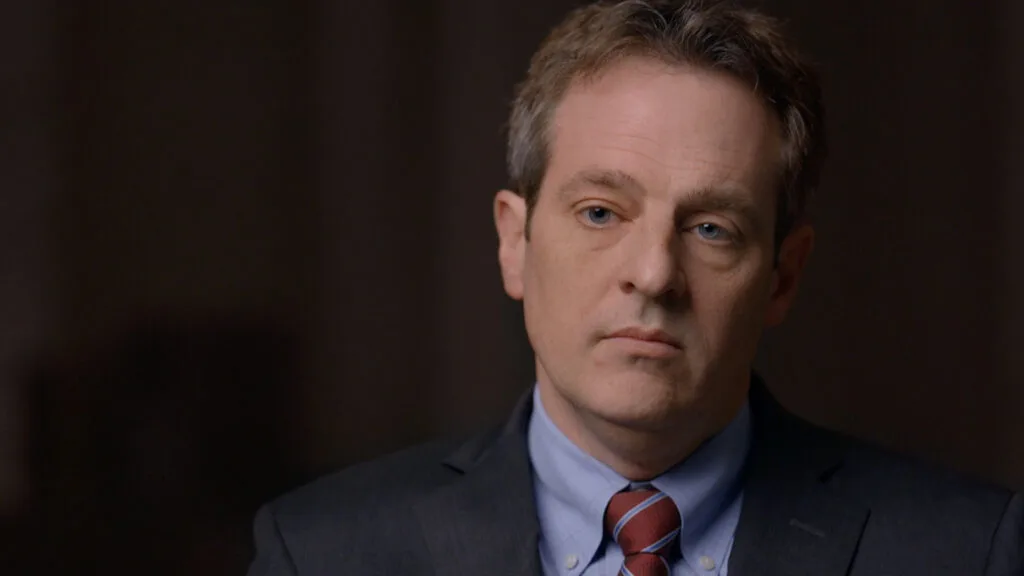
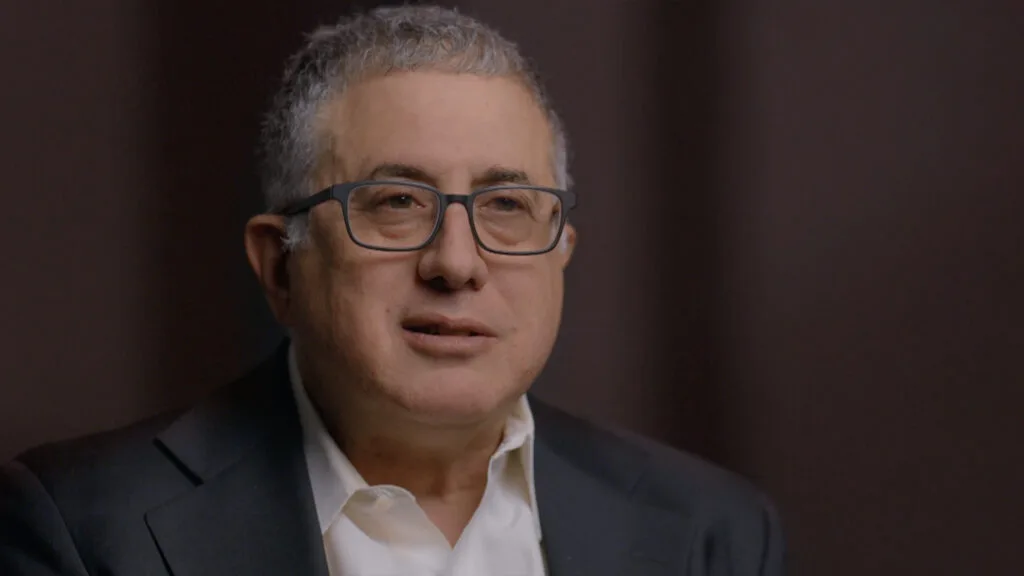
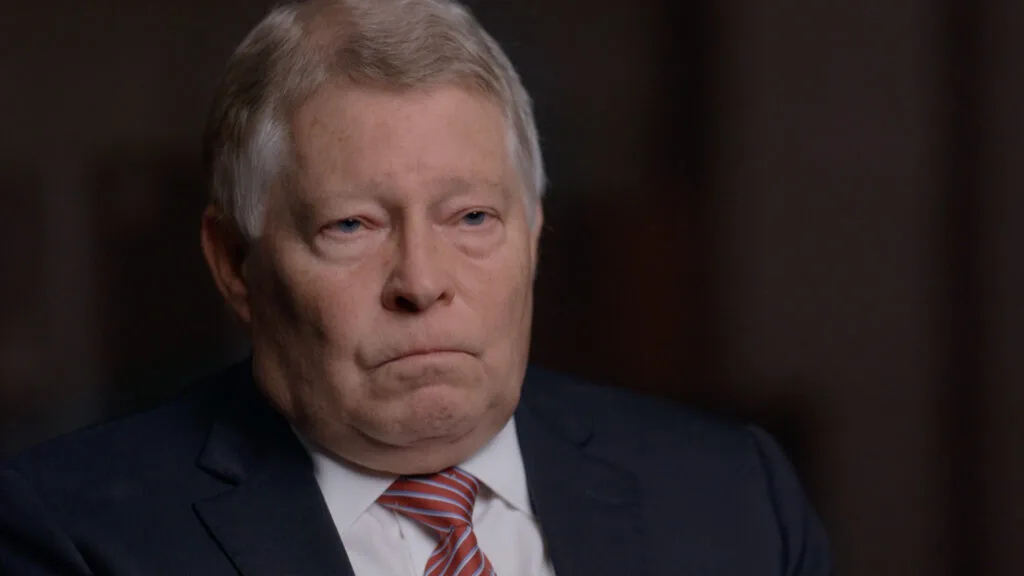
Nelson Cunningham is an attorney and president of McLarty Associates, an international strategic advisory firm that he co-founded. He has served as a federal prosecutor under Rudolph Giuliani, as general counsel of the Senate Judiciary Committee under then-Chairman Joseph Biden, and as both general counsel of the White House Office of Administration and a special adviser for President Bill Clinton.
This is the transcript of an interview with FRONTLINE’s Jim Gilmore conducted on July 11, 2018. It has been edited for clarity and length.
You worked with James Comey.Talk a little bit about him.Describe … the way he acted as the head of the FBI, your overview of Jim Comey.
I first met Jim Comey 30 years ago, in 1988, when he and I both started as assistant U.S. attorneys in the Southern District of New York.Rudy Giuliani swore us in a few weeks apart.He started just before me, so by the time I got there, he was, of course, already a wise old man who had been there maybe two months by the time I arrived.We spent the better part of six years working either down the hall from each other or in offices next to each other.
As you would imagine, a prosecutor’s office in New York, it’s a hothouse.It’s constant foxholes.So I would say I was in foxholes with Jim Comey and a number of us for a period of years.You get to know somebody during that time.
So you know the man.How surprising do you think it is that he would eventually come to blows with the president of the United States, Donald Trump?
He has always been a person of tremendous integrity.Let me start by saying that Jim Comey, certainly, as a young prosecutor, was the epitome of the young prosecutor: straight down the middle, always turning square corners.Made a good name for himself early on in the office.Rose quickly in the office.It’s possible he rose quickly because he was, in fact, a Republican, and the office was headed at the time by Republican appointees.But he did rise.He did rise quickly, and had a very good reputation.
I think we learned a lot about him during the time when he was deputy attorney general in the Bush 43 administration, during the famous episode in which he rushed to [Attorney General] John Ashcroft’s bedside in order to stop the signing of an order on wiretapping that he thought was unconstitutional.
What did that say about him?
It said that he’s a man of, frankly, tremendous courage.There are not a lot of people who would stand up not just to a White House counsel, but implicitly to the president himself.I believe that the day after this all transpired, he was invited down to the White House to meet with the president himself.That would have been something that would cause me certainly to tighten up and maybe not have a good night’s sleep.But then, overnight, the train bombing in Madrid happened, and suddenly we were off on a new counterterrorism investigation, and I think all was forgiven.
The reason I note the episode with Attorney General Ashcroft is I do think it showed great courage on Jim Comey’s part, standing up to the president, standing up to the White House, standing up to the White House’s chief of staff and the president’s White House counsel.I think it also tells us something maybe about him that we also know every jot and tittle about what happened in that hospital room, almost down to where people were standing and what they said and how they interacted.How do we come to have such a great understanding of what happened in that room?Well, you're a journalist, so you know how this information comes out.
And also Jim Comey gave testimony about it.
He did, but in great cinematic detail, which is also sort of a foreshadowing of the later testimony he gave about President Trump.
This brings up a point.Other people have said that there was an antagonism felt by the president toward Jim Comey from day one, and I’d like to get your opinion about why that is.The president famously believes that Jim Comey is a showboat.Some people say that in some ways, they're similar, because they both feel that they need to get their message out on the media and such.There's also the situation that Jim Comey was the one that briefed the president on the dossier in that early January meeting in Trump Tower.It’s also the fact that he was in charge of the investigation, the Russia investigation.Why do you think there was that animosity?What do you think was the most important thing of how this president viewed Jim Comey?
Don’t forget that they're both Republicans, and you might start with who their political allies are.Jim Comey was hired by Rudy Giuliani.Of course, we both were.We were career prosecutors, but he prospered politically in Republican administrations.He became the United States attorney in New York, the job that Rudy Giuliani earlier held, at the age of 41.That’s very young.At the age of 42, he was deputy attorney general.He rose very quickly in the Bush 41 and 43 administrations.
Donald Trump started off thinking perhaps Jim Comey is from the wrong wing of the Republican Party.He was close to Chris Christie.They had served in the Justice Department together.Chris Christie famously was terminated as head of the transition team shortly after the election and sent into some sort of political exile.So Trump might have started, first, Jim Comey is the wrong kind of Republican.
Second, he had the stigma of having been appointed by Barack Obama.He had the stigma of, in some fashion, representing what I think even then, in President Trump’s mind, was the deep state, the career professionals at the FBI, at Intelligence, at Justice, at the State Department, who might have it in for the president, might view the world differently.And then I think he saw Comey as an immensely powerful person in his life potentially, and he wanted to ensure that he had his loyalty.Loyalty is obviously very important to the president.Also getting a personal sense of those who might someday have an influence in his life is important.
He famously interviewed the candidates for the U.S. Attorney’s Office in New York.There are two U.S. Attorney’s Office[s] in the country that are likely to have a direct impact on Donald Trump’s life.One is the U.S. Attorney in the Southern District of New York, where the Trump Organization is headquartered.The second is here in Washington, D.C. President Trump famously—and I must say very unusually—interviewed the final candidates for each of those positions.He reached way down into the Justice Department to interview the candidates for those jobs and to ensure that he was comfortable with those individuals.I've never heard of a president ever interviewing a United States attorney for any district, much less two.
… We’ll get more into that with the Michael Cohen case, but let’s stay in chronology right now.So the loyalty issue: the famous dinner for two, where he invites Jim Comey to the White House.Surprising to James Comey is that it’s only for two people, on Valentine’s Day.And he asks for his loyalty.From your point of view, what did that mean to President Trump, and what would it mean to Jim Comey, this question, this request for loyalty?
I'm tempted to put this in cinematic terms.Someone like Donald Trump, he is a showman, and he thinks about the world in cinematic ways.The two movies I've always thought about when I look at Donald Trump are, first, The Godfather series, and of course he’s from Queens, which is also where Don Corleone was from.The second is House of Cards.I think as the president arrived in the White House, he brought with him, maybe from his Queens upbringing, a strong sense of tribal loyalty.You're with me, or you're not with me.Are you with me, or are you on the other side?
And then, coming into a White House, you might imagine Kevin Spacey as the president in House of Cards, leaning across the table and asking his FBI director, “Are you loyal to me?”.So when I think about President Trump and his motivations, I think about it in terms of some of these larger-than-life TV and movie personalities.
… If I could say, from Jim Comey’s standpoint, to be asked whether he was loyal to the president, that would have to be a startling question for anyone in law enforcement.I think, again, President Trump had some trouble in the early going distinguishing between pure political appointees and those who might feel that they had a higher duty.Law enforcement is one of those.The intelligence community is another one of those.Perhaps diplomacy in the Department of State is another.
From your Secretary of Housing and Urban Development, you might expect personal loyalty and also that he or she will run the department with clear instructions from the White House.I think the president found it hard to understand that the Department of Justice does not run that way, and it is not there to operate at the president’s beck and call.Indeed, it’s been a tradition since Watergate that the Justice Department has strong independence from the president.And the attorney general might often find himself at odds with the president.I think that was a new concept to President Trump.He didn’t expect it.
It’s maybe why he was startled that he didn’t get a clearer answer from Jim Comey, why he was frustrated that Jim Comey didn’t simply do what he asked him to do, which is to say publicly that he was not a subject of the Russia investigation or a target, and that he couldn’t get a clearer answer from Jim Comey as to whether he would be loyal.Trump thought he could expect that from somebody who worked for him.
From Jim Comey’s standpoint, it had to be startling to be asked by a president, particularly in the context of what they both knew was an ongoing investigation that reached into the White House, to be asked for his loyalty.
Tell us a little bit about Donald Trump, the New Yorker, New York developer, his view toward lawyers, his 4,000 to 4,500 legal cases, his reputation in New York when you were there.Tell us a little bit about his bio that helps one to understand how he views lawyers, the use of lawyers, and the law in general.
New York, of course, it is a place of tribes.It’s a place of warring tribes.I think that probably is as true in the real estate world in New York as it is in any other.When you're going up against another mogul in the real estate world for ownership of a piece of property, either you’ll win or he wins.One of you leaves the field with the prize.If you're going for an Atlantic City casino, one of you gets the casino or gets the license, and the other one doesn’t.That sense of life as a power struggle, as a tribal power struggle, seems to have been ingrained in Donald Trump from the time he was a young man coming up in the rough-and-tumble world of Queens construction and real estate, and then moving into Manhattan.
There's an expression in New York.Those of us who live in Manhattan will talk about people who come from beyond as the “bridge and tunnel crowd.”.Back when we thought that Manhattan was the center of the universe, those who came from the outer boroughs were somehow arrivistes in Manhattan, and I think those who are old money, old-line in New York will still look at Donald Trump, even as a billionaire, even as someone who has ascended to the position of president, as being somewhat of a “bridge and tunnel crowd” recent arrival in Manhattan.I think that has to shape the psyche of someone like Mr. Trump.
As he came into Manhattan, he took on the moguls.He beat them.At least he will tell you he beat them for hotel properties, for casino properties.But that sense of life as an antagonistic struggle seems deeply embedded in him.
You asked about lawyers.Well, lawyers are tools.Lawyers are the snarling dog on the chain that you threaten to let go in the middle of a business negotiation or a rough-and-tumble business negotiation.Lawsuits, counter lawsuits, threats, injunctions, they become tools by which real estate negotiators in New York can accomplish their business.
It’s clear, looking at it, that President Trump, Donald Trump over the years honed the fine art of using lawyers as attack dogs, as shields to protect him.It’s also clear that he doesn’t always enjoy paying the last dollar that he owes on commercial transactions, so therefore, sometimes it’s cheaper to hire a lawyer to fight than to pay that last down payment .
The number, 4,500 cases, is that pretty extraordinary?
Is that a real number?
The reporting has come up with between 4,000 and 4,500 cases.
Yeah.The number of 4,000 to 4,500 cases is extraordinary.As someone who practiced law in Manhattan, who knows a lot of New York lawyers, that is simply an extraordinary number, and it suggests someone who either is crossing over the line, is perceived to be crossing over the line, or who views lawyers as tools to be used for negotiating.Forty-five hundred cases is extraordinary.
There's been a lot reported about his relationship with Roy Cohn.How important do you think his relationship with Roy Cohn is?How did that help define how he would view lawyers and how he would view the legal system?
Having watched a lot of newsreel footage of Roy Cohn over the years, it’s pretty clear to me that he taught Donald Trump a lot about how to negotiate, how to negotiate publicly, how to negotiate loudly, how to live your life in the tabloids in a way that advances your business, advances your cause, advances your image, and advances the kind of person that you want to be.
Roy Cohn built a very clear public persona of himself.He was someone who was not to be trifled with.He was someone who, if you hit him, he would hit you back twice as hard.These were all lessons that Donald Trump seems to have learned as a young man and Roy Cohn’s client.
So lawyers are tools that do your bidding, get you out of trouble, don’t question—are loyal and are directed by the person paying the bills.Is that fair?Is that view of lawyers, his New York City kind of view of lawyers, how does that come to blows with coming to Washington, D.C., and what lawyers in Washington, D.C., are, compared to New York City real estate lawyers?
Well, of course, Donald Trump has dealt with government lawyers for many, many years.The Trump Organization, when his father was running it, famously came under investigation for race discrimination.Trump dealt with lawsuits from the City of New York, which was looking to collect taxes and to examine some of the financial filings on some of the buildings that Donald Trump had purchased.He’s been fighting with government agencies for years, and his lawyers were always his cudgel and his shield to use against those government lawyers.
So he came in, I think, viewing government agencies and the lawyers who work for them as being somewhat the enemy.These were the guys who would come after you.And he probably felt a certain sense of relief and satisfaction, that finally, as president, he could direct these guys, and he could tell them what to do, and he could tell them to knock it off.Pled it was a surprise to him that it didn’t work that way.
So when Jim Comey is in the Oval Office, and there's a meeting, and it ends, and the president asks everyone to leave the office except for Jim Comey, including AG [Jeff] Sessions, and then he asks Mr. Comey to back off Gen. [Michael] Flynn, why do you think he does that?What's he thinking?Is it just naiveté or whatever?And how would Jim Comey accept that, or how would he view that?
Well, first of all, first of all, looking at it, isn't it a scene out of House of Cards?Isn't it just the way that a brand-new president might think that presidents act when they're confronting a situation?A key aide is under investigation; you call a meeting in the Oval Office, the majesty of the Oval Office.As the meeting ends, you ask everyone to excuse themselves, but you bring the FBI director over to you, and you give him his instructions.It’s the way that a layperson thinks that government works.
It’s not the way that Washington actually works.It’s not the way that law enforcement works, and it’s certainly not the way that the head of the FBI works.I can think of no instance since Watergate where the head of the FBI took directions from the president and executed them in quite the way that I think Donald Trump was hoping that his instructions might be taken by FBI Director Comey.
It had to be, for any law enforcement official to be told by your chief executive, your commander in chief, how to run an investigation into one of the president’s closest aides, that would be absolutely startling, absolutely beyond the imagination of what anyone in law enforcement, even at senior levels of the FBI, would expect in terms of behavior from the president of the United States.We have to view it as an extraordinary moment.
Obstruction?
One could certainly view it as part of a pattern of wishing to shape the FBI’s investigation in a way that steered away from certain issues, steered away from certain people.I think you could call it obstruction.
We've talked to Alan Dershowitz, who has a very different opinion, and it converges or agrees with the White House, which is their position [and which] was in the [John] Dowd letter.Their position is the president can't be convicted or said that he’s obstructing, because he runs the FBI. .He can fire anybody at anytime.He can stop any investigation at anytime.He can pardon anybody at anytime, including himself.How does that argument wash with you?
Yeah.
And certainly, also, because you were in that Oval Office, you’ve been through these situations.How extraordinary is that?
Let’s break the question down into two or three pieces.First of all, is Mr. Dershowitz right that a president can never be charged with obstruction of justice, because, after all, he is the executive who has the unlimited power to hire, fire and to direct what his people do?Let me give you a hypothetical, which we lawyers love to do.The president is meeting in the Oval Office with someone who displeases him.He pulls out a gun, and he shoots that person in the head.The Secret Service runs in and immediately begins collecting evidence of what happened.The president fires those Secret Service agents.Ten minutes later, the head of the Secret Service comes rushing into his office and says, “Mr. President, I don’t know what happened, but we have to investigate.”.He fires the head of the Secret Service.
The FBI director then comes over to continue the investigation.He himself is also fired by the president.Does Mr. Dershowitz really mean that the president could not be convicted either of murder or of obstructing justice in the investigation of the cold-blooded crime he just committed?No.
So once we’ve established that Mr. Dershowitz’s broad proposition is wrong, then the question becomes, where do we draw the line between what a president can be investigated for and cannot?Again, here we have to divide it into two.One is criminal investigations, and the second is what might be an impeachable offense.And many people, including Mr. Dershowitz, conflate the two, because I think it’s convenient for their argument.
Can the president be convicted of obstruction of justice?Well, the first question that we have to ask is, can a sitting president be charged criminally while he is still in office?Frankly, that’s an open question constitutionally.It’s clear from U.S. v. Nixon, the Watergate case, that a sitting president can be subject to a criminal law subpoena.The unanimous Supreme Court said he must turn over the Watergate tapes.It’s clear from Jones v. Clinton, the case against Bill Clinton, again, a unanimous Supreme Court decision, that a president may be subjected to a civil lawsuit while he is president and may, in fact, be compelled to testify in a civil lawsuit under the right conditions.Those two cases are very clear.
But neither one addresses the question of whether a president can be prosecuted criminally while he is in office.We’d have to assume that’s an open question, simply because a criminal prosecution would pull the president so far away from the responsibilities he has as commander in chief and the need to run our government, one could see constitutional lawyers arguing whether a criminal prosecution can go forward.
But if we talk about impeachment, obstruction of justice is plainly something that a president can be impeached for.Richard Nixon, the articles of impeachment against him that were voted in the House of Representatives and which led to his resignation [included] prominently obstruction of justice as one of the counts.Bill Clinton, the impeachment articles that were voted, that were presented by Kenneth Starr, the independent counsel, and that were voted by the House of Representatives included obstruction of justice.
So to hear Mr. Dershowitz and other conservative lawyers today say that obstruction of justice can never be part of impeachment proceedings flies in the face of the only two impeachment cases we've had in the last 50 years.
Great.That’s very helpful.The firing of FBI Director Comey, when you heard it, what did you think?You’ve been in that White House.How extraordinary did that seem?And what came to mind to you?
I remember exactly what I was doing when I heard it.It was one of the most startling pieces of news in a young presidency that was full of startling pieces of news.The notion that he had fired his FBI director because, as he was quite open in saying two days later to Mr. [Lester] Holt on television, because of “this Russia thing” was to me the most extraordinary combination of action and admission that I can imagine a president saying.That day, I wrote one of my colleagues.I said, “I think we will look back on today as the day that Donald Trump’s impeachment began,” because I could see, even then, the act of firing an FBI director, at least in part because that FBI director was running an investigation that the president felt was coming too close to him, that act right there led to extraordinarily serious constitutional crosscurrents.
[Robert] Mueller is named special prosecutor, special counsel.Who is Mr. Mueller, and why [did] Rosenstein [choose] him?
I have never met Mr. Mueller, but I can tell you that he has been a legend in the law enforcement community for easily 30 years.When I was a young assistant U.S. attorney in New York 30 years ago, he was already someone who stood out for his dedication and for his sense of service.He had served in the Reagan administration.He had been a career prosecutor in San Francisco and then in Boston.He had worked for James Baker during the Reagan administration.
He retired from his job as a prosecutor, and he went to go work for a private law firm.That lasted two years.Then he asked to be sent to the streets of Washington, D.C., to become a homicide prosecutor.That caught the attention of every young prosecutor back then, in the mid-90s, because that was an ethic.That was a sense of civic responsibility that we all reacted to.
If you remember the late ’80s, early ’90s, the crack epidemic was sweeping major American cities.We saw it in New York.We certainly saw it here in Washington, D.C. They both became, in different ways, the murder capital of the U.S. because of the way in which the crack epidemic was moving through urban communities.And Robert Mueller said: “My comfortable life as a partner at a major law firm is too comfortable.I want to get back on the streets and be a homicide prosecutor.”.That struck the imagination of so many young prosecutors.
So he went on from that to another moment of service, the U.S. Attorney’s Office in San Francisco in the late ’90s.Had some scandals, some management problems, was floundering, and he volunteered to go on—for three years ran that office and helped right the ship, helped put it back together at a time when many people would have run away from it, from a difficult management challenge like that.And it was right then that he was asked to become FBI director by George W. Bush in 2001.
Even then he was exhibiting, as a young prosecutor, the sense of duty, the sense of responsibility, and to some extent a sense of selflessness that where there's a difficult task to be done, one doesn’t run away from it; one steps forward into it.And I could tell you, as a young prosecutor, that made a big impression on me.
Why do you think Rosenstein chose him, or announced that there would be a special counsel?
Well, look, for 40 years, 50 years, ever since Watergate, we've had the notion that sometimes you need independent lawyers, independent investigators to look into a president, into a White House or at serious political figures.It was Richard Nixon’s firing of Mr. Cox, Archibald Cox, who was the White House prosecutor, in the famous Saturday Night Massacre, which also took down the attorney general who refused to comply with the order.It took down the deputy attorney general who refused to comply with the order.And then, finally, Robert Bork, who was the solicitor general, agreed to follow through with President Nixon’s order to fire Archibald Cox.
Ever since that direct presidential intervention into an investigation that touched him, we've had various means of setting up investigators, lawyers, prosecutors, who would have some measure of independence from the president and who could act without direct political interference.For years we had the independent counsel statute , which famously spawned Kenneth Starr and a raft of other independent counsel cases over the years.Iran-Contra, a special prosecutor came out of that.
We sometimes need these mechanisms to have investigations that can run on their own professionally and without political interference.The independent counsel statute that previously existed is gone.It expired in 1999 and was replaced by, I think, Attorney General [Janet] Reno, with what are now called the special counsel regulations, which is what Rosenstein used to name Robert Mueller.Those provide that, in certain cases, the attorney general or, in this case, the deputy attorney general can name a special counsel.That special counsel is to be given a particular charge, and that special counsel is only to be interfered with for good cause.That special counsel reports to the attorney general or, in this case, the deputy attorney general and must report findings, conclusions to the deputy attorney general.It’s a structure set up to provide independence and frankly, to give us all the assurance that an investigation can go forward fairly and without political pressure.
So it’s not a surprise to me that Mr. Rosenstein, who I also do not know, but whose courage and whose dedication to law enforcement and to prosecutorial ethics has been very strong, it is not surprising to me that, given the enormously unusual circumstance of a president firing an FBI director precisely because of an investigation that, in some measure, touched the president, that Rosenstein would look to this tool in his toolbox, the special counsel regulations, as a way of putting someone in place who could operate with some autonomy, with some independence of decision making, and without a direct reporting line up to political figures.It took courage, I think, for Rosenstein to do this.But it’s precisely what any prosecutor, I think, will tell you he should have done under these enormously unusual circumstances.
Sessions, of course, at that point, the president soon after became very angry and started tweeting about the attorney general.He wanted to fire him.He took offense at the fact that he recused himself.What's your view of that reaction, and how dangerous it was, to some extent, for the president to be even considering firing Sessions at that point?
Well, it really is an O. Henry story, isn't it?The president fires the FBI director because he won't follow orders, and what he finds himself confronting is instead a special counsel who really won't follow orders.It had to be the most enormously frustrating moment of Donald Trump’s young presidency to have taken an act impulsively, but that he thought was an act that would resolve a problem, and it wound up making the problem even more complicated for him.
One can imagine his frustration.What we know about President Trump is that when he’s frustrated, the whole world soon learns of it, because the president communicates his frustration very openly and often with his thumbs.So we’ve learned about the president’s view of Jeff Sessions, Attorney General Sessions, very directly from the president’s own fingers.
I keep on using the word “extraordinary,” but it is extraordinary for a president to complain about his sitting attorney general, that he cannot use that sitting attorney general to control a criminal investigation against him.We really have to pause and pull the lens back and say that's what's happening here.A president is trying to control the Justice Department’s investigation into him, and every time he fails to control them, every time they fail to follow his direction, he erupts in anger and frustration.That’s extraordinary.
The Jan. 29 Dowd memo that defines the philosophies of the White House toward the investigation and argues against the interview at the same point … that memo itself, is that an extraordinary memo in some ways?How did you view that?Was that just an opening, negotiating position?What was that?
I view it as an open negotiating position.It’s very common for lawyers in high-stakes negotiations to set out their views in some extreme fashion, because they want to set their goalposts as far over on one side as they can.We only know about these negotiations from one side, of course, because Mr. Mueller has been completely silent.No one either on the record or from what any of us can tell off the record from his team has ever lifted a finger to defend themselves, to give their version of events, or to put out their side of matters that have happened.The only time he has ever opened his mouth metaphorically is in court, and it’s through court filings, through indictments, through charges, and, of course, through arrest warrants.That’s the way in which he has spoken most loudly.
That, by the way, is the way, as prosecutors, we are trained to behave.We are trained to do our work in court, to do it with the instruments, indictments, motions, court filings that the law gives us, and not to do it with press conferences, not to do it with leaks to the media.The whole debate we’ve heard about the conditions under which the president might be asked to interview by Mr. Mueller has all been given to us by the Trump side, and no one from Mueller’s side.
We don’t know exactly how those discussions have gone forward.We don’t know anything other than the president’s lawyers’ views.I can tell you that the Dowd memo sets out a view of the law that I think is simply at odds with the clear constitutional precedent.As I mentioned before, we have two cases here which are unanimous Supreme Court cases, each going directly to the question of, when is a president subject to subpoena?[The first is] the U.S. v. Nixon, the Watergate tapes case, where a unanimous Supreme Court said that the president of the United States was subject to a criminal grand jury subpoena and would be required by that subpoena to turn over physical evidence, in this case the Watergate tapes.
The second unanimous Supreme Court case is during the Clinton years, when the president sought to bar a civil lawsuit against him, a sexual harassment lawsuit brought by Paula Jones, because he was a sitting president.The Supreme Court unanimously averred that a sitting president does not have immunity from a civil lawsuit.He must deal with the civil lawsuit even while being a sitting president, and they went so far as to suggest that a president could be compelled to testify in a civil case.
To me, you add those two cases together, U.S. v. Nixon and Jones v. Clinton, two unanimous Supreme Court cases, and I don’t see how any judge concludes that President Trump would not be subject to a grand jury subpoena given to him by Mr. Mueller if that grand jury subpoena was, indeed, handed to him.
Another thing that came out of that, the Dowd memo—and tell me if you think this is important in any way whatsoever, how you read it—was the fact that it also admits that the president had been briefed by his lawyer about the Sally Yates briefing about Gen. Flynn that same day.The night of that day is when the dinner with Jim Comey is and where he asks for the loyalty.Anything unusual about that?Does that speak out to you in any way?
Well, the entire question of whether a president’s actions are an obstruction of justice come down to, what was in the president’s mind at the time that he took the action?Whether you're talking about a criminal case, which I don’t think we will in the case of President Trump, or an impeachment proceeding, which is a greater possibility, it’s going to be about what was in the president’s mind.What did he know, and what was he intending to do when he took certain actions?This is exactly why it becomes relevant for Special Counsel Mueller to want to interview President Trump on the record and under oath.What was in his mind?Mr. President, what did you know at the time that you took this action?What did you intend?Why did you do it?What was your justification?
That interview could exonerate the president; it could implicate the president.It could also obviously lead to questions of further obstruction of justice or further, perhaps, perjury.That’s why the president’s lawyers are fighting so madly to keep him from being testified, and yet it’s also precisely why Special Counsel Mueller might view it as central to the conclusion of his investigation, to have the president’s evidence and testimony on the record.
Let’s not forget that, when Jim Comey in the summer of 2016 was wrapping up the Hillary Clinton email investigation, after his teams had worked for many months, many thousands of hours, building the case, the final step was the interview of Hillary Clinton, conducted on a Saturday morning.And then the following Tuesday, Jim Comey had his famous press conference in which he concluded no charges would be brought, but in which he walked through, in great public display, the wrongdoing that he felt that the investigation had uncovered.
The interview of the principal is for any investigator, any prosecutor, likely to be one of the final stages of the investigation.Once you’ve built your case, you lay the case in front of the principal, you get the principal’s answers, and then you make a judgment as to whether you think the evidence supports in this case obstruction of justice or perhaps collusion, whether the evidence supports exoneration, or whether the evidence supports conclusion of further perjury.
So when he sits down with Comey that night, in the back of his mind is this understanding of just how much trouble Flynn is in, which might mean complications for himself?When you see that taking place just before this questioning of loyalty, does that raise a red flag?
Well, if, as you say, the president’s own lawyers admitted that the president would have been briefed before that dinner on the fact of the investigation into Mr. Flynn, it’s certainly a reasonable conclusion for a finder of fact, whether a jury or a Senate, to conclude that there was an intent to obstruct an investigation, to shape an investigation, to even impede an investigation into the president’s own conduct.
There were beliefs that the president was being counseled correctly to moderate his behavior by [Ty] Cobb and Dowd.When they go, the other issue that comes up is the president goes out looking for other lawyers, and Washington lawyer firms, large firms rejected him one after another.I think the number is supposedly eight major firms said no.Why?What was going on there?
Well, I think it’s plain that over the years, you pointed out there have been 4,500 cases that Donald Trump and his organization were involved in over the years.It’s obvious that Mr. Trump can be a very difficult client.I think at least some of those 4,500 cases were brought by lawyers seeking to get their fees paid when they had been stiffed by Mr. Trump or by the Trump Organization .Any lawyer thinking about taking on a major representation such as that of the president of the United States has to think to themselves, “Will this be a successful client relationship, or will it be a difficult client relationship?,” before embarking on it.
In a sense, it may be unfair to President Trump that, because of his political positioning at odds with establishment Washington, that establishment lawyers might not wish to represent him.Everyone deserves a lawyer.Everyone deserves representation.I think these, in most cases, most lawyers would jump at the chance to serve as the counsel to the president.But Mr. Trump’s reputation as being a poor client, his reputation as being at odds with establishment Washington, and for not listening to his lawyer’s advice, plainly it would be a daunting challenge for any lawyer to take him on.
The Michael Cohen case, the raid of Michael Cohen’s office on April 9, 2018, how big a threat did that pose for the president?How was it, do you think, … viewed by the White House?
Well, I keep on using and maybe overusing the word “extraordinary,” but it really is extraordinary for someone’s lawyer to be searched, for his home to be searched, for his records to be searched.For law enforcement to go after someone’s lawyer is extraordinary.And in fact, the guidelines, internal guidelines at the Justice Department suggest that that decision has to go up to the very highest levels of the Justice Department before a prosecutor can get authority to go raid a lawyer’s offices, because the principle of protecting attorney-client privilege is so important.
It suggests, first, that the decision to go after Cohen and his personal property and his office was taken at the highest levels and with the utmost seriousness.This was not a casual move.This was something that took weeks, if not months, to plan and to execute.Second, the fact that it was done separately by the Southern District of New York U.S. Attorney’s Office and not by any members in Mueller’s team suggests that Mr. Mueller wanted to insulate himself from the actions that were taken in taking Mr. Cohen’s documents, wanted to insulate himself not only from the act of requesting the search warrant, but second, from the evidence that was turned up itself.Mr. Mueller does not want to be tainted by improperly coming across any attorney-client privilege material that Mr. Cohen might have in his files.He wouldn’t want to become unwittingly privy to something that he should not become privy to, so very careful processes were set in place to isolate anything that might be attorney-client evidence.
Coming back to your question about the Oval Office, it had to have been extraordinary for the president to learn that his own lawyer, his own lawyer’s offices and home had been ransacked by the FBI and by the Department of Justice.One can imagine the frustration, even the anger that would flow from the Oval Office to learn that, again, an arm of his government had taken this extraordinary action of going after his own lawyer.
Now, we don’t really know fully why the search warrants were sought or executed.Was it simply because of some taxi medallion issues, some real estate transactions that are being investigated, or is it closer to the heart of Mr. Mueller’s investigation into Donald Trump?Certainly the fact that Michael Cohen was involved in the payment to Stormy Daniels in the weeks before the election, that could clearly tie into Mueller’s investigation in a very direct way.One can imagine that that would feel that it was coming very, very, very close to Donald Trump, to have his lawyer’s offices tossed.
The fact that it’s now in the Southern District, the Southern District that we talked about in the very beginning, [which] the president considered to be a very important institution, so much so that he did an interview himself, what might the worries be, and especially because of the involvement of Michael Cohen in so many of the business activities of Donald Trump, including deals that they were trying to arrange in Moscow, certainly the Stormy Daniels type of activity?How could this be a danger to this president who might worry that his entire business career becomes underneath the magnifying glass?
The investigation of Michael Cohen, the seizing of records from his office and his home, has to feel, to the president, like an arrow pointed directly at his chest.It has to feel that this is aimed precisely at uncovering the president’s own history, both before he took office and since he took office, in ways that perhaps might be the most deeply sensitive to him.Whether it’s his real estate dealings in New York—as you pointed out, New York is not a pristine place in which to engage in the real estate wars.Certainly if it involves payments to women who claim that Mr. Trump had engaged in sexual improprieties with them, those are the things about which Donald Trump has to find most sensitive and most concerning to him.
… When you were general counsel for the Clinton administration, what was in your portfolio?
For the Office of Administration .I was, in effect, the business lawyer for the White House.I represented all the machinery that ran the White House, by the way, which included, of course, email.I actually, before the Hillary Clinton investigation, I was one of Washington’s great experts on the law of what's proper in email, how email servers may be treated, how email records must be kept.But that was all part of my end of it.I was brought into the White House in the spring of 1995 precisely because I’d been a prosecutor for six years, precisely because the House and Senate had just flipped from Democrat to Republican, and precisely because the White House knew that a raft of investigations were coming their way from criminal investigators in the Congress from congressional investigators, but also from the Independent Counsel’s Office.So I was brought in very much because of my prosecutorial and my congressional experience.I had come from the Senate Judiciary Committee to help deal with these investigations.
So you’ve seen a White House under pressure.
I've seen a White House under pressure.The White House in Bill Clinton’s time had a very active Counsel’s Office that was busy defending the actions of the White House from congressional investigators and from multiple independent counsel, not just Ken Starr and his team, but also there were some independent counsel investigations that touched members of his Cabinet and which, of course, also bumped up against the White House.
… Giuliani is hired 10 days later after the raids.His moderating forces within the legal community seem to be going out the door.… That moment, when you look at the Michael Cohen case, do you see an adjustment in the way that this White House is dealing with the Mueller investigation, is dealing with Congress, is dealing with the DOJ?
Certainly the hiring of Rudy Giuliani has to be viewed as a turning point in the president’s response to the investigation.Giuliani is one of the highest-profile and, in many regards, historically most respected figures in law enforcement.He is someone who is very comfortable on camera.He is someone who is very comfortable in the public arena, and who also—and the President likes this—is a fighter, is a combatant, and is somebody who’s willing to go to the mattresses when needed on behalf of a client.Giuliani was plainly brought on to be the president’s shield, to be the president’s chief defense, to be the president’s loudest defense, and to be the one also mounting counterattacks to attempt to weaken the special counsel, to attempt to weaken public support for the special counsel, and, of course, because of public support, to weaken congressional support for the special counsel.And he’s very honest recently, last weekend, but later on, about what he’s doing.He’s saying, basically, that if in case this becomes a political battle, which it really is, if it has to be a red versus blue issue, we need to convince the public that there are some bad folk in the FBI and the DOJ and Mueller’s investigation that are attacking us and trying to bring down the president of the United States, and they're preparing, basically, for the possibility of impeachment.When you hear Giuliani defining what they're doing and why they're doing it, what’s your take on that?
To overuse that word, it is extraordinary.For Rudy Giuliani, who used to head the Southern District U.S. Attorney’s Office, which is the most respected and the most professional prosecutor’s office in the country, for him to deride that office, to criticize its behavior as corrupt, as improper, to criticize the former head of the FBI, a man who was confirmed twice unanimously by the Senate for FBI director, once under George W. Bush and once when Barack Obama extended him for two years, for Rudy Giuliani to turn an iconic figure, the former head of the FBI and his own office into instruments of corruption, is extraordinary.
For Republicans in general to now suggest that the FBI is a cauldron of left-leaning bias flies in the face, certainly, of what I know about the FBI and the career agents there, who, if they had any politics at all, were not leaning in favor of the Democrats.But simply the notion of attacking these institutions, the Department of Justice, the FBI, and to attack them in deeply personal and over-the-top fashion, using words like “corrupt,” we've never—I've never seen anything like this before.
The long-term effects of all this?Are they considering them?
I don’t think the long-term effects are being considered by anyone.Certainly Rod Rosenstein is deeply concerned about it.Certainly, Chris Wray, the current head of the FBI, in his testimony, he’s concerned about the need to protect his department, his agents, to protect their integrity.It’s palpable among those who are still in the law enforcement at the Justice Department, they see these attacks on them, on their institutions, on their methods, as being hugely disturbing.But that’s not part of the political calculation.That underlays Mr. Giuliani’s attack.
Or Mr. Trump’s.
Or Mr. Trump’s.Neither of them seem to care that what they are doing is bringing down institutions that most Americans, even in today’s era of cynicism, that most Americans have viewed as being beyond the pale.
In the end, the way that Trump has dealt with the judiciary, the way that he has dealt with the FBI, the Justice Department, the investigations, how he has also proceeded in changing the courts by judiciary appointments?How successful has he become in, [what] we are calling in the film Trump’s law, how has Trump’s law, in fact, done in this past year and a half?
President Trump has wreaked a change in the way that we view law enforcement.That is extraordinary.He has turned the Republican members of the House and Senate, most of them, into his supporters on this issue.He has led them to target the FBI. .He’s led them to target the intelligence community, two institutions which Republicans have always supported and have given their full, both emotional and financial support.Donald Trump has turned them, members of Congress, against these very institutions.He has been enormously effective at putting these institutions under great pressure.He has been enormously effective at weakening their standing in the public eye.And I think it is only the courage, the individual courage of people like Rod Rosenstein, Christopher Wray and Robert Mueller that prevent Donald Trump’s law from prevailing completely.