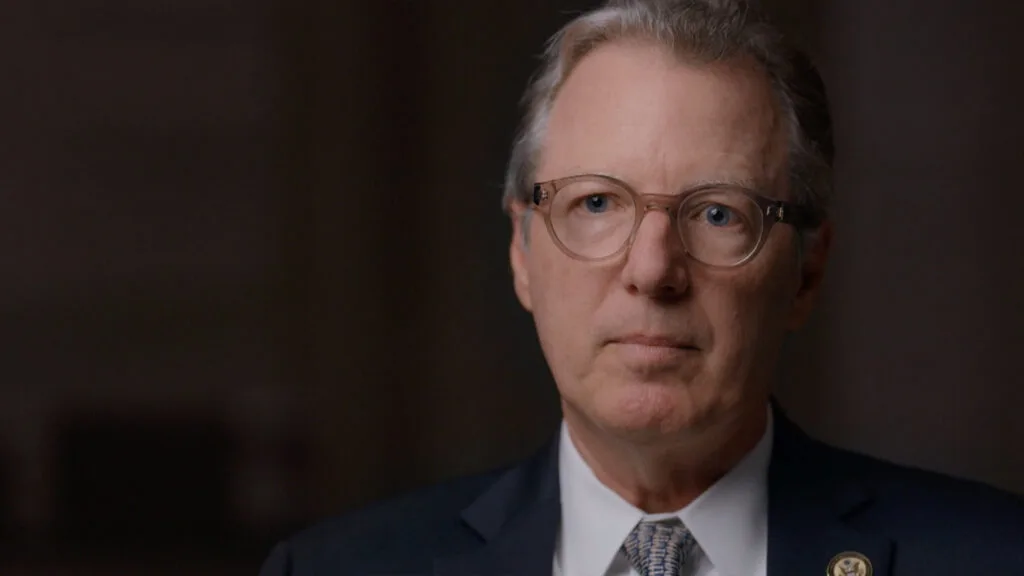
U.S. Senator (D-VT) and Judiciary Committee Member
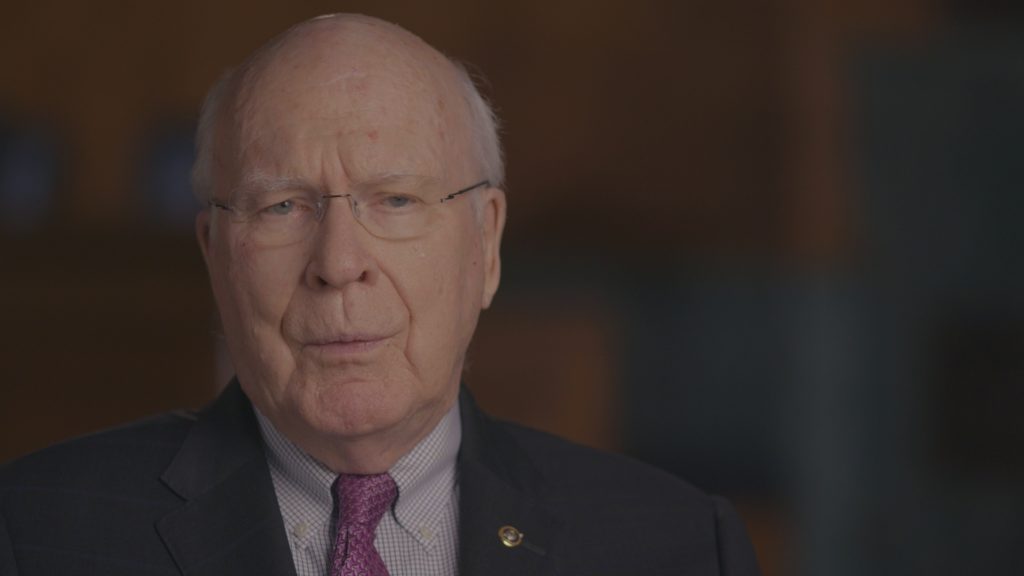
Patrick Leahy, a Democrat, is a United States senator from Vermont. Leahy serves on the Senate Judiciary Committee and has voted on the confirmation of every sitting Supreme Court justice.
This is a transcript of an interview with FRONTLINE’s Jim Gilmore conducted on February 6, 2019. It has been edited for clarity and length.
The Death of Justice Scalia and Mitch McConnell’s Gamble
Let’s talk a little bit first about Merrick Garland.[Antonin] Scalia passes away, and Leader [Mitch] McConnell (R-Ky.) immediately states that no nominees will be considered.This is 10 months before the election.Why is that important?…When you heard McConnell make that statement, what were your thoughts?
Well, what Mitch McConnell did was totally unprecedented.Here you had Merrick Garland, somebody that dozens of Republican senators had said they would vote for under normal circumstances; Democrats certainly would have.He would have been easily confirmed—a moderate judge, could have easily been confirmed, highly respected.And then Mitch McConnell did something that had never been done before.He said, “We’ll not even have a hearing.”
And I was surprised his caucus just backed out and said, “OK, we won't.”Well, this says that the Senate is useless when it comes to advice and consent unless a couple political operatives say otherwise.I think that doing something totally—and then going on and saying, “Well, we never have a confirmation of a justice in a presidential election year.”Well, of course we have many times.In fact, the most recent was President Reagan nominated a person.Democrats were in control of the Senate, and in the election year, we almost unanimously confirmed him.
I can think of only a few things in my 45 years in the Senate I found as shocking as that, because it broke everything the Senate stands for, the advice and consent.It allowed the politicization of the Supreme Court in a way it never had been, and it’s been a downward trail ever since.
But McConnell is well known for the fact that he considers his legacy will be made, to some extent, because of what he’s done with bringing forth judges, conservative judges during the Trump years.But also during the Obama years, he was known for his tactics which delayed, delayed, delayed nominations.Talk a little bit about the effect of that and what it means, what you need to understand about McConnell to understand why this was so important.
Well, I think it’s an unfortunate to place such politics in judges, especially federal judges.These are lifetime employments.I've tried a lot of cases when I was in private practice, and even when I was a prosecutor, I’d get a lot of cases in federal courts, both at the district level and the appellate level.I knew some of the judges that had been appointed by Republicans, some by Democrats.I never thought of their politics, though, because you knew that they were going to be fair and objective.
And what they were saying, though, by trying to play politics, was saying that, “Well, [we] won't allow a Democratic president to—or we’ll hinder a Democratic president from nominating judges, but we will go full-bore for a Republican president.”They're saying, “We’re putting a political stamp on the federal court.”The federal court is supposed to be independent, is supposed to represent all Americans.They're saying, “No, we’re putting a stop to that; we are going to politicize the federal court.”
And then, using groups like the Federalist Society and others, that have spent years and years grooming people to line up so they can be a Republican judge, I think that that is diminishing the federal judiciary.
Some will say that—
And I would feel the same way if it was Democrats doing it.Anybody who has tried cases in a federal court or argued cases in a federal court of appeals knows that they have to hope that whoever is the judge is impartial.But Mitch McConnell and others are saying: “No, they're not going to be impartial.They're going to be who we handpick; that they're supposed to rule the way we want.And unless you're willing to be on our side, tough luck.”
Mitch McConnell’s Focus on the Courts
Some will say that McConnell and the Republicans were always focused on the judicial and understood the importance that, while during the Obama years, that President Obama was not focused enough on judges and the importance of judges, of pushing forth nominations.
I think that’s probably so.You know, certainly in the years I've been here, I've not heard Democrats talk about how “We've got to have a political stamp on the federal judiciary.”I think the part, though, that was a mistake, [was that they] didn’t realize how much Republicans wanted to put a political stamp on the federal judiciary, and did.I do remember urging President Obama and others to get your nominees up there; whoever they're going to be, get your nominees up there.
Now, I know they wanted to have diversity.They wanted women and everything else.That’s fine.But there are a lot of qualified women.There are a lot of qualified people of color.You can have that diversity, but get the nominees up here.We can't vote on them unless they're here.
Other people that we've talked to, Democrats have talked about the fact that to some extent, these nominations, pushing forth these nominations, trying to get a political voice on the majority on the court, was to some extent revenge against what happened back in the Bork years and the [Clarence] Thomas years.So let’s talk a little bit about Bork.When Reagan nominates Robert Bork, when [Lewis] Powell retires, what's at stake here?
The Nomination of Robert Bork
Well, I looked at it, OK, it’s a seat to fill.Who’s going to be there?I mean, I walk into that hearing, the Robert Bork hearing, and I was there.I met with him.I read all the material.I went to the hearing.I fully expected to vote for Robert Bork, and I know a number of others there who fully expected to vote for him.But as the hearing went on, he had—in fact, I refer to it as a “confirmation conversion”, and a lot of the press actually picked that up, because he was switching his position almost depending upon who was asking him questions.
And a number of people, myself included, who did intend to vote for him, they said, “No, we can't vote for him.”But the thing that those who want to claim it’s all the fault of the Bork hearing forget a number of things.One is that he lost in committee.But the Democrats said, “No, he deserves a right to be voted on by the full Senate, and we will do that,” knowing that some Democrats were going to vote for him in the Senate.
During that time, the Reagan administration was trying to get him to withdraw his name, because they realized what a terrible job he’d done during the confirmation hearing.He said no, he was going to go forward.Again, if all Republicans had voted for him, he would have made it, because there were enough Democrats voting for him.But at least six Republicans voted against him, and a number of other Republicans were very, very relieved privately that he didn’t make it.
So Bork, before the hearing started, he had enough votes to easily be confirmed.His own conduct and his confirmation conversion during the hearings lost him support, including mine, because I was going to vote for him.And then, when he went on the floor, not heeding the calls from many in the Reagan administration asking him to step down, there were enough Republicans who voted against him that he lost.
The Case Against Robert Bork
Though the other side of it also is that there, from the very beginning, on the Democratic side, 45 minutes after Reagan nominates him, Sen. [Ted] Kennedy (D-Mass.) goes on the floor and makes an amazing speech about what is to fear in Bork’s America.…What was the thinking among Democrats?And where were you when the Kennedy speech happened?
Well, I told Sen. Kennedy after I had met with Robert Bork that I disagreed with him, and I told him that, depending upon how the hearing goes, I fully expected to vote for Robert Bork.I don’t think—you know, I had great admiration for Sen. Kennedy.I felt privileged to serve with him.But this was one time I disagreed with him in making that kind of a statement before you hear the facts.
Now I must admit that once I heard Robert Bork testify, the fact that I was going to support him went away, and I said I wouldn’t.But I was also one of the Democrats who said, even though he lost in the committee, that he deserves the right to be voted on on the floor.And actually, it’s when he came on the floor, it was a defection of some significant Republicans who voted against him that finally doomed him.
What, for you, during the hearings, what was the biggest turning point?Was there one statement?
I would ask him questions based on things that he had said before, and he just totally switched his position.But then it kept happening.And I finally said to him, in the hearing, I said, “Are you having a confirmation conversion?”And then he went all over the place.And in my mind, that was it.
One of the people we talked to on this was Bork’s son, who talked about these times and still had an anger.The amazing thing is, how 30 years later, a lot of Republicans continue to talk about Bork...Why that anger?Why do you think it still is to this day?
I think it is, with many, they realized that President Reagan made a bad mistake nominating him.They had gone out on a limb to support him, and now they're trying to say that—I don’t mean members of his family; I'm talking about others—we weren’t wrong in supporting him.Wasn’t it terrible what the Democrats did?And every time they say that, they forget that some Democratic senators voted for him on the Senate floor, and a number of Republicans voted against him.And had those Republicans voted for him, he would have been confirmed.
And your attitude is that you or the other members of the committee didn’t go too far in attacking him?
I can only speak for myself.I would not have given a speech as soon as he was nominated.I’d wait to hear and meet with him.As I said, when I met with him, I remember making a note for my journals, “I think I’ll vote for this man.”And I fully expected, going into the hearing, that I’d vote for him.But it was his confirmation conversion.And that was also a number of Republicans were going to vote for him, said: “I watched the hearing.Now they're televising it.I watched the hearing.I cannot vote for this person.”
The Nomination of Clarence Thomas and Allegations by Anita Hill
So let’s skip up to ’91 and Clarence Thomas.So the Clarence Thomas hearings, this time it was different, very different.… Take me back to those hearings, sort of your overview.This is the [Thurgood] Marshall seat now, and a very conservative man was being put forward.What were some of your thinkings about those hearings, and what you saw, and how different it was, and how more political or whatever, however else you would define it?
It was a strange hearing.Everybody was focusing on it.He was strongly supported by a Missouri senator, a Republican, who was well liked by both Republicans and Democrats and well respected by both Republicans and Democrats, and so he had some things going for him.But when he—two things.When he testified, I’ll give you an example.I knew that very much that the Republicans were concerned about Roe v. Wade …and he’d be asked questions about it.So I said: “Well, Roe v. Wade came down while you were in law school.Have you ever discussed Roe v. Wade?”“I have never discussed Roe v. Wade.”I said, “Not even in law school?”He said, “Absolutely not.”Now he’s under oath.
Everybody on that panel who’s a lawyer couldn’t believe that, whether Republicans or Democrats.When you're a law student, and a major case comes down, you’ll spend half the night reading it, reading everything about it, because you know a couple of your professors the next day are going to call on you.And whatever position the court took, or whatever position, if you said you agreed with the court or you disagreed with the court, your professor would take the other side, just to make you think and work you over.
There is not a law student in the country who was there when Roe v. Wade came down who didn’t discuss it, whether they were for the decision or against the decision.… And then when Anita Hill came, I said, after hearing all the testimony, I was one of the few who said I believed her.I believed her.I've been a prosecutor for years.I have prosecuted a lot of these kind of cases, and I like to think I have a sense when a witness was telling the truth and when they weren’t.I thought she was.But I also thought his response was one who is not being truthful.And you combine that with what he said on Roe vs. Wade, and I said, “That’s it.”
Take me to his response.…
Well, I mean, that’s his words—this is a “high-tech lynching” and everything else.And I don’t know what he thought those words might mean.I saw it as a woman who had been sexually harassed and was telling the truth.And she had no reason to lie.She had absolutely no reason to lie.
The Nomination of Brett Kavanaugh
…When Kavanaugh is first nominated, [Anthony] Kennedy has retired.What was your view?...
Well, President Trump made it very clear, when he spoke of first “Brent Kavanaugh” and then corrected himself and said “Brett Kavanaugh,” how much he’d studied him and knew him, but made it very clear this was somebody he thought would vote the way he wanted.He made it as a campaign promise and all he would take names from a special interest group that they had vetted, and they would guarantee would be OK.
But anybody coming in like that, I don’t care whether it’s special interest groups on the right as this one is, or it’s on the left, that would raise suspicion.But the president said, “No, they vetted him, so I know, in effect, I know how he will vote, so therefore, I'm nominating him.”Well, a lot of us went back.We knew that he—or thought he had not been truthful in other hearings when he went on the court of appeals, certainly when he talked about his involvement in torture memoranda in the White House or the [William] Pryor—P-R-Y-O-R—nomination.
…And then the Republicans decided, between the White House and the Republican majority, to block the access to the vast bulk of his papers.Now, I mention that because when I was chairman, and Elena Kagan was before the committee, they said they had to see her work from when she worked at the White House.They got 99 percent of it.I don’t think we got 9 percent of Kavanaugh’s.
And then they declared much of what we had in committee confidential, and the White House refused to allow the archives to come up with the rest.Eventually I think those papers will become public.There's a Freedom of Information Act suit going on, but the fact that they wanted to hide the vast, vast bulk of his work, work that would show whether he had told the truth under oath—it’s not so much what position he took, but did he lie under oath…
These concerns I guess partially led to that first day of hearings, which were chaotic what was going on, and the debate between the two sides, and with the protesters.Take me to that first day, something that you probably had never seen as circus-like as that day.
Well, yeah.I've been here longer than anybody else.I've certainly never seen anything like this, and I'm sure none of my predecessors in the Senate have seen anything like this.It was chaotic.I know when I was chairman of the committee, I did not want demonstrations in the committee either for or against my position.I was a trial lawyer.I always treated it like a trial.I want the decorum of a court.But then I want to get at the facts and the truth, and shouting and posturing wasn’t doing that.We knew for a fact that he had been involved with stolen Manny Miranda tapes or emails.We certainly knew that the White House was—and the committee of Republicans were blocking the vast bulk of his background and reports that he had been involved with.
And that raised the obvious question, why?Why are you blocking this?Judge Kavanaugh, why are you unwilling to tell the truth about what you were involved in?
What—
And that was before.That was before the accusations by Dr. [Christine Blasey] Ford.
Allegations by Christine Blasey Ford
Let’s talk about the …moment of Dr. Blasey Ford coming forward.The information comes out.When do you first hear about her?…What are your thoughts about it?
Well, there had been a meeting on the Senate floor to talk about—this was the first I heard about—about a letter from her.I was only able to come to a very small part of that meeting, because I'm vice chairman of the Senate Appropriations Committee, and I was managing appropriations bill on the floor, and there's only so many things you can do.But then afterward, I got it, I looked at it, and I said: “OK, right now we’re in a ‘he said/she said’ bit.Are we doing an FBI background?Are we doing a full FBI background, talking to all the potential witnesses on this?”
Then I was bothered to find no, they're limiting what the FBI can ask.And I can't remember that ever being done in 45 years.I can never remember a committee saying, “Well, we’re going to limit what you're allowed to ask.”You might as well not waste your time asking.
Why was it happening, just to push this thing through quicker?
I have no idea.You’d have to ask the Republicans.Now remember, these are the same people that blocked access to Kavanaugh’s writings, who blocked access to reports we had on him.And now we’re going to block a full examination of what happened.I've never seen that done on an FBI investigation.But it seemed to be one step after another saying, instead of us getting all the information we can, let’s block as much information as we can.
And then, when Dr. Ford testified, I had never met her.But I remember a question I asked, I asked her, “What do you remember of that incident?”And I think everybody in that hearing remembers her answer: “I remember the laughter.I remember the laughter.”And anybody who watched that knew she was telling the truth.And I think, especially in the long run, I think that the Republican majority made a mistake in not allowing a full FBI background and giving the time for it, and the time to look into it.I think the American public would have had a better picture.I think we would have known better what happened.
The Kavanaugh testimony afterward, take us to that moment, what you saw, what you thought.
I saw a man who came in almost rehearsed.And he was going to—he had certain things he intended to say, irrespective of the questions.I thought it was a performance, an unfortunate performance.It’s almost strange to say, but it was caricatured on Saturday Night Live, and those of us who were there thought the caricature was almost replaying the actual hearing.It may have satisfied those who were determined to do what the special interest groups say he had to put Kavanaugh in so that Donald Trump could have somebody to vote the way he wanted.It may have served their purpose.But people thinking objectively said, “Something’s wrong here.”
Legitimacy of the Courts
…The legacy of this case, the divisions that are seen in the committee and in Washington as a whole, how has it changed, and how does it affect the legitimacy of the courts?
…I think the legitimacy of the Senate is being affected.I think the legitimacy of the court.I think if the court is seen as the arm of the Democratic Party or the Republican Party, they are greatly diminished.How could you have a Brown v. Board of Education if it’s seen as a rubber stamp of one party or not?I mean, how do you have the moral standing that a Supreme Court decision needs to be able to have the American public follow it?I think it’s diminished the Supreme Court.Notwithstanding some very good people on that court, it’s just diminished it.But also the Senate, which is supposed to be the conscience of the nation, has been diminished by all this.