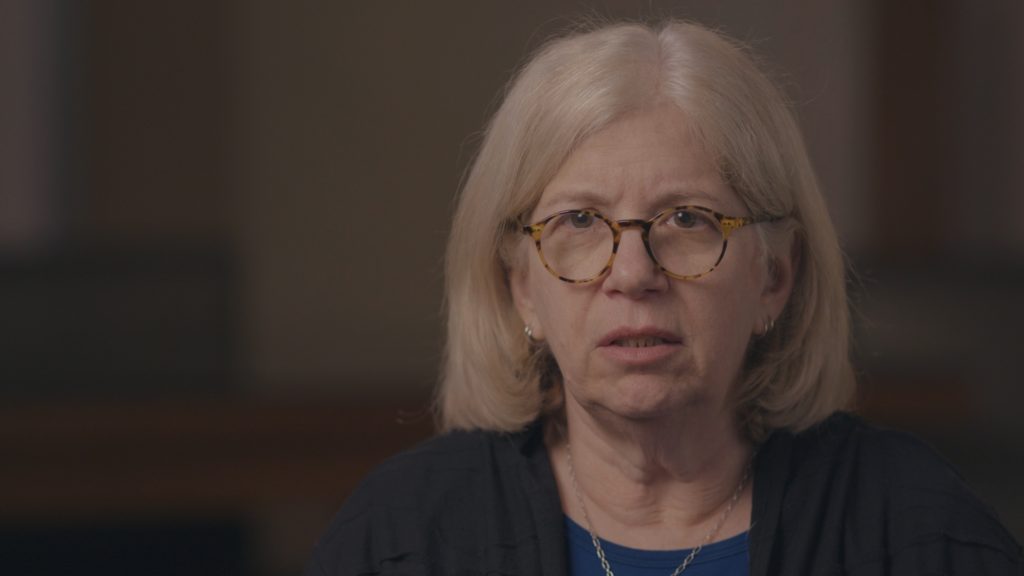
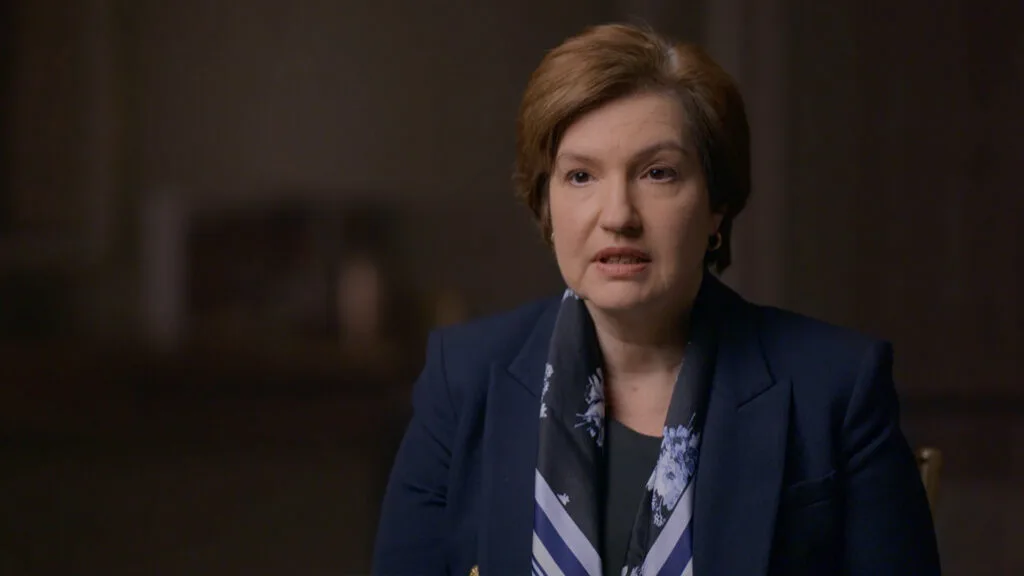
Ricki Seidman is a Democratic political strategist. She worked in the Clinton White House and advised opponents of the Supreme Court nominations of Robert Bork, Clarence Thomas and Brett Kavanaugh.
This is a transcript of an interview with FRONTLINE’s Jim Gilmore conducted on February 5, 2019. It has been edited for clarity and length.
So in ’87, when Reagan nominates Bork, when do you hear?How do you hear?What's his reputation?What are you guys thinking?
I can't say that I remember where I was or exactly the moment, but I very strongly remember what I was thinking, which was that Robert Bork was an extreme—you couldn’t even call him a conservative, because he wanted to upend decades of precedent that protected our constitutional rights.And his temperament was such that he clearly wasn’t open-minded.He had spent years on the D.C. Circuit, so people had a chance to see him in action, and cases were decided before people walked in the courtroom, so in terms of his views, his legal views.
Let’s get a little history here, your history.So you were working for Sen. [Ted] Kennedy (D-Mass.) at that point.What was your role at that point?
No.At that point, I was working for People For the American Way, and I was the director of their Judicial Selection Project.That project was created to examine the Reagan nominees, because Reagan really changed the approach to nominating judges.Prior to him, ideology was not the overriding factor.Reagan and his team had a philosophy of, “We’re going to put the youngest, most extreme judges on the bench, and they are going to continue our policy long after we are out of government.”
So when do you start working with Kennedy?
I started working with Kennedy in 1991, just prior to the [Clarence] Thomas nomination.
…So 45 minutes after Bork is nominated, Sen. Kennedy goes to give a speech in the Senate.Do you remember that speech?How surprising was that?How impressive, however you want to define it?
I remember it very vividly.I think he did something really courageous, and he got a lot of criticism for it.But the important thing was prior to Bork’s nomination, the inclination of senators was to vote for confirmation as long as the nominee was qualified, and Robert Bork was clearly qualified by virtue of education and experience.So what Kennedy did was he basically stopped the action, where after he gave his speech, certainly Democrats were not going to go to the floor to say that they support him.It really created an opportunity for people to look at his nomination.
And the view was that he wasn’t nominated because of his qualifications; he was nominated because of his ideology, so it was really important to consider his ideology as part of the confirmation process.
But Republicans of course said, you know: “You're changing the rules.This is not what advice and consent is supposed to be all about.”Why was it so important with Bork that ideology needed to be looked at?
Well, again, if you look at prior nominations to the court, the people who had—and I'm not a Supreme Court expert, so please get someone else who is more of an expert to say this than me.But you had people—Justice [John Paul] Stevens was not a liberal when he was nominated.Justice [David] Souter came later.But Justice [Lewis] Powell was a conservative who was nominated in part because he had written a very strong memo about segregation and was considered very anti-civil rights.And if you look at their records—well, even Justice [Earl] Warren, who was a Republican appointee.Justices—and when I went to law school, what I thought was the most qualified, the most fair people were the people who went on the Supreme Court.
It wasn’t what changed about the confirmation process; it was what changed about the nomination process.I think that people have missed that all along in terms of, they talk about how things changed with the Bork nomination and the opposition to Bork, but really, it was the selection of Judge Bork, specifically for his extreme ideology.That was what changed the entire process.
So the seat was Powell’s seat.What was at stake, and what did that add to the mix?
Well, Powell was, at that time, he was the [Antonin] Kennedy of the court.He certainly wasn’t a liberal, but he was someone who looked at every case that came before him and applied what he saw as the law.And that resulted in sometimes what was thought of as the Republican view would prevail, sometimes the Democratic view or the liberal view or the conservative view.Again, you need to get this more from someone who was more of a scholar of the court, but he was someone who wasn’t entirely predictable.
And the thing about Judge Bork was, he had written about everything.He had a view on everything.His views were way outside the mainstream, and they would have limited our constitutional rights.They would have led to rollbacks in civil rights.And he was, if you looked at him and his ability to influence others on the Court of Appeals, I think he would have been a very influential member of the court, as opposed to, say, Clarence Thomas, who is a vote, but doesn’t really work to—or doesn’t appear to work to bring over colleagues to his point of view.He just decides as he sees it.
So Kennedy’s speech clearly—all of you, the folks in your situation, as well as certain people on the committee and such, were expecting that Bork was going to be or was probably going to be the nominee.
Yes.
So everybody seemed to be pretty prepared.
Yes.
When Kennedy laid out sort of the case, some people will say that he went overboard, that he went too far, even Democrats and stuff.Why was it so important?Why do you think Sen. Kennedy decided that this was a place he was going to plant his flag?
I think in order to focus attention—I can't speak for the senator, and there are people around who worked for him at the time.But I think it was clearly to create awareness that something different was happening here than in previous nominations and that senators and the world needed to understand that.And I think if he hadn't done that, you would have seen this trickle of particularly conservative Democrats who would have just reflexively said they would support him.
So this changed.That speech had a large effect.
I believe it did.
Energizing Civil Rights Groups Against Robert Bork
The civil rights groups, other groups were working with Kennedy.To some extent, there was some coordination about, because this was very important.Why did people come together around this nomination?Was it sort of all thought that this, indeed, was going to be a fight, that all would have to fight at some point?So it wasn’t that surprising?Or when you look back at it, what was taking place, and why?
Well, the court was balanced.And this was replacing Lewis Powell, and Robert Bork was going to shift the balance of the court in a very extreme way.
And so—
And Supreme Court appointments, as you know, are lifetime appointments.We have people who have sat on that court for 30-plus years.
And I guess what I'm getting at, how did it motivate not only Sen. Kennedy, but people in civil rights organizations, people who had—this was the core.This was very, very important to—how did it motivate lots of different groups, and how did it work?
Well, I think of it—and this is in hindsight—but I think this is what I thought at the time.It was very energizing, because it created an opening, because what we had to do was not talk about this, not explain this to people in the way of, “He’s going to vote wrong on this case; he’s going to vote wrong on that case,” but to help people understand that a judge’s temperament included this extreme ideology, and so that was a basis to oppose the nominee, because prior to that, it was disqualifications in temperament.And to my knowledge, people weren’t, other than very basic questions, they weren’t looking for someone’s ideology in considering the nomination.
So an important thing to do was to motivate people, of course.Then how did it come about that the Gregory Peck ads, and this real campaign grew out of your organization, other organizations and such, to convince people?Especially with things like Gregory Peck doing an ad and such, how important was that to motivate people, and why was it done?
Well, traditionally conservatives have paid more attention to court nominations than the rest of the world.Most people don’t have a clear sense of how the Supreme Court affects their daily life.They only experience it after bad decisions, and even then, they don’t usually ascribe those decisions to the Supreme Court.So it was important, at the same time that we were conveying that Bork was not qualified by virtue of being intemperate, that people understand the importance of the court in protecting our rights.And that is how People For arrived at the idea of doing an ad, which was, as far as I know, the first ad that was made about a Supreme Court nominee.
Since then, the other side took that up in spades.But Norman Lear, who founded People For the American Way, was a strong believer in the power of video, and I think he personally reached out to Gregory Peck, and that was how the ad came to be.
And how successful was it?
That’s hard for me to answer, because I don’t have any measure of its effectiveness.It certainly helped raise attention.The public was opposed to the Bork nomination.So I believe that it contributed to information that people got about the nomination.But I think that the person who defeated Robert Bork, ultimately, was Robert Bork.
Robert Bork’s Testimony
Take me to his testimony and what it was like, whatever you can remember.He certainly was open to discuss his point of view.What was it like watching him?
Well, one, I don’t know—I've not met him in person.I don’t know whether he would have been coachable.But I don’t know that anyone who was working on his nomination thought there was any serious chance that he was not going to be confirmed, because they were looking at this through this traditional lens.Even though, again, they were the ones who changed the rules, they weren’t thinking about what the reaction to that might be.So Bork was very open in his testimony and talked quite a bit.And I think that was what did him in, to the point where very conservative Democrats like Howell Heflin from Alabama opposed his nomination.
…What were you doing?I mean, what was your role?
My role was helping bring together tremendous amount of research and understanding about his record and make it understandable to people.Because as you know, a lot of lawsuits, legal cases, legal decisions sound like a lot of gobbledygook to most people when they have actual real importance.So that was mostly what I did.And I worked with other organizations.There were some terrific organizations that not just worked on the nomination, but produced—Public Citizen Litigation Group, for example, did a study of Bork’s opinions and published it in a small book so that you could look at the way he looked at corporations versus individuals, the way he decided cases in a wide range of areas.They did an objective study.
The Defeat of Bork as a Turning Point
…So looking back at it, to this day, Republicans look at this, and they call it the original sin.They focus on the Democrats and how they defeated this highly educated judge, highly respected in the conservative circles.Why?When you talk to people that have that attitude, what do you say to them?
Judge Bork was the first time that a nominee was defeated because of their extreme ideology.And like I said, from my perspective, it was a change from history that he was appointed because of his ideology.Yes, he had a long career.Yes, he was on the D.C. Circuit; he had taught at Yale; he was celebrated in conservative circles.But the reason why he was named—there are always many people who are qualified to be on the court.He was named in order to push the court in a direction, and he was the culmination of a number of judicial nominations that Reagan had made in that direction.It wasn’t like he was just the first one—Alex Kozinski, Jeff Sessions, Daniel Manion, who looks like a moderate in hindsight, compared to nominees that come now.
So it wasn’t like this was just out of the blue that they came up with this new idea.He was part of what had become their strategy for the courts.…But this is one of those times when they started in the middle of the story, not the beginning of the story, or they—when I, in my view, they’ve changed the perspective of history.And what in general happened was that the Democrats viewed this as this happened, and then they move onto the next thing, and Republicans couldn’t move on.They also saw an opportunity to mobilize their own base, and since that point, they’ve been mobilizing their base with judicial nominations.
The Nomination of Clarence Thomas
… Let’s talk about Clarence Thomas. So ’91. So where are you now, and sort of where are you when you hear of Clarence Thomas being nominated for the [Thurgood] Marshall seat?
So I had been talking to the Kennedy office about becoming the chief investigator for the Labor Committee.They had a very celebrated investigator, Walter Sheridan, who had been with Kennedy, I think his entire tenure in the Senate, and he was retiring, so I was invited to replace him, which I still think of as the biggest honor I've ever had in getting a job. The ground rules were that unless there was a Supreme Court nomination, even though I had worked a lot with the Judiciary Committee, my job was to work with the Labor Committee, which focused on labor and education and health issues, and I was going to stay away from the Court.
But after I accepted the job, and before I had started, Thomas was nominated, and I had to move up my start time in order to get there and start working on Thomas.And my job in the Thomas nomination was the Judiciary Committee was working on all of his legal opinions and legal things that he had done, you know, at his prior jobs.My job was to look at everything else, what kind of person he was, what his staff thought of him, what he had done as an administrator, all the things that would relate to temperament as opposed to his legal views.
Again, why?What was at stake here, and how was this a different sort of fight than, for instance, the Bork [nomination]?
Well, here with Bork you had an arch conservative or radical conservative replacing a moderate.In this instance, you had a radical conservative replacing the first African-American justice, who had been a legal giant.It wasn’t just what he had done, and that Justice Marshall was progressive; it was his storied career.And on the other hand, you had Clarence Thomas, who had spent some years in government and positions that were anti-civil rights, and then was elevated to the Court of Appeals for I don’t think it was much more than a year as a stepping stone to the Supreme Court.
And so you're not just replacing an African American with an African American.It was a slap in the face to the legacy of Justice Marshall.
So there's a lot at stake.
Yes.
But [then-Sen. Joe] Biden (D-Del.) and Kennedy were in an awkward situation.I mean, at that point, there were a lot of black organizations that were backing him.It was a difficult situation for Kennedy, for Biden?
I can't speak to Sen. Biden.I think Sen. Kennedy very quickly saw that, based on Judge Thomas’s record, that the color of his skin made no difference.He was going to undermine civil rights, civil liberties, and turn back the clock.So Sen. Kennedy was going to—he cared a lot about that.
But the answers?I mean, how difficult was it?How did Thomas react?I mean, Thomas came in, and he was selling bio.That seemed to be the tactic that was being used.He wasn’t going to be selling ideology.He was going to be selling the Pin Point, [Ga.], story.So take us there and sort of what you guys saw and how Thomas was presented.
Well, it was a very sophisticated branding marketing strategy, because Thomas didn’t have the legal background, and he didn’t have the qualifications, so the White House made it about his personal story in a way that I think warped his personal story.Not that he didn’t have a tough upbringing, but not all of it was as tough as they described.They went out of their way to emphasize things that didn’t square with what was on paper as his biography.
And they got Sen. [John] Danforth (R-Mo.), who was regarded as a moderate-ish, at the time, to be his protector.And Sen. Danforth had a lot of relationships across the aisle and was very effective in getting support for Judge Thomas before very early on, before anything happened.And I do think that there was no Kennedy speech that stopped people in their tracks the way they had been stopped in their tracks during Bork.
So fair to say that initially, during those early hearings, it seemed that Thomas was going to go through.
Yes.
Explain that.And then we’ll talk about Anita Hill.
The Thomas hearings were very different in terms of substance, because he wasn’t answering questions, and was very frustrating for Democrats.And he didn’t have much of a record.I think that one of the lessons that Republicans took from Bork was that they should look at people who didn’t have a long record, who hadn't written a great deal, because then you couldn’t find what they had written and use it against them.So I believe when he was pressed on Roe v. Wade, he said he had never said anything about it, never expressed a view, which I couldn’t tell you with evidence that he had.But everyone at that time was getting questioned before they were nominated as to whether they supported Roe v. Wade or not.
And I think that there was—I would call it maybe Bork fatigue.You know, it really was a very unusual event for the Senate to do what it did.
Allegations by Anita Hill
So Anita Hill’s story comes out.Talk a little bit about how her name becomes public, how you were sort of involved in that whole situation at that point, and the ramifications, and how that sort of became what it became.
As part of what I was doing, I talked to a lot of people who had worked for Thomas, both at the EEOC [Equal Employment Opportunity Commission] and the Education Department…I didn’t go back to my notes for this, but I had page after page of talking to people who had worked at the EEOC, who were very unhappy with how he had managed the EEOC.
And then you hear about Anita Hill?
And then I heard about Anita Hill, and I reached out to Anita.Anita had also had been interviewed in The Washington Post about Thomas’ views on Brown v. Board of Education.And I spent some time, because I was really interested in her sense of Thomas and what kind of justice he was going to be, and then started talking to her about the issue of sexual harassment and that I had been hearing that it came up.Ultimately she was very reluctant, initially, to talk about her own experience and said she wanted to think about it.And what she said at the time I will never forget for the rest of my life, which was, she said, “In my experience at the EEOC, the victim becomes the villain.”
I was also extremely sensitive to that.We’re talking about human beings whose lives are affected.I've seen that more recently with Christine Blasey Ford.So my boss was not really focused on the nomination as much at the time.And there was a man who also worked on the Judiciary Committee, who had been a law school classmate of Anita’s and was an employment lawyer, Jim Brudney, and when Anita decided that she was willing to talk about it, I connected her directly with Jim Brudney.
I think that what ultimately happened afterward was it was an extremely sensitive and difficult subject that the committee certainly hadn't dealt with before, and Anita was not interested in making her allegations public.She felt like it was her civic duty to convey to the Senate, but she was only willing to do that privately.
You’d have to talk to the Biden staff about why they were not proactive in talking to her once we knew what the situation was.But they weren’t.And ultimately they did send the FBI to interview her.She wrote an affidavit, and her affidavit was just sitting there, and people weren’t doing anything.And ultimately two reporters, Nina Totenberg and Tim Phelps, who were dogged investigators, pieced her story together.And her affidavit became public, and there you have it.
…So then take us to Anita Hill’s testimony, the specter of being before all these white men, older senators.Talk a little bit about the hearings.Talk a little bit about her presentation and the effect of that.
Anita Hill is one of the bravest people that I've ever met.I certainly don’t think I could have done what she did in her situation.And she was in a really tough position.She wasn’t campaigning against Clarence Thomas.She was merely presenting what had happened to her, which I believed was not just about Thomas as an individual, but really reflected how Thomas would view women in the context of the law.It was not just a personal treatment issue; it was about his qualifications to be an open-minded justice.
I certainly was riveted, and I think the world was riveted.It was CNN.Well, I don’t think there was any other cable network then.It showed all over the world.I heard from friends who were traveling in the Czech Republic that they stayed up all hours to watch her.She was just amazing.
And the way she was attacked by [Arlen] Specter (R-Pa.) and [Alan] Simpson (R-Wyo.), and Simpson who specifically says, “This is not a sexual harassment case.”Some of the things that were said when you were watching it, what were you thinking?
Well, my sense was that the Democrats were focused on being fair.They were listening to what she was saying, trying to understand it, and they weren’t on a side.The Republicans were not listening.Their goal was to destroy her, and that’s how they acted.The result that they wanted was to confirm Thomas, and she got in the way.She was getting in the way.
Clarence Thomas Alleges a “High-tech Lynching”
Think Clarence Thomas’s testimony afterward, and his anger, “high-tech lynching” statement and such—how did you see that?
I saw it as very effective for the audience that he needed to keep in his corner.And one of the things that the Republicans did that was I think central to these things was even now, if you go back and talk to people about [it], who might remember—and I meet a lot of people in their 20s, and a lot of millennials, at least until this past year, had never heard Anita Hill’s name—but that they remember two people, Clarence Thomas and Anita Hill.And to me, what the reality was, was someone who serially had mistreated women.Anita was the person who came before the committee, but it was a pattern, and it’s much easier to make it he said/she said when you're not looking at all the other women waiting in the wings.
Which is what happened.
Which is what happened.
The Nomination of Brett Kavanaugh
So Brett Kavanaugh is nominated.Again, a pivotal point or seat in the Supreme Court.Who is Brett Kavanaugh, and why that was so significant?
Well, Kavanaugh was a darling of the Federalist Society.He came to the bench having been more engaged on the political side than most people who ever make it onto the federal courts.…His work for Ken Starr—he worked for Ken Starr not once but twice; his work for Bush and in the White House Counsel’s Office before he went on the Court of Appeals.And you could see how controversial a figure he was, because it took him quite a while to get confirmed after he was first nominated.So he went through two completely different cycles.
And there were rumblings about Kavanaugh that started after the Neil Gorsuch nomination, because Kavanaugh was not on the original Federalist list, and then he was added to the list.And it was—there were people from his generation and his colleagues and friends all through the government, so he had, I presume, a lot of internal support for his nomination.
The hearings and how he presented himself to begin with—again, it’s, I guess, using the lessons learned from Bork, very difficult to get at.Of course there were all sorts of documents that weren’t released.
Well, that was, again, where the Republicans changed the rules, because previously—and the Democrats assiduously followed their requests.When Sonia Sotomayor was nominated to the Supreme Court, the Republicans asked the White House for documents from a board of directors that she had been on in the 1980s, and the White House provided them.Elena Kagan, all of her records having worked for the government, I think 95 percent of them were provided to the committee before the hearing, in time for people to review them.
In the case of Kavanaugh, one, if you're working to get someone confirmed, speed is of the essence, because the longer that they're hanging out there, the longer something can go wrong.There was such voluminous information that needed to be collected, I think the archives said it would take them until October to be able to collect all the information and review it, and the Republicans in the White House wanted him on the court by then.So they created a mock system where they had a lawyer for the Bush Foundation who was a close friend of Kavanaugh’s and later ran his confirmation war room, according to news reports, who was responsible for reviewing documents and turning them over, some very small percentage of documents, to the committee for review.
So it wasn’t just Kavanaugh himself who took advantage of that, and the lack of documents to obfuscate at his hearing about specific things, but it was the White House and the Senate working in concert to protect this voluminous record that would have been very unattractive to a broad range of people if they knew.
Allegations by Christine Blasey Ford
So let’s cut to the déjà vu moment when Dr. Blasey Ford's allegations first come forward.When it becomes public, how did you view it?Did you think, OK, here we go again?What was your estimation of what was coming out and the effect that it might have on the nomination?And then how [did] you get involved or brought in as an adviser to Dr. Blasey Ford?
So I first met Dr. Blasey Ford in the middle of August and worked with her lawyers and talked quite a lot with her.I was out in California for my job, and I met her and spent some time with her.My personal view was that she, one, it would be impossible for her to come forward anonymously, and she wanted to remain confidential, or her identity confidential.And for me, the calculation was, is this going to impact the outcome of the vote?And my personal view, which I expressed to her—I never told her to do one thing or another, but what I expressed to her was I didn’t think it was going to have an effect on the outcome, so that she needed to weigh how important it was to come forward versus the impact it was going to have on her life.
Why did you think that?
Because I had lived through Clarence Thomas and Anita Hill, and I didn’t see a great deal of difference in the Senate.If you look at the history of Mitch McConnell (R-Ky.) as leader, and you look just at the Merrick Garland nomination, you know he wasn’t going to lose.It just seemed like the fix was in.
So what was her reaction to that advice that you gave her?
She decided she was not going to come forward, and she asked Sen. [Dianne] Feinstein (D-Calif.) to maintain her confidentiality, and by that, she meant her confidentiality.I don’t know who was the person who started talking to the media about what had happened to her.She had talked to a number of people in the area, because she didn’t know what to do.She was looking for advice from people as to what to do, how to reach people to tell them what had happened, and ultimately that’s how she came to talk to Congresswoman [Anna] Eshoo.
But essentially, when it became clear that her story was going to become public, and it did become public without her name, she decided that she wanted to own her own experience, and she came forward.She did not choose to come forward.And there was no strategy about the timing.It was entirely because the story had leaked out.
So when you see her testifying, explain the woman that you saw; explain the fears that you had about what happened, and explain the effect that it had on America, on those senators.
Just like I said about Anita Hill, Christine Blasey Ford showed so much courage in sitting in front of the committee and giving her testimony, in answering questions that the committee had.She didn’t do moot courts like Brett Kavanaugh did.It was all her.She kept her own counsel, and she wrote her own statement, and she didn’t practice a single answer.What you saw was Christine.And I can't tell you how much I admire her.I think that this time—and her testimony was so powerful that it was days before the Republicans really attacked her.They focused more on defending Kavanaugh and on trying to claim very erroneously that there was no corroboration for her, for her story.
The fact that she had told not just one person, but several people, years before the nomination happened that she had had this experience, and described Kavanaugh even if she didn’t mention his name, was extremely clear corroboration for her story.And that was one of the things that Republicans stole from her in the recounting.The other thing was this whole idea of making this about one person.So it’s he said/she said as opposed to the pattern, which the committee didn’t explore with Debbie Ramirez and other people whose names didn’t become public.
Brett Kavanaugh’s Response to the Allegations
Kavanaugh’s testimony afterward, your reaction to that, and also if you know what Dr. Blasey Ford’s reaction to it was?
She didn’t watch his testimony.She finished testifying and then went back to her hotel.So I've not talked to her about his testimony.I thought his testimony was appalling for anyone who was a judge to exhibit that kind of temperament.I was shocked, actually, because it didn’t comport with anything I had heard about Kavanaugh.I have friends who thought of themselves as friends of Kavanaugh.And the vitriol, and the lack of respect for the Senate—talk about turnabout.If a Democratic nominee had done that to the Republicans, they would have just walked out of the room….The way he spoke to Sen. [Amy] Klobuchar (D-Minn.), it was horrific.But it was really clear—and Sen. [Lindsey] Graham (R-S.C.) was the first one out there with the hollering and, you know, outrage—that they were going to stand by him.And very quickly, when Jeff Flake (R-Ariz.) announced that he was going to vote for Kavanaugh, again, it felt to me like this wasn’t going to be any different.
And the lessons learned from all of this?As someone who’s seen it all happen before, what did you take away from it?
I think that the Republicans will stop at nothing to get their people confirmed.And certainly what we've seen with this president is that he refuses to admit defeat ever.And I think in other times, this was so severe, and I think because it was so true, Dr. Ford’s testimony was so compelling, that another president might have withdrawn the nominee.Dr. Ford herself said: “I understand the president is going to name a conservative.This is not about whether there's a conservative justice on the court.This is about whether this man, who assaulted me, is on the court.Why couldn’t he pick someone else?”
But I think that Mitch McConnell has ice in his veins when it comes to this.And there's a sense of, if you just keep going and don’t let anything get in your way, eventually you're going to break through.And you know, he held his caucus together.
Lessons of a 30-Year Battle over the Courts
There's been a long battle going on for 30 years, and it seems the Republicans have had a smarter way to go—have more interest in judges than Democrats, for whatever reason.When you look at this long game being played, and the victories that have been achieved by McConnell, and the fact that the court now has turned conservative, and might turn even more conservative before Trump leaves, what’s your impression?What's the lesson learned from this that we should understand?
You have to elect a Democratic president and Democratic senators.
Because?
Because it’s a lot easier to be for something than to be against it; that a minority has no power to stop the president when it comes to a judicial nomination.