![The Age of Aids [home page]](../art/p_title.gif)



Living with HIV (2005)*: 5,300 (Less than 0.1% pop.)
Receiving Drugs (2005): Fewer than 500 (12% of those who need them)
Est. AIDS Deaths (2005): Fewer than 500
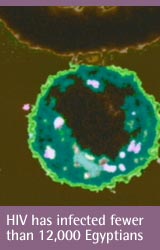
Egypt has a very low HIV infection rate -- only 0.1 percent. But if the disease does begin to spread, the nation's deep-seated cultural taboos could make the epidemic even worse.
An estimated 12,000 Egyptians are currently living with HIV/AIDS. But experts believe there's underreporting of cases because of insufficient surveillance and because, until 2005, the country had no anonymous testing centers. People who suspected they might be infected were unlikely to be tested for fear of being ostracized. And unless their cases were handled through the Ministry of Health, they were unable to receive the government's free antiretroviral drugs. Few Egyptians can afford unsubsidized drugs, which can run $400 on the private market.
Meanwhile, encouraging prevention of a sexually transmitted disease is difficult in a country where sex is rarely discussed and contraception is condemned. HIV is being spread primarily by unprotected sex: Half of all cases result from heterosexual intercourse and one fifth from homosexual intercourse, although UNAIDS reports that the social taboo against homosexual sex could be keeping the true number of infections artificially low. In conservative Egypt, homosexuals have reason to be wary. In a high-profile court case in 2001, 25 homosexual men were sentenced up to five years in prison for what the court described as "habitual debauchery."
For heterosexual couples, sex outside of marriage is condemned by both the Muslim majority and the Coptic Christian minority, and as a result, contraception is not widely used even though condoms are readily available from pharmacies. Discussion of contraception is not a part of sexual education in Egypt, and a 2003 survey by UNAIDS found that only about 57 percent of 1,252 university students in Cairo had ever seen a condom. Muslim officials, including Egypt's Grand Mufti Ali Gomaa, have said that teaching children about pregnancy and disease prevention would encourage sexual promiscuity.
So when 80 religious leaders from North Africa and the Middle East descended in Cairo in December 2004 for a conference held by the United Nations Development Program's Joint Programme on HIV/AIDS, the goal was to reach an understanding about a common strategy for prevention. Although these Muslim and Christian leaders stopped short of endorsing condoms, they agreed that preventing the spread of the disease was a joint priority. In what has become known as the Cairo Declaration, conference attendees stated: "Abstinence and faithfulness are the two cornerstones of our preventative strategies," but added:"We understand the medical call for the use of different preventative means to reduce the harm to oneself and others."
One innovative way Egypt has tackled prevention is through an anonymous HIV/AIDS hotline that is widely advertised in newspapers and in public transportation. It provides information about the disease as well as general sex education and receives more than 1,000 calls per month -- some from as far away as Europe and the Middle East. Dr. Nasr Al-Sayyed of the Egyptian Ministry of Health developed the hotline in 1996. Despite its popularity, Dr. Al-Sayyed has said his team must walk a fine line when providing information so as not to be accused of spreading "immoral propaganda."
* Note: Figures reflect most recent statistics from UNAIDS and the World Health Organization.