![The Age of Aids [home page]](../art/p_title.gif)



Living with HIV (2005)*: 63,000 (1.5% pop.)
Receiving Drugs (2005): 4,300-4,500 (36% of those who need them)
Est. AIDS Deaths (2005): 3,700
Honduras makes up only 17 percent of Central America's total population, but the country has 60 percent of the region's HIV cases.
In this small country of 7 million people, AIDS is the leading cause of death for women of child-bearing age and the second-leading cause for hospitalization and death. AIDS has orphaned 18,000 Honduran children.
Urban areas like the port of San Pedro Sula draw workers who fuel a thriving commercial sex industry and become hotbeds for the spread of HIV. Sixty percent of HIV cases are reported to be from heterosexual contact and the breakdown of male-female infections is roughly 1-to-1. Meanwhile, infection rates among specific groups -- including men who have sex with men, sex workers, the Afro-Caribbean Garifuna ethnic group, soldiers and prisoners -- is dramatically higher than the national average.
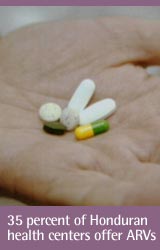
The government offers antiretroviral drug treatment through the nation's social security system, and 35 percent of health centers offer the drugs. The cost of the drugs is covered by patient co-pays, the Honduran government and Global Fund money.
In 2003, the Honduran government spent a total of $7.1 million on HIV/AIDS. Its National AIDS Commission (CONSIDA) was created in 1999 and oversees 15 national institutions. CONSIDA's plan, PENSIDA II for 2003-2007, calls for a multisectoral approach, and part of its focus is to reduce poverty. Two-thirds of the nation's population lives below the poverty line, and this is seen as a key issue in stemming HIV's spread. However, according to UNAIDS, the PENSIDA II plan is not adequately funded. In addition, the government must contend with opposition from a conservative society that resists condom distribution and sex education programs in school. There is no national condom distribution program.
In 2003, the Global Fund awarded $26.2 million to a program to promote education, reduce prejudice and improve health care in high-risk areas. Among the country's other external sources of funding is $5 million from the World Bank in 2003 and $5.2 million from USAID in 2004.
* Note: Figures reflect most recent statistics from UNAIDS and the World Health Organization.