![The Age of Aids [home page]](../art/p_title.gif)




Living with HIV (2005)*: 1.3 million (6.1% pop.)
Receiving Drugs (2005): 60,000-72,000 (24% of those who need them)
Est. AIDS Deaths (2005): 140,000
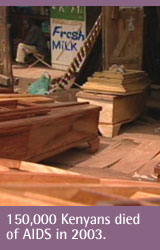
In Africa's fight against AIDS, Kenya is one of the more hopeful stories, but its challenges still seem daunting.
Although HIV/AIDS prevalence fell from 10 percent to 7 percent since the late 1990s, 150,000 Kenyans died of AIDS in 2003. That number is projected to rise as those infected in the 1990s succumb to the disease. Kenya has had success driving down infections in pregnant women, but infection rates among teenage girls are six times higher than among boys the same age.
The recent flow of international HIV/AIDS money into Kenya threatens to overwhelm its ability to coordinate a response. Only 37 percent of the country's 440 health facilities offer HIV testing; less than half have running water. And there are signs that the government's commitment may be faltering: A 2006 African Union report showed that Kenya allocated only 7 percent of its national budget on HIV/AIDS, rather than the 15 percent it had pledged to spend.
After failing to address the disease during the 1980s and '90s, Kenya worked to catch up with the progress of nations like Uganda and Senegal. President Daniel arap Moi led Kenya for 24 years, but only created the National AIDS Control Council (NACC) near the end of his tenure, in 1999. His successor Mwai Kibaki has been more active, declaring "Total war on HIV/AIDS" in 2003. Using monies from the Global Fund, the United Nations and Bush administration's President's Emergency Plan For AIDS Relief (PEPFAR), Kenya has rapidly expanded voluntary counseling and testing services, antiretroviral treatment and prenatal clinics for pregnant women.
The most immediate threat to Kenya's anti-AIDS efforts may be the country's endemic corruption. Kenya's anti-corruption czar was forced to resign and flee the country in 2005 after being prevented from investigating abuses by senior officials. In August 2004, NACC Director Dr. Margaret Gachara was found guilty of fraud for enriching herself with HIV funds.
The international community has taken notice: In February 2006, the World Bank withheld $24 million in loans to Kenya, as part of director Paul Wolfowitz's crackdown on corruption. In March 2006, the Global Fund threatened to cancel the remaining $100 million of its AIDS grant if the government didn't account for its spending, but in April it approved an additional $70 million. Also in March, the government's raid on The Standard Group, a media company and newspaper that reported on the graft scandals, sparked outrage and fear that the World Bank might withhold another $50 million earmarked for HIV/AIDS to be reviewed in June 2006.
* Note: Figures reflect most recent statistics from UNAIDS and the World Health Organization.