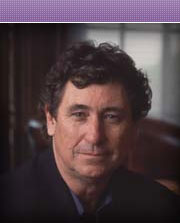
frontline marks 25 years on pbs: an interview with
executive producer David Fanning
Since January 1983, FRONTLINE has served as PBS' flagship public affairs series and has never shied away from tough, controversial issues or complex stories. January 2008 marks the beginning of FRONTLINE's 25th anniversary. FRONTLINE remains the only regularly scheduled long-form public-affairs documentary series on American television, producing more hours of documentary programming than all the commercial networks combined. In this interview with Public Media Digest, Executive Producer David Fanning shares some of its greatest moments and the exciting future ahead.
David, you began FRONTLINE 25 years ago. When you consider what the TV landscape was back then, did you think FRONTLINE would work and develop as it has?
When we began FRONTLINE in 1983, Current magazine called us "the last best hope for the TV documentary." I can't say I believed that then, but it was an inspiration of sorts. We knew all along that this was an extraordinary act of faith by the system-guaranteeing us the first three years to get it right-and all of us felt that we had to make it as good as we could, because we might never get another chance at it. I would often say to a producer that you have to make this the best film on this subject that's ever been made; no one else is going to give you this opportunity. It's been a great privilege to say that.
Is there anything else that developed in those 25 years that you'd compare to FRONTLINE, or anything you have seen during that time that made you say, "I wish we had done that"?
We have been copied over the years-remember Investigative Reports on A&E?-but they never seem to commit the resources to match FRONTLINE. I am occasionally irked by a documentary on another channel, wishing we had done it, but almost always it's because we had discussed it, and we passed because our schedule was full. ... But in general we've found that if we hesitate to do something because we hear that a network is going to do it, we should just ignore them and go ahead. What we do is usually so much better that it only proves the point of FRONTLINE and public television.
You have been at the helm since the beginning. Can you tell us about a high point and a low point for you over the years?
There have been so many high points that it's impossible to identify any one. There have been great individual films made by great producers and journalists; there have been awards, miniseries and terrific ideas that came out of unexpected conversations. In general there have been very few low points. I know that's hard to imagine in any endeavor, but the spread and breadth of the series has been an act of constant reinvention, and I have never failed to enjoy the editorial discussion.
Personally, I regret the time in the field that I have had to give up in return for staying at home base, but I have had such rich rewards, especially in countless editing rooms, where I've been allowed to have an influence on the shape and content of the films. Our producers have been very generous and trusting, and that collaboration and their support have kept me going. I have times when I think I should step aside, but I can see a younger generation coming along, and I am enjoying sharing the conversation.
FRONTLINE has been on the front lines-pardon the pun-with regard to online video. Your online player has been a breakthrough for PBS stations wanting to have the rich video content you have had for years on the FRONTLINE Web site, available on their own station Web sites for local viewers and users. What is the next generation of the player, and what do you hope it will accomplish? Do you see a day when online might overshadow broadcast? How can you keep an eye on developing both?
As you all know, we have been pioneers on the Web, trying to think ahead about its impact on our work. We created the first deep-content editorial Web sites in history, in 1995, and in 2000 began streaming our documentaries. We pushed forward with the player because we wanted PBS stations to be a part of this revolution, and providing a higher-end video player to stations for their own Web sites would give them a way to feature FRONTLINE and connect to their local audiences, and by co-branding claim the national broadcast as part of their own identity. It's also a way to encourage membership and contributions.
Of course the Web is a disruptive technology, and broadcasters are all struggling with how it will change what we do, just as DVRs are changing viewing habits. The marquee value of FRONTLINE on the air is invaluable, though, and we have to keep thinking of the two media, broadcast and online, as interconnected platforms. We need to use each to reinforce the other.
There has been much buzz recently about "citizen journalism." What does this mean to you and FRONTLINE, a series that prides itself on journalism?
There could be a place in public broadcasting, to live up to its name, for citizen journalism, but FRONTLINE's mission is a broad and demanding one, and it requires professional journalism. This is a highly manipulative medium, and it takes a rigorous editorial process to make a guarantee to the viewer that the work is trustworthy. We've earned that over the years, but that's because we're not an anthology series, gathering finished works, but a journalistic entity initiating and reviewing the films from their inception, with a few exceptions.
It is widely known that there is a small group of accomplished producers and journalists that work on FRONTLINE, yet there have been several films in the FRONTLINE series of late that come from PBS stations, such as "The Meth Epidemic" from Oregon Public Broadcasting, and from independent producers, such as "So Much So Fast," about the Heywood brothers and their fight toward a cure for ALS. As executive producer and curator of FRONTLINE, why do you work with the producers you do, and when and how do you select a partnership with a station or select a film from an independent? What are the benefits and drawbacks of all these scenarios for the series?
There have been over 100 producers who have worked on FRONTLINE films, but in general we work with what I call the "repertory company" of about 20 producers, people whose exceptional work has earned them a chance to turn around another film. We've worked at getting some new, younger producers into that mix as well. The strength of that is obvious: We know and trust each other, and we can assign them stories much as if they were part of our staff.
Among the thousands of proposals we receive, there are very few that come to us from individual stations. In the case of OPB, we approached them because we were interested in an investigative series on methamphetamine that had been published in The Oregonian, and we proposed a co-production based on the newspaper articles. It was an opportunity to shoot what had already been researched and to do a mostly local shoot that had national implications. OPB put in a lot of in-kind resources to get it done, and it was a very successful collaboration.
There are fewer and fewer opportunities for co-productions in general these days. Our former partners in the U.K. have been reduced to making local, low-budget and often tabloid-y programs. There is almost nothing like FRONTLINE produced anywhere else in the world, so we are forced to hunt down opportunities to fill our schedule. We try to originate as much as possible, but occasionally we can find a film, like "So Much So Fast," which, while it breaks the mold for FRONTLINE, is quite simply a stunning piece of up-close documentary journalism. We know and trust the team, and we were pleased to give them a venue. But those are the exceptions.
Another election year is upon us, and FRONTLINE's "The Choice" is a well-established tradition to help better inform the electorate. Any other election plans?
We have proposed a second two-hour special to PBS as a companion piece to "The Choice" in the fall of 2008. We are proposing "The War Briefing," which takes as its proposition that this is the most important issue facing the new president, and he or she deserves a good and clear briefing on the options. Using a combination of documentary footage, interviews and formal presentations, we will try to bring together the best people to lay out the situation on the ground in Iraq and in the region and, with military strategists, diplomats and policy experts, take the measure of the candidates' stated positions from the campaign.
We're also proposing an exclusively online set of reports on FRONTLINE/World's Web site called "The World Is Watching," with reports from around the world about the American election. We did a pilot of this in 2004, and it was very successful.
How did you develop the concept of FRONTLINE/World with other programs-such as "Wide Angle"-that explore current affairs with a global focus?
FRONTLINE/World was in development in the fall of 2001 as a broader idea to develop a relatively low-cost magazine concept for public television, and also to fill the urgent lack of international programs at a time of crisis. It met two needs: FRONTLINE can only do a few international programs, and they almost always have a strong U.S. angle, which is limiting. In addition, we need a place for younger producers to get a crack at a broadcast. We have very few places for a new generation of smart, digitally literate broadcast journalists to ply their craft. There are lots of filmmakers around making personal films, but we are trying to pass on the skills and discipline of broadcast journalism. The program is based at the Graduate School of Journalism at UC Berkeley, and it has been a great incubator of talent, as well as a place that has drawn attention from many younger producers, with over 64 broadcast reports from 62 countries.
Two years ago we turned it upside down and decided to make it an essentially Web-based idea with occasional broadcasts, and a new continuing series of Web-exclusive videos, called "Rough Cuts," produced in collaboration with our editorial team. This year four of those stories have been nominated for the News and Documentary Emmys. I urge anyone interested to look at the Web site (pbs.org/frontlineworld) and click on the map icons to look at the range and variety of the stories that are up as streaming video. There are another 50 or so "Rough Cut" stories online. There's something very special going on here, which I think is what we're supposed to do in public broadcasting.
This has been the purpose of FRONTLINE/World; it is a place to experiment and innovate. I sincerely believe that it is a better mousetrap-not all international stories deserve the full one-hour treatment-and we can get a good mix of hard investigative as well as softer but important and optimistic stories. I have always thought that it did not have to remain an exclusively international series, but with some domestic stories could be a model for a new, vital program strand.
You and FRONTLINE recently received the Edward R. Murrow Award for "distinguished achievement displaying journalistic integrity and courage" from Washington State University. Add this to an impressive list of Emmys, Peabodys, duPonts and others. How do you maintain that level of quality on one hand and continue to create an environment that requires constant improvement on the other?
It had been a great honor and privilege to lead the series, but I always feel a bit of an impostor when I stand up and receive the awards. It's really the collective work of the producers and journalists. I am in awe of how hard they work. I have seen the obsessiveness with which they dig into the stories-the detailed timelines on the administration's decisions that have informed Mike Kirk's films on the war are worth publishing in their own right-and I know how passionately they believe in what they're doing. It's to our collective honor in public television that we give them the resources and the time-especially the time-to do this work.
With less and less in-depth reporting and journalism taking place in America, what do you compare FRONTLINE to in order to stay competitive? How do you see the state of journalism in America in general and on TV specifically?
Sadly, we have less and less competition. We have a unique franchise, and while there are many, many people who care deeply about investigative journalism and how important it is for the country and the culture, we are pretty much alone in what we do. There are exceptions, like CNN's recent series on fundamentalism, but then we feel we've done much of that reporting spread over the last six years. We have an obligation to keep doing it.
Our series on journalism, "News War," told the big story on the changing face of American journalism. There are more and more talented reporters leaving their newspapers as investigative units get axed and publishers try to go "hyperlocal." I believe that this is the most important time for public broadcasting to take advantage of the vacuum that is being created. I think we could do much more and fill a need in the same way that NPR has done. FRONTLINE is a brand that is deeply respected in journalistic circles, and I would love to see us leverage that strength and enlarge the series and its reach.
-Interview courtesy of Public Media Digest.
 THOUGHT PROVOKING JOURNALISM