1976 Domingo Ulloa Oil Painting
GUEST: I brought a painting by Domingo Ulloa. He's a local artist from El Centro. The little information I have about him is the California State Assembly passed a resolution declaring him the father of Chicano art. One Saturday morning my wife sent me to go get some eggs and I happened to be driving by a yard sale, and the painting caught my eye and I asked the gentleman if it was for sale. He said it was. I said, "I'll be right back when I get back from the market." I purchased it...
APPRAISER: So you went and bought the eggs first.
(laughing)
APPRAISER: Okay, but it was still there.
GUEST: Eggs came first.
APPRAISER: How much did you buy it for?
GUEST: I bought it for $15.
APPRAISER: How long ago did you purchase the painting?
GUEST: I purchased this in 2010.
APPRAISER: And then you took it home and put it up on the wall?
GUEST: No, my wife, she said it was too ugly to go on the wall. Well, I like it. To me, it tells me what the migrant farm worker would do on a weekend after probably a hard week of work. And this is how they would relax and entertain themselves on the weekend, a little dancing, food, a little drinking, and, of course, you can never forget the music.
APPRAISER: Domingo Ulloa, he was named the father of Chicano art, and this painting actually has a lot of themes in it which deal with the Chicano movement, and as well as the Chicano art movement. The medium looks like it's oil on Masonite. He was very much influenced by certain social movements, as well as certain art movements. Now, the social movements were the United Farm Workers, run by Cesar Chavez, so he was influenced by the progressive politics of that particular movement and that particular individual. Also, as an artist, he was influenced by Los Muralistas. Now, when I talk about them, I'm talking about three main guys, although there were others. I'm talking about Diego Rivera...
GUEST: Wow.
APPRAISER: ...David Siqueiros, and Orozco, Jose Orozco. They were famous for their mural paintings, especially, but they were all social-minded paintings in terms of themes. A lot of them had even socialist or communist, sometimes, themes and subjects going on, things having to do with labor. So you can actually tell here, we're talking about the same kind of subject matter. This is labor that was very often oppressed, the farm workers. That's why that whole movement came into being. Ulloa, as an artist, his work was very political. Now, this is not necessarily a picture of oppression. This is more like a happy painting.
GUEST: It's more a happy scene.
APPRAISER: Right. Now, he studied at the Antigua Academia de San Carlos in Mexico City.
GUEST: Oh, wow.
APPRAISER: Even though he was born in Pomona.
GUEST: Pomona.
APPRAISER: So he went there to study. And he was also very influenced by the Taller de Gráfica Popular, which was also an artist movement that had a lot of socialists and revolutionary kind of ideas. So, again, we're talking about an artist whose other work was very, very revolutionary and inspired. In 2012, there was an exhibition of Mexican-American artists.
GUEST: Yes, there sure was. It was at the Gene Autry Museum. It was called "Art Beyond the Hyphen." And a lot of his work was there. One that really stood close to me was one that was called "Los Braceros," where basically they had all these farm workers kind of caged up.
APPRAISER: Right. I think the fact that they had an exhibition in 2012, it shows that there is an increasing interest in Mexican-American art and Chicano art, in particular. Now, what is interesting to think about is that this painting is from 1976.
GUEST: Correct.
APPRAISER: Now, to a certain extent, these artists were forgotten. I think there's a reason that you found it driving on your way to get some eggs. He went to a very good school in Mexico City. He was a trained artist. But his theme in the 1960s and '70s had more to do with that kind of revolutionary communist theme, rather than abstract expressionism and modern art, which was popular in America in the '60s and '70s. But now, things are changing. There's more of an interest in Chicano art and Chicano culture. And I think what's going to happen is that's going to become something that happens more and more, that there will be more and more interest. If I was going to put it at auction, I'd put an auction estimate on it of $3,000 to $5,000.
GUEST: Very nice.
$3,000 - $5,000 Auction
$3,000 - $5,000 Auction
Featured In

episode
Palm Springs, Hour 1
A 1965 Noah Purifoy sculpture, an Archie Bunker coat, and a Franz Bergman lamp.
2D & 3D Art Media
appraisal
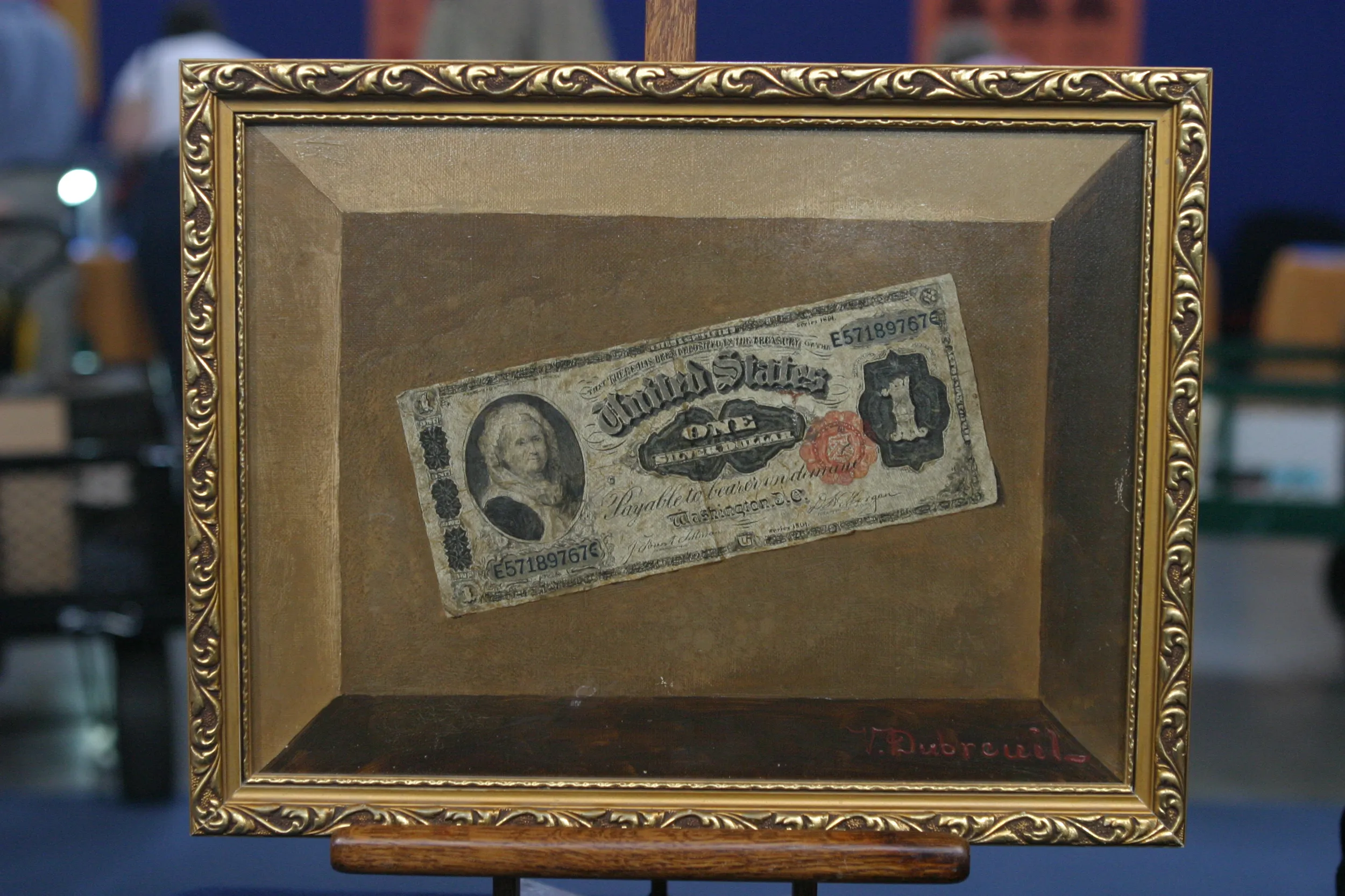
Victor Dubreuil Oil Painting, ca. 1891
appraisal
Early 20th C. Yates & Curran Oils
appraisal
F. T. Johnson Painting, ca. 1931

appraisal
American School Portrait, ca. 1820
Understanding Our Appraisals
Executive producer Marsha Bemko shares her tips for getting the most out of ANTIQUES ROADSHOW.
Value can change: The value of an item is dependent upon many things, including the condition of the object itself, trends in the market for that kind of object, and the location where the item will be sold. These are just some of the reasons why the answer to the question "What's it worth?" is so often "It depends."
Note the date: Take note of the date the appraisal was recorded. This information appears in the upper left corner of the page, with the label "Appraised On." Values change over time according to market forces, so the current value of the item could be higher, lower, or the same as when our expert first appraised it.
Context is key: Listen carefully. Most of our experts will give appraisal values in context. For example, you'll often hear them say what an item is worth "at auction," or "retail," or "for insurance purposes" (replacement value). Retail prices are different from wholesale prices. Often an auctioneer will talk about what she knows best: the auction market. A shop owner will usually talk about what he knows best: the retail price he'd place on the object in his shop. And though there are no hard and fast rules, an object's auction price can often be half its retail value; yet for other objects, an auction price could be higher than retail. As a rule, however, retail and insurance/replacement values are about the same.
Verbal approximations: The values given by the experts on ANTIQUES ROADSHOW are considered "verbal approximations of value." Technically, an "appraisal" is a legal document, generally for insurance purposes, written by a qualified expert and paid for by the owner of the item. An appraisal usually involves an extensive amount of research to establish authenticity, provenance, composition, method of construction, and other important attributes of a particular object.
Opinion of value: As with all appraisals, the verbal approximations of value given at ROADSHOW events are our experts' opinions formed from their knowledge of antiques and collectibles, market trends, and other factors. Although our valuations are based on research and experience, opinions can, and sometimes do, vary among experts.
Appraiser affiliations: Finally, the affiliation of the appraiser may have changed since the appraisal was recorded. To see current contact information for an appraiser in the ROADSHOW Archive, click on the link below the appraiser's picture. Our Appraiser Index also contains a complete list of active ROADSHOW appraisers and their contact details and biographies.