1979 - 1981 Iran Hostage Archive
GUEST: It was 1979, the American embassy in Tehran, Iran. 52 Americans were stripped of their freedom, their dignity and their pride, known as the Iran Hostage Crisis. That lasted 444 days. The Shah had fled in January of 1979. The government of, uh, Islamic Republic of Iran was formed. I arrived October 7. When we were taken hostage. I was a young 22-year-old kid. My part at the American Embassy was a Marine security guard. And I'm happy to say that for four hours that morning of November 4, seven Marines held that American Embassy, waiting for the host government, the Islamic Republic of Iran, to come to free us. But that never happened. They basically broke through the basement window and attacked the embassy. President Carter at that point in time said, uh, to give ourself up, that, uh, they were going to work on diplomacy to basically free us. Well, that lasted 444 days.
APPRAISER: What was it like being a hostage?
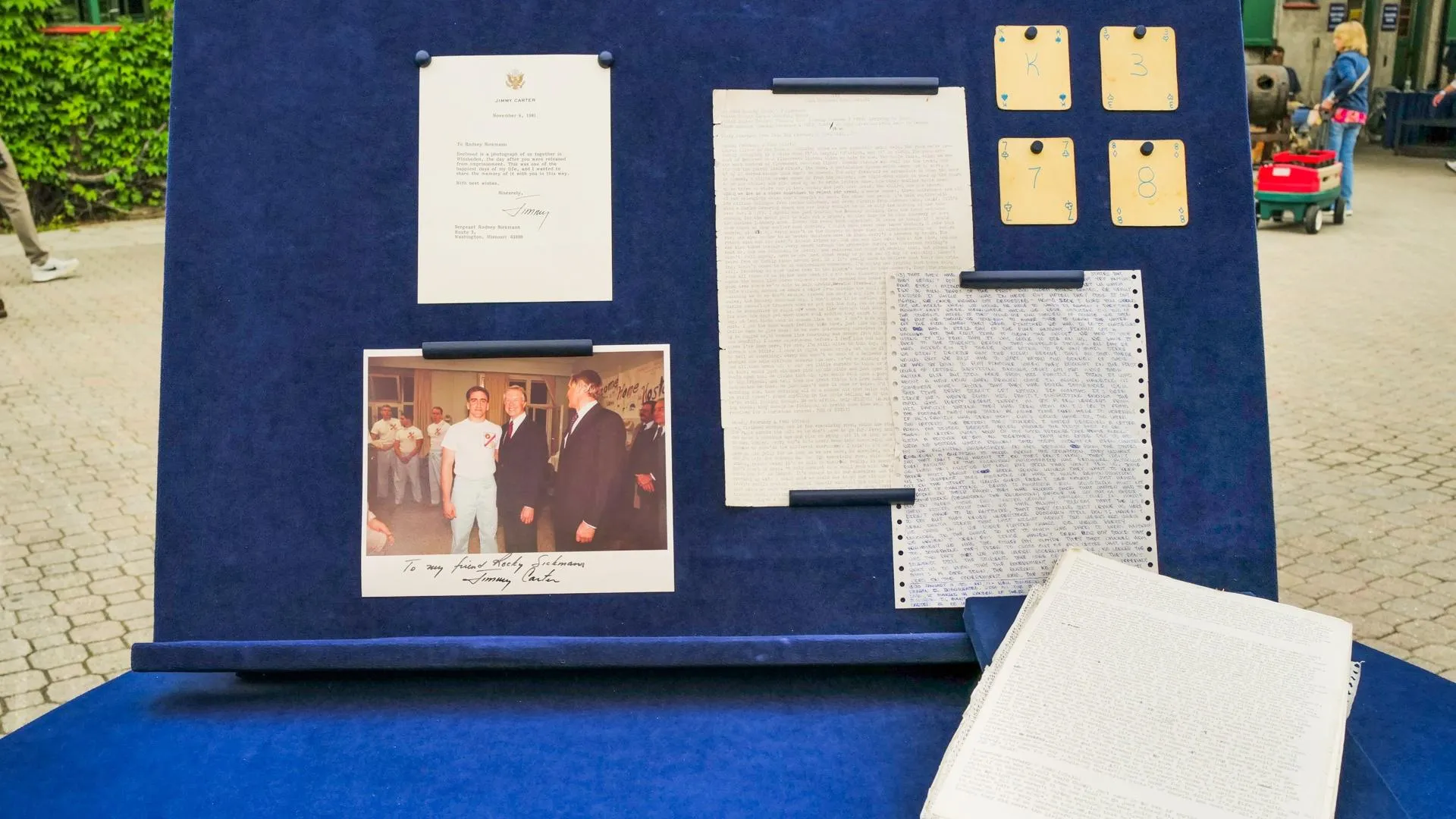
GUEST: The first 30-plus days, we sat tied to a chair and not allowed to speak. It wasn't Until January of 1980 I was put into the room with Billy Gallegos, another Marine, and Jerry Plotkin, the only American civilian. And in that room, we came up with something to do. And that consisted of those, uh, playing cards that we created. We were locked in that room-- we went outside seven times out of 444 days. We were put into offices of the American Embassy. And in the offices, there was a table with a typewriter. The Islamic Republic of Iran, they wanted us to write derogatory statements to our government asking for the Shah to return. Uh, instead, I took the paper, started typing my diary, which really helped me pass the time. Within weeks, they took the typewriter away. Then I just got the paper and I started writing the diary. There was about 600 pages. Every time I would move, I would put it in a plastic bag and tie it around my thigh. January, uh, 20, 1981. When we were let go, uh, that night, I had it in a plastic bag. I took two socks, again, tied it around my thigh, and I didn't take it off my body until we got to Germany.
APPRAISER: That's the first page when you had the typewriter?
GUEST: Yes, sir.
APPRAISER: That's the last page just before you put it around your leg.
GUEST: Yes sir.
APPRAISER: And you brought it out of the country.
GUEST: Yes. So we get to Germany and President Carter, he jumped on Air Force One and came over immediately to meet with us.
APPRAISER: When did you get the signed picture and the note?
GUEST: It was that year of November 1981. Uh, he had presented each one of the hostages.
APPRAISER: The note that Jimmy Carter sent? Now, he was not president at the time, Reagan was president.
GUEST: Yes, sir.
APPRAISER: But can you read a little of that?
GUEST: It "is a photograph of us together in Wiesbaden "the day after you were released from imprisonment. "This was one of the happiest days of my life, and I wanted to share this memory with you in this way."
APPRAISER: The two items of Jimmy Carter, usually, the more valuable items would be when they were president. But the sentiment that he expresses by sending you that picture and saying, this is one of the happiest days of his life, I think easily an insurance value would be $5,000 on the pair of them.
GUEST: (chuckling)
APPRAISER: You have four cards of the deck. People collect cards, people collect P.O.W. items. So the cards, an insurance value, I would say would be $2,000.
GUEST: Wow.
APPRAISER: When people are looking for diaries, the reason they buy it, one, is because... ...the information in it is unknown. In other words, it's something that can be studied. It's bringing forth new information. The other reason you buy it is it's a, a great item in and of itself. It's a display piece-- you published a book. From what I understand, the book is almost covering word-for-word.
GUEST: Yes, sir.
APPRAISER: So in a way that cuts what somebody might pay for it.
GUEST: Right.
APPRAISER: An insurance value, I think, is more on the $20,000 value.
GUEST: Got it.
APPRAISER: It's a priceless piece because it was really a way for me to survive each day and think of home.

$27,000 Insurance
Photos
Featured In
episode
Grant's Farm, Hour 3
Catch a crop of ROADSHOW discoveries in our final hour at scenic Grant’s Farm in St. Louis, Missouri! — Mon, May 11, 2026
Paper and Cardboard
appraisal
7th Cavalry Archive, ca. 1876
appraisal
Coca-Cola Founder's Family Photos, ca. 1900
appraisal
Maurice Utrillo Lithograph, ca. 1925
appraisal
John F. Kennedy Inscribed Book
Understanding Our Appraisals
Executive producer Marsha Bemko shares her tips for getting the most out of ANTIQUES ROADSHOW.
Value can change: The value of an item is dependent upon many things, including the condition of the object itself, trends in the market for that kind of object, and the location where the item will be sold. These are just some of the reasons why the answer to the question "What's it worth?" is so often "It depends."
Note the date: Take note of the date the appraisal was recorded. This information appears in the upper left corner of the page, with the label "Appraised On." Values change over time according to market forces, so the current value of the item could be higher, lower, or the same as when our expert first appraised it.
Context is key: Listen carefully. Most of our experts will give appraisal values in context. For example, you'll often hear them say what an item is worth "at auction," or "retail," or "for insurance purposes" (replacement value). Retail prices are different from wholesale prices. Often an auctioneer will talk about what she knows best: the auction market. A shop owner will usually talk about what he knows best: the retail price he'd place on the object in his shop. And though there are no hard and fast rules, an object's auction price can often be half its retail value; yet for other objects, an auction price could be higher than retail. As a rule, however, retail and insurance/replacement values are about the same.
Verbal approximations: The values given by the experts on ANTIQUES ROADSHOW are considered "verbal approximations of value." Technically, an "appraisal" is a legal document, generally for insurance purposes, written by a qualified expert and paid for by the owner of the item. An appraisal usually involves an extensive amount of research to establish authenticity, provenance, composition, method of construction, and other important attributes of a particular object.
Opinion of value: As with all appraisals, the verbal approximations of value given at ROADSHOW events are our experts' opinions formed from their knowledge of antiques and collectibles, market trends, and other factors. Although our valuations are based on research and experience, opinions can, and sometimes do, vary among experts.
Appraiser affiliations: Finally, the affiliation of the appraiser may have changed since the appraisal was recorded. To see current contact information for an appraiser in the ROADSHOW Archive, click on the link below the appraiser's picture. Our Appraiser Index also contains a complete list of active ROADSHOW appraisers and their contact details and biographies.