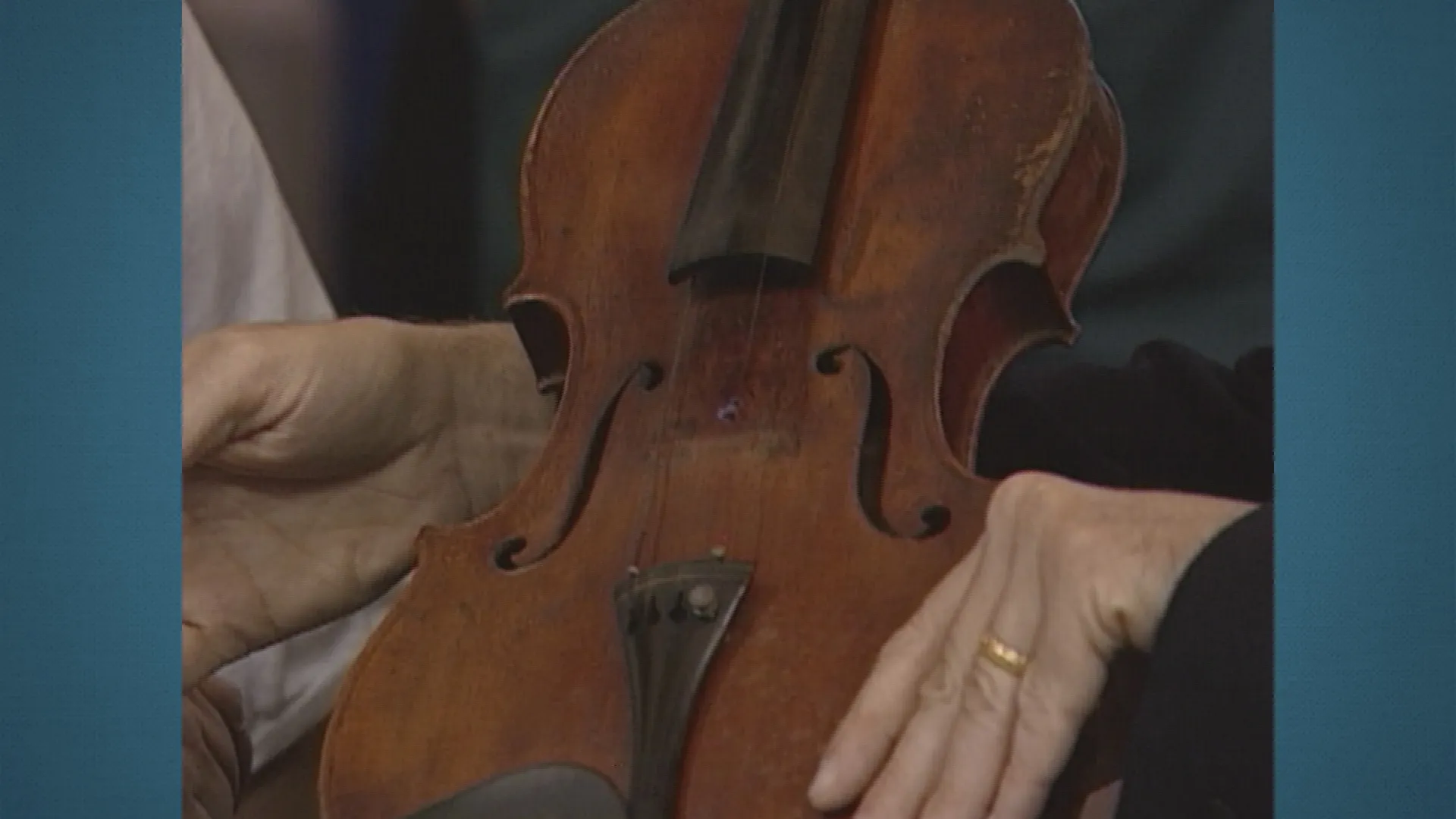
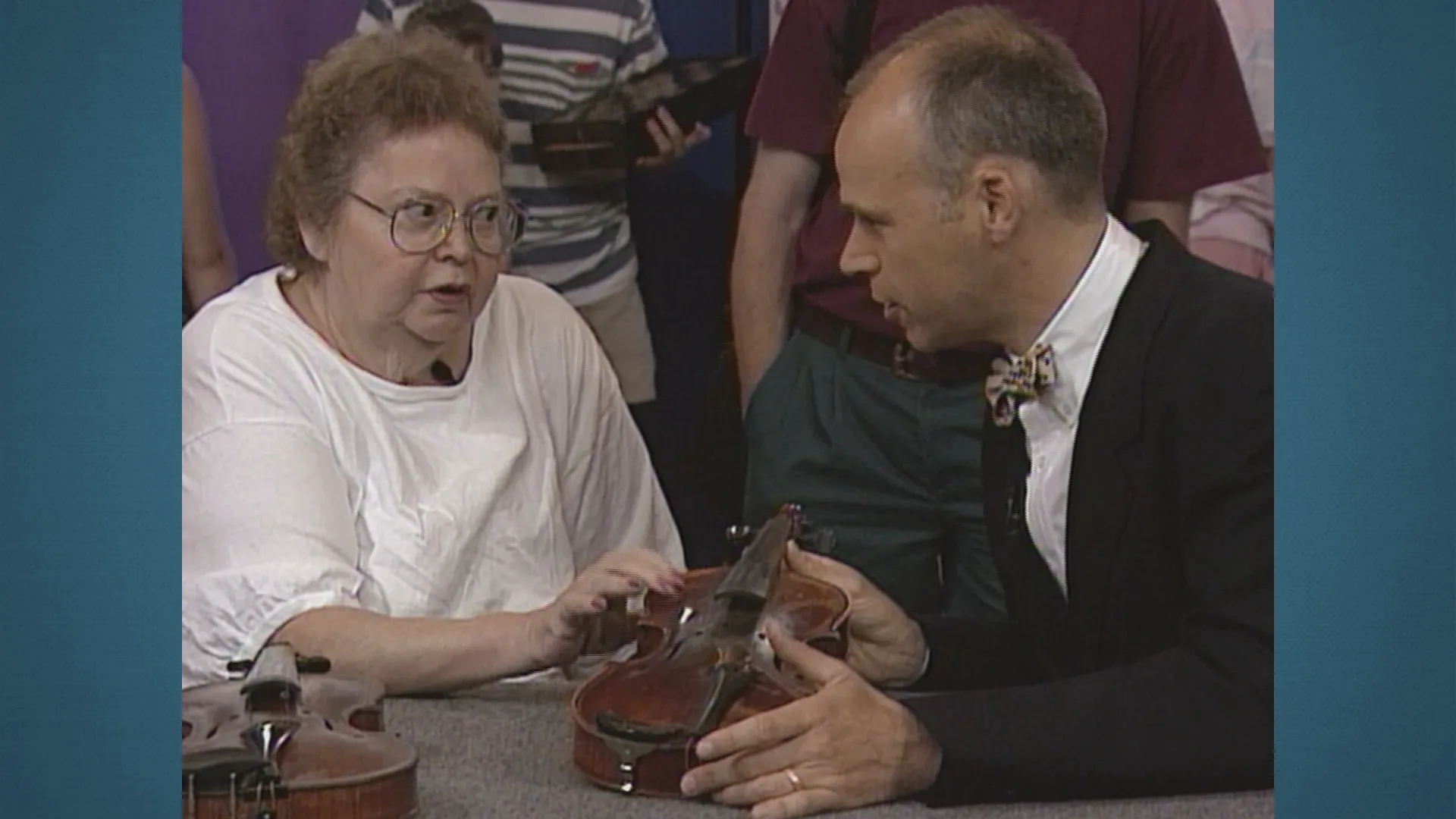
Hammig-attributed Violin & German Violin
APPRAISER: You've brought two instruments, I see.
Um... GUEST 1: Right.
APPRAISER: But you both play these, is it?
GUEST 2: No, no.
APPRAISER: No?
And whose instruments are these?
GUEST 1: They were my, my adopted father's.
APPRAISER: On down.
GUEST 1: And I think this was passed down from my to my father, from my grandfather.
APPRAISER: From your grandfather, so a representation here of four generations, amazing.
GUEST 1: Or more.
APPRAISER: Or more.
Can you tell me anything about this instrument that, that you know about?
The history of it?
GUEST 1: The only thing that I know is that my grandfather and my father both played it.
APPRAISER: And what did he ever tell you about this instrument and where it was from and who made it?
GUEST 1: Well, he told me that it was a Stradivarius.
APPRAISER: That it was a Stradivarius.
GUEST 1: Right.
And that, um, it was named after his second wife.
APPRAISER: Your husband's sec no.
GUEST 1: No, no.
An-Antonio Stradivarius.
APPRAISER: Antonio Stradivarius's second wife.
GUEST 1: Right, and her name was Faciebat Anna.
APPRAISER: Her name was?
GUEST 1: Faciebat.
APPRAISER: Faciebat Anna.. GUEST 1: Uh huh APPRAISER: £and her name, Faciebat Anna, would be in here.
GUEST: Right.
APPRAISER: Okay.
Um, that's... ...actually, I wasn't aware of Stradivarius's second wife, um, but uh it-- this is amazing.
Amazing story connected to it.
Any history here on this one?
GUEST: This one, I just, I don't really know... APPRAISER: Mm-hmm.
GUEST: ...that much about this one, I do know this one, but not, not so much this one.
APPRAISER: Not so much on this one.
GUEST: Right.
APPRAISER: Well, this instrument, I, I hear that word "faciebat anno," and though I, I failed Latin, I think, uh, I think it's going to tell us something in here once we look and we light it up.
Um, and in fact, yes, it says in there, "Antonius "Stradivarius, Cremonensis, Faciebat Anno 17."
And then there's a blank.
"Faciebat Anno" actually means "made in."
"Facie," made to construct, made in the year.
"Anno," "anno 17," and then a blank.
There-there's a date on that.
GUEST 1: Mhmm.
APPRAISER: Um, but looking at the instrument, I'd have to say that it is not Italian work, not the work of Stradivarius, but in fact, trade work, German mass-produced early 20th century.
And we can identify that by the quality of the varnish, the quality of the work, not the workmanship that we want to see in Stradivarius.
So not quite as exciting as maybe the, the family history goes along with.
But what's interesting is I'm looking at this violin and I find it a little more exciting.
And this is the instrument that you don't know much about.
This violin, on the other hand, uh, is German work again but much earlier and of a very high quality.
Um, made in probably Saxony, that eastern region of Germany, and made by one of the makers.
I would probably guess Hammig was a very prolific maker at that time, about 1850, 1860s, thereabouts and a very nice fiddle.
This violin, though purported to be a Stradivarius, has a value of maybe only $200.
While this instrument quite easily would be worth about $4,000.
Or better it's very excellent quality work.
And it's, it's a, it's a good example where a false label placed in an instrument... ...masquerades for quite a long time as being wonderful work.
While this instrument, unlabeled, is really the finer piece.

$8,200
$4,200
Photos
Featured In
episode
Vintage First Finds, Hour 3
Go back to the beginning for value updates on finds from ROADSHOW’s very first season! — Premiered Mon, Oct 5, 2026
Fine Art, Literature & Music
appraisal
1918 Sallie Coyne Rookwood Vellum Plaque
appraisal
Victor Dubreuil Oil Painting, ca. 1891
appraisal
Maurice Utrillo Lithograph, ca. 1925
appraisal
John F. Kennedy Inscribed Book
Understanding Our Appraisals
Executive producer Marsha Bemko shares her tips for getting the most out of ANTIQUES ROADSHOW.
Value can change: The value of an item is dependent upon many things, including the condition of the object itself, trends in the market for that kind of object, and the location where the item will be sold. These are just some of the reasons why the answer to the question "What's it worth?" is so often "It depends."
Note the date: Take note of the date the appraisal was recorded. This information appears in the upper left corner of the page, with the label "Appraised On." Values change over time according to market forces, so the current value of the item could be higher, lower, or the same as when our expert first appraised it.
Context is key: Listen carefully. Most of our experts will give appraisal values in context. For example, you'll often hear them say what an item is worth "at auction," or "retail," or "for insurance purposes" (replacement value). Retail prices are different from wholesale prices. Often an auctioneer will talk about what she knows best: the auction market. A shop owner will usually talk about what he knows best: the retail price he'd place on the object in his shop. And though there are no hard and fast rules, an object's auction price can often be half its retail value; yet for other objects, an auction price could be higher than retail. As a rule, however, retail and insurance/replacement values are about the same.
Verbal approximations: The values given by the experts on ANTIQUES ROADSHOW are considered "verbal approximations of value." Technically, an "appraisal" is a legal document, generally for insurance purposes, written by a qualified expert and paid for by the owner of the item. An appraisal usually involves an extensive amount of research to establish authenticity, provenance, composition, method of construction, and other important attributes of a particular object.
Opinion of value: As with all appraisals, the verbal approximations of value given at ROADSHOW events are our experts' opinions formed from their knowledge of antiques and collectibles, market trends, and other factors. Although our valuations are based on research and experience, opinions can, and sometimes do, vary among experts.
Appraiser affiliations: Finally, the affiliation of the appraiser may have changed since the appraisal was recorded. To see current contact information for an appraiser in the ROADSHOW Archive, click on the link below the appraiser's picture. Our Appraiser Index also contains a complete list of active ROADSHOW appraisers and their contact details and biographies.