Mashhad Carpet, ca. 1925
APPRAISER: You're a hardy soul to lug such a big piece.
GUEST: Oh, sure, I got my workout today doing this.
APPRAISER: I think it's the biggest piece I've seen yet on the, on the ROADSHOW.
GUEST: (chuckles) APPRAISER: Um, so what can you tell me about your carpet?
GUEST: Well, uh, I inherited this from my grandmother, actually.
Uh, as far as I know, she purchased it probably in the 1920s.
Had it in the dining room of her house.
And she had a companion rug to this in the living room.
It was larger, probably about 12 by 15.
Um, in the '50s when they put wall-to-wall carpeting in, she moved it upstairs to an upstairs bedroom.
And, uh, I always absolutely loved this rug.
I just thought it was one of the most beautiful things I'd ever seen.
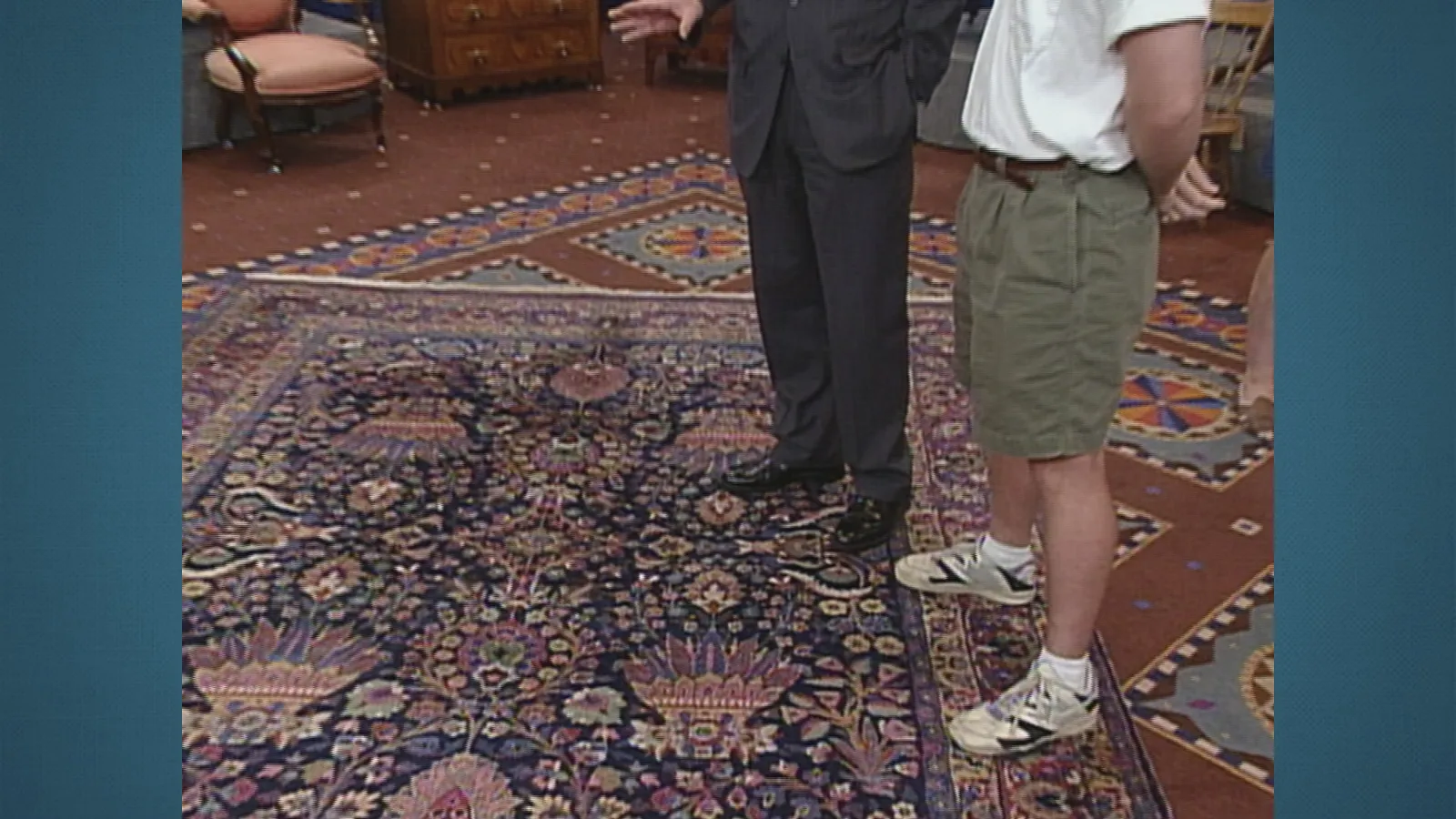
APPRAISER: It's quite a nice carpet and it's also in wonderful condition, which is nice to see in a carpet like this.
It was probably new in the 1920s when your grandmother acquired it, 'cause that's where it dates from.
It's a carpet from Persia.
It's an Iranian carpet from the city of Mashhad, which is in eastern Persia.
Um, and I want to point out one thing about how you can identify that.
Mashhads are great.
The Mashhadi weavers were great in that... area.
GUEST: Mm-hmm.
APPRAISER: So whenever you see this multicolored finish here on the edge of a carpet, you can be pretty much assured that it's been woven in Mashhad.
For the rest of the carpet... ...the design is picked up.
It's really a derivation of a 17th century design that you would see used throughout Persia.
GUEST: Mm-hmm.
APPRAISER: Primarily, uh, in the cities of Isfahan and also around Mashhad and Khorasan.
GUEST: Mm-hmm.
APPRAISER: And it's just a nice representation of the Persian version of paradise, which is a lush, plentiful garden.
Do you use the carpet?
GUEST: Actually, no, I don't.
I don't really have a place to display it properly right now.
So it's been rolled up in a spare bedroom (chuckling) in my mother's house.
APPRAISER: Oh, okay.
Have you ever had it appraised?
GUEST: Never.
APPRAISER: Do you have any sense of its value?
GUEST: None whatsoever.
APPRAISER: Well, I would say because it's a great design with wonderful color and in just immaculate condition, if you're going out to buy this rug today, you'd be looking at a price of around $15,000 to $20,000.
GUEST: Not bad for a little inherited piece here.
APPRAISER: Yeah, yeah, well it's worthwhile taking care of as well.
GUEST: All right.

$6,000 - $8,000 Retail
$15,000 - $20,000 Retail
Photos
Featured In
episode
Vintage First Finds, Hour 5
Discover today’s values for ROADSHOW’s first finds, including one with a whopping update! — Premiered Mon, Oct 19, 2026
Wool
appraisal
Navajo Ute First Phase Blanket, ca. 1850

appraisal

appraisal
1969 Sam Maloof Chess Table & Chairs

appraisal
1948 Cleveland Indians Bat Boy Worn Uniform
Understanding Our Appraisals
Executive producer Marsha Bemko shares her tips for getting the most out of ANTIQUES ROADSHOW.
Value can change: The value of an item is dependent upon many things, including the condition of the object itself, trends in the market for that kind of object, and the location where the item will be sold. These are just some of the reasons why the answer to the question "What's it worth?" is so often "It depends."
Note the date: Take note of the date the appraisal was recorded. This information appears in the upper left corner of the page, with the label "Appraised On." Values change over time according to market forces, so the current value of the item could be higher, lower, or the same as when our expert first appraised it.
Context is key: Listen carefully. Most of our experts will give appraisal values in context. For example, you'll often hear them say what an item is worth "at auction," or "retail," or "for insurance purposes" (replacement value). Retail prices are different from wholesale prices. Often an auctioneer will talk about what she knows best: the auction market. A shop owner will usually talk about what he knows best: the retail price he'd place on the object in his shop. And though there are no hard and fast rules, an object's auction price can often be half its retail value; yet for other objects, an auction price could be higher than retail. As a rule, however, retail and insurance/replacement values are about the same.
Verbal approximations: The values given by the experts on ANTIQUES ROADSHOW are considered "verbal approximations of value." Technically, an "appraisal" is a legal document, generally for insurance purposes, written by a qualified expert and paid for by the owner of the item. An appraisal usually involves an extensive amount of research to establish authenticity, provenance, composition, method of construction, and other important attributes of a particular object.
Opinion of value: As with all appraisals, the verbal approximations of value given at ROADSHOW events are our experts' opinions formed from their knowledge of antiques and collectibles, market trends, and other factors. Although our valuations are based on research and experience, opinions can, and sometimes do, vary among experts.
Appraiser affiliations: Finally, the affiliation of the appraiser may have changed since the appraisal was recorded. To see current contact information for an appraiser in the ROADSHOW Archive, click on the link below the appraiser's picture. Our Appraiser Index also contains a complete list of active ROADSHOW appraisers and their contact details and biographies.