Pre-Columbian Peruvian Collection
GUEST: My family grew up in South America. We lived in Lima, Peru. My father was a geophysicist, and he appreciated archeological items, and items of primitive art.
APPRAISER: What were the dates that your father lived in Peru?
GUEST: We were in Peru from ’57 to ’66.
APPRAISER: ’57 to ’66, so then the collection process started in 1957 or so?
GUEST: Yes.
APPRAISER: We have to be concerned that these came out at a time that it was legal. The dates that you described, and we were very definitive about the dates. This was prior to any issue with the UNESCO Convention, which was 1970, it was all before that.
GUEST: Yes.
APPRAISER: There certainly are indications in what's happening in the Peruvian marketplace right now, that some people are more aggressive about trying to get things back. Now in your case, where you have proof that they were acquired much earlier, that's really good. So I think that we're covered. What I'm gonna do is I'm gonna give you some homework. The process of authentication in this case, is gonna start with a gold test. The second thing that we want to do in this process, is we look at it stylistically. Do these things make sense for what they're purporting to be at this time period in this country? This gold here is, as you said it's all from Peru. Most of it is from the North. Assuming that it's gold, we have gone over, and we feel comfortable stylistically. Then the last thing that I would do if I could examine it by hand, is I'd have an expert go over each piece, and make sure that nobody restored it, nobody made a repair, That's really important on value. It's a segment, it's a little bit frustrating to me, because I wanna claw my way through this glass, and pick it up and sniff it, and lick it and, you know, find out exact-
GUEST: Don't do that.
APPRAISER: I won't do that, thank you. In my judgment, the dates are pretty varied here.
GUEST: Okay.
APPRAISER: I think this material is earlier. I think this could be before the birth of Christ. These things are a little bit later. Even the later ones, I don't think are any later than about 800 AD. It's really early material.
GUEST: Wow, wow.
APPRAISER: I think almost all of this is personal adornment. That would be in some way, it would be either attached to costumes, it would be strung around the neck, and even this could've been sewn on a costume, or it could've been used in some sort of, like a shrine piece or in a burial, that's possible. It is some sort of a deity. You can see that it's holding sort of a scepter. That is a symbol of power and status. These are actual burial masks.
GUEST: Are they?
APPRAISER: And they're probably made out of tin. Clearly this is a necklace. These are beads. These would have been unbelievable necklace strung around someone's neck.
GUEST: Okay.
APPRAISER: I think these might also be beads. I can see on these little tiny containers here, they're beads, there's holes in the back of them, so you have an amazing collection of personal adornment. This is worth some money. A conservative price for this, assuming that everything that I said is legitimate, conservatively you're looking at $50,000 to $100,000 dollars.
GUEST: That's incredible.

$50,000 - $100,000 Retail
Pre-Columbian

appraisal
Anasazi Ceramic Vessels

appraisal
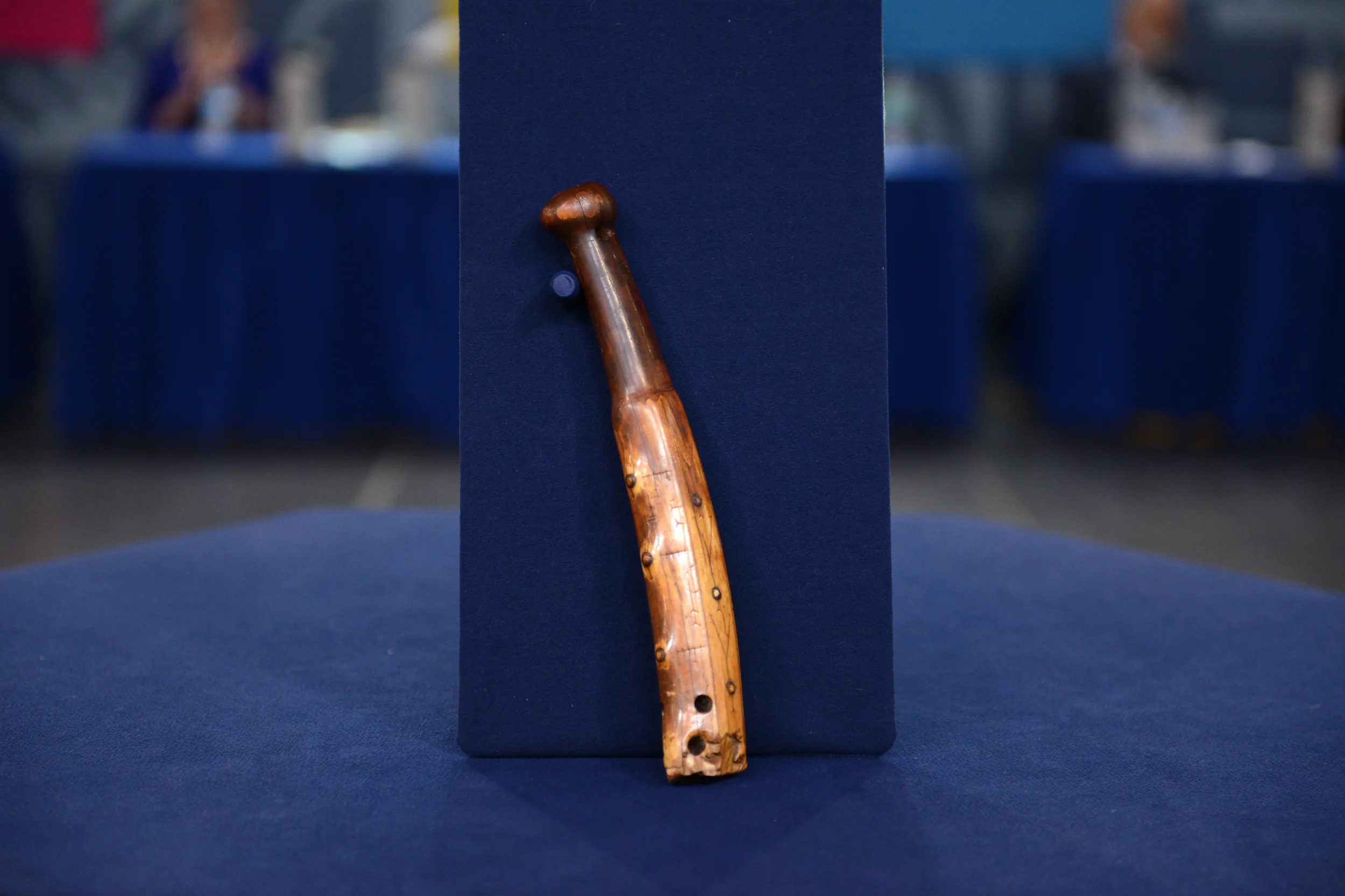
Pre-Columbian Peruvian Implement
appraisal
Pre-contact Eskimo Walrus Adze Handle
appraisal
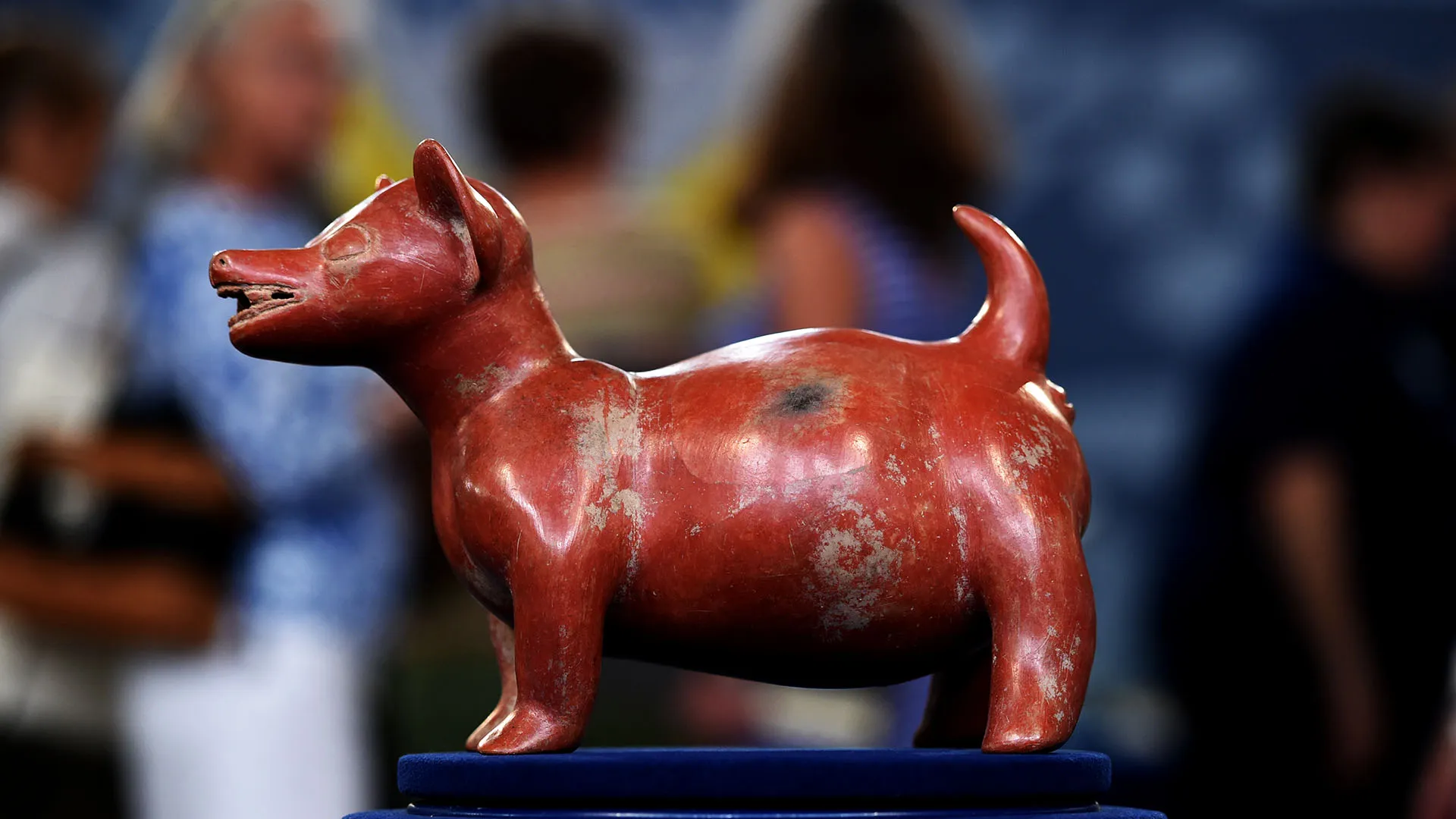
Colima Pottery Dog Figure, 200 BC - 200 AD
Understanding Our Appraisals
Executive producer Marsha Bemko shares her tips for getting the most out of ANTIQUES ROADSHOW.
Value can change: The value of an item is dependent upon many things, including the condition of the object itself, trends in the market for that kind of object, and the location where the item will be sold. These are just some of the reasons why the answer to the question "What's it worth?" is so often "It depends."
Note the date: Take note of the date the appraisal was recorded. This information appears in the upper left corner of the page, with the label "Appraised On." Values change over time according to market forces, so the current value of the item could be higher, lower, or the same as when our expert first appraised it.
Context is key: Listen carefully. Most of our experts will give appraisal values in context. For example, you'll often hear them say what an item is worth "at auction," or "retail," or "for insurance purposes" (replacement value). Retail prices are different from wholesale prices. Often an auctioneer will talk about what she knows best: the auction market. A shop owner will usually talk about what he knows best: the retail price he'd place on the object in his shop. And though there are no hard and fast rules, an object's auction price can often be half its retail value; yet for other objects, an auction price could be higher than retail. As a rule, however, retail and insurance/replacement values are about the same.
Verbal approximations: The values given by the experts on ANTIQUES ROADSHOW are considered "verbal approximations of value." Technically, an "appraisal" is a legal document, generally for insurance purposes, written by a qualified expert and paid for by the owner of the item. An appraisal usually involves an extensive amount of research to establish authenticity, provenance, composition, method of construction, and other important attributes of a particular object.
Opinion of value: As with all appraisals, the verbal approximations of value given at ROADSHOW events are our experts' opinions formed from their knowledge of antiques and collectibles, market trends, and other factors. Although our valuations are based on research and experience, opinions can, and sometimes do, vary among experts.
Appraiser affiliations: Finally, the affiliation of the appraiser may have changed since the appraisal was recorded. To see current contact information for an appraiser in the ROADSHOW Archive, click on the link below the appraiser's picture. Our Appraiser Index also contains a complete list of active ROADSHOW appraisers and their contact details and biographies.