
Go behind the scenes of Legendary Tigers of India and discover the remarkable partnership between filmmaker Mike Birkhead and conservationist Valmik Thapar.
Features
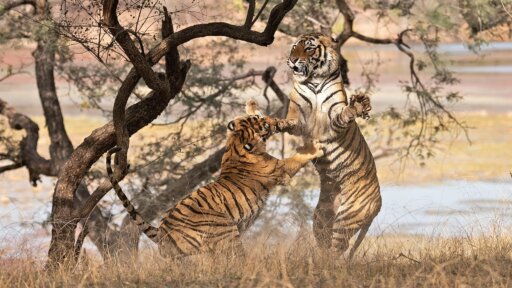
Tiger Mom Fights to Protect Her Cubs
Faced with a powerful male, a mother tiger must choose: mate, or protect her cubs.
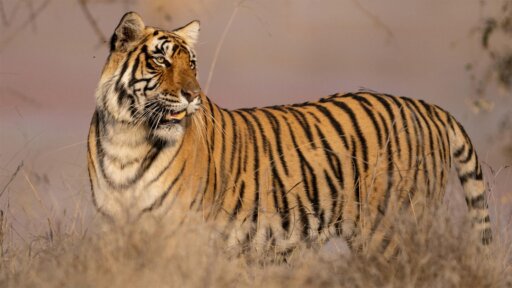
Poachers Return: How Trust Made India’s Tigers Vulnerable
These tigers had lost their fear of humans — and it cost them their lives.
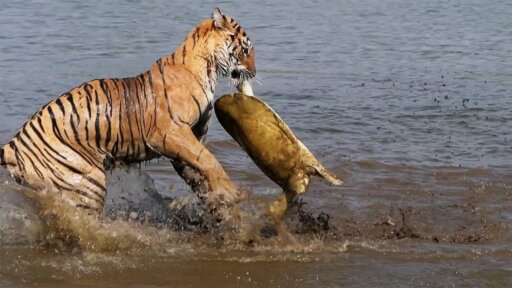
Why This Tiger Hunts Turtles… And Crocodiles
A tiger’s dangerous behavior shocks researchers, until the reason is revealed.
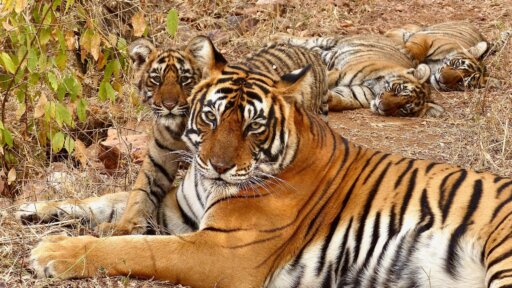
Legendary Tigers of India
Uncover the story of the revival of northwestern India’s legendary tiger clan.
TRANSCRIPT
- Everybody's aware in the tiger world that this year is the 50th anniversary of the celebration of the establishment of Project Tiger, which has helped in conserving India's tigers.
But for me, that didn't interest me in a film because I knew a lot of other people would want to pursue that, what I describe as a more political film.
But then Valmik rang me up from the edge of one of Ranthambhore's famous lakes, and said, "There's this amazing tiger called Charger who specializes in charging into the lakes, chasing all the deer out."
So I thought, hmm, should I watch telly, play golf, smoke cigars -- or do this one more film?
My first tiger film was initially not supposed to revolve around tigers.
Because I was an evolutionary biologist, I wanted to do a film about the evolution of the peacock's tail.
So I thought, I'll have to go to India to make it, and I took it to the BBC, and they said, "Yes, we'll take a film on the evolution of the peacock's tail for David Attenborough's "Wildlife on One" series, but you've got to make it the tail of the peacock and the tiger."
The key thing that stimulated me to know that I could make a film was Valmik's three or four books on the tigers of Ranthambhore, which were gloriously illustrated.
The imagery, the evocative nature of this huge fort that sits on the edge of Ranthambhore, and then the tigers that run in and out of the lakes through the lilies, past the crocodiles -- It was like Disneyland for wildlife.
I did my recce and went to Ranthambhore.
It was better than I ever imagined.
It was magnificent and is magnificent still.
But the weak link for me was getting tiger footage.
Tejbir, Valmik's brother-in-law, who helped me on my peacock film, said, "We filmed tigers in the 1980s.
I think Valmik's got the footage."
And so I went to meet Valmik.
When he met me at the door, there's this big figure who I instantly knew was a star in the making, a hugely charismatic person.
He realized I was passionate about conservation, and he was passionate about conservation.
So I think it created an understanding, where we could work together.
But the nitty gritty of that meeting was, "Valmik, can you find your tiger footage?"
I had no idea what the tiger footage was like.
We found some cliche dusty film cans under his desk, which turned out to have some phenomenal tiger footage of Valmik's most favorite tiger gangs charging into Ranthambhore lakes killing deer.
So that was an absolute wonderful moment.
So after I finished that film, I instantly thought this guy could present a superb landmark series on the Indian subcontinent.
But the key was making Valmik Thapar into a presenter as opposed to a contributor.
At the time we made "Land of the Tiger" we were both 39, 40 years old.
That created a little bit of chemistry where we got on very well.
I couldn't force Valmik to do something, I had to convince him, which is good training, to be convinced, and he would challenge me a lot.
But we're still working together 30 years on.
He will ring me up periodically and say, "Mike, there's this event going on," or, "There's this crisis going on."
And this film is a product of exactly that.
We definitely are friends, more than colleagues.
It goes further than that for me.
It wasn't that Valmik was just a presenter.
It wasn't that Valmik was just a punter.
It wasn't that Valmik was just a powerful character fighting for the good of India's tigers and its land.
There were more aspects to his life that I appreciated, I think.
We may have got older and more grumpy and lots more bits of our bodies ache without any doubt.
But I don't think our passion for tigers and conserving tigers has diminished at all.
Telling stories about tigers, especially this film, which might have quite a nice good news aspect to it, will both educate people and encourage them that there's hope.
Not false hope, but it's important to give them hope that the tigers of Ranthambhore, which have been through two significant crises, have come through, and a huge part of that is down to Valmik's enthusiasm and bullishness to fight and help save the tiger.
You May Also Like

Touching the Wild
A biologist crosses the species divide and becomes part of a wild mule deer family.

Sharkland
Great White Shark Hunts Fur Seals
A special band of muscle running along its side helps the great white hunt fur seals.

The Whale Detective Preview
Follow filmmaker Tom Mustill as he investigates his encounter with a humpback whale.

Super Cats: A NATURE Miniseries - Sneak Peek
Discover what makes big cats among the world’s most diverse and successful predators.

Living with Snow Leopards–Tashi’s Story: A NATURE Short Film
One village works to find ways to both live with and save one of the rarest cats on Earth.

The Beauty of Ugly
Male Elephant Seals Battle Over Females
In a winner-take-all contest, two male elephant seal fight for access to females.