Dietrich Bonhoeffer


BOB ABERNETHY, anchor: This weekend will be the 100th anniversary of the birth of Dietrich Bonhoeffer, the German theologian put to death by the Nazis, whose writings and life made him a modern martyr. In the U.S. and Europe there will be observances in his honor, among them a documentary on Bonhoeffer to run on most PBS stations February 6. We have some images from that program.

bonhoeffer-post01-kids

Bonhoeffer was raised in a distinguished but not particularly religious family said to have been surprised by his decision to study theology. He was brilliant, getting his doctorate at age 21. Then he spent a year at Union Theological Seminary in New York. He studied ethics under Reinhold Niebuhr and also discovered the fervor and social consciousness of Harlem’s Abysssian Baptist Church, where he taught Sunday school.

Christianity, Bonhoeffer came to believe, meant not just professing faith but really putting into practice Jesus’ teachings in the Sermon on the Mount. When Bonhoeffer returned to Germany in the early 1930s, his convictions were tested dramatically. Adolf Hitler and the Nazis were just coming to power. What should Bonhoeffer do about them? He spoke out, urging his fellow Lutherans to reject as idolatry the Nazi claim that the Führer and the state deserved allegiance above that owed to God.

Bonhoeffer also condemned Nazi persecution of the Jews, urging the Christian Church to stand with the Jews and all victims. He also helped some Jews escape.

By the late 1930s, Bonhoeffer realized that, for him, even though he respected pacifism and nonviolence in principle, Hitler’s war-making and injustice required resistance. A Christian must act, he insisted, so he joined a conspiracy to oppose Hitler. It seemed a lesser evil than doing nothing.

bonhoeffer-post03-cell

Bonhoeffer became part of a resistance cell inside German military intelligence. On trips abroad, he tried to get Allied support for the German resistance, but he was not successful. In 1943, Bonhoeffer’s fellow resisters tried to kill Hitler but failed. The Gestapo identified Bonhoeffer as part of the plot, arrested him, and sent him to prison.

Earlier, in a widely influential book, THE COST OF DISCIPLESHIP, Bonhoeffer had condemned what he called cheap grace — accepting God’s love without cost. At the same time, he extolled costly grace — grace that requires radical obedience, even the willingness to die for one’s beliefs, which Bonhoeffer did.

Less than a month before the war in Europe ended, the Nazis moved him from prison to a concentration camp and hanged him on April 9, 1945. He was 39 years old.

Some Christian pacifists say Bonhoeffer was wrong to resist evil with violence, but for millions of other Christians, Bonhoffer became an inspiring symbol of what it can mean, in times of crisis and every day, to practice what you preach.

Faith and Family in America, Part Four: Religious Responses


BOB ABERNETHY, anchor: Now, the last in our series on Faith and Family in America. Today, how churches and other religious groups are responding to the growing number of families who are not the traditional married mother and father with children — single mothers, cohabiting men and women, gay couples, and the divorced.

Judy Valente begins her report with conservative Protestant evangelicals trying to preserve traditional marriage.

TONY PERKINS (President, Family Research Council) (Speaking at Event): We’ve got to take a stand, even if it means people say bad things about you.

religiousresponse-post01-perkins

JUDY VALENTE: Tony Perkins is champing at the bit. The president of the Family Research Council told a California audience he is looking forward to the Supreme Court confirmation hearings for Judge Samuel Alito. Perkins believes Alito will not be the kind of high court judge who tries to redefine marriage, but one who will uphold traditional religious values.

Mr. PERKINS (Speaking at Event): This nation will only be as strong as its families, and the families will only be as strong as the parents and marriages that bind them together.

VALENTE: Earlier this month, Texas became the 19th state to pass an amendment defining marriage as between a man and a woman.

Mr. PERKINS: In every state where a marriage amendment has made its way to the ballot it has passed, on average with over 70 percent of the support of the voters.

VALENTE: These votes, he says, will put pressure on Congress to pass a similar amendment to the U.S. Constitution.

Mike and Harriet McManus started Marriage Savers nearly 10 years ago. They say their program has saved 50,000 marriages that would have ended in divorce.

MIKE MCMANUS (Co-founder, Marriage Savers): You are declaring, by your actions here, a new day for marriage and an old day for divorce.

religiousresponse-post02-training

VALENTE: McManus says churches need to stop being wedding factories and start working to preserve marriages. Marriage Savers appears to have made an impact. Earlier this month, Cheyenne, Wyoming became the 198th city in which his “Community Marriage Policy” has been adopted. Clergy from different denominations signed the policy, agreeing to require four months of preparation for couples wanting to marry in their churches. The plan also provides support for troubled marriages.

Mr. MCMANUS: We think that there are couples in every church who could be trained to be mentors — to help people either prepare for marriage, to enrich existing ones, or save troubled ones. And this is really a new idea.

Pastor JERRY DYCE: I’m Pastor Jerry Dyce; my wife Opal, from Cheyenne Christian Center.

VALENTE: Those who volunteer to be mentors get a weekend of training before they begin to counsel other couples.

UNIDENTIFIED WOMAN #1: I came because I love children, and having been a teacher for many, many years, and watching the pain that children go through from a divorce — they don’t adjust well.

HARRIET MCMANUS (Co-founder, Marriage Savers): They’re sitting on a great mother lode of wisdom, a wealth of experience, some of it not so pleasant, but hopefully some of that experience has helped them to hone and fashion a more successful, more healthy marriage over the years.

VALENTE: Pam and Chad, who live together in Chicago, are about to take a premarriage inventory. She is Methodist. He is Catholic. And they want to get married in the Catholic Church. Each has filled out a lengthy questionnaire which includes specific questions for interfaith couples and for cohabiting couples. Now they will compare notes with a facilitator from the Archdiocese of Chicago.

religiousresponse-post03-couple

EILEEN SMITH (Facilitator, Archdiocese of Chicago): Rather than marry and then over time have some of these items come to the surface — both strengths and challenges — take a look at it ahead of time and be able to communicate about it. Are we ready to plunge in?

PAM: I think so.

Ms. SMITH: Okay.

ELSIE RADTKE (Director of Family Ministries, Archdiocese of Chicago): Many of the young couples getting married today come from families of divorce, and they do not want to go though the pain of divorce. So their rational is, “If we live together it’s like test-driving the car. If we live together, then we’ll see how that is.” Of course, what they don’t know is what research is showing us, and that is that about 70 percent of the couples that do cohabit will end up divorced. You cannot test-drive commitment.

VALENTE: Pam and Chad, both from stable, intact families, are confident about their relationship.

PAM (To Ms. Smith): We have mutual respect for each other that I think we’ll always have. I think that’s kind of what makes a marriage work.

CHAD (To Ms. Smith): We seem to do everything together and we work together really well.

VALENTE: Without a camera in the room, Pam and Chad would go on to discuss more delicate issues, including their different faiths and their approaches to child rearing. In the end, the couple said they were pleased with the experience.

CHAD: I think we learned that we already have a strong communication base between the two of us and that, I think, we’re going to be in really good shape.

PAM: Yeah.

VALENTE: The counseling doesn’t always go so well. Sometimes couples discover the relationship wasn’t as good as they thought.

Ms. RADTKE: One of the ladies in our office that does the facilitation calls herself now the “marriage buster” because she has found that about 20 to 23 percent of the couples that she has worked with — and she’s worked with hundreds of couples — end up either postponing their plans to marry or canceling them completely.

VALENTE: For religious institutions, preserving traditional marriage is one aspect of supporting family life. Another is how to support couples who are not married.

Even in some conservative faith traditions, cohabitating couples, single moms, gay couples, and stepfamilies are not uncommon in their congregations. Some churches have been slow to address these changes in family life and now find themselves in a dilemma: how to pass on their traditional religious teachings while still reaching out to nontraditional families.

Sociologist Penny Edgell of the University of Minnesota has studied church outreach to couples and families. She found a lot of nostalgia for the traditional family.

religiousresponse-post04-edgell

Professor PENNY EDGELL (Sociologist, University of Minnesota): But I also found that there were a lot of congregations where there was really quite a bit of innovation. There was a lot of talk about how we make dual family earners fit. There was a lot of talk about ministry to single parents and the divorced.

Pastor GENE APPEL (Willow Creek Community Church): There’s not a person in this room that doesn’t need a family — some kind of place to belong, to be loved, to have mercy extended to you there. Let’s pray together.

VALENTE: Willow Creek Community Church in suburban Chicago is one of the best-known of the megachurches. There are gay couples and cohabiting couples in the congregation. They are welcome, but there are no specific ministries for them.

Pastor RANDY FRAZEE (First Evangelical Free Church, Chicago): There is certainly a desire for churches to maintain and promote a concept of family that is extremely intact. And yet, again, I think we also have to deal with the reality that there is an enormous pandemic — there’s a crisis that’s going on, and we’re called on to reach out to help people right where they’re at.

VALENTE: In contrast to Willow Creek, the First Evangelical Free Church is a much smaller, more intimate congregation on the north side of Chicago. On a recent Sunday, a dramatic presentation on premarital sex, the challenges of marriage, and the issue of homosexuality.

UNIDENTIFIED MAN #1: Lord, I’m burning. Lord, I’m burning. Find some nice lady to put me out.

religiousresponse-post05-presentation

UNIDENTIFIED WOMAN #2: Sometimes it’s so easy for we happily married couples. We wag our fingers and shake our fingers at those who didn’t make it, feeling all superior. As if we don’t all have our own troubles and secrets.

VALENTE: The congregants have developed a real sense of community, lingering long after the service is over. In addition, small groups meet on a regular basis in private homes. Some have become like small families. It is a place for people to share their burdens.

UNIDENTIFIED WOMAN #3: I had a huge fight with my father yesterday.

JENNIFER: As you know, I wasn’t here last week because I was crying.

UNIDENTIFIED WOMAN #4: There was a death in our family.

Pastor BILL SHEREOS (First Evangelical Free Church, Chicago): We can’t replace family, but we can provide supportive environments where we do treat one another like families. And we don’t have many particular groups that are targeted toward individual kinds of people or kinds of families, but we do a lot of mixtures.

JENNIFER: We were joking at dinner that there really is no functional family. There’s no family that’s normal.

MARY: Being part of a small group, you get different feedback and different ideas about things because we’re related to each other through Christ, but not necessarily through blood or marriage.

Prof. EDGELL: I make a distinction between what I call radical innovation, which is really reconceiving what a family is, and incremental innovation, which is keeping your idea of what a family is, but doing whatever you can in terms of practical changes in ministry to reach out to more people.

religiousresponse-post07-shereos

Pastor SHEREOS: There are two cultures I think that you have to bridge. And one is the culture of the Bible and the other is the culture in which you live. And to me, the church has to be a bridge between those two cultures,

VALENTE: Divorce is one area where churches do seem to be creating a bridge. St. Peter’s Catholic Church in the heart of Chicago’s business district is a place where people come and go throughout the day to say a quick prayer or just sit quietly. It also has an active outreach to divorced people.

CARYN WIECZORKIEWICZ (Facilitator, St. Peter’s Church): Most of them seem to come to the church because of divorce. They start coming more often to the services here, daily Mass, or stopping in to say a few prayers because it’s a time of struggle and there’s nowhere else to turn. Nonjudgmental friendship; seeing other people who are struggling as they are, who have the same faith background, who’ve all come from a background where they truly believed as they stood at the altar, “‘Til death do us part” — and now that’s all changed.

UNIDENTIFIED MAN #2: For a lot of us growing up Catholic, Mom and Dad, the worst thing I could think of was losing my parents — never divorce.

UNIDENTIFIED WOMAN #5: It was scary. What would happen to my faith, and how it would be accepted in the Church afterwards? It’s helped, talking it through with other people.

religiousresponse-post09-wieczorkiewicz

Ms. WIECZORKIEWICZ: There’s really two sets of people. There are people who come to Mass regularly, or who stop in at church when they’re going through a struggle — whether it be divorce or illness or whatever — and turn to church. Then there are others who are afraid to ask, they’re afraid to find out. They’re afraid of rejection. They’re trying to do it on their own. And that’s when they end up falling away.

VALENTE: Many churches struggle with ministry to unmarried couples.

Pastor SHEREOS: We have couples in our church that live together. And, you know, we don’t want to chase them out of the church. We want to minister to them in the name of Jesus. They would not end up being a leader in the church, but we would want them as part of the community.

VALENTE: Another issue is the status of gays, who make up a significant part of this Chicago neighborhood.

Pastor SHEREOS: We have some people in our congregation that would have same-sex attraction; some that would be gay couples. But our church wouldn’t give the message that that is a biblically endorsed lifestyle. We would recognize that it’s part of the broken world we live in.

VALENTE: Within the Catholic Church, ministry geared to gays is limited. In Chicago, at one church, one night a week, there is a Mass for A.G.L.O, the Archdiocesan Gay and Lesbian Outreach. It keeps a low profile. The priest did not want a camera at the Mass.

Elsie Radtke, of the Archdiocesan Family Ministries office, sees some signs of change.

Ms. RADTKE: I can’t speak for the Church. But I can speak for local parishes, and I have seen on the local level some very, very good pastoral outreach to couples and individuals who are homosexual. And they are treated with respect. They are invited to be part of the community.

religiousresponse-post08-tablegroup

Pastor FRAZEE: It’s easy for us to tell people what we’re against. It’s another thing — it takes up more energy and time to come alongside people where they’re at and show them grace. And the thing that the evangelical church, by and large, believes is that all of us fall short of the perfection of God. A church can, with great conviction and compassion, maintain a position of what we believe the Bible teaches about what is good, what is right, what is healthy, but at the same time reach out to people where they are in their time of need.

Prof. EDGELL: One of the things we have to be careful of is thinking about religious congregations, religious leaders, religious doctrine as somehow set in stone and that that’s what’s authentic religiously. Because whether religious communities acknowledge it or not, authentic expressions of faith are ones that are relevant for contemporary society.

VALENTE: Edgell predicts that the most successful churches of the future will be those, like St. Peter’s in downtown Chicago, that recognize the new realities of family life and respond compassionately to the members’ changing lifestyles.

For RELIGION & ETHICS NEWSWEEKLY this is Judy Valente in Chicago.

ABERNETHY: And this footnote: in our RELIGION & ETHICS NEWSWEEKLY survey, about three quarters of nontraditional families and more than half of traditional families said love is what makes a family, and it doesn’t matter if people are gay, straight, married, or single.

New Orleans Jazz Funeral and Rebirth


BOB ABERNETHY, anchor: In New Orleans, recovery from Hurricane Katrina remains slow. The mayor estimates about 100,000 people have returned, of the 485,000 who lived there before the storm, in August. Forty percent of the homes are still without electricity and — again according to the mayor — half the small businesses, 57,000, may have been lost for good.

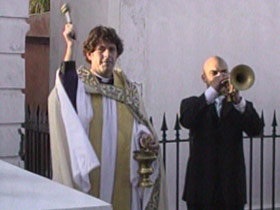
But amid the complaints and the finger pointing, there was this week a celebration. Christ Church, the Episcopal Cathedral of New Orleans, is 200 years old, and it honored its birthday and the city with a formal concert and the street music of a jazz funeral — mourning what was lost but confident of rebirth. Kim Lawton was there.

jazzfuneral-post01-funeral

KIM LAWTON: Like any proper funeral, it started with mourning.

Reverend DAVID DUPLANTIER (Christ Church Cathedral) (Praying): I am the resurrection and the life, said the Lord. …

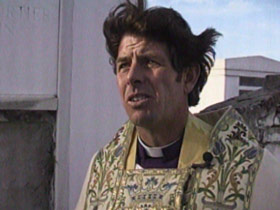
LAWTON: In the city’s oldest cemetery, Christ Church Cathedral’s dean, David duPlantier, performed his church’s rituals for death. With prayers, holy water, and incense, he remembered those who died during Katrina and he mourned the passing of the old New Orleans.

Award-winning jazz trumpeter Irvin Mayfield, a New Orleans native, then took up the dirge.

IRVIN MAYFIELD (Award-winning Jazz Trumpeter): When we play those slow dirges, they’re serious and they’re slow. They’re like those good old spirituals, and everybody gets to mourn a person’s passing and it’s a sad moment.

jazzfuneral-post03-parade

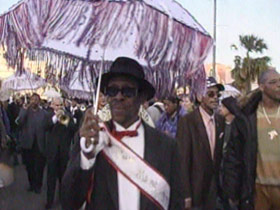
LAWTON: In a New Orleans jazz funeral, after the service, mourners process into the streets in a slow and somber march. Then, the mood begins to change.

Mr. MAYFIELD: Maybe a block away from the graveyard, they speed the song up just a little bit. People are kind of joining in, and that’s why you notice a lot of people have handkerchiefs and umbrellas.

LAWTON: Those who join in are called “the second line.” The procession becomes a joyous — sometimes even raucous — celebration of the life that has departed and the new life to come.

Mr. MAYFIELD: You see somebody do that second line dance stuff, you say, “Mmmmmmm, that’s something!” And that’s what I want to give the people. We have to be serious about our celebration. Just like we have to be serious about our mourning.

LAWTON: Christ Church Cathedral has a 200-year history here. And, after Katrina, church leaders said they wanted to demonstrate to their city the fundamental Christian belief that death and destruction never have the last word.

jazzfuneral-post04-duplantier

Rev. DUPLANTIER: First of all, acknowledging the grief and pain that is real and will continue to be real, but then move it always toward the vision of the promise of resurrection that comes in Jesus Christ. It can do nothing but help the city itself grieve and celebrate.

LAWTON: Church officials evacuated New Orleans with Katrina’s onset, and it was more than a week before duPlantier and his bishop, Charles Jenkins, were allowed to return and inspect the aftermath. Hundreds of other churches had suffered major damage — but they found the historic Episcopal cathedral largely intact.

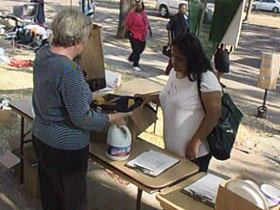
The Episcopal diocese immediately began providing emergency aid to hurricane victims, and strategizing about long-term relief. They are still passing out supplies for the massive clean-up efforts that continue. The needs here remain great. Garbage and debris still line the streets. Homes are uninhabitable, businesses shut down indefinitely.

DuPlantier says the church is deeply concerned about the city’s recovery. And he says that concern includes the city’s spiritual recovery.

jazzfuneral-post06-relief

Rev. DUPLANTIER: We wanted the church to be involved not only in the tangible aspects of human need, but in what we think of as the soul — the theological, the poetic, the musical, the spiritual, all those things are part of the gifts of the spirit. If that is not connected directly with God’s purposes for his church, I don’t know what is.

LAWTON: As a gift to the city, the cathedral commissioned Mayfield to write a jazz composition that told the story of Katrina. And Mayfield says its movements were shaped by the emotions of the jazz funeral — moving from mourning into hope and joy.

For Mayfield, the meanings are especially poignant. His father refused to evacuate New Orleans and is still missing.

Mr. MAYFIELD: I think there’s no greater healing power than music. And I think that’s just, that’s — it’s not only something that’s going to help me heal, I think it’s something that helps everybody heal.

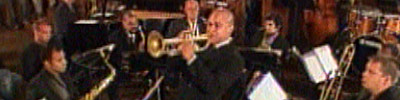
LAWTON: The New Orleans Jazz Orchestra debuted “All the Saints” during a free concert at Christ Church Cathedral. They called the concert the cultural reopening of New Orleans and a symbolic launch of the city’s rebirth.

Mr. MAYFIELD: I really wanted to give people that tool, that thing, that answer, “Well, what are you going to do after Katrina? How does New Orleans come back?” And I’m thinking to myself, New Orleans is back. We’re the definition of “back.” We’re the definition of “rebirth,” of “renaissance.”

LAWTON: I’m Kim Lawton in New Orleans.

All the Saints

jazzfuneral-listen-header

Listen to excerpts of Irvin Mayfield and the New Orleans Jazz Orchestra performing “All the Saints.”

Part 1:
This audio clip requires Adobe Flash Player.

Part 2:
This audio clip requires Adobe Flash Player.

Part 3:
This audio clip requires Adobe Flash Player.

Evolution Update: Kansas and Dover


BOB ABERNETHY, anchor: Developments this week in the national battle over how to teach evolution. In Dover, Pennsylvania, where the school board had voted to teach both evolution and competing theories, eight of the nine board members were up for reelection, and all eight were defeated. Meanwhile, in federal court the trial over the issue ended, with a decision expected by early January.

In Kansas, a different course. The conservative majority on the state board of education opened the way for teaching intelligent design along with evolution. Fred de Sam Lazaro reports.

evolutionupdate-post01-board

UNIDENTIFIED MAN: … two, draft three. All in favor signify by raised hand.

FRED DE SAM LAZARO: The vote was six to four to allow both evolution and alternative ideas to be taught in science classes.

Kansas’s board of education has seesawed three times on this issue since 1999. On Tuesday, evolution critics, once again a majority, voted to revise and rewrite science standards.

Evolution, the theory that all organisms descended from a common ancestor, is widely accepted as a cornerstone of biology. Kansas will now also permit other ideas, including intelligent design. It holds that some biology is so complex that it could only be the result of design. No designer is mentioned, but critics say intelligent design is disguised creationism, a religious view.

JANET WAUGH (Kansas Board of Education): Comments have been made by board members such as, “Evolution is an age-old fairy tale and you can’t believe in evolution and the Bible; you must make a choice,” among others, you know. But those are ones that came to mind. I think that — why not be honest and admit it? It’s a faith issue.

evolutionupdate-post02-willard

KENNETH WILLARD (Kansas Board of Education): Any introduction of any criticism of evolution or the consideration of it is a challenge to the blind faith in evolution that some people want to hold. Now that’s where the faith issue comes, as far as I’m concerned.

DE SAM LAZARO: Supporters insisted the revised standards broaden the science curriculum. But the National Academy of Sciences disagreed and revoked its permission for Kansas to use its national science guidelines. The academy said the Kansas board had changed the definition of science by omitting a key sentence that says science can rely only on natural explanations. But the board’s chairman insisted that does not mean allowing for the supernatural.

STEVE ABRAMS (Kansas Board of Education): And you keep saying it’s supernatural. It’s not supernatural. There’s nowhere that it is supernatural, that it’s mentioned, and consequently, that’s not the case.

SUE GAMBLE (Kansas Board of Education): Well, if this other — but, Mr. Chairman, in all due respect, if they are not natural — if they are not natural explanations — what other kinds are there?

evolutionupdate-post04-abrams

Mr. ABRAMS: It is to discuss what is the natural, to discuss ideas and origins and explanations for natural phenomen[a]. Period.

DE SAM LAZARO: In a room packed with media, there was concern for Kansas’s image.

Ms. WAUGH: We’re becoming a laughingstock not only of the nation but of the world.

Mr. WILLARD: I just went to a national meeting, and nobody laughed at me. And as a matter of fact, I had a number of people come up and tell me that, to keep up the good work.

DE SAM LAZARO: The new standards approved by the board face a few hurdles before they can make it into a classroom. For one thing, rewriting those standards will take months, a period that will see new elections to the state board of education. There could also be lawsuits to invalidate the new standards. For RELIGION & ETHICS NEWSWEEKLY, this is Fred De Sam Lazaro in Topeka, Kansas.

ABERNETHY: As many Americans debate evolution and intelligent design, Pope Benedict XVI on Wednesday used language some observers interpreted as a reaffirmation of divine guidance. He described the natural world as “an intelligent project.” Here at home, televangelist Pat Robertson said the voters in Dover, Pennsylvania who threw out eight members of their school board had rejected God.

Rev. Darrell Armstrong Extended Interview

Read more of Lucky Severson’s interview with the Reverend Darrell Armstrong of Shiloh Baptist Church in Trenton, New Jersey:

darrellarmstrong-extended-post01

My passion for working with families emanates out of my own childhood experiences. I was a ward of the court for 13 years in Los Angeles, where I was born and raised. My mother had me — she was 15 years old. Dad was 18; didn’t know him until I was 22. Through an unfortunate set of circumstances, my mother’s companion was abusive towards me and my 18-month-old brother. Put him in a tub of hot water. It came to the attention of L.A. Department of Children’s Services, and we were removed from her custody. I was in foster homes for about two years out of my life and then placed in long-term kinship care, even though we didn’t call it that in the mid-1970s. It was my maternal grandfather who opened his home and took me in.

In October of 1998 my mother died of a drug overdose at the young age of 45. It was really at her death, when I did her eulogy standing in front of her casket at the L.A. cemetery, that I really recommitted myself to strengthening families, particularly African-American families, particularly those in urban communities.

I think anyone of African descent who would disagree that the African-American family is in crisis is not living in this world, is not being realistic. We may disagree on what are the causes of the crisis. But I think everyone has to accept that when statistics tell us that at least up to 70 percent of African-American children are born out of wedlock, when statistics tell me that in some states, prison populations are comprised of greater than 50 percent African-American men where we only make up 6 percent of the United States population — who are women going to marry if that percentage of them are in jail and incarcerated, and they can’t vote once they get out of jail? We’re in a crisis. There’s no doubt about it. Is it genocidal? I wouldn’t say that, but we are in crisis.

I’m a Democrat, but I’m not led by party solely. I value distinct perspectives on issues. But I would agree with many of my evangelical brothers and sisters, many of my conservative Christian brothers and sisters who would say that when there is an absence of family model, structure of mother and father, and single parenting notwithstanding — I pastor a black church in urban America. I see the black women who are raising their children by themselves. I see the grandmothers who are raising their grandchildren by themselves. But that does not negate that if it took two to make that child, it should take two to raise that child. The absence of a nuclear family model — I think that is the genesis of a lot of the issues that are going on. If young black boys don’t see a positive black male role model, they will seek it somewhere else. I see a lot of that going on in our communities.

Anyone who talks about race in America — you can’t disconnect that issue from the intentional, deliberate onslaught of black families during slavery. I think it’s a direct result of the vestiges and the remnants of slavery. I think if there was an intentional policy by government, regardless of what level of government, to destroy families and to not allow them [to stay] together for the cause of keeping the slave enterprise, you know, profitable, then those remnants take a long time to work through. One has to remember [it was] only in the ’60s that we got rid of the vestiges of Jim Crow, which was as destructive as slavery was. I think some of that stems from those systemic issues of policies that were created. To get welfare in this country, once upon a time, you couldn’t have a man. We know that. So the government has had a part.

I would consider myself more of an independent, to then independently assess the politics of either side. But ideologically and philosophically I tend to agree [more] with the Democratic platform than a Republican platform. But that’s not the issue. The destruction of families — I won’t say it’s not a political issue, but as a pastor I have to address the systemic issues but also address the self-help issues, you know. As Dr. King said, folks can’t ride your back if it’s not bent over.

The new face of racism is not black and white or brown or yellow. I think it’s green. I think where jobs are located has an impact on who gets those jobs, who works in those jobs. I’m part of a coalition in the state of New Jersey, and we’re trying to assess issues from a regional perspective. Jobs are being [created] in New Jersey where the working poor are not living — in suburban communities. Developments are being built in suburban communities, but the working poor are living in Trenton, Camden, Paterson. That’s not where the job growth is. It’s in the suburbs. So how do those families get there? Will they carpool to public transportation? Here in New Jersey we have the historic Mount Laurel law. Development is supposed to build affordable housing in those suburban communities. But we have a loophole in New Jersey that allows suburban communities to sell off their obligation to build affordable housing in the suburban community to urban communities. And in the absence of a statewide housing plan, urban mayors like Trenton Mayor Douglas Palmer are left in a quandary. They want the money to build affordable housing in their city, but it’s at the expense of not building it in the suburban communities. So it’s economic. There’s no doubt about it.

I have been on the front lines of the community Healthy Marriage Initiative in the state of New Jersey since its inception in 2001, 2002. I went down and knocked on doors in DC until I found out where Wade Horn’s office was and Bill Coffin’s offices were. Wade Horn is the undersecretary for children and families in the Bush administration and Bill Coffin is his marriage expert. There’s a national marriage movement that’s going on. Diane Sollee is riding the crest of it right now, and she is a marriage expert based out of Washington, DC. You know, 3,000 folk get together for the last several years in places around the country called Smart Marriages. But do you know less than probably one percent of those who are attending Smart Marriages are of African descent and from African-American churches? I was intentional. I went, and then I was so moved by it I sent a team from my church and commissioned them to not only go and get training in Christian prep for prevention relationship-enhancement programs, but to bring that back, institute it in our church, and figure out how we go about helping to strengthen families, but with marriage as the cornerstone.

In 1996, when Temporary Assistance to Needy Families (TANF) was reformed, it replaced the old AFDC, Aid to Families with Dependent Children, the old welfare. A new model of welfare came into existence in 1996 under the Clinton administration. One of the purpose statements in TANF is the government finds that marriage is the foundation to a healthy society. The government says that. In the four purpose statements of TANF, one of them is to promote two-parent households. Another one is to promote strengthened families through job preparation and marriage. That’s in federal legislation. Bush just came and acted upon it. It was there under Clinton. A Democratic president and his administration enacted federal policy that puts marriage right at the center, at the vortex of a conversation about strengthening family, strengthening communities. I’d buy into it regardless of who put it in place.

I’m a man of African descent. Extended family has been something that I think predates slavery. Even in West Africa, you look at tribal, indigenous social systems and it may not have replicated the nuclear two-parent model that we see in Western Europe, but it did have an extended family. Now the old adage that Hillary made so famous, “It takes a village to raise a child,” that is part of African-American and African culture. African-American culture, because of slavery, has had to rely on extended family as well, to the degree that the church has become the extended family. So a single mother can bring her children to church and see deacons, see a pastor, see positive models of black manhood that challenge and offset the negative stereotypes they may see in and around their community.

darrellarmstrong-extended-post02

This congregation — even though we’re set in the heart of urban-American Trenton — I’d be lying if I didn’t say it was a relatively affluent congregation. There are a lot of well-degreed, high-income-earning individuals and families in our congregation. But that is also not to say that we don’t have the families of the economically challenged — the welfare mothers. To the degree that there is divorce, yes, the national statistic is the national statistic — 50 percent of couples. I would say I see divorce all the time in the church. And I’d say this — that of the 20 marriages I do every year, about 15 of them are cohabitating with each other. That gives way to another conversation about the success of that marriage, right? But we’re trying to help that by giving them prevention and relationship-enhancement programs and other training so that when they get married, their marriages will be more successful.

I would say that the economic stress is less in middle-income families than it is in poverty-stricken families. We all know the statistics, and social science has proven that where there’s economic stress, there’s also mental and emotional stress as well that leads to abuse, that leads to displacement, that leads to generational patterns.

President Bush has been unabashed about his belief in marriage. President Clinton wasn’t as much, but he’s the one who put it in [the law]. The M word has been such a negative word because of, and let’s be real, because of the conversation, the debate about same-sex marriages. So when you start talking about marriage and family, it leads to a very interesting slope that has become so controversial. As you saw in this recent election, I mean, folks were very concerned.

Some other colleagues of mine in the state have come together and we’ve formed a couple of coalitions. One is the New Jersey African-American Healthy Marriage Initiative. We call it NJAAHMI. And there is a second more global, statewide initiative called the New Jersey Healthy Marriages Coalition, both of which are arms in New Jersey to bring faith-based and community-based organizations together to figure out how do we take advantage of potential funding from the federal government. But even in the absence of that, how do we take our communities back? You know, right here in Trenton, we’ve hosted marriage-saving workshops to train marriage mentors in churches. We’ve hosted Christian prep workshops. I’ve talked to the mayor of Trenton, who’s ready to commit publicly, to say, “I won’t marry anyone as a mayor without sending them first to you or someone like you, Reverend Armstrong, so they can at least get training.”

I’m just trying to win the battles that I can. If mayors and judges, who also do marriages, even though we know 70 percent of marriages are performed by clergy — even if they would say, “Wait. I’m not going to marry you until you’ve shown me that you’ve completed at least one training session with one trained individual” — our mayor and mayors around the state, they do five-minute ceremonies with folks they’ve never met before. How do you marry someone if marriage is the foundation of society, and yet we roll them off like cookie cutters on a conveyor belt? What is that saying for the success of those marriages and those relationships and those children? I’m working on a public policy level as well as on a faith level within the congregation to say, “Listen, ladies and gentlemen. Family’s important. It is the cornerstone of our society. And if we continue to go the way we are going in the African-American community, it may very well be genocide.”

We are selecting and training 10 couples per year to actually have them trained as marriage mentors. And they will then be fanned out to deal with three different types of couples in our congregation: those who have blended families, those who are in crisis, and those who are engaged and ready to marry. There will be trained personnel, if you would, in our congregation whose expertise is how to work with these blended families and deal with the issues of different children coming from different marriages and different backgrounds. Or another set would be trained how to counsel and get them ready for marriage. Another set will be just dealing with crises in marriages and how to strengthen them to utilize all the national training models that we can to bring it home to ground zero. If every church took responsibility for a quarter-mile radius of their church, we can then begin to make a difference — a multiplier effect.

Ask any African-American pastor of any African-American church, historically black church, in any urban community or anywhere around the country, do they have some kind of marriage ministry? I guarantee you about 90 percent of them will say yes, they do. What kind of training has been given to those working in their marriage ministry? I’ve said to my associate at Shiloh, “We’re going to send you to get the training requisite, and we’re going to tap into the trained Ph.D. counselors in our congregation and bring a counseling center together, build a marriage ministry.” The congregations are not drilling down to the level that I think they need to, to be successful in their marriage ministry. Most churches are going to say, “Of course we do something for the family. It’s endemic to who we are, you know, as a faith-based institution. We marry folk. We are in the business of bringing families together, keeping them together, counseling them and preaching and teaching to them every Sunday.” But how much training has that pastor had? If I can get more clergy trained, those who are doing the marriages, if I can get them certified in prep and other national models, they will become more effective in their ability to counsel those families.

In my concern it is priority number one. We have seven ministries in our church: Christian education, liturgy and worship, congregational care, missions, and evangelism — all that. Marriage and family is the ministry to which we’ve probably given the greatest budget, to work this with the men’s ministries of our church, the women’s ministries of our church, the seniors’ ministries of our church, and bring family, the emphasis on family — because in the absence of family we’re living an individualistic life, and in America that is our temptation — rugged individualism. But we need to bring the family and have it center. And that’s not a Republican issue, you know. That’s not a Democratic issue. That’s a religious issue.

I am slow to constantly put the African-American community as the most severe. Even though statistics bear out that we are leading in many indices that I rather us not lead in, I know that divorce and marital breakdown are real in suburban communities. I’ve lived in some of the most affluent suburban communities that one might imagine, in Stanford and Palo Alto and Princeton in New Jersey. I’ve seen my friends in the San Fernando Valley in Los Angeles. I’ve watched those families also suffer from marriage breakdown, from abuse. Somehow I think stereotypically the media has portrayed African-American families in a certain way. It is only recently that we’ve seen this positive image of family through Bill Cosby and his wonderful, long-running television show. But count how may public images in media and in music we hear and see. I think it almost becomes a self-fulfilling prophecy.

Hollywood projects certain things. I think certain families live up to certain things. And I think churches have to take it one church at a time and one community at a time. But I full well agree it’s a problem across the board. If you ask those who are divorcing and making up the divorce rate — we’re only 12 percent of the population, so, you know, if the divorce rate in America is 50 percent, a whole bunch of other folk getting divorced as well and a whole bunch of other families are being affected.

Rev. Wallace Charles Smith Extended Interview

Read more of Lucky Severson’s interview with the Reverend Wallace Charles Smith:

wallacesmith-extended-post01

All the pastors that I talk with are concerned about the black family, work to try and do something about it, have strong criteria as to what they expect from people before they perform marriages, talk to children rather often about lifestyle choices. The whole question of the African-American family and its strength or its weakness — you know, [Daniel Patrick] Moynihan did that famous — or infamous, depending on your assessment — [study] of the African-American family. You can’t understand the African-American family and its plight unless you understand what happened during slavery. I mean, it was an intentional attempt for several hundred years to destabilize families. It was for the good of the slave system not to have strong families. In fact, the families were too cohesive, and it wasn’t uncommon for a male or the children to be sold into some other community to keep the family from being so cohesive. And then after slavery, you know, the traditional sort of road gangs of African-American males going from city to city in the South just trying to find work was the precursor of the absentee African-American male. Had there been stable opportunities, job opportunities in the South after the Civil War and Reconstruction, [it] would’ve been a much different story.

[Herbert G.] Gutman did a book years ago called THE BLACK FAMILY IN SLAVERY AND FREEDOM, and it verifies that the numbers of families that were two-parent and staying together and actually running to the courthouse to actually have a regular marriage after slavery when they were permitted to was very high. I think what happened in the 1960s [was] the same thing that happened to America. The African-American community is almost always probably 15 to 20 years ahead of where the rest of America is, because of us being less protected economically. In the 1960s you began to see what most of America began to see in the 1980s. Economic factors were forcing the family into disarray. The whole notion of the 1950s and the rise of the middle class — that never quite struck the African-American family the same way. The sense that African-American families [were] unable to make ends meet and the time when the unions were growing in this country, lots of people were shut out of many of the unions, at least the upper levels — things like the steel industry, where African Americans never got the really good jobs. So what you found in the 1960s was just a huge number of African-American families that just couldn’t make ends meet. I could show you that wherever African-American families are on parity with Euro-American families, Asian families, and wherever else economically, you’re going to find about the same incidence of brokenness. Divorce rates will be about the same. If an African-American family and an Asian family income is somewhere around $65,000 or $70,000, the divorce rate will be almost identical. A lot of it is a class thing. Unfortunately, lots of things began to coalesce in the ’60s — the assassination of John Kennedy, the whole notion of society beginning to be less trustful of its leadership.

Cornel West wrote a great book called RACE MATTERS, and what West said basically is that beginning in the ’60s, but reaching culmination in today’s world, is the sense that black kids really don’t think that life is getting any better. When people stop thinking life is getting any better they become nihilistic. You see the same thing happening in white America right now. I mean, just this whole proliferation of, you know, a heavy metal culture, you know, where drugs are the wave. So-called middle-class kids cope with the stress and the pain of a world that doesn’t seem to be going anywhere. So white America in many ways is catching up to where black America has been, you know, unfortunately, for a long time.

I never drive down I-95 without the fear that I’m going to be hauled in because we have a fairly new car — for no other reason than just driving while black. If you’re an African-American, or in some cases Hispanic, there are incredible pressures from a too often racist society that can cause you to be on the wrong side of the law in a way that does not happen with our Euro-American brothers and sisters.

I have known Gene [Rivers] for years. I consider him a friend. Gene has a very important perspective, and he has a ministry of critiquing the church, which needs to be done. There’s no question that the African-American church has too often been seduced by either middle-class values or, you know, perhaps an individualistic disconnect from the conditions of poverty. Gene’s out there in the trenches, and he knows people and works with people on a regular basis who don’t come to our traditional churches. So he’s got an important voice. But the other side of it is, I think, the African-American church does way more than most people could see, because it’s different — I mean, the way we approach life. And we don’t answer surveys. You know, people knock on the door — they don’t get answers from us because that’s part of how we have had to exist. We’re suspicious of pollsters coming around. So you can’t always trust that sort of thing. I think more goes on than most people are aware of. But we still need the voice of Gene Rivers critiquing, because we all could do a much better job than we are doing.

We have an after-school program for at-risk boys. It’s really kind of a latchkey program. We don’t call it that, but that’s really what it is, where guys can come in after school and get tutoring, and we have a basketball gymnasium upstairs. They play basketball, they get tutoring, get mentored by a fine young gentleman, and other men of the church drop by to help out. There’s no charge for it. One of the real horror stories that I’ve had to live with over the years — they once had a grant from the Ford Foundation, which supported the program. They probably had 50 to 60 guys in the program. After the Ford Foundation grant ran out we determined we were going to keep the program going with volunteers and on a shoestring. We couldn’t do any more than 20 guys because we just didn’t have the people to meet with them and work with them. Lo and behold, two young fellows came in and wanted to get in the program; we had to turn them down because we didn’t have space. They went outside and there was a drive-by shooting and both of them were shot that same day. Neither was killed, thank God. One was wounded rather seriously. The other was not quite as seriously wounded. But here are two guys who, if the resources had been there, could’ve been in a program. And that story has probably been replicated all over this country thousands of times.

The African-American churches, like other churches, are swimming against the stream, and you got to be real honest about that. We’re living in a Hollywood-dominated culture. DESPERATE HOUSEWIVES is the biggest show on TV. Irresponsible sexuality jumps at us from every media outlet imaginable. People with means who can go to better schools are probably a little better insulated from that. People who don’t have means, who go to schools which, unfortunately, are often rather dysfunctional in their approaches, because they don’t have the resources, are less insulated from that. It’s been very difficult, and the churches are swimming against the stream. That’s really the issue.

I saw a piece in the paper about some of the more fashionable outer suburbs in Virginia where drug problems are starting to become a real issue. Having resources doesn’t completely prevent you from having to deal with these things, but it does give a little more insulation. Whereas if you’re an African-American in this country and unless you’re really in what the boys call the talented tenth, the elite, more than likely you are at the break point because you got no insulation. It’s like an electric cord, you know. If you take the rubber off it, then anybody can be electrocuted by it.

Many things in the Bush administration I don’t agree with. I think some of what, however, he has called for — working on individual responsibility — makes a lot of sense. But I think that can’t be promoted without some resources that, you know, can help with that. The Democrats, unfortunately, probably go the other way a little too much and remove the whole notion of individual responsibility. Somewhere the balance, I think, is in the middle. I think you’ve got to call for responsibility ultimately, you know, for all of us, whether you’re poor or rich. And it is your responsibility to say yes or no to life. But I think you got to put the kind of support structures in there so that people are better able to say no to those things that are destructive.

I think you could make the case that the so-called ethnic families, Irish families, Italian families historically did what African-American families have also done, and that is rely on an extended family. I think you could make the case that this mythology of the nuclear family is something that was a part of the American dream — the post-World War II expansionist dream of mother, father, and 2.3 children being able to happily survive. Look underneath that sort of iconic image and we found out from the 1950s LEAVE IT TO BEAVER on TV and FATHER KNOWS BEST — well, FATHER KNOWS BEST is a great example. The guy who played on that was an inveterate alcoholic. They had to sober him up to get him to the set. So I’m not sure that the concept of the nuclear family was ever as idyllic as we painted it. But what happened, I think, was ethnic families, African-American families in a survival mode brought some of their Old World concepts to this country, and that was that you took more than two parents to raise a family. Often there was a strong maternal figure and, certainly in the African-American culture, a grandmother. In the Italian culture it was often a strong paternal figure. But pretty much in the extended family there is a strong central person who holds it all together. For us, that has often been the African-American woman for a number of reasons. Some of it goes back to our African roots in Western African culture. Women always had a stronger role than they had in European culture. The notion of the subservient female was never a part of African culture. Then you bring that over to this country, and you put that along with the fact that African-American males were completely undermined economically. And often the only one who could make any money was the African-American woman. So she became the economic actor. It may not have been very much money, but she could work as a maid or she could take somebody’s laundry in, whereas the male was often without resources at all. Put all that together and you come up with a very strong African-American female presence that helped the family survive when otherwise they would have come completely undone.

Back in 1985 I did a book called THE CHURCH IN THE LIFE OF THE BLACK FAMILY and argued then that the church is really a model of the extended family. The church is really what the village was in Western Africa. We very actively promote the notion that the church is a family, and we try our best to get our men to mentor our young men, to have our mature women mentor the young women, and provide for our families where they are at the break points — a church structure where they can come, where they can find resources that they could not find if there was not a church. I mean the old village resources — somebody just to care about them.

I don’t agree that [black families are] crumbling. I do agree that the challenges are large and that it’s going to take an effort from all aspects of our community. Churches are going to have to play a larger role. I’d like to see every African-American church in this country understand itself as the modern-day village. Hillary Clinton, of course, took the old African proverb, and I think she was right to talk about it takes a village to raise a child. And then, of course, Rick Santorum or somebody came along and refuted that — a village is not enough or whatever. But the African-American church is the place where community can happen. And I think as our churches help rebuild community, then families will be stronger. We have a theme here at our church, for instance, and it’s called “Building God’s Village.” We see ourselves as creating a village in the church that has tentacles to the outside world and that ultimately can impact the community and change the community.

Models, for me, are people like former Congressman William Gray in Philadelphia. He still pastors a very fine church in North Philadelphia but has used his extraordinary influence to help with resources to network so that it’s to the advantage of the congregation. I think that’s the model that we need to promote — pastors connecting with the business community and connecting with the government in ways that we can deliver goods and resources to our people. The African-American church is an amazingly resourceful place that has done enormous good, when you think about it.

Rev. Eugene Rivers Extended Interview

Read more of Lucky Severson’s interview with the Reverend Eugene Rivers in Boston, Massachusetts:

afr-amer-families-post02-rivers

I have been working on issues of public safety and violence, and by implication black family issues, for the last 25 years, intensely focused on that. And over the last 25 years I have seen the complete unraveling of what has been understood for all of our history in this society to be the black family. I’ve seen phenomenally high divorce rates among black families, regardless of class, even when we control for socioeconomic difference. I’ve seen extraordinary levels, as a result, of father absence, which has contributed to crime and higher incarceration rates among young children who did not have the benefit of a two-parent household. It has been observation over many years, as well as the intellectual crisis within the black community with regard to the family. We saw it in 1965 with the Moynihan report, where there was a great deal of denial. Moynihan was labeled a racist, and the black community just continued to unravel. So here we are 40 years after the Moynihan report, and the black community is in a state of crisis.

We have a generation of young people who buy what they want and beg for what they need and who in many cases, based on current labor market demands, would be obsolete for slavery, as we see China become an increasingly powerful competitor on the global market with the United States. It’s a confluence of factors that have brought us to the conclusion that there needs to be a forthright, articulate, clear discussion [about black families]. Not that everyone agrees. People will disagree about what family is, and that’s okay, but at least there needs to be a rational discussion to facilitate some new policy conversations 40 years after Moynihan.

Father absence is the single most important independent variable affecting or correlated with incarceration rates for young males or some form of criminal justice supervision. So you have this issue of father absence contributing to, being a variable in, as a predictor of whether or not a young black male gets involved in the criminal justice system. Well, it seems to me that if there is a variable, that if it’s not causal but is correlated with incarceration patterns and predictions, we should be having a discussion about how do we keep fathers in families when you have got these divorce rates, when we look at teen pregnancy.

It has been greatly underestimated — the role of fathers in contributing to the stability of girls. Every girl needs a daddy. The daddy is the first guy in a girl’s life who tells the daughter she is beautiful. There are some very, very basic things that aren’t nuclear physics that have to do with the socialization and rearing of our children.

We have higher pregnancy rates. We have phenomenally high sexually transmitted disease rates that are so terrible that you don’t have any public discussions of it because most good liberals in traditional black leadership don’t want stereotypes being reinforced. So we don’t discuss the fact that we have got these phenomenal problems that are creating in some instances a biological underclass. This is absolutely terrifying.

My wife specializes in math education, and after 20 years of doing community organizing she says the single most important factor shaping the academic achievement of the child is the family and the culture produced by the family. It is not per capita expenditures on public schools; it’s about what families do with their children. Stable families produce better, higher-achieving students than families that are broken. By every possible sociological indicator that we can use, if there’s not some causal relationship, the correlation is almost one to one.

Part of it, I think, has to do with labor markets. William Julius Wilson talked about this 30 years ago in his studies on black unemployment trends and patterns in the black community. Another piece is culture. What kind of culture are the young people raised in? It was very difficult to talk about culture because Bill Ryan in BLAMING THE VICTIM said that if we talk about culture within the context of poverty and race, we are blaming the victim. Well, no. Another factor that contributes to this instability and nonperformance across these indicators is that a stable black family can create the appropriate culture of achievement, of discipline, of gratification deferral, which are the basic things that any civilization in any society needs to rear healthy children that become functional adults.

The welfare system has contributed. It was the development of a welfare system that penalized women for having fathers in the household that here again promoted, directly or indirectly, a culture of poverty and encouraged the kind of bad habits that do not lend themselves to helping young people become successful participants in the society.

In my judgment, there are some unresolved issues around the roles and images of black males as providers, performers, producers that go back to slavery and the breakup of the family. We had a brief period where it was slightly more stabilized. But the issue of familial stability — we saw that in the Moynihan report, in the scholarship of E. Franklin Frazier, W.E.B. DuBois, and a whole range of scholars that said, “Look, there are some factors that have to be corrected for that are intergenerational, and we have got to focus on those in a very coherent way.”

Part of what I see contributing to this was a major cultural shift. You know, the liberalization of sex, you know, during the ’60s and early ’70s created an environment where sex was disconnected from commitment, and that was viewed as progressive. The recreational sexual practices of the elite, who could engage in sexual and pharmacological experimentation, when it filtered down to the poor had absolutely catastrophic consequences.

Black churches are now maintaining as much order as they can for the people whose lives they directly impact. The incidence of divorce for regular church-attending communicants, right, is dramatically lower, just much, much lower than those that are non-church attending. Why hasn’t the black church had a greater influence? If there are such phenomenally high levels of religious participation on the part of the black community, why hasn’t this filtered down? Well, I think there are a couple of factors. One is the black church has not successfully engaged the culture. We live in a very different culture. Hip-hop, which is middle-range pornography, is having a very corrosive effect upon growing numbers of young black people, and the church has not successfully engaged that culture. So you have this generational disconnect where an increasingly older baby-booming black church-attending population, which is largely middle-class, is disconnected from an increasingly significant black underclass that is disconnected from the churches as well as the black middle class, who should play some socializing role in the lives of the poor. But as a result of the residential resegregation of the black poor as a function of the black middle class moving out and commuting into churches, we have a major cultural crisis.

Black preachers have their own sex problems. And the issue of sexual fidelity and what it takes to produce a culture of sexual fidelity has to begin in the church. The way one arrests the moral disorder of the black community is to correct the moral disorder within the black church. The black leadership, the black church must exhibit and model the kind of moral culture and provide some empirical evidence that legitimates the moral discourse around fidelity, simply from a functional standpoint. Forget the morality; it is simply more functional to be faithful to the mother of your children so that the children [are] socialized to believe that relationships have integrity, you know, relationships are sacred. And as a result, sex should not be disconnected from commitment or integrity, and that’s a challenge before the black church.

In some cases we have highly visible black clergy, whose names are too well known for me to mention, who have been caught in sexually compromised situations where there was a very public expression of infidelity that was humiliating for the wife and family and was the source of a significant scandal in the black community. Now those kinds of events, which are highly visual, tend to be demoralizing, because in many cases you have got young people, you have got young women who are thinking about marriage and companionship and [they] believe increasingly that there is no possibility of having a trusting relationship of permanence over the long term. And so the black churches — we have not done enough to model, walk the talk, you know, of fidelity and integrity. And it is a spiritual issue, it is a political issue, it is a cultural issue.

Part of the problem is that the black church, not unlike many other churches, has not had a coherent theology of sexuality that would deal with the realities, the struggles, the difficulties of sex. It’s not that the black church is actually homophobic. As I told a gay friend of mine, homophobia — whatever that means — is a symptom of a deeper issue, which is the black church has not dealt with the question of sex in a forthright way. There is not a systematic theology of human sexuality, of marriage, of fidelity. The black church has failed to present that and project that. As a result, many of the problems the black community has must be laid at the foot of the church.

Some churches normalize the abnormal. The traditional understanding for the last 2,000 years within the Eastern and Western church of what constituted a normative understanding of marriage has been the subject or the object of considerable debate recently. Our view is that there needs to be a philosophically coherent defense and exposition of the normative understanding that is civil, that is courteous, but that is clear. So that if there is debate or dissent, we can have that discussion, and the object of our statement was to provoke that discussion at a more intellectually serious level. So that we weren’t name-calling, it wasn’t PC rhetoric back and forth. You’ve got right-wing cuckoo rhetoric; you got left-wing cuckoo rhetoric. Pick your poison. We can go from Lynchburg, Virginia to San Francisco and get flip sides of the same coin. What we were calling for was for the black community, for Cornel West, for Michael Dyson, our celebrity intelligentsia, our theologians to be engaged in a serious discussion around the issue.

If there is anybody that does need the traditional family, it’s the black community. We don’t presume to tell white people what to do. What we do know is that in the black community we are completely off the hook with a wire cut. In the black community we have gone from “Lift every voice and sing” to “booty-popping bootylisciouness,” where pornography is mainstreamed. That is in part a function of the failure of black men to respectfully and lovingly support black women, the mothers of their children. I do know this: black men who father children need to be there to support the mothers with whom they had the child so that child can come up healthy, and that is my definition of a family. I father a child with a woman, I am morally obligated to partner with that woman in the rearing of that child.

Increasingly, the black church is going to be picking up on this issue, because they simply can’t avoid it. Once it becomes more public what the sexually transmitted disease rates are for black teenage girls, or how disproportionately the AIDS epidemic has impacted black people, there is going to be a national come-to-Jesus discussion with black churches about how we have failed to engage the issue.

The language, the apparel, the sexually explicit nature of public conversation on a bus on the part of 12-, 13-, 14-year-old girls is unbelievable. Whites don’t have the sexually transmitted disease rates that blacks have. Whites don’t have the level of disorganization and poverty that we saw in evidence with Hurricane Katrina. Whites have a level of organization. If the statistics that exist for blacks existed for whites, there would be a national summit every week on how to save our children.

If the infection HIV rates for black girls continue to grow, they in turn produce HIV fetally infected infants. In a country with no national health care system, new kinds of discussions around who deserves to receive health care come into play.

Liberals have been intellectually incoherent for 30 years. That’s one of the reasons they continue to lose in terms of political power. The secular liberals and to some extent religious liberals have been intellectually incoherent. They say all the politically correct things, but there are no solutions. Now I’m not saying that the conservatives have solutions. The major contribution to the national conversation on the part of political conservatives is to criticize liberals, which takes absolutely no imagination. It’s not as though they have said anything that produces new ideas. They simply say that the idiot was an idiot, which doesn’t take us anywhere.

What Bill Bennett said was unfortunate, and the only thing more unfortunate than what he said was his failure to apologize for it and the attitude he exhibited. Bill Bennett should have said it was an error of the lip and not the heart. But unfortunately, for reasons that are inexplicable to me, he only made a bad situation worse, by failing to simply say, “What I said was not intended as it came out, I apologize to anyone offended, I’m a humble person and so I apologize,” which is the only appropriate response regardless of what the intent was.

White male ex-offenders have, in a number of cities, a better chance of getting employment than college-educated black males. That’s still true. I’m not going to exaggerate the significance of that because I don’t want to make excuses. There are issues of job training, labor markets, job availability, and those issues have to be addressed. And then there are issues of culture. We are producing a generation of young black males who don’t know how to conduct themselves in a job interview, who come in trying to looking like a rapper when what was required was a shirt and a tie and English at least as a second language, and it is the failure on our part to properly resocialize these young people. In other words, who was right was Bill Cosby. Cosby had it right, notwithstanding Michael Dyson’s marginally useful critique.

The only institution that has the capacity and better deal with it are the black churches working in collaboration with other community-based agencies. So the Urban League, the NAACP, the Untied Negro Women’s Association — all of those agencies have to be collaborating with black churches to engage this issue.

One of the things that is perhaps most disturbing is that the divorce rate for blacks, the out-of-wedlock births actually travel up and down the class ladder. Black middle-class people have a divorce rate that exceeds the national average. It is twice the national average for middle-class people. So whatever socioeconomic strata you go to, we still have this crisis, so it runs throughout the entire community.

One cannot overemphasize how corrosive the popular culture has been. I mean, its sewage. It’s sewage. You can’t build healthy young people with healthy attitudes. Just take males. It’s misogynistic. Where are the feminists when I need them? They should be all over this. You’ve got these absolutely reprehensible, misogynistic lyrics. Then the high liberals come out and say First Amendment rights for the folks who want to promote pedophilia and misogyny, except when it comes to right-wingers who are outraged by this stuff, because they don’t have First Amendment rights. They are cavepeople; we don’t want to hear from them.

Blacks have the highest church attending rates probably of any group in the society. Pew and Gallup data seem to indicate that’s the case. So why is it that we have such a dramatic breakdown culturally, behaviorally? There are a couple of things going on. One is many people do not have any sense of how pervasive and powerful the culture industries are in terms of saturating the public mind with stuff that’s pornographic, that gets targeted early. So, for example, black church folk go to church, let’s say, twice a week. They watch more television than any other group. Nobody sits in front of the tube and looks at more garbage more hours of the day than the black community. No other group sits in front of BET or some other, MTV, looking at pornographic video culture than blacks. We sit up and watch that stuff ’round the clock. Now let’s say 20 hours a week of television, which is probably low, versus two hours on Sunday. Who wins? We undo a lot of what we learned on Sunday with the next 20 hours of absolutely disgusting programming that we have our children watch because the television is a babysitter. It’s amazing. Add to that the radio music. Then in addition to television we’ve got “booty-popping bootylicious back that thang up” lyrics on the radio. So we really have a very challenging cultural crisis for which the church has not really developed a thoughtful strategy. The average age of the average black clergyman has got to be in the 50s. He is competing with a rapper or a producer who is 22.

The black preacher, ironically, is still the leading, stabilizing role model in the black community, even with everything that we’ve said about what the black church does not do. The black church is now sort of morphing into the de facto government for black America. If we got every one of the 65,000 black churches that exist in the United States to carry 300 times their load — even if they did that, they would be less than a drop in the bucket for 35 million black people in the United States.

There has to be a new conversation. There have got to be new strategic partnerships, and the black community across the board has to make the decision that we are going to own our stuff. We are going to own sex; we are going to own crime; we are going to own the programmatic piece of developing the kinds of comprehensive programs in collaboration with the public sector and the private sector to address the problem. At the end of the day, black people have to take the moral responsibility for themselves.

I have heard no one call me a racist. Folks would like to say I was too conservative, but that would be difficult to sustain because I’m a Democrat. On the economy I’m a liberal. Estate taxes — bad. Iraq war — bad. Should they get out? There should be an exit strategy. Was it a mistake? Absolutely. Were there weapons of mass destruction? I’m still waiting. So on any number of issues, on war and peace, bread-and-butter issues, I would be a liberal unquestionably, which is right at the center of the black church tradition. The overwhelming majority of black church people are Democrats. The overwhelming majority of black people voted for Kerry, not because they were thrilled about it. The overwhelming majority of black people on cultural and social issues were conservatives [and] on bread-and-butter, economic, peace and justice issues were liberals.

We have come to the end of a cycle. The kind of high paleo-liberal integrationist policy, politics, and rhetoric are over. It’s over. Intellectually there’s no traction. Politically there’s no traction. Nobody’s going to put any money behind it. Even the liberals who are exhausted say they were all bad ideas. We hate the Republicans, but we can’t go back to this other stuff. Aside from which, we don’t know what to do in terms of black leadership because none of the established recognized brand names have any real political traction in the black community. Obama is a rock star. He’s gorgeous, articulate, good liberal, end of story. He’s a good liberal, and as long as he is able to keep that together he will be in the Senate. He will not probably in our lifetime be President of the United States. That’s not going to happen.

Anglican Communion Network Meeting


BOB ABERNETHY, anchor: More now on the growing divisions in the worldwide Anglican Communion over issues of homosexuality. Top Anglican Church leaders from Africa and Asia came to the U.S. this week and issued a joint pledge of support for conservatives in the U.S. Episcopal Church. Kim Lawton has our story.

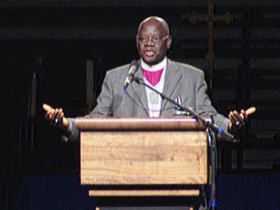
KIM LAWTON: They called it a show of strength from the international reinforcements. Nine Anglican archbishops from countries in the global south promised to stand with American conservatives in their battle over the future of the U.S. church.

anglicancommunion-post01-orombi

The international leaders met in Pittsburgh this week with more than 2,100 Americans who are at odds with the Episcopal Church USA over the consecration of an openly gay bishop. Participants said the U.S. church is promoting liberal interpretations of the Bible, which undermine the traditional Anglican faith.

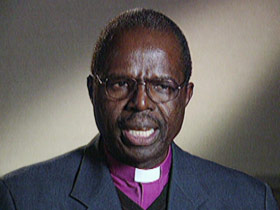
Archbishop HENRY OROMBI (Anglican Church of Uganda): I think what’s really important is that the conservatives here in America and us in the global south are thinking alike.

LAWTON: This week’s meeting was sponsored by the Anglican Communion Network, a new coalition of disaffected conservative Episcopalians who want to stay connected to the worldwide Anglican Communion. Pittsburgh Bishop Robert Duncan heads the network.

Bishop ROBERT DUNCAN (Diocese of Pittsburgh): Rallying the troops is exactly what we’re doing.

LAWTON: They’re building a new alliance with African and Asian church leaders who make up the majority of the worldwide Anglican Church.

Bishop DUNCAN: Anglicanism is reforming and re-forming.

anglicancommunion-post02-akinola

LAWTON: Archbishop Henry Orombi heads the Ugandan church, which has more than 9 million members, compared to the 2.2 million American Episcopalians.

Archbishop OROMBI: And I think we have talked too much now. The time for debates are over.

LAWTON: Another outspoken supporter was Nigerian Archbishop Peter Akinola, who leads a church of more than 17 million.

Archbishop PETER AKINOLA (Anglican Church of Nigeria): As long as we hold this together, we are with you every inch of the way.

Bishop DUNCAN: Their presence is a real act of solidarity — that the church throughout the world has noticed our difficulty here in North America, not just the difficulty of the Episcopal Church but of the Christian church in general, and they’ve come here to stand with us.

LAWTON: But liberal Episcopalians argue that Anglican tradition allows the Episcopal Church USA to interpret the Bible for its own context.

anglicancommunion-post03-deimel

LIONEL E. DEIMEL (President, Progressive Episcopalians of Pittsburgh): The moderates and the liberals within the church don’t want to exclude anyone, and yet at the same time they feel that they shouldn’t be intimidated, and they shouldn’t go against what they feel is God’s call to them.

LAWTON: Bishop Duncan urged patience and perseverance in the long and difficult battles that still lie ahead.

Bishop DUNCAN: We need people all across North America to be making a choice for God, no matter what it costs them. For some of our people, it’s cost them the congregation they’ve known. For some of our people, it’s cost them the denomination they’ve known. For some of our people, it’s cost them the friends they’ve had.

LAWTON: Leaders here acknowledge the coming year will be pivotal. The Episcopal Church USA meets in June for its triennial General Convention. They’ll be debating all the controversial issues and electing a new presiding bishop.

I’m Kim Lawton in Pittsburgh.

Faith and Family in America, Part Three: African-American Families


BOB ABERNETHY, anchor: Now, another in our series on Faith and Family in America. Today, a special look at African-American families, especially the poorest of them. In recent years, there’s been a dramatic growth in the black middle class. But poor black families endure huge problems — high rates of divorce, single parents, and out-of-wedlock births. At the same time, African-American women are very religious. According to a RELIGION & ETHICS NEWSWEEKLY poll, 81 percent of them say religion is very important in their lives.

Why are so many poor African-American families in trouble, and what are their churches doing to help? Lucky Severson has our special report.

afr-amer-families-post01-armstrong

Pastor DARRELL ARMSTRONG (Shiloh Baptist Church, Trenton, New Jersey) (During Sermon): The issue is about what is going on in American families today, in the 21st century in the year our Lord 2005.

LUCKY SEVERSON: Pastor Darrell Armstrong at the podium of the Shiloh Baptist Church in Trenton, New Jersey. His sermon is devoted to the status of families in America, especially black families.

Pastor ARMSTRONG (During Sermon): I am tired of seeing families destroyed. I am tired of seeing families ripped apart. I’m tired of seeing families eroded. I’m tired of seeing families kicked to the curb. I’m tired of seeing families ended in divorce. I want to do something about it, y’all.

SEVERSON: It’s a constant theme of Pastor Armstrong, maybe because he grew up a physically abused victim of a broken home, but also because he agrees with a recent study which concludes that black families are in “a state of crisis unmatched since the days of slavery.”

Pastor ARMSTRONG: I fully agree with it, and I think anyone of African descent who would disagree with that is not living in this world.

Reverend EUGENE RIVERS (Co-Founder, Seymour Institute): Over the past 25 years, I have seen the complete unraveling of what has been understood for all of our history in this society to be the black family.

SEVERSON: The Reverend Eugene Rivers and the Seymour Institute he founded released the alarming report on black families — one that’s similar in tone to a warning from the late Senator Daniel Patrick Moynihan 40 years ago that black families were falling apart.

afr-amer-families-post02-rivers

Rev. RIVERS: There was a great deal of denial. Moynihan was labeled a racist, and the black community just continued to unravel. So here we are 40 years after the Moynihan report, and the black community is in a state of crisis.

SEVERSON: Reverend Rivers’s report draws from some distressing facts of life among mostly poor black families. As many as 65 percent of first marriages end up in divorce. Forty-five percent of all black families are headed by single women, and 70 percent of African-American children are being born out of wedlock.

Rev. RIVERS: We have higher pregnancy rates. We have phenomenally high sexually transmitted disease rates. If the statistics that exist for blacks existed for whites, there would be a national summit every week on how to save our children.

SEVERSON: A majority of the kids at this neighborhood center in Boston run by Reverend Rivers don’t have fathers at home. Jimmy Dauphine and Derrick Patrick are mentors, trying their best to be substitute fathers.

JIMMY DAUPHINE (Ella J. Baker House): Eighty percent of the kids that work here right now are foster kids. They have no sense of family, and actually we become their family. We look out for their homework, see how they are doing at school, check out the teachers.

DERRICK PATRICK (Ella J. Baker House): These kids here, they really need structure. They want somebody to tell them, you know, that’s wrong — little things like that, you know, the American family would take for granted.

afr-amer-families-post04-studying

SEVERSON: Other studies conclude there is a huge positive impact on African-American children who are brought up in two-parent families. They are happier, do better in school, and are far less inclined toward delinquency. But it’s quite a different story for kids who are brought up by a single parent or in a broken home.

Rev. RIVERS: Father absence is the single most important independent variable affecting or correlated with incarceration rates for young males.

SEVERSON: Consider this. One in three black men, over their lifetime, will spend time in jail or prison. Derrick knows personally the price of not having a dad around.

Mr. PATRICK: If my parents, my father doesn’t care enough to be in my life, why should I care about the person walking down the street? I can just go rob you.

SEVERSON: Fatherless families are the single largest cause of poverty in the black community.

LADONNIA WHITTAKER: I need sunflower seeds.

SEVERSON: But Ladonnia Whittaker is determined she is going to beat the odds. She, her two children, nine-month-old Trinity and seven-year-old Makhi, and her mother, Maria Peterson, live with Ladonnia’s grandparents. Their story is not unusual. Maria’s rocky marriage disintegrated when her abusive husband got hooked on drugs.

afr-amer-families-post07-peterson

MARIA PETERSON: I got on drugs, too. He wound up going to prison and everything.

SEVERSON: Was this tough on your kids?

Ms. PETERSON: It was, it was. It was real tough.

SEVERSON: Maria had two children by two different men. So did her daughter. Researchers say it is increasingly common for African-American women to give birth to children of different fathers.

Pastor ARMSTRONG (During Sermon): Monogamy and fidelity are issues that we must adhere to.

SEVERSON: After Ladonnia delivered Trinity she got sick, unable to work. Neither could Maria, who had to take care of Ladonnia’s kids.

Ms. WHITTAKER: So by me being in the hospital and the bills started adding up and the rent wasn’t getting paid, so we had to lose it. I mean, we lost it. We got evicted.

SEVERSON: Ladonnia says she’s a good mother and will make the best of her circumstances, for which she blames only herself.

Ms. WHITTAKER: I chose not to go to school. I chose to have my son and to raise my son. So that was my choice. I can’t blame anybody else for that.

SEVERSON: Wouldn’t it be easier if you had a husband?

Ms. WHITTAKER: It may be because of what I saw with my mother and my stepfather — what they went through. It may be because of that stuff subconsciously. But I just never wanted to get married.

SEVERSON: Jimmy and Derrick think they know why black women are reluctant to marry black men.

afr-amer-families-post03-dauphine-patrick

Mr. DAUPHINE: One of the problems that I see personally is that the fathers, especially young fathers — I would say anywhere between 20 and 45 — some of them seem to be disempowered, like there’s a sense of hopelessness.

Mr. PATRICK: Because of black people being disenfranchised, it makes it a little harder actually. You know what I am saying? Economically and everything, it is just a little harder to do things.

Pastor ARMSTRONG (During Sermon): You know, my belief is if it took two to make the child, you ought to have two to raise the child.

SEVERSON: Everyone we spoke with agrees that African-American families — particularly in the inner city — need help. But they also say there are some extenuating reasons why they are in such a predicament.

Pastor WALLACE CHARLES SMITH (Shiloh Baptist Church, Washington, DC): You can’t understand the African-American family and its plight unless you understand what happened during slavery.

SEVERSON: Dr. Wallace Charles Smith is pastor of the Shiloh Baptist Church in Washington, DC.

Pastor SMITH: I mean, it was an intentional attempt for several hundred years to destabilize families. It was for the good of the slave system not to have strong families.

SEVERSON: How much of it is economic, do you think?

Pastor ARMSTRONG: Well, economics is the new — I think the new face of racism is not black and white or brown or yellow. I think it’s green.

SEVERSON: Blacks have always taken a back seat in terms of economic opportunity. Experts say African Americans are often the last hired and the first fired. When jobs moved to the suburbs, blacks were still stuck in the inner cities. The unemployment rate compared to whites is still two to one, and 30 percent of all black families live below the poverty level.

afr-amer-families-post06-walking

Rev. RIVERS: The welfare system has contributed. It was the development of a welfare system that penalizes women for having fathers in the household — that there again promoted, directly or indirectly, a culture of poverty.

SEVERSON: Another factor eroding the black family, most everyone concurs, is the pervasive culture of sex that confronts parents of all races.

Pastor SMITH: Irresponsible sexuality jumps at us from every media outlet imaginable. And you know, I mean, people with means who can go to better schools are probably a little better insulated from that. It’s like an electric cord, you know. If you take the rubber off it, then anybody can be electrocuted by it.

SEVERSON: And black leaders say kids in the ‘hood need better role models. Jimmy agrees.

Mr. DAUPHINE: The most successful people in the neighborhood are, like, drug dealers, pimps, or what have you, because the people who are supposedly successful in black society move to the suburbs, so you don’t see them.

Pastor ARMSTRONG: The church has become the extended family, so a single mother can bring their child, her children to church and see deacons, see a pastor, see positive models of black manhood that challenge and offset the negative stereotypes they may see in and around their community.

SEVERSON: Churches have long been the most important institution in black communities, but Reverend Rivers says they have been largely silent on the decline of the black family.

Rev. RIVERS: If there are such phenomenally high levels of religious participation on the part of the black community, why hasn’t it filtered down? Well, I think there are a couple of factors. One is the black church has not successfully engaged the culture. Black preachers have their own sex problems. And the issue of sexual fidelity and what it takes to produce a culture of sexual fidelity has to begin in the church.

Pastor ARMSTRONG (During Sermon): But now, Lord bless the proclaimed word, that it may do what you have intended for it to do.

SEVERSON: At the Shiloh Baptist Church in Trenton, members about to be married, newlyweds, all couples are encouraged to attend marriage classes that are faith-based.

TAMARA GASKINS: God is key. We said it in our vows. Keeping God first, all things are possible.

afr-amer-families-post05-gaskins

SEVERSON: Tamara and Tyrone Gaskins have been married three months. Tyrone was a foster child, did time at the New York Riker’s Island jail, but says it is possible to break out of the statistics and turn your life around.

TYRONE GASKINS: I think that the story doesn’t get told about the number of individuals in the African-American community who are able to take very challenging circumstances and turn their lives around.

SEVERSON: Pastor Smith’s Shiloh Church in Washington offers a mentoring program for at-risk boys. He agrees and disagrees with Reverend Rivers’s findings about the status of the black family.

Pastor SMITH: I don’t agree that it is crumbling. I do agree that the challenges are large and that it’s going to take, you know, an effort from all aspects of our community. And that, you know, churches are going to have to play a larger role.

SEVERSON: In the trenches, Jimmy and Derrick agree that religion is important.

Mr. PATRICK: Well, church and God is really important. Like, you know, I’ll write something in there, and I’ll put “God bless” at the bottom — little things like that. Sooner or later, they come around. Hopefully they will.

SEVERSON: At Pastor Armstrong’s church, another 10 couples graduate from marriage class. The pastor has a simple plan

Pastor ARMSTRONG (During Sermon): I want to invoke the power of God into the marriages, into the families, into the homes, into the churches so that God can straighten this stuff out.

SEVERSON: For RELIGION & ETHICS NEWSWEEKLY, I’m Lucky Severson in Trenton.

Faith and Family in America, Part Two: Religion and Parenting


BOB ABERNETHY, anchor: Now, the next in our series on Faith and Family in America. In a national survey we commissioned, three quarters of all Americans say they believe it’s likely their children will grow up to be of the same religious faith as their parents, but more than half say they worry about that. Betty Rollin reports on the parents and children of four religious traditions in three very different families.

BETTY ROLLIN: A special prayer clock calls the Ashmawi-Ibrahim family to prayer five times a day. Hassan was born in Egypt, his wife Salma in Kuwait — both into religious Muslim families. Now in Centreville, Virginia, it is of utmost importance to them, they say, to keep their religion strong among their four children.

HASSAN IBRAHIM: To us religion is not just a practice; it’s a way of life. It’s part of the value system.

religionparenting-post01b-ashmawi

SALMA ASHMAWI: They know that every day they have five times that they stand before God and that they are meeting God — basically they have an appointment with God, so there is a self-discipline. How can they stray between five times prayers and know that they are going back to stand before God, and keep that appointment knowing they just did something that they shouldn’t?

ROLLIN: Has any one of your children ever said, “I just don’t like praying so much”?

Ms. ASHMAWI: Everybody tries to get out of prayer when they are still young. They all do. You have to remind; you constantly remind.

Mr. IBRAHIM: Yeah, you cannot force them. You cannot drag them to pray.

ROLLIN: Professor Brad Wilcox of the University of Virginia studies religion and the family.

Professor W. BRAD WILCOX (Department of Sociology, University of Virginia and Resident Fellow, Institute for American Values): The parents who are more religious and are affectionate and firm with their kids are likely to ensure that they will transmit the faith that they have to their children. Parents who are too strict with their kids, who are authoritarian parents, are more likely to see their children rebel, both with respect to their moral beliefs as well as their religious beliefs.

ROLLIN: There seems to be little rebelling in this family. Ayah is 20 years old and goes away to college.

AYAH: There’s a lot of temptation. You are away from home for the first time and you look around you and everybody is just doing exactly what their parents don’t want them to do. I know that I don’t want to do those things. So, how am I going to keep myself busy and keep myself motivated? And I was able to do that by keeping strong in my faith.

ROLLIN: Like many religious parents, Salma and Hassan are active in their children’s public school. One area that troubles them is how sex education is taught.

Mr. IBRAHIM: It seems sometimes that they are forcing on the children maybe values that are contradictory to our beliefs.

religionparenting-post01-ibrahim

ROLLIN: As Muslims, the Ashmawi-Ibrahim children have special challenges with their peers. Mohamad is 12.

MOHAMAD: I was running the mile in school, and I was saying verses from the Qur’an, and I was saying them out loud. And every time I ran by someone or someone ran by me, they would stop and they would be like, “What are you saying? What are you doing?”

ROLLIN: Nada is 15.

NADA: Sometimes, you know, in school you just want to fit in. You don’t want to be different. But I just find a group of friends that kind of accept me for who I am.

ROLLIN: Nada’s parents would like her to cover her head like her sister Ayah, but they don’t push it.

NADA: It’s my choice. When I’m doing everything else perfectly and when I feel like I’m completely ready for it, I feel like that’s when I’ll take that step.

ROLLIN: Muslim women are supposed to dress modestly — a problem for Salma when she shops with Nada.

Ms. ASHMAWI: Blouses are too short. They barely cover her stomach. If you find something that covers the stomach, it doesn’t cover the top. I tell you!

Mr. IBRAHIM: My son who is 22 went through high school without dating, went through college without dating. I mean — that is the most difficult thing. And when I go to pick him up from school and see how the girls are dressed, I say I really sympathize for him. It’s very, very difficult.

ROLLIN: For many conservative Muslims, going out with the opposite sex, except as a prelude to marriage, is forbidden.

NADA: I do have friends that are guys. And so occasionally, like if we all want to go bowling or to the movies, I might ask to do that, but they feel strongly against it, and I think that I’ll probably understand why when I’m older. But I do kind of argue with them about that.

ROLLIN: Who wins?

NADA: They do!

religionparenting-post03-costello

ROLLIN: Judy Costello is a single mother in Bethesda, Maryland.

JUDY COSTELLO: I was married in 1989, expected to be happily married ever after. I was married in the Catholic Church. We had four children: Michael was born in 1992; Julianne is 11; Daniel is nine; and Naomi is five. Ultimately we were separated in 2002 and formally divorced in 2003.

As a single mother, I face the challenges of limited time and financial resources. As a Catholic single mother, I face the challenge of working to role model the Catholic teachings for my children without having two parents in a household to practice what we’re preaching.

ROLLIN: The divorce tested Judy’s faith, but ultimately it was her faith that helped her through it.

Ms. COSTELLO: To me, our religion — Catholicism — is about loving others and treating other people the way you want to be treated, having a respect and love for God, family, and friends, and even those who aren’t as respectful towards you. With that overriding framework, it helps me help our children make choices in their daily life.

JULIANNE: Naomi couldn’t find her backpack before we went to school and I knew I didn’t want to be late, but I remember it’s better to help people than to think of ourselves. So I stayed and helped her look for it.

ROLLIN (To Naomi): What do you pray for?

NAOMI: I pray for family and friends to be safe and for victims of Hurricane Katrina and for them to find their moms and dads, ’cause a bunch of people, they don’t have water, food, and they miss their moms and dads.

religionparenting-post06-praying

ROLLIN: Do you pray for yourself?

NAOMI: Like, I pray for nothing bad to happen.

ROLLIN: Is religion good for children? Professor Wilcox says yes.

Prof. WILCOX: Parents whose kids are more religious are likely to see their kids do slightly better in school and also to see their kids to be much less likely to be involved with alcohol and drugs, to be delinquent or to experience psychological distress, things like depression, for instance.

MICHAEL: It’s, like, burned into my consciousness — stuff like, “Don’t drink alcohol. Don’t do drugs. Don’t smoke.” I don’t want to, like, disappoint my parents or God or anybody by doing the wrong thing.

Ms. COSTELLO (To Kids): Who’s got what? Naomi, Julianne — dance. Michael, get your soccer stuff.

ROLLIN: Religion is not the only thing this family is busy doing. There is soccer for Michael, tap dancing for Naomi, and modern dance for Julianne. Judy has managed to make all of this work while holding down a full-time job, often done on her lap — which is not to say she doesn’t worry.

Ms. COSTELLO: I am most worried almost in the innocence of our children. I try to give them enough information so that they can make the right choices, but I get the sense that in a couple years my children will be surprised by the things they didn’t know.

ROLLIN: Of course, part of every parent’s job is to worry about the children. Our poll reveals that religious conservatives in particular — more than half the number of traditional Catholics and almost as many evangelical Christians — worry about their children seeing too much sex and violence on TV, video games, and in the movies. Many parents hope that religion will not only instill better values in their children but protect them from these negative influences in the culture.

And what about families with two religions? Meet Eric Nelson and Sarah Anders of Rockville, Maryland and their children, 14-year-old Faith and 10-year-old Marc.

religionparenting-post04-nelson

ERIC NELSON: I grew up a Reform Jew. Both sets of grandparents came over from Belarus, very hard, under very hard circumstances. Neither of my parents really wanted to force us to go to services like they were forced to. But I still identify myself as a Jew, consider myself a Jew.

SARAH ANDERS: I was brought up a Southern Baptist in Little Rock, Arkansas. I came from a very religious family, and both of my parents came from families who were Southern Baptist and very active in their church.

ROLLIN: Ultimately, their parents accepted their marriage. Even so …

Ms. ANDERS: I do have an aunt who is very Baptist and lives in Atlanta, and she prays for Eric every day that he will be saved, that he will come to know Jesus.

ROLLIN: It’s Sunday morning. Sarah and her daughter Faith are at Christ Congregational Church. A few blocks away, Eric and Marc are singing Jewish prayers at IFFP, the Interfaith Families Project, a community of Jewish and Christian families where both religions are taught and celebrated.

Ms. ANDERS: Once I started taking Marc and Faith to church, he really sat up and said, “Wait a minute, this is not going to work. We have to do something different.” And we were lucky we found out about this interfaith families group and went to a picnic at one of the member’s houses. And I remember going out on their back porch and looking at this sea of people and saying, “Finally, a place where we belong.”

Mr. NELSON: The reason why we ended up coming up with what we did, which is essentially a compromise, is because I really kind of felt that I was betraying my traditions and my roots and, you know, all my relatives who were killed for being Jews, by not pitching in and making sure that our children at least had an understanding and an exposure to my tradition and where I came from.

ROLLIN: Suppose your children decide to be Jews?

Ms. ANDERS: I knew you were going to ask that. I knew you would ask that. As long as they have a spiritual life, I don’t care.

ROLLIN: I’m not convinced.

Ms. ANDERS: No? It’s deeper and more complicated than that. It’s the intimacy of the religion; it’s what I know. It’s the language of belief that I know. I love the rituals in Judaism, but it’s not in my blood.

ROLLIN: What if your children become Christians?

Mr. NELSON: The biggest disappointment to me would be the loss of the heritage and the loss of the tradition and the loss of the identity.

ROLLIN: In the last 40 years there has been a marked increase in interfaith marriages. What effect does this have on the children?

religionparenting-post02-wilcox

Prof. WILCOX: It makes them less likely to be religious both as teenagers and as young adults; there are some risks in terms of delinquency and depression. On the positive end of the ledger, I would say that these kids tend to think for themselves more than other children, and they tend to have a better sense of how different traditions relate to one another or don’t.

ROLLIN: Are they more tolerant?

Prof. WILCOX: They’d be more tolerant, typically. That’s right, yes.

Ms. ANDERS: Hopefully they will wind up with more tolerance and an openness to people being whatever they are. But I think, realistically, I think the day-to-day challenges, just the logistics, going to Interfaith, going to church, doing Rosh Hashanah, doing seders, doing Hanukkah, doing Christmas — it’s sort of a mess. So it’s very busy, and sometimes I wish, “Oh, why can’t we just have Easter, and just only Easter!”

Mr. NELSON: Easter being one of the more difficult holidays.

Ms. ANDERS: Yes!

ROLLIN: Children of interfaith marriages are more likely to question religion.

religionparenting-post07-mompraying

FAITH: Sometimes I don’t think God is real, because sometimes I’ll say prayers and my prayers won’t come answered. So I’ll be, like, “Yeah, you are not real. Bye.” But then, you know, after all you learn, all the miracles that happened, you kind of have to start to believe that someone is looking over you and is looking over our country.

MARC: I have scientific explanations for about everything they say God has done. The world started from bacteria. The parting of the Red Sea, tides coming in — they just didn’t know what the heck that was.

ROLLIN: So you question what you learn in religion; you just don’t accept it?

FAITH: Well, you accept some of it but, I mean, you question a lot of it. I think you question more than you accept.

MARC: That’s mostly it.

ROLLIN: Studies show that at age 16 and 17, children from one-faith families may start to question religion as well, as they grow more independent from their families. But when they marry and become parents themselves, they often return to religion, if only to pass it on to their children.

For RELIGION & ETHICS NEWSWEEKLY, I’m Betty Rollin.