A Poet on the Psalms


Originally broadcast July 2, 2010

PAMELA GREENBERG (Poet and writer, The Complete Psalms): I began the translation at a very dark time in my life. I came to religion as an adult really as an act of desperation. I felt I needed to believe in something, and I struggled with depression. I had an intuition that in the psalms I would find something of the relationship to God that I was looking for.

The psalms are full of longing for God, a longing to experience God more intimately. I think mostly for Christians the psalms represent exactly what they do for Jews, which is the person of faith standing up in relation to God in a very honest and genuine way, and I think in that way they speak to all of us.

The great thing about the psalms is that they address really the whole spectrum of human emotion, from intense despair and feelings of abandonment by God, feelings of betrayal by humankind, fear of mortality, to great joy and jubilance.

(reading from translation of Psalm 23): “And when I walk through the valley overshadowed by death, I will fear no harm, for you are with me.”

In translating Psalm 23, I was very aware that it is the psalm that people are most familiar with, and so I wrestled with it. It seemed to me to be a psalm that addressed the fear of mortality, and it’s about death but it’s really for the people who are living, and it’s also about the kind of spiritual death that we experience in our lives, distance from God.

The psalms are very important to people who are suffering, because illness can leave us feeling very distant and cut off from God, and for people to feel that there’s a way to talk to God, even from those periods of intense, almost unbearable torment was very transformative.

To my mind, anger at God is a part of religious life. In Psalm 39, for instance, the psalmist is saying, “I am getting ready to walk away from you. My interaction with you brings only pain and sorrow. Answer me before I leave.” And to me that’s religious speech.

I did wrestle with, I would say, particularly with the concept of the enemy in the psalms. Psalm 109, verse 8, which is a psalm that wishes destruction upon the enemy in very vivid terms, and that kind of thing terrifies me. You do find within the psalms wishes for revenge upon the enemy. In my understanding, those expressions are really meant to diffuse the kind of human anger that we experience by articulating them, by placing that revenge in the hands of God rather than in human hands.

The psalms are very much concerned with justice, while at the same time looking around the world and seeing the injustice of the world and crying out to God saying, “God, you who created the heavens and earth, why can’t you create justice on earth?”

The psalms that praise God are also important because they situate joy within the context of a relationship with God, which makes joy more than simply moments of happiness within a person’s life. But it sort of gives joy more of an eternal context.

The ending of the Book of Psalms is a crescendo of praise. The very last psalm, Psalm 150: “Praise God with cymbals that ring loudly. Praise God with cymbals that come crashing down. Let everything that breathes praise God. Shine forth your praises on God.”

Pamela Greenberg Extended Interview

Originally published July 2, 2010

Watch more of producer Susan Goldstein’s interview about the psalms with poet and writer Pamela Greenberg, whose new book, The Complete Psalms: The Book of Prayer Songs in a New Translation (Bloomsbury, 2010), is being praised for its literary beauty.


Illuminated Psalms

Originally published July 2, 2010

View a gallery of selected details from an anthology of 36 psalms, “I Will Wake the Dawn: Illuminated Psalms,” by Hebrew manuscript artist Debra Band (Jewish Publication Society, 2007). In her introduction to the illuminations she writes: “Just as psalms occupy a central role in Jewish liturgy and many home and life-cycle rituals, so are they valued in the other Abrahamic religions. Islam holds the Psalms of David, known in that tradition as Zabur, among its sacred texts, although it does not incorporate them into liturgy. Psalms have formed the core of Christian prayer since its inception. Jesus, as a Jewish rabbi, quoted Psalms liberally in his teachings, and the earliest Church Fathers founded Christian prayer on Psalms. Monastic movements recite the full Book of Psalms in regular cycles, and the medieval traditions of psalters, breviaries, and books of hours, and indeed Gregorian chant, are based on readings of the Psalms….the Psalms remained key texts for Luther and Calvin and became the basis of Protestant prayer and source material for hymns. A fervent and well-read Lutheran, Bach’s Passion settings are largely based on texts from Psalms. The very first book published in the American colonies was The Whole Booke of Psalmes Faithfully Translated into English Metre, known commonly as The Bay Psalm Book and produced in Massachusetts in 1640.”

Dr. Abraham Verghese


Originally broadcast July 16, 2010

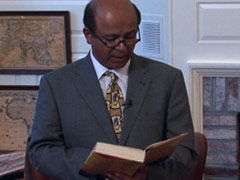
FRED DE SAM LAZARO: Abraham Verghese has all the credentials and degrees befitting a professor at Stanford Medical School. But he is best known and acclaimed for his writing — two best-selling memoirs and a new work of fiction that evoke a different kind of medical vocation.

ABRAHAM VERGHESE: My desire to be a physician had a lot to do with that sense of medicine as a ministry of healing, not just a science. And not even just a science and an art, but also a calling, also a ministry.

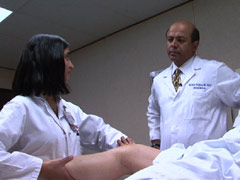
DE SAM LAZARO: His goal is to have today’s medical students aspire similarly to a calling­ as much as a career in medicine, to awaken a more basic curiosity as they sharpen their clinical acumen. These third-year medical students were studying abnormalities on a scan, specifically the prominence of certain blood vessels.

post01-vergheseVERGHESE: (Speaking to students) This is what’s called pulmonary redistribution. Have you heard that term? It’s an early sign of heart failure. Who’s got good hand veins that I can borrow?

DE SAM LAZARO: Verghese offered a simple physics explanation of why blood vessels should not normally be visible above the level of the heart.

VERGHESE: (speaking to students) The level of her right atrium is about here. So watch what happens as I raise her hand. You still see the veins, nice three dimension, right? See how they’re flattening out? Now they are gone.

DE SAM LAZARO: The bottom line: Well before an x-ray, a doctor might spot telltale signs of disease.

VERGHESE: (speaking to students) And you see their neck veins and they’re not coughing, speaking, singing, straining, they have increased venous pressure.

DE SAM LAZARO: Increasingly, he says students and practitioners of medicine in the West rely on technology in a system that stresses cognitive knowledge and machines over the skill that comes from touch and feel.

post02-vergheseVERGHESE: I’m the first to admit that the resolution of a hand feeling the belly doesn’t compare with the resolution of a CAT scan scanning the belly, but only my hand can say that it hurts at this spot and not at this spot. Only my hand can say that. Only my hand can say that this pulsatile mass, which might be an aneurism, is also painful, which is therefore maybe a leaking aneurism. You know, there are nuances to the exam that no machine is going to give you.

DE SAM LAZARO: It’s a theme Verghese has sounded repeatedly over the years, writing in magazines, including the New Yorker and Atlantic, and now in a best-seller called “Cutting for Stone.” It fulfills a long-held desire to write fiction, as he told this book club in Menlo Park, California.

VERGHESE: (Speaking at book club) Dorothy Allison, a wonderful American writer, she says fiction is the great lie that tells the truth about how the world lives.

DE SAM LAZARO: The setting for Verghese’s novel is far from Silicon Valley — a mission hospital in Ethiopia. It is a textured, 650-page narrative, set amid that country’s turmoil in the 60s and 70s. Its stories of medicine, doctors and future doctors at the hospital all illustrate what the author calls the “Samaritan role” of the healer. Verghese went from med school in India to Boston, Tennessee, Texas, then Stanford. He was born and raised in Ethiopia to parents originally from Kerala, India and from its Syriac Orthodox traditions. Faith was a big part of life for this and other expatriate communities in the Addis Ababa of his youth, which may unwittingly have shaped some of the novel’s characters.

post03-vergheseWoman at Book Club: You said that what really inspired you to write the book was you wanted to write a book that would get people interested perhaps in medicine. But there was so much in the book about faith and different types of faith, and so how did you come to have so much of this, of another theme in your book?

VERGHESE: Well, you know, the honest answer is I don’t really know. It all just sort of evolved that way. And I think when you’re in medicine, you agonize over matters of faith.

DE SAM LAZARO: The confluence of faith and medicine, and the mission hospital itself, attracted Duke University Divinity School dean Gregory Jones to Verghese’s book. It was a timely find, just before a recent trip to discuss his church’s own mission work.

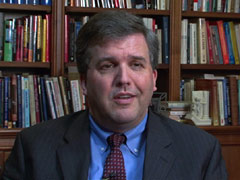
GREGORY JONES, Duke University: It becomes a shaping institution that plays a really significant role in any developing country and one that we need to pay a lot more attention to. My trip to London was actually to deal with issues around southern Sudan, and so I was struck by the significant role this hospital was playing in the novel about Ethiopia.

DE SAM LAZARO: And even though its setting seems distant, Jones says the novel’s context is very relevant to many students he sees at Duke.

post04-verghese
Gregory Jones

JONES: I think a lot of Christians go into nursing or medicine or other health-related vocations out of a deeply formed and felt Christian vocation, but sometimes the practice of health care, in the United States particularly, often pushes those apart. And I think the novel portrays that in a really beautiful way.

VERGHESE: I joke but only half joke that if you show up in an American hospital missing a finger, no one will believe you until they get a CAT scan, MRI and orthopedic consult.

DE SAM LAZAROAll the emphasis on machines, he says, adds cost to the health care system, and comes at the expense of one of our most important rituals — a visit with one’s doctor.

VERGHESE: Rituals are about transformation. You know, we marry with great ceremony to signal a transformation. We are baptized in a ritual to signal a transformation. The ritual of one individual coming to another and confessing to them things they wouldn’t tell their spouse, their preacher, their rabbi, and then even more incredibly, disrobing and allowing touch, which in any other context would be assault. You know, tell me that that’s not a ritual of great significance. If we short-change the ritual by not being attentive, or you are inputting into the computer while the patient’s talking to you, you basically are destroying the opportunity for the transformation. And what is the transformation? It’s the sealing of the patient-physician bond.

DE SAM LAZARO: Ironically, Verghese says, research is emerging that corroborates the importance of this bond, the virtue of the Samaritan healer.

VERGHESE: We’re learning that you can have a powerful effect on patients, or a powerful negative effect on patients based on context, based on your tone of voice. They are actually associated with significant chemical changes in the brain. The Parkinson’s patients’ dopamine levels go up with a placebo. We’re now able to show that the words of comfort trigger biological reactions which are the very things that you want, and you can use drugs to get there, or you can use words of comfort to get there, which would make your drugs so much more effective. It’s an incredible insight, and you know, a couple of decades now of practicing medicine, it’s lovely to come full circle to where I started, but with the science to back it up.

DE SAM LAZARO: For Religion & Ethics NewsWeekly, this is Fred de Sam Lazaro.

Abraham Verghese Extended Interview

Watch more of Fred de Sam Lazaro’s conversation with writer and Stanford Medical School professor Abraham Verghese, author of “Cutting for Stone.”

Originally published July 16, 2010


Brother David Steindl-Rast on Gratitude


KATE OLSON, correspondent: On a recent Saturday morning at the First Congregational Church in Berkeley, California, church members and neighbors gathered to hear Brother David talk about living “a spirited life.”

Church group singing: Viva, viva la musica…

OLSON: For Brother David, it is grateful living that makes everything come alive.

BROTHER DAVID STEINDL-RAST, OSB: The practice of gratefulness that I’m concerned with is grateful living. That means every moment of your life you practice gratefulness. You practice awareness that everything is gift, everything is gratuitous, and if it’s all given, gratuitously given, then the only appropriate response is gratefulness What we really want is joy. We don’t want things. We don’t want to accumulate things. We forget that, and so gratefulness can help us see that, can help us realize that.

OLSON: Though Brother David acknowledges there are many things for which we cannot be grateful, he encourages people to be open to the opportunity being given in every situation.

post01-steindlrastBROTHER DAVID: We cannot be grateful for war. That’s an unmitigated evil. We cannot be grateful for exploitation, for untimely death. But we can be grateful in every situation. The key word is “opportunity.” If you catch onto that, then if we are in practice, when something comes along for which we cannot be grateful, spontaneously we will—our mind will say, “Well, what’s this the opportunity for now?” And there’s always an opportunity for something positive, usually the opportunity to learn something new, even in the worst situations, or for the opportunity to do something. If we learn of an injustice we have the opportunity to stand up and to speak up and to do something.

OLSON: During the day, people reflected on moments of ‘epiphany’ in their lives – what brother David calls mystic or peak experiences, which often include an experience of profound gratitude.

BROTHER DAVID: The mystic is not a special kind of human being, but every human being is a special kind of mystic. We all have mystic experiences, and in these peak moments, in these peak experiences, all of us have this experience of being one with all. Those are the moments in which we feel most alive, most truly ourselves.

OLSON: Grateful living is something you can practice moment by moment in your daily life, he says, and like other spiritual practices, such as Zen meditation, its goal is to live in the present moment, to see everything as “word of God.”

post02-steindlrastBROTHER DAVID: “Word” is not just vocabulary, but “word” is everything that speaks to us, and in this sense a flower can be a word that speaks to me. A poem as a whole can be a word that speaks to me, a piece of art, everything. It speaks to me. It tells me something, it tells me something about ultimate reality. That’s a mystic insight that every human being can appreciate, I think, and experience, if we only allow ourselves.

OLSON: Cultivating this aliveness in life is central to Brother David’s vocation as a monk and to his message. Born in Austria, he immigrated to the US in 1952 and joined Mount Savior Monastery in Elmira, New York.

Brother David singing: Alleluia …

OLSON: For decades he has lived part of his life as a hermit, in prayer and contemplation and writing books. The other half he travels the globe lecturing and leading retreats, helping people discover this “aliveness” in their own lives. Finding the deeply shared personal experience is at the heart of Brother David’s work in interreligious dialogue.

Brother David speaking at retreat: “…always checking it back with your own experience, always checking it back against your basic faith…”

post03-steindlrastOLSON: A pioneer in the Christian-Buddhist dialogue, he returns frequently to Tassajara, a Zen monastery in California where he lived for several years. As part of the dialogue with Buddhism, Brother David trained in Zen meditation and joined in Buddhist rituals. He says the task of interreligious dialogue today is to understand the meaning beneath the words of particular creeds or beliefs, to discover the faith that underlies these words that we all share.

BROTHER DAVID: Deep down there is only one faith that all human beings have, and that is that deep trust in life. Even our body expresses that trust in life by always taking another breath. We can’t even stop it. We can’t stop breathing. So that deep trust in life—that is what all humans share, and that expresses itself, then, in a Buddhist way, in a Christian way, and even in ways that we don’t recognize as explicitly religious. Many atheists have a deep faith. They all have that deep faith, but they express it very differently.

OLSON: Beliefs are not faith, he says. Faith is deep trust. And the opposite of faith is not doubt, but fear.

BROTHER DAVID: The one most frequently repeated command in the Bible is not “love your neighbor,” but “fear not.” And if there is one thing that we need in our world, if there’s one thing that we should write on our mirror and see every morning when we look into the mirror, it’s “fear not.” If we went into the day with that command deeply tattooed on our heart, “fear not,” we’d be completely different people and create a completely different world—a world of faith.

OLSON: This deep trust in life is at the heart of what he sees as “the round dance of grateful living.”

BROTHER DAVID: So we participate in this tremendous dance in which the gift comes forth from the source and through thanksgiving returns to the source, where the word comes out of the silence and through understanding returns to the silence. Gratefulness is not just saying “thank you.” It’s acting. It is being your self. A mother is grateful, shows gratefulness by mothering, a scientist by doing science. That is what the Bible calls “in God we live and move and have our being.”

Church group singing: “Viva, viva la musica…”

For Religion & Ethics NewsWeekly, this is Kate Olson reporting from San Francisco.

Brother David Steindl-Rast Extended Interview

Watch more of correspondent Kate Olson’s conversation with Brother David Steindl-Rast on faith, belief, mysticism, interreligious dialogue, and prayer.


Raising Ethical Children


BOB ABERNETHY, host: We have a profile today of a man who is spending his life trying to help bring about a more ethical America. He is Rushworth Kidder, a former Christian Science Monitor correspondent and columnist who founded and runs the Institute for Global Ethics. As he makes clear in his new book Good Kids, Tough Choices, Kidder wants to help parents help their children make ethical decisions and develop the moral courage to carry them out.

A familiar sight in Rockland, Maine is Rushworth Kidder leaving town. From his think tank, the Institute for Global Ethics, Kidder is on the road about half the time helping corporations, schools and other groups think about what’s ethical. This day-long session was at New York University’s Schack Institute of Real Estate.

RUSHWORTH KIDDER (speaking to group): So the whole thing is just to think about the characteristics of a morally courageous individual.

post01-ethicalchildrenABERNETHY: Kidder says at sessions like this one over 20 years he has talked ethics with 40,000 people. The first step is easy, he says: telling right from wrong. You ask, is this illegal? Against the rules? If not, another question:

KIDDER: We just call it the stench test. Does the thing just plain stink? At some gut level, instinctive way, is this just wrong? Suppose it passes that one. Go on to what we call the front page test: How are you going to feel if everything you did shows up on the front page of tomorrow morning’s paper, or these days on YouTube, on Facebook? And finally, the one I love to get to is what we call the Mom test. The Mom test is what would my Mom do in this situation?

ABERNETHY: Kidder says the most important thing parents can do for their kids is set a good example. He also says there are helpful ways to think about ethical choices, and he demonstrated some of them with a group of parents he invited, at our request, to talk about issues they face.

KIDDER: What do you do as a parent if it’s clear to you that one of your children has told a lie to you?

MOTHER: The three-year-old still tells the truth. The nine-year-old—lying is pretty prevalent. I’d say daily to weekly. It’s been quite an issue.

post02-ethicalchildrenABERNETHY: Kidder says younger children lie, but don’t cover it up. Older kids do both.

KIDDER (speaking to parents): There’s a piece of research that describes the fact that, if we’re not careful, by the age of eight kids become—and this is the phrase the researchers used—“fully skilled lie-tellers.” That’s a frightening phrase.

ABERNETHY: Kidder says all cultures identify the same five core values.

KIDDER (speaking to parents): Everywhere we go and do this work, and I’m talking about around the world, we’ve worked in about 30 countries on this kind of idea, we keep hearing people talk about the same thing: honesty, responsibility, respect, fairness, and compassion. There’s no difference between the values held by people who say I am deeply religious and those who say I have no religion whatsoever. This really goes deep.

ABERNETHY: The hardest ethical choices, Kidder says, are not between right and wrong but between right and right, when two or more core values conflict. He told the story of a girl whose friend told her she was anorexic, but swore her to secrecy. Then the girl discovered that her friend’s condition was life-threatening.

KIDDER: Wow, you’ve just dumped that teenager or that middle-schooler right in the middle of a right-versus-right dilemma, where everything about truth-telling is hugely important. You don’t tell the truth, somebody may be dead. On the other hand, you don’t break a promise.

ABERNETHY: Kidder urges parents of young children to drill right and wrong into them. With older children he encourages discussion—recognizing potential conflicts before they occur.

KIDDER: Just having the opportunity in some ways to talk about these things ahead of time with kids, just to begin to get at some of the right-versus-right kinds of questions that come up, you’re at least giving a child a way to understand that oh yeah, these things happen.

post03-ethicalchildrenABERNETHY: Of all the ethical issues the group raised, the most troubling was how to handle computers and new social media like Facebook.

FATHER: We’ve had five or six kids sitting in our living room, all on their computers, not interacting with each other.

MOTHER: On weekends in the afternoon we don’t allow any media—and that’s TV, computer, anything—because we need to disconnect.

MOTHER: I am petrified the day that she gets on Facebook. She’s not using email yet, but it’s certainly going to be an issue, and it’s scary.

KIDDER (speaking to parents): This is third grade you’re talking about?

MOTHER: She’s in fourth grade. I have full intention of reading emails before she even has an account. If you’re going to have this account it’s going to be monitored.

FATHER: The power is there to change the world. On the other hand, can it be used for things that are not great? Absolutely, and we’ve seen examples of that: kids, you know, having their sexual preference put up online and committing suicide and things like that.

post04-ethicalchildrenKIDDER: There is now so much power and so much immediacy in the technology that a single unethical decision put into the system can have consequences that it never could have had 30, 40, 50 years ago.

ABERNETHY: Kidder argues that identifying and choosing what’s right always carries the need to act. He calls that “moral courage,” and one of the group gave an example. Her daughter saw some kids picking on another child on the school bus.

MOTHER: So she is a very quiet girl, but she actually kind of stood up and said, “Hey, stop doing that. That’s bullying,” and I said, “What happened?” She goes, “Well, they didn’t hear me so I had to do it again.” It made me very proud of her. It was something that hopefully was based on our values that she’s ingrained in her.

ABERNETHY: At dinner that night, two of the parents tried out on their two daughters the idea from the discussion of banning all electronic media on weekend afternoons. It did not sell.

DAUGHTER: Why?

post05-ethicalchildrenMOTHER: They want their kids to be connected with the family again.

DAUGHTER: I feel really bad for those kids.

MOTHER: I kind of like that idea. I thought we should adopt something like that here.

DAUGHTER: I don’t understand. I mean, what would you do?

MOTHER: What about you, Jen? What do you think about that?

DAUGHTER: No. It’s not a good idea.

ABERNETHY: Whatever the resistance, Kidder looks at the power of new technology and sees an urgent need to anticipate its effects and prevent the worst of them. Indeed, he wants to make his Institute’s top priority now trying to create all over the US what he calls “a culture of integrity.”

KIDDER: I think our ethics is climbing. I think maybe the curve is sort of going up like that. I think our technology is going up like this. Unless we can ensure that there is a moral compass behind our uses of the new technologies, we run the risk of putting ourselves in grave danger. Will people look back at us today and say, “You discovered the digital age, and you frittered away the whole thing on Twitter, on Facebook, on Google, on those sorts of things. What on earth were you thinking?”

National Museum of American Jewish History


JOSH PERELMAN (Deputy Director of Exhibitions, Programs, and Collections): The primary theme of this institution is freedom and the opportunities, the challenges, the choices that come with that. Here we really have the opportunity at the place where freedom was enshrined in this country. This museum sits across the street from the Liberty Bell, up the street from Independence Hall and the Constitution Center.

It’s largely a chronological core exhibition that begins in 1654 with the first permanent settlement of Jews in what was then colonial America and weaves its story up until really the present day.

The first Jews who came to this nation came in search of freedom, came in search for opportunity.

post01-jewishmuseumWhen Washington was elected president, Jewish communities around the nation sent him letters of congratulations, and they did so along with other religious communities around the country. Washington replied to a number of those letters, but the most famous reply was to the Touro Synagogue in Newport, Rhode Island, stating that the government of the United States would give “to bigotry no sanction, to persecution no assistance,” thereby enshrining in that letter, really, the principle that this would be a country to which all religions, all peoples would have the opportunity to live in freedom.
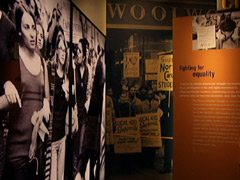
Freedom, while a revolutionary ideal, has been imperfect in its application. This has been a nation where there has been anti-Semitism, and Jews have had to wrestle, overcome, and challenge it.

The exhibition includes the story of Leo Frank, the only Jew known to have been lynched in America. Leo Frank was wrongly accused of raping and murdering a young girl in Atlanta. His story is emblematic of the struggles Jews have faced on their pathway to integration.

post02-jewishmuseumAt the same time freedom makes possible the potential for integration at a level that Jews had experienced at very few times in their history, it also makes possible the ultimate choice, which is to not be Jewish, and in some ways this is one of the inner dramas of the American Jewish experience. It’s negotiating between heritage and homeland.

The ingenuity of Jews in America has led to all sorts of amazing achievements in the sciences, in culture certainly. Irving Berlin’s story is really remarkable in that here he is, this Jewish immigrant from Russia who wrote “God Bless America,” who wrote “White Christmas.”

One item that visitors will love to see is the typewriter from “Schindler’s List,” which Mr. [Steven] Spielberg made available to the museum for exhibition.

And certainly one of the most colorful groups are Jewish gangsters, Jewish criminals.

I think one of the important roles Jews have played in the history of this nation is that Jews have been advocates for civil rights, civil liberties, for the extension of freedom not only to themselves, but to others as well. Whether it’s Abraham Joshua Heschel in the civil rights movement or Bella Abzug in the women’s movement, or the many people who came together for the movement for Soviet Jewry, here they are staking their claim to freedom and working tirelessly, energetically on behalf of the freedoms of others.