Islamic School


LUCKY SEVERSON, correspondent: The first thing an outsider might notice at the Universal School in Buffalo is how well behaved the students are. The chaos that sometimes erupts between classes at public schools is not to be found here. Universal is an Islamic school for students in pre-K through eighth grade. It’s one of 240 private Islamic schools in the country and is supported through tuition and fundraising. Kathy Jamil is the principal.

KATHY JAMIL (Principal, Universal School, Buffalo, NY): We hope to instill in our children what it takes to be a responsible, caring and giving person who is God-conscious, and we believe we can only do that if we develop a whole child. So we focus on academics, but it’s just one small part of everything else, because we actually feel if we can hit the other realms, we feel like the academics just skyrocket.

SEVERSON: God-consciousness, they say, is meant to be a constant state of awareness of Allah throughout the day. Tamer Osman directs the Islamic studies program.

post01-muslimschoolTAMER OSMAN (Director of Islamic Studies, Universal School): There are times when students are traveling in the hallway that maybe an adult’s eye may not be on them for just that moment. If they remember that God is watching, they may not do those type of things that we find in other schools, whether it is ridicule other students or bullying. We have a lot less of those types of things at the school here, and I think part of that reason is because we are trying to inculcate the idea of God-consciousness in the children.

SEVERSON: They are reminded of God five times each day during prayer. Universal is a state-accredited school so the students are taught the same curriculum as those in public schools and their test scores are on grade level or above. But here they’re also taught Arabic and Islamic studies, including the Quran and the sayings of the Prophet Muhammad. They learn about values from the teachings of the Prophet.

JAMIL: The Prophet, peace be upon him, as we believe, is the best of all mankind, and he embodied all the beautiful qualities and characteristics that we want to work on in our lives.

OSMAN: One of the wisdoms in Islamic schools today is that if you look at our core American values, they coincide with a lot of our Islamic values.

post03-muslimschoolSEVERSON: Those shared interests apparently include the love of sports, like soccer, which is popular in many of the different countries these kids’ families emigrated from. But one of the challenges at Universal is to separate the religion from the attitudes of the culture they left behind—attitudes, for instance, detrimental to women.

JAMIL: I work with some domestic violence clients here in the US on relation to immigrant families and Muslim families and with the conversations that I have with the court systems, you will hear a man walk on, sit on the stand and say “I have the right to,” from a religious perspective, and we are there saying you absolutely do not. You clearly don’t understand your faith tradition.

SEVERSON: Islam considers homosexuality a sin, and in some Muslim countries the punishment is severe.

ALET SIAM (Eighth Grade Student, Universal School): Being gay is forbidden in Islam but you cannot make fun of that group or people who are like that. You’re supposed to be nice to everybody, but it’s still forbidden. You can’t do that.

OSMAN: As Muslims, we shouldn’t be judgmental. Just like in many of the other faiths it is frowned upon. It’s not seen as something that’s praiseworthy. But at the same time, it’s not—we don’t see it as if the person does that then that’s it, they are condemned forever.

post04-muslimschoolSEVERSON: The school found its home in an unlikely place—a former Catholic church and convent. Students from Universal and St. Monica Catholic School share interfaith programs throughout the year. Nancy Langer is with St. Monica.

NANCY LANGER (President, NativityMiguel Middle School of Buffalo): What I’ve noticed is that they don’t seem to look at each other and see any differences. They seem to accept each other for who they are, and they’ve become instant friends. It’s really wonderful.

SEVERSON: Universal opened its doors three days before the 9/11 terrorists attacks. Suddenly there were bomb threats. Police were patrolling the school—not a good time to be a Muslim in America, and it was perhaps the worst time to open an Islamic school.

JAMIL: That evening we had an emergency board meeting. There was just silence. Everyone was quiet. We didn’t know what to say. We didn’t know what to think. We didn’t know what to do.

SEVERSON: Ultimately they decided that keeping the school open presented an opportunity to reach out to the inner-city neighborhood that surrounds the school. Ray Barker teaches social studies. He’s not a Muslim but is impressed with the mission of the school.

RAY BARKER (Social Studies Teacher, Universal School): It is really looking at developing the whole person through a moral structure set up by the religion. It very much is creating a strong foundation for them for these years and the rest of their lives.

post07-muslimschoolMIRIAM AHMED (Eighth Grade Student, Universal School): You just do good in school.

SEVERSON(speaking to students): So are you good all the time?

For some parents, learning good values was only one reason they wanted their children in a religious school. Even before she gave birth to her three kids, Maha Zaatreh didn’t care whether they went to an Islamic school or a Catholic school as long as it wasn’t a public school.

MAHA ZAATREH: Discipline, really—that was my concern. Discipline, respect to their parents, respect to older people. That was my first goal.

OSMAN: Prophet Muhammad, peace and blessing be upon him, he talked about how important gentleness was—that God is gentle, and he loves gentleness. At our school you would find it very rare that you’d have a teacher raise their voice.

SEVERSON: They may not raise their voice but they do achieve discipline. Listen to Alet and Hakim.

ALET SIAM: You know that room downstairs right before you come up here, the library? In there you spend the whole day with the guy at the desk downstairs, Brother Jabor. Oh, man, he can give some punishments.

post06-muslimschoolSEVERSON: Like what?

HAKIM ARMAN: He gives us all this writing to do. Sometimes, like last year, there was the other hall monitor. They’re kind of strict. If you walked down the wrong way, they make you walk up and down like 80 times.

ZAATREH: It gets me worried to know the fact that when my daughter is a teenager, she’s going to start thinking, “I want to date, I want to go here, I want to go there.”

SEVERSON: She needn’t worry about Universal. Dating is not allowed here for a host of reasons. Some are found in the Quran’s views on chastity when it refers to Miriam, whom Christians call Mary, the mother of Jesus.

OSMAN: In the Quran God uses Miriam as the example for our young girls, on how he had so much love for her because of her chastity, because of her modesty before God, because of her purity and her internal beauty, and that’s all part of it. We don’t want to necessarily come down on them and say dating is bad, dating is bad. Rather, we want to tell them how positive a healthy family is.

SEVERSON: Why do you think it is that they don’t want you to date?

ALET SIAM: Because you don’t want any like diseases. Like because of the STDs going around.

post08-muslimschoolSEVERSON: Values are enforced and behaviors like gossip and bullying strongly condemned. Bullying is a very real and personal concern for these students. Some come looking for a safe environment.

(speaking to student): Why were you bullied?

HAKIM ARMAN: I was bullied because I’m Muslim. I got like punched a couple of times.

SEVERSON: Girls who wear the head scarf, the hijab, often feel the insecurity of being the object of stares, of being different. Some wear their hijabs only at school. Others wear them as a badge of honor.

KHADIJO ABDULLE (Eighth Grade Student, Universal School): I started wearing hijab when I was little in first grade. I have been wearing it since then, outside even, and people just used to look at me, and then I used to have to act like them and I didn’t want to do that. I wanted to be me.

SEVERSON: So it made you feel bad.

(speaking to students): Do you think Muslims get a bad rap in this country?

FADUMO MOHAMMED (Seventh Grade Student, Universal School): Because they don’t know who we are.

MIRIAM AHMED (Eighth Grade Student, Universal School): If they see the truth, it’s very obvious that we are good people.

SEVERSON: Universal started with 17 students. Today they have over 100. The eventual goal is to expand Universal to include high school.

For Religion & Ethics NewsWeekly I’m Lucky Severson in Buffalo, New York.

An Unconventional History of Human Rights

by David E. Anderson

On December 10, the Nobel Peace Prize is scheduled to be presented to Chinese dissident and pro-democracy activist Liu Xiaobo.

Liu will not be in Oslo to accept the award. He’s languishing in a Chinese prison under an 11-year sentence. Nor, in all likelihood, will his wife go to Oslo to receive the prize for him. She has been under house arrest since October 8, when the Nobel committee named Liu as the recipient of this year’s award.

Fifteen Nobel peace laureates, including retired Anglican Archbishop Desmond Tutu, former US President Jimmy Carter, and the Dalai Lama, urged the G20 group of nations to press China at their November meeting to free Liu. The appeal fell on deaf ears, as did a similar request from President Obama, last year’s peace laureate.

The Liu episode underscores in dramatic fashion both the ubiquity of human rights in international affairs and the constraints on a movement in which nation-state sovereignty and national foreign policy interests still dominate world events.

In a provocative and contrarian new book, “The Last Utopia: Human Rights in History” (Harvard University Press, 2010), Columbia University professor Samuel Moyn outlines the moral and political dilemmas in which the movement currently finds itself, describing his subject as “the place of human rights in the history of moral opinions and modern schemes of progressive reform.”

Moyn takes a revisionist and decidedly minority stance compared with more conventional histories of human rights. Generally, historians mark the beginning of human rights with the revolutions—American and French—of the late 18th century, with traces leading back to the Bible and Greek philosophy and forward to the 1945 formation of the United Nations and the 1948 Universal Declaration of Human Rights.

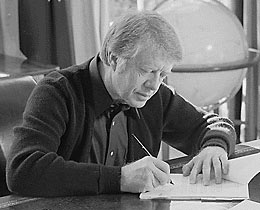
JimmyCarter-andersen
President Jimmy Carter

But Moyn rejects these usual starting points, instead positing the 1970s, and especially the crucial year of 1977, as the true moment of the birth of the human rights movement. “In the 1970s,” Moyn writes, “the moral world of Westerners shifted, opening a space for the sort of utopianism that coalesced in an international human rights movement that never existed before.” The paradigmatic year—perhaps the movement’s zenith as well—began in January with Jimmy Carter’s inaugural address in which for the first time an American president made human rights a centerpiece of American foreign policy, and ended in December with the presentation of the Nobel Peace Prize to Amnesty International, the organization that pioneered and embodied a transnational understanding of human rights.

Moyn’s dating of the full-fledged human rights movement to the 1970s rather than 1776, 1789, or the 1940s is dependent on two things: the failure of other universalistic systems or utopias such socialism, anticolonialism, or democracy promotion wedded to laissez-faire capitalism, and the transcendence of the nation-state as the site for and enabler of human rights.

In Moyn’s view, as long as rights were linked to nation-state citizenship, as in the American and French revolutions, and to the nation-building of the anticolonial movement or the narrow foreign policy interests of the Cold War and the neo-conservative pro-democracy movement, then human rights could not be realized in a morally full and transcendent manner as a transnational ideal. The “central event” in the creation of human rights was the recasting of rights “that might contradict the sovereign nation-state from above and outside rather than serve as its foundation.”

During the revolutionary era of the 18th and 19th centuries, rights “were very much embedded in the politics of the state, crystallizing in a scheme worlds away from the political meaning … [they] … would have later. The ‘rights of man’ were about a whole people incorporating itself in a state, not a few foreign people criticizing another state for its wrongdoing. Thereafter, they were about the meaning of citizenship.”

Similarly, Moyn writes that the “true goal” of the prospective United Nations as it was being hammered out in the post-World War II era was less about enshrining the rights of individuals over against the state than it was about establishing a balance of power among the states. In the end, he says, the idea of human rights, despite being bandied about primarily as wartime anti-Nazi propaganda, entered the final plans of the UN “as a negligible line buried in the proposal for an Economic and Social Council without any serious meaning.”

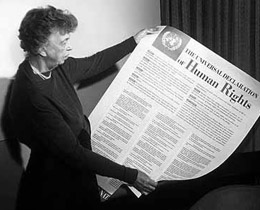
eleanor-with-declaration
Eleanor Roosevelt with Universal Declaration

Nor did human rights emerge, he notes, as some historians have suggested, as a response to the Holocaust. “In real time, across the weeks of debate around the Universal Declaration in the UN General Assembly, the genocide of the Jews went unmentioned, in spite of the frequent invocation of other dimensions of Nazi barbarity to justify specific items for protection, or to describe the consequences of leaving human dignity without defense.” Moyn acknowledges that “human rights crystallized as a result of Holocaust memory, but only decades later, as [they] were called upon to serve brand new purposes.” He speaks of the “increasing Christianization of human rights after World War II,” but characterizes the 1950s human rights rhetoric of Popes Pius XI and XII as “a throwaway line, not a well-considered idea” and “an empty vessel that could be filled by a wide variety of different conceptions.”

The bulk of Moyn’s extended essay is devoted to three moments in contemporary history and how they not only created the framework for but also, in his view, impeded the development of human rights: the creation of the United Nations, the rise of anticolonialism, and the development of international law. In a chapter called “The Purity of the Struggle,” Moyn traces the emergence of the human rights movement in the 1970s, paying critical attention to Russian and Eastern European dissidents such as Andrei Sakharov and Vaclav Havel, as well as President Carter’s foreign policy efforts (though without mentioning Patricia Derian, who served during the Carter administration as the nation’s first assistant secretary of state for human rights and humanitarian affairs), and crediting “the supreme importance of political Catholicism in Eastern Europe” and Amnesty International as a central player.

Human rights exploded in the 1970s, Moyn writes, “in direct relation to the breathtaking marginalization of the UN as the central forum for and the singular imaginative custodian of the [human rights] norms. For this outflanking of the UN, American internationalism during World War II and its postwar remnants provided no precedent. It was Amnesty International [AI] above all, whose origins Moyn situates in “Christian responses to the Cold War,” that “made this move most decisively.” In the wake of the failure of the Tehran conference of 1968 marking the 20th anniversary of the Universal Declaration, the need for a new kind of mobilization on behalf of human rights became apparent, and AI provided the model. Indeed, Moyn writes, “almost alone, Amnesty International invented grassroots human rights advocacy, and through it drove public awareness of human rights generally.”

Yet it seems too much to argue that the movement had no real antecedents and somehow sprang full-blown from Jimmy Carter and his speech writers, or Vaclav Havel and Charter 77, or the founders of Amnesty International. It is interesting to note that in a bibliographical essay on additional research that appears at the end of the book, Moyn goes only so far as to acknowledge the work of many other scholars as a “quixotic search” for the deep roots of human rights. For those interested in “claims” about the deep Christian sources of human rights, he refers readers to philosopher Nicholas Wolterstorff’s 2008 book “Justice: Rights and Wrongs” (Princeton University Press).

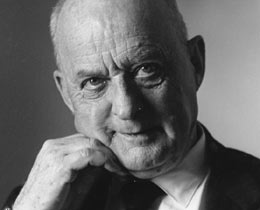
reinhold-niebuhr
Reinhold Niebuhr

Religion, nevertheless, runs through Moyn’s account like a red thread, sometimes notable in its impact, sometimes negligible, sometimes less than clear, and sometimes negative, as when Reinhold Niebuhr, the great apostle of internationalism and realism in foreign policy, criticized any proposed injection of human rights into the Dumbarton Oaks framework for the UN on the grounds they would be meaningless. “Nor would the Dumbarton Oaks agreements be substantially improved by the insertion of some international bill of rights which has no relevance, and would have no efficacy in a world alliance of states,” Niebuhr argued. “It is nonetheless true,” Moyn writes, “that against Niebuhr’s advice advocacy groups kept human rights on the agenda in the winter of 1944-45.” Moyn also notes the collaboration of the NAACP, under the direction of W.E.B. Du Bois, with Jewish and Christian organizations like the American Jewish Committee and the Federated Council of Churches “to return the idea of human rights to more prominence in the prospective [UN] charter.”

Moyn is telling a large and complex story concisely and often persuasively, even if he does not give enough credit to alternative versions. But there are many times when the reader wants more details and more context, especially about the role of religion, even though Moyn acknowledges that in the US “it was religious groups who were probably the most active in the campaign to raise the profile” of human rights. At least one reading of his argument suggests that US religious groups—especially the “old-stock Protestants” of the Federal Council of Churches and Jewish organizations like the American Jewish Committee, along with philosophers such as Jacques Maritain (“rights talk seems to have been dominated by Catholics,” Moyn observes at one point), Protestant Swiss theologian Emil Brunner, Anglican bishop of Chichester George Bell, religious peace groups, and Christian layman and Republican foreign policy thinker John Foster Dulles, Eisenhower’s secretary of state, for whom a Christian concept of human rights was “the last best defense against the communist threat”—all played an important role in the post-World War II debates around the formation of the United Nations in keeping the idea of human rights alive, even if its fully formed version did not come to fruition until the 1970s, and by that time, Moyn says, human rights “lost the religious associations” that had counted for so much in the 1940s.

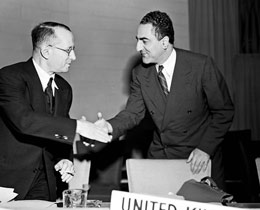
charles-malik
Lebanese-Christian diplomat Charles Malik

Moyn notes “the striking prominence of Christian social thought” among the three main framers of the Universal Declaration. In different ways, he writes, Christianity defined the worldviews of lawyer John Humphrey, who directed the UN’s Human Rights Division for two decades; Lebanese diplomat Charles Malik; and Eleanor Roosevelt. Even Amnesty International, which Moyn considers critical in the development of a full-blown, transcendent and untainted human rights movement, had its roots in Christian peace movements, including Quakers, Pax Christi and the World Council of Churches (although Moyn observes that neither Pax Christi nor the WCC “had made human rights a central idea.”)

“It was in the atmosphere of the crisis of utopias old and new [in the 1970s] that human rights broke through,” Moyn writes. The stalemate of the Cold War, the end of the anticolonial movement for self-determination—in short the failure of politics fired a longing for a movement and a meaning beyond nation-state politics. What distinguished human rights consciousness in the 1970s was that its appeal to morality “could seem pure even where politics had shown itself to be a soiled and impossible domain,” says Moyn. “Morality, global in its potential scale, could become the aspiration of humankind.”

But what might be called the pure human rights moment of moral vision passed from the scene almost as quickly as it had arrived, and human rights advocates were forced, Moyn argues, to confront the need for a political agenda and a programmatic vision. “If human rights were born in antipolitics, they could not remain wholly noncommittal toward programmatic endeavors, especially as time passed.”

In an epilogue on “The Burden of Morality,” Moyn looks at the new constraints and obstacles facing the movement, because despite transnational treaties aimed at protecting human rights, the nation-state did not wither away and human rights rhetoric—though not necessarily human rights realities—became another tool in the arsenal of national diplomacy.

One of the major issues facing human rights groups today is how to combine the political rights that fueled such groups as Amnesty International and Human Rights Watch with the social rights—work, housing, food—that were also a part of the formulation of human rights in the 1948 Universal Declaration. Slowly, Moyn notes, there has been an amalgamation of the human rights movement and the humanitarian movement. Today, he says, “human rights and humanitarianism are fused enterprises, with the former incorporating the latter and the latter justified in terms of the former.”

Moyn is writing as a historian, not an advocate, so he does not address the still incomplete record of the human rights movement in responding to the so-called war on terror and the erosion of political rights with such legislation as the Patriot Act, the use of torture by the United States and other governments against alleged terrorists, or the possible violation of the Geneva Conventions or other international laws and norms in the name of national security. He does, however, observe that “human rights are not so much an inheritance to preserve as an invention to remake—or even leave behind—if their program is to be vital and relevant in what is already a very different world than the one into which it came so recently. No one knows yet for sure…what kind of better world human rights can bring about.”

To date, the human rights movement seems to have been singularly ineffective in offering or enacting the transnational utopian moral vision Moyn believes so distinguished it in the 1970s.

David E. Anderson, senior editor for Religion News Service, has written recently for Religion & Ethics NewsWeekly on artist Mark Rothko, drone warfare, and the ethics of sanctions.

Gossip


BETTY ROLLIN (correspondent): It’s called CyberAbuse and it looks like this: “She is a whore and she’s not even good looking.” “Biggest freshman slut.” This is the sort of message that Erin Roy and her sorority sisters found themselves confronted with in Erin’s junior year of college. Erin is now a senior at Marist College in Poughkeepsie, New York, a small college with a Catholic heritage.

ERIN ROY: One day I came home from class, walked in my house, and my housemates were huddled around the computer, and they said that they had heard of and found this Web site. So I went over, checked it out and just saw terrible, terrible things written. Initially it definitely affected a lot of girls I know. I think they were just devastated, embarrassed, upset. Marist is a very small school, so one person hears something, and it spreads like wildfire even if it holds no truth.

ROLLIN: The Web site that was spreading the malicious gossip at Marist and 500 other colleges and universities was called JuicyCampus. Incredibly, the students had no way to stop it since the messages were all anonymously written, and the Web site was under no legal obligation to remove it.

gossip-post01-lab

ROY: Some of them definitely, probably were written by men who maybe left off on the wrong foot with a girl. Maybe something happened, and you know he didn’t think of her in the highest regards, and for girls—jealousy. They know this site is anonymous, so they are just so willing to jump on their computer and write comments about people, because they know they will never be caught.

ROLLIN: Erik Zeyher, who graduated from Marist last year, was class president. A fellow student’s email alerted him to the problem.

ERIK ZEYHER (reading an email): “Two of my roommates have suffered eating disorders and have been getting help from the school. Because of this site they have been up for panic attacks most of the night.”

ROLLIN: The site became like a campus virus affecting everyone. There was a particular fear that potential employers would see the comments. Given that there was no legal way to stop postings, the question was how do you stop them? Student leaders and administrators first considered banning the site, then decided to launch a campaign.

ZEYHER: We actually found a program that Princeton was using, they came up with, called “Own What You Think,” which is a way for students to basically voice their opinions in a constructive, respectful—and in a way that isn’t anonymous, so you could find out exactly who was saying what about each other.

gossip-post02-website

ROLLIN: And what were the opinions?

ZEYHER: “Hey Julie, you are the best roommate ever” to “Brandon, thanks for helping me out with my homework. You are a great person and a really great friend.”

ROLLIN: In addition, they flooded JuicyCampus with messages of love.

ROLLIN: So all of this together seems to have worked.

ZEYHER: It actually did. Students really bought into the idea of social change and that we won’t stand for this, and as a community we really made a difference.

ROLLIN: Although JuicyCampus ran out of money and eventually shut down, other sites are alive and well, and the targets are not only on campuses. Michael Fertik, who lives in northern California, is in the business of trying to protect adults and companies from online attacks.

MICHAEL FERTIK (Reputation Defender Inc.): Our customers tell us that their lives had been ruined, that their livelihoods have been ruined, that their sense of dignity has been ruined, that their kids’ mental health has been ruined. Your education, your training, they are all tied up with your name, and your livelihood is tied up with what people see about you when they look up your name online. Our job, where there’s a problem and where we want to remediate the problem by repairing the Google result, is to make sure that the most recent, truthful, and good stuff shows up on the top of Google, and the nasty attacks descend so that they are harder and harder to find.

ROLLIN: This is Manhattan High School for Girls on East 70th Street in New York City, where they consider the act of gossip to be a sin, a huge sin. The Orthodox Jewish girls who attend this school are made aware every day of the danger of gossip, which they call lashon hara. Lashon hara is speaking ill of someone—or even listening to such speech. Even though constructive criticism in conversation can be allowed, harsh criticism is forbidden.

RABBI MORDECHAI PRAGER (Teacher of Jewish law): Human beings which are created in the image of God deserve to be protected. Their dignity should be protected, that even if they do something wrong they should not suffer embarrassment. They should not be degraded by other people.

gossip-post03-prager

Rabbi Mordechai Prager

ROLLIN: This morning the subject of lashon hara is part of Rabbi Prager’s lecture. But what if someone seems to deserve criticism?

RABBI PRAGER (speaking during lecture): Once we establish that the person did something wrong we are still obligated to try to find, to minimize the wrong. Maybe the person doesn’t understand, the person doesn’t know.

ROLLIN: And what about gossip that is intimate but not critical?

RABBI PRAGER: There is a prohibition of spilling the beans. If something was told to you in privacy, the person does not want it to get out, you have no right to tell it to anyone.

ROLLIN: The students regularly do skits about the evils of lashon hara. But avoiding nasty comments isn’t always easy.

MIRI LIDSKY: I think I’ve been in a few situations where I had a really juicy story to tell to people, and it really wasn’t so nice about somebody else, and I stopped and just thought about these laws. Learning the laws every night, it really helped me just bring about an awareness that I stopped to think about before I said the story, that maybe I really shouldn’t say this.

MICHAL LOSHINSKY: Every single day you are talking with your friends and there’s always new conversations and new pieces of gossip to talk about. Like it does get easier, because you first have to learn the laws. You have to want to do it, and you have to push yourself and control yourself.

gossip-post04-class

ITA DAICHES: It turns me into a more positive person, because if I am not saying bad things about other people it affects the way I think.

ROLLIN: There are times when Jewish law allows, even condones lashon hara—when giving factual information in a court of law, for example, or to protect a person from imminent harm. And outside Jewish law, defenders of gossip say that often it’s just a way that friends bond.

ROLLIN: The girls at Manhattan High School are largely unaffected by the biggest conveyor of gossip, namely the Internet. For the most part, this Orthodox community prohibits use of the Internet. But many people, especially young people, virtually live on the Internet, where it’s open season and there is no law to protect them.

FERTIK: That law today is set up in such a way that the Web site where you publish that content is absolutely immune from liability. So even if you do defame someone, absolutely defame someone, the Web site where you publish the content never has to take it down.

ROLLIN: In spite of the victory at Marist College, many other colleges are dealing with the problem of online gossip sites and which, given their growth, will continue to be a problem for some and a temptation for others.

For Religion & Ethics NewsWeekly, I’m Betty Rollin in Poughkeepsie, New York.

Festival of Lessons and Carols

Originally broadcast December 18, 2009

KIM LAWTON, correspondent: It’s one of the best loved church services during the Christmas season. With Scripture and song, the Festival of Lessons and Carols retells the Christmas story, and for many it’s a moving spiritual experience.

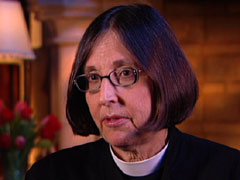
CANON VICTORIA SIROTA (Cathedral Church of Saint John the Divine, New York City): Lessons and Carols is not a concert. It’s not where you’re going to applaud after everything. You’re going to allow yourself to meditate at a much deeper place.

LAWTON: The service intersperses prayers, carols, and Bible readings, traditionally nine passages called “lessons.”

Reading from the Book of Genesis at Service of Lessons and Carols: Then the Lord God said to the woman, what is this that you have done? The woman said, the serpent tricked me and I ate.

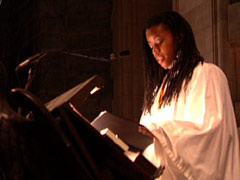
post01-lessonsandcarolsLAWTON: The readings start at the beginning with the Book of Genesis and the story of Adam and Eve sinning in the Garden of Eden and damaging their relationship with God. The lessons move on through the Old Testament prophets who foretell the coming of a Savior who will restore the relationship with God.

Reading at service: The Virgin shall be with child and bear a son and shall name him Emmanuel…

LAWTON: And then to the Gospels, which describe the coming of Jesus.

Reading at service: And of his kingdom there shall be no end…

SIROTA: From a theological standpoint, and actually from a visual standpoint, it is getting that wide-angle lens and moving back and seeing the whole story, seeing the panorama of God’s plan for salvation for humankind and why that was even necessary.

LAWTON: Canon Sirota wrote a book called “Preaching to the Choir.” She says the songs after each reading help amplify the message.

post02-lessonsandcarolsSIROTA: In a sense, the hymns and carols, most of them are based on biblical sources, so they are interpreting for us. The music really tells you how to feel about the text.

LAWTON: The Festival of Nine Lessons and Carols has its roots in ancient Christian vigils. But the service in its current format was first held in 1918 at King’s College in Cambridge, England. It was adapted by Reverend Eric Milner-White, dean of King’s College and a former army chaplain. Milner-White was preparing a Christmas Eve service just after the end of World War I. The war had taken a heavy toll on his flock. About half of King’s undergraduates had gone off to war, and a third of them never came back. Milner-White wanted to do something special.

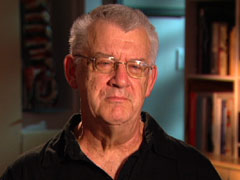
WILLIAM EDWARDS (Editor and Author, “The Festival of Nine Lessons and Carols”): You have to visualize December 1918 in Cambridge. You’ve got a congregation which is probably largely made up of widows, girlfriends—in those days they’d have been called fiancées—children there to somehow deal with this horror that they’d just been through. I think he wanted to deliver some level of comfort, that all this pain and suffering and death had some meaning.

post03-lessonsandcarolsLAWTON: Bill Edwards is author of a book called “The Festival of Nine Lessons and Carols.” He says the service that Milner-White put together caught on.

EDWARDS: Throughout the early 1920s, more and more people would attend the service, and by 1928 it was well known enough that the BBC, which was then in its infancy—I mean we’re talking radio 1928—picked it up to broadcast throughout the British Isles, and then two years later throughout the world.

LAWTON: Minnesota Public Radio began broadcasting the King’s service across the US in 1979. The service in King’s College’s magnificent 16th-century chapel is not televised. People line up outside for days before Christmas Eve, hoping to get one of the best seats. Edwards describes himself as a lapsed Congregationalist, but says attending the service in person was like being on a religious pilgrimage.

EDWARDS: My favorite is I think probably everybody’s favorite, and I can’t even talk about it without getting choked up because it’s so emotional, and that’s hearing those first few bars of “Once in Royal David’s City.” It’s just magic. Magic.

post04-lessonsandcarolsReading at service: The spirit of the Lord shall rest upon him…

LAWTON: Local churches began copying the King’s service and then adapting it. People in the pews loved the format, and pastors appreciated it because they didn’t have to come up with a sermon. Protestants and Catholics alike do Lessons and Carols services. The Catholic version usually includes some rendition of Ave Maria. While many services stick with the familiar carol favorites, others incorporate more contemporary songs, or songs from a variety of cultures.

EDWARDS: It’s wonderful that a concept that’s almost 100 years old has the power, and has been helped by technology, i.e. worldwide radio, to say something to ministers, priests, whatever you will—hey, I can do something with this that’s meaningful in my church.

REV. JAMES KOWALSKI (Dean, Cathedral Church of Saint John the Divine, New York City, speaking to congregation at Advent Procession): As we await the great festival of Christmas, let us prepare ourselves so that we may be shown its true meaning.

post05LAWTON: Some churches don’t actually sing carols until right before Christmas, so their congregations have developed Advent Lessons and Carols services for early December using Advent hymns instead of carols. At New York’s Cathedral Church of Saint John the Divine, they turned their entire Advent Lessons and Carols service into a processional, with the choir moving to every corner of the church. Advent lessons and carols tend to be more reflective, while the Christmas versions take on a more joyous mood. Sirota says the music reflects that.

SIROTA: The amazing thing about Christmas is that it allows us to celebrate a really profound joy, the joy of being re-found by God, of opening our hearts to that love in a new way and of receiving this light that will transform us and reconcile us not only with God, but with each other.

LAWTON: Every Christmas Eve, Bill Edwards and his wife have friends over to listen to the King’s College service live on the radio or the Internet. He downloads the bulletin or order of service so they can all follow along.

EDWARDS: Many of our friends are Jewish. They enjoy it just as much. A bunch of my friends don’t believe in anything, and they enjoy it just as much. Everybody prays along with the prayers, which kind of surprised me, but they do. It’s about finding, I think, some sort of spiritual component in life that people are missing.

SIROTA (reading at Advent Procession): A reading from the Gospel of Luke…

LAWTON: Sirota believes that’s the power of the Festival of Lessons and Carols and of the message that it celebrates.

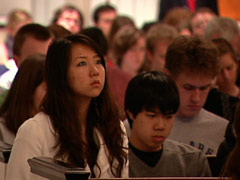
SIROTA: The gift of Lessons and Carols is that it takes time. You let the music, the carols, the texts, the prayers wash over you, and the light will break through. Some text, some image, some musical phrase will change you, and that’ll be the gift you get.

I’m Kim Lawton reporting.

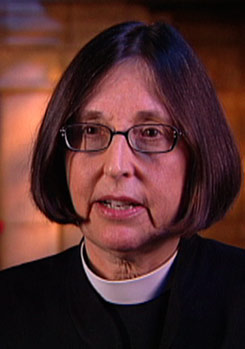
Victoria Sirota Extended Interview

Read more of Kim Lawton’s December 6, 2009 interview in New York City with the Rev. Canon Victoria Sirota, pastor and vicar of the congregation at the Cathedral Church of St. John the Divine and the author of Preaching to the Choir: Claiming the Role of Sacred Musician (Church Publishing, 2006):

Talk a bit about the service of Nine Lessons and Carols and what it means.

The Festival of Lessons and Carols, in a sense, is a vigil. How do you spend time waiting for something to happen that hasn’t quite happened yet? What do you do if you’re with friends waiting for something? Well, you tell stories, you pray, you sing songs, and that’s exactly what Lessons and Carols does. From a theological standpoint, and actually from a visual standpoint, it is getting that wide-angle lens and moving back and seeing the whole story, seeing the panorama of God’s plan for salvation for humankind and why that was even necessary, so we have to start at the beginning. We start with Genesis.
post02-victoriasirota

Tell us more. Why start with Genesis at Christmas?

Well, the story of Adam and Eve is evocative of profound truths about humanity and our relationship to God, and what you get from that story is this vision of Adam and Eve walking in the evening with God when the cooler breezes are blowing—from having a relationship with the divine, being able to walk with God in the Garden of Eden, which is Paradise, and then disobeying God, feeling shame about it, blaming each other, and then Eve blames the serpent. So they’re always blaming “other”—“‘it’s not my fault, it’s because so and so told me to; it’s not my fault it’s because…,” which immediately sets up a block into your relationship with the Holy One, so they can’t walk in the garden anymore. That’s the saddest thing about that story—that they have lost that ability to be present with the Holy in Paradise, and that story still speaks to us today. We understand that, and I think we long as human beings to get back to a place of Paradise, to get back to a place where things are right and just and beautiful, where there is not anger and fear and evil, and where we are at one with God.

In the service several Old Testament passages are read. Talk more generally about how that leads to Christmas.

In the readings in the Hebrew Bible, in Isaiah especially, we have some beautiful passages about the people of Israel being in exile and longing for Messiah to come, longing for a Savior, longing to return to the city of Jerusalem, longing for that reconnection that is proof that their relationship to God has been reconciled, and so we have promises of the Shoot of Jesse, promises of the House of David, promise that a Messiah will come, and Christianity has taken all of those beautiful promises, and we use them as showing that Jesus was foretold. Probably the most powerful place that that happened for us happened musically, and that’s when George Fredrick Handel decided to choose all those beautiful Isaiah passages and to set them to music in “Messiah,” and we hear that all the time now. Christians—actually everyone in the world is aware of those particularly wonderful passages because they have been set to music so wonderfully, and we do of course sing them a lot at this time of year.

Why is it important and meaningful to weave the scripture readings with the carols and the music?

The Scripture is the basis for our understanding how God operates. We are leaning on the experiences of souls of light before us who have felt connected to the divine, and those are the people that—we really stand on their shoulders. We look to them, the great prophets, Moses, Isaiah, Jeremiah, Elijah—we ponder their stories, their struggles with God, and from that we glean how to have a relationship with God. So those stories are showing us more profound truths. In a sense, the hymns and carols—most of them are based on biblical sources, so they are interpreting for us, and it’s interesting with carols and hymns you have two different things happening at least: You have someone who wrote the text. You possibly have a translator—some of the texts were in Latin or other languages. And then you have a musician, a composer who either wrote the music for that carol or wrote it for something else, and it gets turned into a carol. So it’s very interesting how that process works and how people who sing actually make the decision what it going to end up in that song.

The Scripture and the music build on each other, interpret each other. How does that work?

The music really tells you how to feel about the text. It’s not a small thing. For example, “Joy to the World”: As soon as you start singing it it’s on a high note, you have to support your breath, you’re joyful even singing it. “Silent Night” is more of a lullaby, and it makes you think more of a little baby coming into the world at night time. It settles you into a different place. “O Come All Ye Faithful” is a procession. You can see people lining up and walking. That first verse—seven times the words “O come” are in there, “O come let us adore him, O come let us adore him, Christ the Lord”—so it’s inviting people to join this procession of faithful people across the ages. I think most churches will use it as the opening procession, because it’s a march tempo.

Let’s talk about the difference between Advent and Christmas.

Advent is the church’s preparation for the second coming and also for that first coming again, so we prepare for Christmas, but we also are preparing for the eschaton, for the final things, the second coming, the end of the world. Like Christians always say in Advent, “the end is near,” and we don’t like to talk about that, and the secular world pretty much jumps to Christmas. That’s a much safer place to be than talking about the final judgment and what will happen then. But for Christians it’s important to be thinking every year—it’s like cleaning house, it’s sweeping out, it’s preparing and trying to remember what it is that is really important in our lives and getting back to that, so it’s letting go of our need to try to be in control and remembering to let God be in control so that there is a place to invite God into our hearts.

And how is that reflected in the music?

The music of Advent—a lot of it has to do with John the Baptist, who was the prophet who came before Jesus just a little bit, enough for him to be baptizing people in the River Jordan when Jesus showed up and was calling people to repent and saying the kingdom of God is at hand, make yourself ready, and that’s the message of Advent. The message of Advent is this time is coming. I think the Advent hymns and carols tend to be more eschatological. They’re talking, again, about larger issues other than just a baby Jesus being born. They’re talking about opening our hearts to what heaven is really about. When we then move closer to Christmas and we talk about the Angel Gabriel coming to Mary, then it gets much more specific in preparing for Christmas. We tend to be more comfortable with that. A little baby Jesus is coming, and that’s great, and we know we are all loved by God. But when we get this bigger John the Baptist yelling in our ear from the desert “you should repent,” you should figure out what’s important and follow the truth, follow God, work toward authenticity—that’s a little harder to take.

Christians talk during this time of year about the Incarnation, and a lot of the music of Christmas speaks to that.

Yes. Incarnation means coming into the flesh, literally, so it’s becoming human. What’s wonderful about Incarnation is God actually lowering God’s self to become human and in doing so reminding us of how awesome it is to be human. That original sin with Adam and Eve and that break between divine and human which was so huge—the whole thing changes when God becomes Jesus as a little baby, and now we are reminded that our humanity is not something to be thrown away or discarded. That God would use the Virgin Mary, would use a human mother, that a mother could be the mother of God changes how we think about ourselves, and I would just say in our own lives that often God comes to us in the form of someone else always, and it’s always a human being, and if I go back in my own story about my own conversion as an adult, re-conversion, I can tell you the people who have touched me, where I saw God in them, I saw Christ in them, I saw a love beyond what I could understand and imagine. So, in a sense, God Incarnate is coming to know love in a very personal, very real, and very human way.

You have talked about the God who is far away and the God who is close. Can you talk about that concept and relate it to Christmas?

The transcendent God is God who is the skies, above us, so far away that we often don’t feel any connection whatsoever, or we’re so fearful of God that we can’t imagine approaching God in that form. “Imminent” means that God is right here with us, God’s presence is here now, and that’s the gift of Jesus coming into the world, of being born as a child. In the Christian world, one of the great, great gifts we have been given is the gift of Communion, of Eucharist, of being able to break bread with each other and drink wine, and in that simple act of sharing these very basic things, bread and wine, we believe that Christ is present again with us and becomes incarnate anew, so that every time that we join together in a service of Holy Communion we are reenacting this Incarnation, and God comes in us.

We also spoke about a tie between Christmas and Easter. How are they related, and how does the music show us this?

Well, the interesting thing about Christmas music is that we love best the ones that just tell the story clearly about Jesus being born, about shepherds coming, about angels singing, about wise men coming. We sort of like to leave it there. But there are some carols that hint at what is to come. Our Advent lessons and carols [service] today is going to end with a wonderful hymn “Lo! He Comes!” that really talks about Jesus now having to go and to suffer and die for our sins and then to be resurrected. Also, it’s interesting that Bach’s “Christmas Oratorio”—the very last chorus in it is beautiful and joyful and has a wonderful trumpet solo, but the music is the same music that we sing to the chorale “O Sacred Head Now Wounded,” so Bach is speaking very theologically, knowing that, yes, this is joyous, this is the end of the Christmas festivities, but you know how the story ends.

The themes of hope and joy are really present, and the music highlights that.

“The hopes and dreams of all the years are met in thee tonight”: That’s part of “O Little Town of Bethlehem,” and in this particular carol Phillips Brooks had been in Bethlehem three years before, and he had stood on the hills where the shepherds might have been and looked down at the little, sleepy town of Bethlehem. So here he is at his job as a priest, a young man, and he’s asked to write a text, or a carol, for the Sunday school, and he thinks about looking down at this little town of Bethlehem, and then Lewis Redner, who was not only his organist but also the Sunday school supervisor, was in charge of composing a tune for it, and he couldn’t. Nothing came to him, it didn’t come, and then Christmas Eve he finally had a dream, and the tune was given to him, and it’s chromatic, it’s thorny, it’s beautiful. We know it so well as the American tune for “O Little Town of Bethlehem.” But what it does is it captures the darkness, the sadness, the fear and then also turns it to this hope and this joy in the baby Jesus being born in Bethlehem. The words have meaning, but the melody tells you what that meaning is and how to listen to it. We’re used to Redner’s version in America, but in England they’re used to a different tune, “Forest Green.” The two versions give you a very different sense of those texts. The Lewis Redner—“St. Louis” is the name of the tune—has a much more profound sense of the darkness of being in the city and hoping for something beyond ourselves and of longing that God will come to us. The “Forest Green” version sounds like it’s Christmas morning already. Everything has happened already, and we are safe in heaven with God.

Hope is deep in our communal soul. We want to be saved. We understand that we as human beings somehow let our pride, our egos, take over and when we do that it tends to alienate us from other people. We tend to cut ourselves off. The people who really are the happiest are not the people necessarily with the most things. It’s often people who have a community that they care about, a family where there is love that prevails even in the times of darkness. Almost anything that we face as human beings—if we can face it with other people of faith, other people who share love with us, they can be endured, and I’ve seen this again and again watching couples who have been so in love with each other, and one partner dies and being honored to be able to step into this holy place and to witness this extraordinary love that finally transcends the grave. It’s absolutely clear to me that there is something beyond, and there is a part of us that wants to be part of God, that wants God to dwell within us. I believe we’re happiest when we give. I think we are happiest when we are able to love. This season with the beautiful carols, many of them sentimental, many of them more lullabies, many of them helping us deal with the darkness—they are reminders to us that we are loved and that we are loveable, and in getting to that place it actually allows us not only to give gifts, but to receive love in a way we didn’t think was possible.

The amazing thing about Christmas is that it allows us to celebrate a really profound joy, the joy of being re-found by God, of opening our hearts to that love in a new way and of receiving this light that will transform us and reconcile us not only with God, but with each other.

And the themes of darkness and light?

Advent really is dealing with the fact that our days are getting shorter and that we are losing light, that we feel a sense of darkness encroaching and that the true light of the world now will come in the form of this baby, and if you think of a dark room and just one small, tiny candle, that will indeed make a difference. You will see that. So we’re reminded that even when things seem the darkest, seem the most impossible, seem absolutely like we have lost our way that we look to that light of Christ, and we invite that light within us.

Candles and the verses about darkness and light are important: “The people who walked in darkness have seen a great light.”

Absolutely, and I believe those lights, the Christmas lights, the lights in the store, the shiny baubles that get reflected light—I think that’s our society’s way of trying to be mystical, and I think it works.

What about the meaning that “O Come, O Come Emanuel” transmits?

“O Come, O Come Emanuel” is one of the hymns that is based on Latin chant and is at least nine centuries old or more, and there were “O” antiphons that were written for every day before Christmas, for the eight days before Christmas, and each one had a different word for who was coming, a different word for God: O Come, O Come Emanuel; O Come O Wisdom; O Come O Root of Jesse. But it’s inviting God in, and that’s what Christmas is all about. It’s asking, pleading with God—this yearning, this desire to be reconciled, to get it right once more. Hymns such as “O Come, O Come Emanuel,” which has been chanted through the ages by monks and nuns in processions of faithful Christians—you have this sense of a timeless melody, and you join all these fellow souls of light and the communion of saints when you sing it.

“Hark! The Herald Angels Sing” is very typical in the lessons and carols service.

Charles Wesley, one of the great hymn writers of all time, wrote “Hark! The Herald Angels Sing” and the story goes that he was very moved by the sound of the bells ringing on Christmas morning and that inspired him to write that song. The other interesting fact about it is that Felix Mendelssohn’s music was actually from another secular work that he had composed, and Mendelssohn didn’t think it was appropriate at all, but we have so taken over that tune, and we so accept that as wedded to that particular text that, for us, that is the angels at Christmastime.

What do people feel when they sing that?

This is where heaven and earth meet. In our society I don’t think we’re ever going to get rid of Halloween. We have horror movies at Halloween that remind us that evil is present in the world, and I don’t think in our secular society we’re ever going get rid of Christmas, because we need those angels. We need that image of something outside ourselves, and somehow we know that. Often I talk to people who say they’re atheists, they don’t believe in God, struggle with that, there’s nothing out there, but I have to say that when people who proclaim that to me are then in some grave difficulty, health problems or someone they love is dying, that my conversation is always very different to them, and I don’t need to talk anyone into believing in God. But I have to say in my own experience with life and death and with being with people who are dying and have died that there are mystical things that happen that I cannot explain in any rational way. I’m aware that if we live in a place of hope and faith that opens the door to beautiful things happening, wonderful coincidences that we can’t explain that change our mood from one of darkness and despair to one of joy. Christina Rossetti’s wonderful text “In the Bleak Midwinter” makes this point very well about this moment between heaven and earth coming together in the second verse: “Our God, Heaven cannot hold Him / Nor earth sustain; / Heaven and earth shall flee away / When He comes to reign: / In the bleak midwinter / A stable-place sufficed / The Lord God Incarnate / Jesus Christ.” So that brings together the sense of Advent, when we’re looking towards the end time, and then focusing it finally on this little baby who saves the world.

Is it the words, is it the melody? Is it both?

It is always a combination of the words and melody, as far as I’m concerned. When we sing “Gloria” in “Angels We Have Heard on High” we’re singing this long melisma, all of these notes on one word that allows us to get into a place where we’re actually going beyond the verbal. The music is going to tell you how to feel about it, and oftentimes it will flip you into a nonverbal place of ecstasy. Many, many notes to the same syllable is a way of trying to express the ineffable. We are trying to express what cannot be expressed. We are trying to get to a place of ecstasy that is beyond our normal experience.

How does sitting in a service of lessons and carols take us through all of this?

The gift of lessons and carols is that it takes time, and that you sit there and at the beginning you’re thinking about all those things you should be doing, and hopefully you just take out a piece of paper, write them down, and let them go. And then you let the music, the carols, the texts, the prayers wash over you, and if you do it well you will open your heart into a place of deeper and more profound meditation, and the light will break through. Some text, some image, some musical phrase will change you, and that’ll be the gift you get.

Many different kinds of churches and congregations have taken the traditional lessons and carols service but have changed it, adapted it. What does that say?

The idea of lessons and carols probably comes from the oldest service we have, which is the Easter vigil, and that was very early Christianity, so it’s the idea of waiting around for something to come. What are you going to do? Well, you’re going to sing, you’re going to read scriptures, etc. So for us to keep changing the order of what is read and what carol is sung is absolutely appropriate. It is good and right for us to keep recreating something so that it speaks to us now.

Some people coming to a lessons and carols service may expect that it’s going to be all the old carols that they know so well, but there may be some carols they are not as familiar with. How does that work into their experience of it?

Lessons and Carols is not a concert. It’s not where you’re going to applaud after everything. You’re going to allow yourself to meditate at a much deeper place. It can be very annoying if you’re expecting to sing carols that you know and are confronted with hymns you’ve never heard before, that go into different places. But my best suggestion is rather than being annoyed at it, talk to God about it, and say, okay, why are you telling this to me now? And then if you open your hearts you’ll find that all of the anthems, all of the carols are going to show you a different side of what you know in the familiar carols , but they’ll help you to attach it to your life now, in the present. Sometimes when we sing carols, we forget the text altogether, and we are at our grandmother’s knee, or whoever first taught that to us. But the gift of new carols is that God is working among us today, even now, inspiring us anew with the Holy Spirit breaking through in new ways, and often the Spirit is talking to you right now, and it could be that that most annoying new anthem or carol is just for you.

William Edwards Extended Interview

Read more of Kim Lawton’s December 6, 2009 interview in New York City with William Edwards, author of The Festival of Nine Lessons and Carols (Rizzoli, 2004):

Tell us how this service got started.

post01-williamedwards

The service as we know it started in 1918 in King’s College Chapel, and it was started by the chaplain, Eric Milner-White. He had taken a concept that had been used in 1880 in Truro by Ezra Benson, who later became the Archbishop of Canterbury, so it wasn’t a new idea, but he made it what it is today. You have to visualize December 1918 in Cambridge. This is a university where somewhere in the area of half of all of the undergraduates had gone off to war, and a third of them never came back. On December 24, 1918, six weeks after the end of the war that was going to end all wars, you’ve got a congregation which is probably largely made up of widows, girlfriends—in those days they would’ve been called fiancées—children there to somehow deal with this horror that they’d just been through. Most Americans, because we weren’t as deeply involved in the First World War, don’t understand the impact that war had on Europe. I grew up, we all grew up, really, being talked to about appeasement and how we gave Hitler too much and blaming [Prime Minister Neville] Chamberlain, but in fact if you look at what the British had gone through less than twenty years before you can understand. I mean, 900,000 Britons were killed in that war compared with only 300,000 in the Second World War, even with the Blitz and everything else. The war had taken the best and the brightest, and [Eric Milner-White] put together a service of what he called Nine Lessons and Carols, and the nine lessons were things from the Scriptures in, at that point, of course, the King James Bible. There were four from the Old Testament foretelling the birth of Christ, four from the New Testament telling the Nativity story, and one from the Book of John, “In the beginning was the Word,” and so on, and he interspersed them with carols.

What do you think he wanted to do? How would this Christmas service have had an impact on those who had suffered so much?

I think he wanted to deliver some level of comfort, that all this pain and suffering and death had some meaning. There was so much rationalization about the war. We’ve heard the term “the war to end all wars.” They wanted to believe it made sense. We now know from the perspective of the rest of the century that the war proved nothing. It killed millions of people, and it only led to the Second World War, which killed many millions more, and from our perspective it seems insane sending men out of the trenches to be mowed down by machine guns. But, in any case, he also wanted to restore more of a sense of a traditional liturgy in the chapel, and this was relatively High Church Episcopal at the time. He was appointed the chaplain earlier that year, and this was really his first meaningful effort, and it turns out, of course, here we are almost 100 years later, and the service is unchanged from what it was then. The only change he made, and it was a very important change in the service in 1919, he inaugurated the use of “Once in Royal David’s City” as the processional hymn at the beginning of the service, and to most people who think of the service they think of that single boy soprano singing the first verse of “Once in Royal David’s City” as the choir begins to come into the church. Most—not all, but most churches that have picked up in some way the Nine Lessons and Carols use that carol at the beginning of the service.

At King’s College I know they have a special tradition about the boy who sings that.

In the process of doing my book, I interviewed Stephen Cleobury, who has been the director of music there since 1982, and he said that it used to be that they would tell the boy who was going to be the chosen boy a week or two before so he could tell his family, and what happened was the boy, in several cases, got so nervous that he didn’t perform well. And so what they now do is a system where there are three boys, and they say, “It’s going to be one of you,” and then at the very beginning, just before they begin the procession, they tap the one boy on the shoulder and say, “You’re it,” and that boy starts. Now I will say this. The year I was working on the book, and I went over there and interviewed everybody, they had me interview two choristers, and one was this big, husky boy who was obviously a soccer player and just a delightful working-class kid who was in this boy’s choir at school. It was clear that he was expected to be the chosen boy, and indeed he was. I have a feeling that somehow or other, through body language or something, he had picked up the message before the beginning of the service, but he had so much self-confidence it wasn’t going to be an issue for him. But normally there are three boys, and each one does not know if he’s going to be the boy.

Talk about from that first service in 1918, how it was received, and how it kept getting more and more popular, not only in England but around the world.

I don’t know, and there isn’t much documentation as to how—because it was primarily word of mouth how people learned from year to year. But what did happen throughout the early 1920s, more and more people would attend the service, and by 1928 it was well-known enough that the BBC, which was then in its infancy, I mean we’re talking radio 1928, picked it up to broadcast throughout the British Isles, and then two years later throughout the world, so obviously there was a lot of word of mouth. I have not been able to find much of anything in ephemera, magazines, newspapers, anything like that of that period that says “this is a wonderful service, come to it,” but the word got around very quickly so that by the 1930s everybody, and once it was on the radio everybody in Britain knew what it was and, you know, you’ll ask anybody British, and they’ll say, “Well, that’s when Christmas begins.”

What about beyond Britain? How did it spread around the world?

I think you have to start with the BBC World Service, which was broadcasting the service on short-wave starting in the 1930s, and I’ve always loved the idea of people, particularly in the beginning of the war, and we think of December 7, 1941 as when the United States got into the war, but it’s also when the British were first attacked in the Far East. In fact, the fall of Singapore was, to Churchill, one of the great shames of the British efforts in the war. He was outraged that Singapore had fallen. But during December of 1941 Singapore was under siege, and nobody knew what the Japanese could do. The British also, of course, controlled Hong Kong and obviously were closely tied to Australia, and there were a lot of British people there, and nobody knew how big this was going to be, whether ultimately the Japanese were going to take all of the Pacific, and they did of course conquer Singapore, and it must have been a great comfort to turn on the radio and hear this sound of home in December of ’41 and throughout the war. During the war, they took all of the glass out of the—because of the English Reformation, much of the glass from churches that existed before that was lost, but because the chapel was on a university campus, it was protected from the worst outrages of the Reformation, the destruction of the monasteries, and so forth, and the glass is some of the best late medieval glass you can find anywhere, and what they did, they took the glass out of the chapel throughout the war for fear the Germans would bomb Cambridge, and when they went on the radio they would talk about how this was a service being conducted in a church in England, and they didn’t identify it. But of course everybody knew. Presumably the Germans didn’t know or chose to ignore it.

Talk about today and how it’s grown.

It’s grown such that people start lining up four or five days before the service, and it’s kind of fun to see, you know. It’s a tradition. People come every year, and they know, they have friends, and they wait on line. Most of the people—and I was there like on midnight the night before the service, and at that time I imagine there were probably 75 people waiting on line for a service that wasn’t going to start until 3:00 the next afternoon. Fortunately, it wasn’t cold, and it wasn’t raining, but they’re prepared for that too, and they trade off places in line—hold my place in line so I can go get some sleep, whatever.

Are they waiting for tickets or a good seat?

They’re waiting for a good seat. The best seats are behind the choir screen where the choir is, and there’s a relatively limited number of those, and a bunch of them go to VIPs from the university, so only a handful go to the general public. But basically the church fills up, and if you go at 8:00 in the morning you will see hundreds of people on line. They come from all over the British Isles to stand on line, and the service was really almost unknown in this country until Minnesota Public Radio brought it in. I first learned about it in the late ’60s because I had a Fulbright, and I was living in London, and it was part of the atmosphere, but it wasn’t until 1978 that Minnesota Public Radio, under the leadership of Nick Nash, brought the service to the United States, and Minnesota Public Radio is still the producer of the show which now is heard on every public radio station.

You were there in person at King’s College. What was it about the service that touched you so much?

First of all, it’s a little bit like a pilgrimage. You know, you’ve wanted to do this for years and years. I mean, in my case, I had wanted to go see that service in Cambridge for the better part of forty years, so to finally be there and see it was really quite a wonderful experience, and I guess I’ve always been something of an Anglophile. I’ve lived there, and the research for my unfinished PhD thesis was all done there, and my daughter was born there. There is something—even though I am myself a lapsed Congregationalist, there is something about the organized liturgy of the Anglican Church that is very appealing and very friendly and open.

Why, for you, has this become part of Christmas?

Well, for years even before the service came over the air on Minnesota Public Radio I had whatever recordings I could get of the King’s College Choir singing Christmas hymns, and those we played at Christmas at great length because it’s a unique sound, the King’s sound, and anyone who has heard it will see it as just as unique as hearing Pavarotti or Caruso, one of those unique voices. Once the service was in this country, I started going to various local churches to hear how it had been interpreted and performed by, in my case, Protestant churches running the gamut from Episcopalian to Congregational to Methodist to Lutheran, because so many churches in this country have some version of Nine Lessons and Carols, and what Eric Milner White felt and I think everybody at King’s has felt all along is that, yes, you listen for the music, but the important part is the so-called lessons, which are these simple readings from Scripture that are the same every year.

You’re very familiar with the gold standard, the King’s service. What do you make of local churches doing it in different ways?

Well, I may be a traditionalist, but I think it’s wonderful. I think it’s wonderful that a concept that’s almost 100 years old has the power and has been helped by technology, i.e. worldwide radio, to say something to ministers, priests, whatever you will—hey, I can do something with this that’s meaningful in my church. And yes, of course, King’s is unique. I mean, you have got the boy’s choir, you’ve got the men’s undergraduates, so the sound—and you’ve got the building, which is an extraordinary building, but it’s still about the service. It’s still about the combination of music and the Nativity story and how it was predicted in the Old Testament and how it transpired in the New Testament, so I think it’s great.

Tell us about the tradition you and your wife have here.

This will be the sixth year that we do it, and what we do is we invite a bunch of friends, and it’s gotten to be an unwieldy number, but what the heck, it’s Christmas. We’ll have about fifty people show up at our house, and we’ll tell them they have to be there at 9:45 in the morning, and a few days before the service I go to the King’s website, and I download the order of service for this year, and I go to Staples, and I have copies run off so they actually have the program for this year, and then I’ve got either the radio or I’ve got my computer tuned into BBC, and so I play it and we sing along with the people 3,000 miles away, and the service—what’s fascinating to me is that many of our friends are Jewish. They enjoy it just as much. A bunch of my friends don’t believe in anything, and they enjoy it just as much, and everyone prays along with the prayers, which kind of surprised me, but they do. At the end of the service we serve everybody a big lunch, a buffet lunch and lots of North Fork wines. I live on the North Fork of Long Island, and it’s a wonderful way to spend a day where you’d probably otherwise be running out to the Wal-Mart to get something that you forgot to buy that ultimately life will go on if you don’t have. As I said before, in England they say this is the start of Christmas. Well, that’s the way it feels to us.

What does that say about the enduring power of the service?

Well, I think even if we were not in this economic catastrophe we’re in, we’ve lived through a materialistic age which has not yielded most people what they hope they’d gotten. So it’s not surprising that more and more people are going to some version of Nine Lessons and Carols every year. It’s not surprising that over 100,000 people, growing at ten percent every year, are walking the Camino de Santiago in northern Spain every year from all over the world—did it myself this spring. It’s about finding, I think, some kind of spiritual component in life that people are missing. You asked about the relationship of the lessons to the music, and I think anyone who listens to the service from Cambridge, and particularly it’s helpful if you’ve downloaded the program from the King’s website. You’ll see the relationship. Each carol is intended to illustrate the lesson that went before. That’s why in “The Fall of Man,” which is the first lesson, where they have a chorister talk about how Eve got Adam to eat of the apple and wasn’t that a terrible thing, they always follow it with the only carol I know that is related to the apple, and that is “Adam Lay Ybounden” which is a medieval or Renaissance, I guess technically, carol about why Adam took the apple, and blessed be the apple, and so on. But if you listen through the nine lessons, each carol that is sung is illustrative of the lesson that preceded it.

What’s your favorite part of the service?

My favorite is, I think, probably everybody’s favorite, and I can’t even talk about it without getting choked up because it’s so emotional, and that’s hearing those first few bars of “Once in Royal David’s City.” It’s just magic. Magic.

Hanukkah’s Light

Dr. ERICA BROWN (Jewish Federation of Greater Washington): In Israel today you’ll find that most menorahs, or as they are called hanukiyot, are lit outside, because that’s the way the commandment should be fulfilled. But because of persecution throughout Jewish history people lit indoors, and they placed their menorahs on tables inside their homes.

On Hanukkah every night we add an additional candle. We begin with one, and the last night we light eight candles. We light them with the aid of a shamash, which is the center candle or the central candle, and you’ll see it often has a special place on a menorah.

Dr. Erica Brown

We make two blessings on the lighting of the candles. We actually have another blessing that we say on the first night, which is a generalized blessing – “Thank you, God, for bringing us to this day…” And then we add two special blessings just about the miracles of these days, and it’s a good time to think about the miracles in our own lives.

But we also don’t use the Hanukkah lights for anything else. So, for example, we wouldn’t use them to read by or to do any kind of mundane activities by. They are a sacred sort of light while they’re burning.

Because it’s a holiday where we celebrate a small jug of oil that lasted miraculously for eight days, we celebrate all kinds of food cooked with oil. Latkes, which are fried potato pancakes, are very popular at this season. People eat them with applesauce and sour cream. The other thing that’s quite popular are sufganiyot or doughnuts.

I think the holiday season is a time of a lot of generosity and a lot of compassion and goodwill. I do a lot of community teaching in high-tech firms and law firms and other firms. In today’s class, we looked at sources on light and talked about the magical properties of light as a way to start talking about responsibility. How do we have a responsibility when we can see the vulnerable, we can see the oppressed? We can’t walk away from them.

Hanukkah is a time where we take responsibility for the world, not only for ourselves but for spreading kindness through the world.

Certainly at this season of the year I think many Jews, even highly assimilated Jews, feel a lack of belonging in the mainstream culture, and Hanukkah’s always been a good time for them to come together in a social setting to feel a sense of belonging with each other.

Front page photo: “Hanukkah menorah” by Scott Merrill

Disappearing Christians of Iraq


Originally broadcast July 23, 2010

KATE SEELYE (correspondent): In a church in the Iraqi village of Qaraqosh, a priest prepares for a communal baptism. With a splash of water, he welcomes these infants into the Christian faith.

It’s a challenging time for Iraq’s Christians. Since the 2003 American invasion, the Christian community has been threatened and persecuted. Everyone is a target, including Father Mazen Ishou Mitoka. His church in the city of Mosul has been bombed three times. He himself was kidnapped and held for nine days. But the real horror took place last February when his parents responded to a knock at their Mosul home.

FATHER MAZEN ISHOU MITOKA: My father opened the door and saw three armed people. They entered the house and my brother tried to resist them but he had no weapons. We don’t keep weapons at home.

SEELYE: The intruders asked for an identity card to confirm that the family was Christian. They then shot and killed the priest’s father and two brothers. Father Mazin says the killings make no sense to him.

post01-iraqchristiansMITOKA: Are they political or sectarian? Is this part of some plan to get rid of the Christians? There is always a question mark. Nobody claims the assassinations.

SEELYE: Iraq’s Christians are one of the world’s oldest Christian communities. Most belong to the Chaldean Catholic Church. Others are Assyrian, affiliated with the Church of the East, or Syriac Orthodox. While they all speak Arabic, their native tongue is Aramaic, the language of Christ. At the time of Saddam’s overthrow, there were estimated to be up to one million Christians in Iraq. Today their numbers have diminished by more than a third as Christians have fled a wave of violence, unleashed by the US invasion.

Siham and Linda Basheer are widows. Their husbands, a father and son, were killed in 2008. The men were shot within two weeks of each other in Mosul by unidentified gunmen. The widows blame the violence on growing Muslim extremism and intolerance, which they say didn’t exist before the US invasion.

LINDA BASHEER: During the Muslim holy month of Ramadan we sent food and well wishes to the Muslims. Muslims visited Christians, Christians visited Muslims. We all got along. But after the collapse of Saddam, everything changed.

post02-iraqchristiansSEELYE: In the past, they say, Iraq’s Christians were an accepted and integral part of Iraqi society. Their contributions were significant, adds Basile Georges Casmoussa, the Syriac Archbishop of Mosul.

BASILE GEORGES CASMOUSSA: In the 1950s, the dozens of doctors in Mosul were all Christian. Christians opened the first schools, the first publishing house, the first theater, the first hospital.

SEELYE: Most importantly, he adds, Christians were secure and protected under Saddam Hussein’s government, but the arrival of American troops put the community in a difficult position, adds Casmoussa.

CASMOUSSA: The Christians suffered from the advent of the Americans because our Muslim brothers assumed that because they were Christians and we were Christians, we must be allies. So we had to defend ourselves against that.

SEELYE: Christians were not a part of the Iraqi opposition to Saddam, unlike most Kurds and Shia Muslims. But once he was overthrown, many Christians took jobs with the American army. As law and order dissolved in the new Iraq, extremists filled the void. They accused Christians of being traitors, attacking their churches and businesses, and demanded that they convert to Islam. Without a militia to protect them, Iraq’s Christian community started to flee.

Some came here, to this largely Christian village of Qaraqosh, where security is tight. Qaraqosh is located in the Nineveh Plains, just north of Mosul in the northern part of Iraq.

Because it’s so secure, Qaraqosh has largely been spared the violence plaguing big cities like Mosul and Baghdad. Since 2005, nearly ten thousand Christians have fled here. This hastily erected compound houses hundreds of refugees, like the Basheers, who say they are just scraping by.

post03-iraqchristiansBASHEER: The government has never given us anything but there are a few humanitarian organizations which sometimes give us food, clothes and money.

SEELYE: But the vast majority of Christians refugees have fled Iraq altogether and are living in neighboring countries like Jordan and Syria.

Christian leaders here are now debating how to keep the remaining members of their community from leaving. Some hope a new election law giving Christians a minimum of five seats in Iraq’s parliament will increase their influence. Other leaders have been talking about establishing a so-called “safe zone” for Christians in the Nineveh Plains. But Lois Marcos, a local council member in Qaraqosh, says it’s a bad idea.

LOIS MARCOS: An autonomous zone would be a risky solution for the Christians because many other groups oppose it and if the Christians bring this issue up again there will be more threats and killings and migrations.

SEELYE: Instead, Marcos says, he would welcome U.S and foreign aid to create jobs here, as well as to establish local police units, manned by Christians. He says better local security is critical, especially given a growing dispute in the Nineveh Plains between Arabs and Kurds, a separate ethnic group.

Marcos says the Kurds, who run a semi-autonomous region to the north, lay claim to parts of Nineveh, even though its under the jurisdiction of Iraq’s central government.

MARCOS: We live in an area that is disputed. We have our brothers the Kurds to the north, and to the south, our brothers the Arabs. In Nineveh, we are stuck in the middle, caught between a rock and a hard place.

post04-iraqchristiansSEELYE: Mayor Bassem Bello is from another Christian village in the Nineveh Plains. He says the American army has served as a buffer between feuding Arab and Kurdish forces, but now, he fears, Christians will suffer even more after US forces start to leave Iraq at the end of the summer.

BASSEM BELLO: There is an Arab-Kurd conflict that exists in Iraq, nobody admits it. We minorities will be the victims of this conflict and this area will be a war zone.

SEELYE: Lawyer Hani Andrews says given all the pressures his community faces, Christians see no future for themselves in Iraq.

HANI ANDREWS: Every Assyrian Christian single man or woman wants to leave the country, if they get this chance, yes in general. If now, for example, if the United States administration declares that we are ready to give visas, U.S. visas to go to the United States for Christians in Iraq, I think at least 80 percent of what we have left of our population will leave the country to the United States.

SEELYE: And what will that mean for the Christian community?

ANDREWS: We are persecuted. We are, we have been killed every day.

SEELYE: But what will that mean for the numbers of Christians in Iraq? Will there be any Christians left?

ANDERWS: No, of course. The population is rapidly decreasing. Most of them want to flee.

SEELYE: Hani adds that the disappearance of Iraq’s Christians would not be unprecedented. He points to neighboring Turkey, where a once flourishing Christian community is now virtually nonexistent. He says Christians in places like Egypt and Palestine are also leaving due to political pressures.

ANDREWS: If these superpowers will stay ignoring what happening in the Middle East, I think maybe in the next 50 or 70 years the Middle East will be empty from Christianity.

SEELYE: For Iraq’s Christian community, which traces its roots as far back as ancient Mesopotamia, it’s a bitter prospect. But the only real guarantee for its safety is a secure, stable, and democratic Iraq. With Baghdad’s politicians still fighting over forming a new government and American troops soon scheduled to leave, a stable Iraq seems to many Christians like a dream.

For Religion & Ethics Newsweekly, I’m Kate Seelye in Iraq.