Nick Vujicic


LUCKY SEVERSON, correspondent: This is Nick Vujicic in Los Angeles on his way to a sound check before he speaks at the National Resurgence Conference for future evangelical leaders. It features some of the country’s most influential evangelists, including Vujicic.

NICK VUJICIC: I’m going to be speaking about this loud.

SEVERSON: In just a few years, Vujicic has become a superstar evangelist.

VUJICIC: I started speaking 10 years ago and we’ve been across 44 countries, spoken 2,000 times to a live audience of 5 million face to face.

MAN: After the Q and A you want back in the wheelchair to exit right?

VUJICIC: Yes.

SEVERSON: Considering that he has no arms and no legs, traveling the world as he does is no small accomplishment.

VUJICIC: Sometimes my palms still get sweaty before a speech.

(at podium) How are you all.

SEVERSON: The people in the audience soon seem to forget that they have probably never met anyone quite as handicapped.

(to conference attendees) Were you put off at all by his physical appearance when you first saw him?

MAN: Oh, absolutely not.

WOMAN: No. Nothing at all, nothing at all, you don’t even see that, not at all.

MAN: You see the light of Jesus in his eyes and that’s what you see.

SEVERSON: One of the featured speakers here is Pastor Greg Laurie of the Harvest Christian Fellowship churches in Riverside and Irvine, California.

PASTOR GREG LAURIE: You know a person may think, well I’m having a hard time right now, you know maybe I’m not feeling well or I’m sick or whatever, and when you look at a guy who’s facing what Nick faces, that’s severe disability, and to hear him talk about hope and to talk about purpose and to talk about joy kind of silences you in whatever it was that was troubling you and puts your problems in perspective.

VUJICIC: (to conference attendee) Give me a hug. Love you so much.

I’m the world Guinness Book of Records holder of 1,749 hugs in one hour. My arms fell off. (laughs)

(speaking on stage) As a child, I was suicidal and I tried to commit suicide at age 10 because I didn’t know the truth, write this down, the truth of my value, the truth of my purpose and the truth of my destiny.

So at age 10 I tried to commit suicide with 6 inches of water in my family bathtub and the first two times I rolled over I was trying to work out how much air I hold in my lungs before I let the water come in and on the third time I rolled over I saw a picture in my mind of my mum, my dad and my brother crying at my grave wishing they could have done something more. And that alone stopped me. I realized there is a pain of having a disabled son with no limbs but greater is the pain to have a son without limbs who commits suicide.

SEVERSON: Now the Australian born preacher runs an international non-profit organization called Life Without Limbs, has authored books, markets inspirational DVD’s, including one for kids called “No Arms, No Legs, No Worries,” and is in great demand as a motivational speaker. He has two caregivers who help him manage a very hectic life. Bryan Tarter traveled with him to 24 countries.

(to Bryan Tarter): What do you think drives him?

BRYAN TARTER: Oh definitely his faith. Yeah, his faith in God. There’s a lot of people in this world that don’t have hope and he just knows that he can give that hope to people.

VUJICIC: And I was very angry at God and I said God if you’re real and you love me, where is my miracle? So then I started doubting that he was real and I said, “God you owe me an explanation.” At age 15 God clearly answered me through John Chapter 9 about the question of why. Jesus came across a man who was born blind and Jesus said he was born that way so that the works of God would be revealed through him and faith came over me, tangibly I felt peace.

(speaking on stage): Your son and your daughter needs an excellent father more than an excellent college.

SEVERSON: Many in the audience here are laymen or aspiring ministers and his message to them is to not forget their families.

VUJICIC: (speaking on stage) God gave me a wife to enjoy the blessing of being married, and being a husband and being a father.

SEVERSON: His concern for family grew considerably when he got married a few months ago. Now his new wife is pregnant.

VUJICIC: And just a couple weeks ago, I felt my son kick in her womb and it was amazing.

SEVERSON: Amazing for someone born with an extremely rare disease called Tetra-amelia syndrome characterized by the absence of all four limbs, but in his case, a foot with two toes that enable him to type, and answer hundreds of texts every day. He can surf, play drums, comb his hair, brush his teeth, shave, answer the phone and a lot more as Bryan Tarter learned when he went for a job interview as his care giver.

TARTER: The first time you meet him he just breaks down your walls, gives you a hug and you actually forget that he doesn’t have arms and legs.

VUJICIC: (in video) I am not nervous yet. My knees are not shaking, my heart is hot beating yet, but I’ll tell you when I’m on that plane, I’m going to be going…(screams)

PASTOR LAURIE: You know he’ll go and speak in a church or in an arena or in a stadium and everyone will think what a wonderful story he has and how great it was that he came but you know Nick still has to go home and face that disability every night and every morning. I’ve thought about that.

SEVERSON: He says he still goes through bouts of depression.

VUJICIC: We all are going through ups and downs no matter how strong we are in our faith in God, there are still some wild cards that come along our way and we ask God what happened? Why?

SEVERSON: Vujicic says the worst part of his childhood was the loneliness.

VUJICIC: Just five years ago I met a little boy with no arms and no legs, first kid that I ever met that looked nearly exactly like me, left foot and everything. And I heard he was getting teased at his school. So I went to his school and I shared about my life and shared how cool I thought Daniel was and now Daniel is the coolest kid on the block.

SEVERSON: He says it’s his mission to travel to high schools around the country preaching against bullying, which he considers to be a very serious problem. He knows from personal experience.

VUJICIC: You know I actually remember going up to some people who were teasing me at school and I confronted them about how they treated me and they were surprised that I had the guts to come up to them and I went right up to them and I said why do you do that? Why do you tease me? Oh, it’s hurting you? I didn’t mean to. Oh really? Now I’m going to tell you stop it and by the way I forgive you. And I asked him to give me a hug.

SEVERSON: Later this year, he’ll speak to high school students in Oregon on the subject of bullying, and then there will be other preaching engagements on the subject of his faith and his purpose.

VUJICIC: I just hope people see that if God can do something beautiful with my broken pieces, then God truly has a plan for each and everyone of us.

SEVERSON: Next year, Nick Vujicic plans to preach in 27 countries.

For Religion & Ethics NewsWeekly, I’m Lucky Severson in Los Angeles.

Walk the Way of the Cross

On Monday, March 25, Episcopalians began Holy Week with an invitation to “Walk the Way of the Cross” in Washington, DC. The event was described as a time of prayer, pilgrimage, and public witness “to challenge the violence in our world and to call for comprehensive reform in gun legislation.” Watch the procession of religious leaders and laity up Pennsylvania Avenue from Lafayette Square and the White House to the West Steps of the US Capitol. Photos by Sam Pinczuk.

Archbishop of Canterbury Justin Welby


KIM LAWTON, managing editor: In a ceremony filled with pomp and pageantry, Justin Welby was installed as the new spiritual leader to nearly 80 million Anglicans around the world. The 57-year-old Welby is a former oil company executive who became a priest in his mid-30s. He had been a bishop for just a year when he was chosen for the Anglican Communion’s highest post. One of his toughest challenges may be helping the Communion stay together amid profound differences over theology, gender, and sexuality. The Anglican body has more than 40 separate branches, including the Church of England, the Episcopal Church in the US, and numerous churches across Africa, Asia, and South America.

ARCHBISHOP JUSTIN WELBY (Archbishop of Canterbury): We are struggling with very, very significant divisions, different ways of looking at the world coming out of our context, coming out of our history, and learning how we deal with those differences, which are of themselves valuable things, is really significant.

LAWTON: Welby told me as archbishop he intends to promote reconciliation as one of his top priorities.

post01-archbishop-welby

WELBY: It is the key theological concept for Christian faith, reconciliation with God and the breaking down of barriers between people. And therefore for me, I have this sense that part of the church’s role is to be reconciled reconcilers.

LAWTON: He has already created a new position on his staff at Lambeth Palace, Director for Reconciliation, and appointed Canon David Porter from the historic Coventry Cathedral to help oversee his agenda.

CANON DAVID PORTER (Coventry Cathedral): I see my work in conflict areas, in helping people deal with differences, and to celebrate the diversity as a profound expression of the good news of Jesus and as a profound expression of my faith in practice.

LAWTON: But it will be no easy task. For the past decade, the Communion has been in turmoil after the Episcopal Church consecrated an openly gay bishop and approved blessings for same-sex unions. Some African and Asian jurisdictions accused the US church of heresy. Many conservative American congregations have broken away from the Episcopal Church and aligned themselves with African Anglicans. There have been a series of contentious lawsuits over church property, and some congregations are now worshiping in schools. Bitterness still prevails in many quarters throughout the Communion. Welby concedes in such circumstances it’s difficult to even think about reconciliation.

WELBY: Reconciliation is extraordinarily painful for those involved in the conflict.

LAWTON: Some people have a fear maybe that when one talks about reconciliation, what they might really mean is just papering over differences in order to…

WELBY: Yes, absolutely.

LAWTON: …just get along. You know, the most important thing is that we get along.

WELBY: Oh, fuzzy wuzzy tolerance, sort of fluffy, where it would all be nice if we were nice to each other sort of rubbish. Yes, that’s not at all what we’re talking about. It’s not a magic wand that you wave over people, and suddenly everyone’s happy, and when they are I’m usually slightly suspicious.

LAWTON: True reconciliation, Welby says, requires courage, honesty, and integrity.

WELBY: It is the process of enabling, of making yourself sufficiently transparent that people trust each other, of putting your most valued and passionate beliefs out for them to be examined, attacked, and then finding a way to love the person with whom you are dealing, quite probably not agreeing with each other, but disagreeing in love.

LAWTON: On two of the most controversial issues, Welby opposes gay marriage, and he supports allowing women to be bishops. He acknowledges many of the current divisions in the Communion stem from differing views of how to interpret scriptural truth.

WELBY: We need a certain integrity about where we get our truth from. Now I’m not saying that truth is up for grabs. There are truths. I believe passionately in that. There are things I believe passionately are deeply wrong.

LAWTON: But, he says, he sees another need as well.

WELBY: The need for not only theological orthodoxy, but relational orthodoxy. In other words, right relationships as well as right understandings and ideas.

LAWTON: Welby also wants to emphasize peacemaking in conflicts outside the Church, such as in places like Nigeria, where he has traveled many times.

WELBY: The Church is there in a sense as sometimes the least dysfunctional part of a conflicted society, destructively conflicted society, but very often is the only functional part. And that’s where we bring a passion for reconciliation, for enabling people to continue their dispute without violence.

LAWTON: Over the next few months, the new archbishop plans to spend time listening to members of his flock around the world. He hopes to soon visit the US.

WELBY: I really genuinely believe that the United States remains one of the world’s great hopes and potentials for development and peace under God. And so that’s my prayer for the States is continue to find this radical and exciting location that’s been yours for 230 years and challenge us.

LAWTON: Welby is optimistic about the future of the Anglican Communion, mostly, he says, because he believes in the grace of God.

WELBY: When God is left out of it then all we’re left with is our own ideas, and we defend those to the death and preferably the death of the other. When God is in the middle of it, there is a transforming power and presence.

LAWTON: And he says he’ll be praying for that grace every day.

I’m Kim Lawton in the UK.

BOB ABERNETHY, host: Kim, welcome back. You did a great job.

KIM LAWTON: Thanks.

ABERNETHY: Justin Welby says he’s going to try to reconcile things in the Anglican Communion. Does he really have power enough to do something there?

LAWTON: Well that’s the big question. The Archbishop of Canterbury doesn’t have, you know, a lot of authoritative power to make things happen. He has the moral authority to set a tone which is what he’s trying to do, set a tone for dialogue, peacemaking but the divisions are really, really strong. Anglicans have long talked about being unified amid diversity but the question is, is that diversity, are those differences so great that unity is just not possible. And also the level of acrimony, especially here in the U.S. that we’ve seen is still very, very strong between some of the breakaway churches and the official Episcopal Church and attempts at peace building have not been successful.

ABERNETHY: And let’s turn to Pope Francis. You got sort of close to him.

LAWTON: Sort of.

ABERNETHY: What were your impressions?

LAWTON: Well, I was, I was in a meeting with several thousand other journalists. We got to “meet” him and certainly I saw what a lot of people talk about, that quiet warmth. He doesn’t have a big personality. He’s not jovial in that sense. But there’s a warmth that really comes through. He connects with people that he’s with. He went off his text, his script, many times in his talk and made some jokes with the journalists and another interesting thing I found, he, instead of doing a tradition blessing with the cross, making the sign of the cross, he acknowledged that many people in the room weren’t Catholics and probably weren’t even believers so he said I’ll pray for you in my heart out of respect. That was something interesting from a pope.

ABERNETHY: Many people say that the number one thing that Pope Francis needs to do is something about the sex abuse scandal.

LAWTON: I hear that a lot, from U.S. Catholics in particular. They want to see something from him. He’s said in the past that he has a zero tolerance policy. They want to see him embrace that as pope. I hear a lot of Catholics talking about there are changes he could make in the bureaucracy. He could meet with victims. He could meet with victims’ advocacy groups. So they are hoping he really does take a firm stand on that issue.

ABERNETHY: There have been several stories and opinion columns about whether, when he was in Argentina, he did enough to stand up to a very oppressive, cruel government. Is that going anywhere?

LAWTON: You know, who knows what may come out. Certainly there have been questions, there have been questions for a long time now about that. People say he at the very least didn’t stand up as much as he could have. There were some suggestions that maybe he in some way created or enabled some of the persecution but those seem to, other people have come out and said no that’s not the case.

ABERNETHY: And very quickly, many people hope for what they call evangelization in this papacy. Quickly, what does that mean?

LAWTON: Well for Catholics they would like to see their faith spread. And so whether you’re talking moderate and liberal Catholics hope that Francis’s emphasis on issues like the environment and the poor, things that have always been important to the church but maybe not emphasized, maybe that will appeal to some people. Conservatives hope that his pastoral demeanor, his clear love of God, of Jesus, that maybe that will be appealing and help bring Catholics back to the church.

ABERNETHY: Kim Lawton, many thanks.

St. Francis and the New Pope


Read an excerpt from FRANCIS OF ASSISI: THE LIFE AND AFTERLIFE OF A MEDIEVAL SAINT by Andre Vauchez

FR. LARRY DUNHAM, OFM (Franciscan Monastery of the Holy Land in America): This is our first Sunday to gather as a Catholic community to pray for our new pope, Pope Francis. The name he chose after St. Francis of Assisi certainly gladdens the hearts of all Franciscans.

One reason why everyone takes Francis to their heart is because he is not perceived specifically as a Catholic Saint, he’s not perceived as specifically belonging to Christian people but he seems to be someone that appeals to all men and women regardless of their religious background or lack thereof.

Father Larry Dunham, OFM

Francis considers himself to be a brother to everyone. He found God’s life not only in every man or women but in all creation so every living thing. And so he could preach to the birds and he could preach to the forest. He even found God in inanimate creation, the rocks and the fields, everything contained God therefore all of the environment is worthy of respect.

He had his own very special vision that kind of launched him. He’s praying in front of this icon, this icon cross in the chapel, in Italian San Damiano, but St. Damians and suddenly says the icon, the figure of Jesus speaks to him “Francis, go and repair my church.”

Francis left the city of Assisi, goes out and put on the garb of the peasants. This wasn’t a fancy habit this is what the poor wore. It had a hood for the elements. He had a rope just to hold it together so he simply clothed himself in the garb of the poor.

Our new Pope Francis has a reputation for service and love of the poor in Argentina, in Buenos Aires and taking the name St. Francis reminds the church of the poor who shall always be with us as scripture says, and the poor whom Jesus specifically lived among, reached out to, reached out to all people, but the poor were his special charges.

Francis who wanted to imitate Christ so perfectly, who wanted to walk in his very footsteps in everything he did, in everything he said of course would write a rule saying that’s what we are to do follow in the footsteps of Jesus as perfectly as is possible.

St. Francis, when he wanted to go on crusades and come to hopefully meet the Sultan, he did it again out of his conviction that the Sultan would be his brother and that he could cross the divides that separated them and he was able to do so. That interfaith dialogue made them really brothers. I really have hope that the Pope Francis taking the name of Francis of Assisi will re-invigorate the interfaith dialogue of our church, give it new spirit and a renewed purpose.

I do hope that Francis, Pope Francis can lead us to a simpler vision of following Jesus that we can focus less on the trappings and more on the poor themselves. That we can look to the way Francis did of pulling people into the church, that we’d be known for including and not excluding. That’s my biggest hope.


FRANCIS OF ASSISI: THE LIFE AND AFTERLIFE OF A MEDIEVAL SAINT by Andre Vauchez

Read an excerpt from a recent biography of Francis of Assisi:

Francis of Assisi

Francis did not limit himself to charity toward the disadvantaged of his own day; rather, he wanted to share their condition and become the brother of the poor by living with them and for them. His rule is marked by an unconditional rejection of the desire for power and enrichment, and through the movement that he launched he sought to lead the church back to the ideals of the poverty and simplicity of its apostolic origins. This choice has had social implications; was not the first public act of Francis to break with the “pre-capitalistic” society of his time and with the avarice—in the medieval sense of the term, the cupidity—of his father? We find an echo of this in his diatribes against money, which he blamed for being the source of injustice and exclusion, to the degree that it contributes to the marginalization of those who do not possess it. But for all that, he did not exalt misery but sought to bring forward a remedy for it through fraternity and solidarity with those who were immersed in it. The radical poverty desired and lived by Francis is a means of realizing perfect fraternal justice. The Franciscan order did not understand this central intuition of its founder. It remained faithful to it only superficially, for if the order never stopped talking about poverty, it quickly became an abstract notion and the object of endless discussions about what one could possess or use without violating the rule. It could not have been otherwise, once poverty was no longer lived by the friars as a concrete sharing of the life of the forgotten of society. To rediscover the authentic spirit of Francis today, his spiritual sons and the Church must make common cause with the poor against their poverty and participate in their struggles.

From “Francis of Assisi: The Life and Afterlife of a Medieval Saint” by Andre Vauchez (Yale University Press, 2012)


Desert Passover Seder


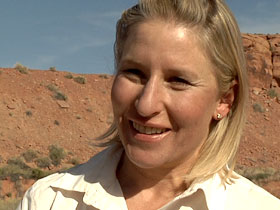
RABBI JAMIE KORNGOLD (Adventure Rabbi): The desert is absolutely the right place to be telling this story. The core of this story is that the Israelites went down to Egypt as a family. They come out, 600,000 people, and then they wander in the wilderness and become a nation. It’s in the wilderness where they meet God. It’s in the wilderness where God speaks to Moses. It’s in the wilderness where the people get the teachings of the Torah.

On Passover, we’re taught to embody the story, to act out the story, and so when we walk through the desert, we really get that idea of freedom, of being out in the wilderness and all the spiritual moments that are possible.

post01-desert-seder

I talk a lot about the idea of cultivating the patience to see burning bushes. The idea being that if Moses had been called from God and the burning bush today, he would have just walked right by it because his cell phone would have rang. So one of the things that we work on a lot out here is just reminding people to just slow down and just be fully present noticing this amazing environment.

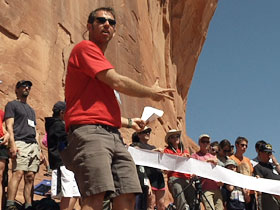
Our seder has most of the elements of a traditional seder but, ironically, we’ve taken the “seder,” which means “order,” out of the seder. We hike a mile and a half up to the seder, we do some teachings along the way. And then we have the first part of the seder underneath the arch.

(reading to group): “On all other nights, we eat leavened bread or matzah. Why on this night only matzah?”

RABBI KORNGOLD: One of the practices that we do that’s very unusual, is we read the story of the Exodus directly from the scroll, from the Torah scroll. We’re trying to take this spiritually rich experience that people have out here and ignite their Judaism.

Rabbi Evon Yakar: (speaking at seder) As we look back and hold on to the tradition, the story, that we come from, it’s also our responsibility to continue telling, and continue writing, that story.

post02-desert-seder

RABBI KORNGOLD: And for a lot of people that come on our trips, they’ve never seen a Torah up close. And what we’re trying to do is create a relationship between the people and their Torah.

Cantor Rollin Simmons reading from Torah scroll: “Here was the bush burning in flames, but the bush was not consumed…”

RABBI KORNGOLD: So you’re already feeling elevated and then you read from the bible, or then you read from the liturgy. Suddenly the words, the ancient words take on the power that they were supposed to take on all along.

The dancing that takes place at the end of the first part of the seder up under the arch is so exuberant. We’re joyful just that we’re up here, that we can be in this gorgeous place. And then we all hike back down, and then finish the seder along the banks of the Colorado River.

Rabbi Yakar: “We now turn to the karpas, parsley…the saltwater represents the tears of enslavement…”

Group reading together: “This is the bread of affliction that our ancestors ate in the land of Egypt.”

RABBI KORNGOLD: One of the things that I love about the Adventure Rabbi retreat in Moab is looking back over my shoulder at this snake, this line of people, walking through the desert. It looks so much like the wilderness of Zin, it looks like the Negev, it looks like the land through which the people walked. It’s an amazing feeling of, “Hey Moses, hey Miriam, hey Aaron! It worked. It worked. All 600,000 of you made this trek through the wilderness and here we are, thousands of years later, going through the wilderness as Jewish people. Your ideas were good. They held out guys!”

Pope Francis


KIM LAWTON, correspondent: There were jubilant shouts in an array of languages as Catholics from around the globe gathered in St. Peter’s Square to meet their new pope. Many here say electing Pope Francis has brought Catholics together.

KIM DANIELS (Catholic Voices USA): We all operate in different countries, we all operate in different idioms and different ways but we come together for our faith and this is a real moment of unity.

LAWTON: The fact that Cardinal Jorge Mario Bergoglio—Pope Francis—hails from Argentina has generated much excitement.

CARDINAL TIMOTHY DOLAN (Archdiocese of New York): You talk about a booster shot to the Church in the Americas, this is going to be a real blessing.

LAWTON: But it’s more than where he comes from that’s unique. David Gibson of Religion News Service says Pope Francis’s simple lifestyle is something new to the papacy.

DAVID GIBSON (Religion News Service): He also has spoken against the clerical privileges in the Church, and the kind of puffery that can often infect the hierarchy and the cardinals themselves—he’s spoken really powerfully against this. If he puts into action the words that he’s spoken against this kind of clerical and ecclesiastical privilege, he could be a revolutionary figure for the church.

LAWTON: Many Americans came to Rome to be part of the momentous occasion of electing a new pope. Kim Daniels and Ashley McGuire say they wanted to support the Church in prayer. Before the conclave started, they worshiped at a Mass led by Washington cardinal Donald Wuerl in his titular church. Every cardinal is assigned a congregation in Rome, which in effect gives him the right to vote for the next Bishop of Rome, the pope. Wuerl’s church is San Pietro in Vincoli, which claims to have ancient chains that held St. Peter captive. Daniels and McGuire went to St. Peter’s Square every time the white smoke might appear.

ASHLEY MCGUIRE (The Catholic Association): The election of a new pope has only taken place a few hundred times over the past 2,000 years, so even to be alive during this event is something, to actually be here is truly a once-in-a-lifetime experience. And I think, you know, for many Catholics, it’s a sort of spiritual pilgrimage to be here and to receive the first blessing from the pope.

Ashley McGuire and Kim Daniels waiting for white smoke

LAWTON: Daniels says she couldn’t be more excited about the selection of Pope Francis. She is confident he will work to renew the church.

DANIELS: To have a pope, to have a leader means that we speak in a clear voice, and I think that’s one of the great attractions of Catholicism is that we speak in a clear voice.

LAWTON: Matthew Niggemeyer and Michael Dion are both studying theology at the prestigious Pontifical North American College here in hopes of being ordained as priests. They too say they’re thrilled with the election of the new pope.

MICHAEL DION (Seminarian): What he does is gives us an overall vision to say, to lead us to see who Jesus Christ is, and obviously every pope is going to do that in a different way. And so that will be his gift to the church is how does he help us at the ground level see who Jesus is?

MATTHEW NIGGEMEYER (Seminarian): I think it’s both an historical moment for the church but also a beautiful moment. With every papacy, there’s a new opportunity and a new chapter unfolds in the life of the church. What that chapter holds I don’t really know and I don’t really want to speculate, but I’m excited to see what will come.

LAWTON: For some, a new pope means an opportunity for new directions in the church.

DAVID CLOHESSY (Executive Director, SNAP): (at press conference) In a monarchy, the monarch has extraordinary power.

post03-pope-francis

LAWTON: Representatives of SNAP, the Survivors Network of those Abused by Priests, were in Rome to push for stronger measures to prevent clergy sex abuse of children. The group released a list of 20 suggested actions for the first 100 days of the papacy. They said this is an opportunity for significant change.

CLOHESSY: We’re a single issue group, this sounds probably dreadfully self-serving to say, but we really do believe that there’s nothing on the next pope’s plate that’s more pressing than the safety of the most vulnerable members of his flock.

LAWTON: They said without new action, the abuse crisis will continue to widen around the world.

CLOHESSY: Because this is essentially like a cancer that’s eating away at the very soul of the church, we believe, and unless the pope really takes quick strong moves to turn things around, the future, especially for children in the church looks very grim.

LAWTON: Other advocates hope for breakthroughs on their issues as well. As pilgrims were awaiting the sight of white smoke from the Sistine Chapel, a coalition of women’s groups raised some pink smoke above the Vatican. They called for an expansion of female leadership roles in the Church, including ordination into the priesthood.

Members of Women's Ordination Conference release pink smoke to protest lack of female leadership in Catholic Church

ERIN SAIZ HANNA (Women’s Ordination Conference): We would like to see some dialogue. Pope John Paul II closed dialogue on women’s ordination, so we’re hoping that the new pope will reopen that dialogue, simply talk with us. People are ready for women priests, people are ready for women’s ordination. We know the polls show that the majority of Catholics want women priests so we’re here to lift up those voices.

LAWTON: Experts don’t expect major doctrinal changes under Pope Francis.

GIBSON: He’s a man who maintains the traditional Catholic line on sexual morality, abortion, gay marriage, contraception. Nobody expected any pope was going to change those teachings or say anything different, but a new pope has a new style and if he stresses the social justice teachings of the church, the very counter-cultural message of simplicity and poverty, that could really change things without technically changing any teachings.

LAWTON: For many Catholics, a top priority for the new pope will be addressing the Curia, the Vatican’s scandal-plagued bureaucracy in Rome.

DANIELS: I think that everybody knows that there is reform needed in the Vatican bureaucracy and I know that we’ll see some effort towards that end, because reform is something that is necessary so that we can move forward and kindle the faith in places where it’s become something that’s lukewarm.

GIBSON: Pope Francis, Cardinal Borgolio had no real experience in the Roman Curia. He speaks Italian pretty well but is he somebody who can actually come in here and clean house the way some of the cardinals want? That’s a real big question.

LAWTON: McGuire is hopeful the new pope will prioritize communicating the church’s message in the modern world, especially to young people. She hopes Francis, like his predecessor, will use social media to do that.

MCGUIRE: When Pope Benedict joined Twitter, for example, he got over a million followers I think within 24 hours. And so I think you know that’s one way that he can signal to the young generation, you know, here I am, I’m going to be talking with you, I’ll meet you where you’re at and be a part of your world.

LAWTON: Among all the priority hopes and agenda setting, some are asking if the 76-year-old new pope will be able to live up to it all.

GIBSON: How much can a pope do? He’s not a pastor to 1.2 billion Catholics. So much is going to depend on the men he appoints, both in the Vatican and also in the dioceses around the world. What kind of bishops are we going to see coming out of the Vatican in the next few years? That’s really going to chart the course of the Catholic Church over the coming years.

LAWTON: The installation Mass is Tuesday here at St. Peter’s basilica. Then Pope Francis gets to work, amid all the high expectations already surrounding him. I’m Kim Lawton at the Vatican.