by David E. Anderson
R.S. Thomas, the Welsh poet and Anglican priest who died a little more than a decade ago, left a body of work that is slowly becoming recognized as among the best and most important religious poetry of the twentieth century.
Like the century itself, however, it is not easily orthodox or pretty. Its bleak moods and near despair reflect the pull of doubt that defined those decades for many, including believers. As such, it stands outside the mainstream of the dominant, God-affirming, sacramental poetry that looks back to Gerard Manley Hopkins’s affirmation that “the world is charged with the grandeur of God.”
Yet Hopkins was also the poet of the “terrible sonnets”—bitter spiritual laments that Thomas described as “but a human repetition of the cry from the cross”: My God, my God, why has thou forsaken me? Thomas’s own prolific poetic outpouring explored this very question, and his work continues to resonate with compelling freshness and urgency as a new century of uncertainty unfolds.
His is, in many ways, an appropriate poetry for Good Friday, exemplified by his emblematic but enigmatic phrase, “The cross is always avant garde.” The line is from The Echoes Return Slow, a long autobiographical piece written in alternating pages of prose and poetry, and it suggests that for Thomas the cross always goes before us, and it presents a radical challenge to any easy resolution of the tough questions of faith.
A cluster of recurring images, symbols, and metaphors mark Thomas’s religious poems: silence, prayer, kneeling, waiting, watching, empty churches, a wound, the pierced side of Jesus-God-the natural world, a bare tree—and the cross, repeatedly described by Thomas as empty or “untenanted.”
Thomas is mostly interested in God’s silence or absence, the deus absconditus or hidden God, and what that means for forging an identity in the modern world. What language might be used to address such a God in a meaningful way? As Archbishop of Canterbury Rowan Williams has written, R.S. Thomas was—like one of the poet’s spiritual mentors, Soren Kierkegaard—a “great articulator of uneasy faith.”
An early poem, “In a Country Church,” from the 1955 book Song at the Year’s Turning, announces some of the themes that would dominate Thomas’s later poetry:
To one kneeling down no word came,
Only the wind’s song, saddening the lips
Of the grave saints, rigid in glass;
Or the dry whisper of unseen wings,
Bats not angels, in the high roof.
Was he balked by silence? He kneeled long,
And saw love in a dark crown
Of thorns blazing, and a winter tree
Golden with fruit of a man’s body.
The opening stanza is a powerful image of silence. The only sounds comes not from words but from the wind, not from the wings of angels but of bats. While there is no word from God, the poet gropes for a signal of grace and wrests from the silence a vision of a wintry image of love and crucifixion—perhaps a divine response.
“In Church,” a poem from Thomas’s 1966 book Pieta, returns to the theme:
Often I try
To analyze the quality
Of its silences. Is this where God hides
From my searching? I have stopped to listen,
After the few people have gone,
To the air recomposing itself
For vigil. It has waited like this
Since the stones grouped themselves about it.
These are the hard ribs
Of a body that our prayers have failed
To animate. Shadows advance
From their corners to take possession
Of places the light held
For an hour. The bats resume
Their business. The uneasiness of the pews
Ceases. There is no other sound
In the darkness but the sound of a man
Breathing, testing his faith
On emptiness, nailing his questions
One by one to an untenanted cross.
This poem, with its hard-won final images, is far more powerful, complex, and successful than “In a Country Church.” It confronts the paradox of presence and absence, faith and doubt in a profound way. Philosopher of religion and critic D.Z. Phillips, in his book R.S. Thomas: Poet of the Hidden God, reads the last lines as a realization that the poet-priest “has to die to his old questions. It is only by dying to the old questions that wonder can come in at the right place.” Baylor University professor of English William V. Davis, in R.S. Thomas: Poetry and Theology, offers a more orthodox reading: “If…the cross is empty, untenanted, as it is in the Protestant tradition, this is not to deny the fact of the crucifixion but the truth of the resurrection.” Davis sees Thomas suggesting that “Jesus, as Christ, even in his absence—indeed, perhaps because of, and by, his absence—symbolizes and thus affirms his continuing presence.”
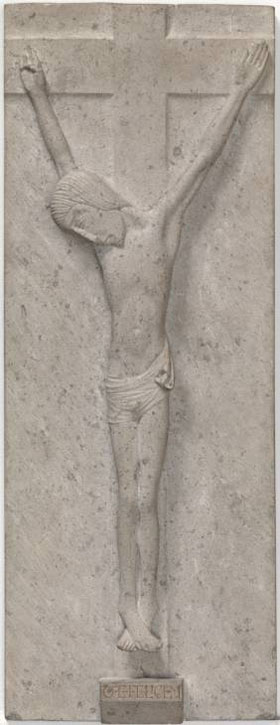
Crucifix by Eric Gill, circa 1913 |
It may seem a strange and contradictory stance for a poet who is also a priest, standing as it does in the face of so many people’s comfortable orthodoxy, but throughout his long career Thomas insisted he found no contradiction in his two vocations, even as he acknowledged he was not especially orthodox. “A lot of people seem to be worried about how I combine my work as a poet and my work as a priest,” he told the BBC in 1972. “This is something that never worried me at all.” He went on to insist, echoing Matthew Arnold, that “in any case, poetry is religion, religion is poetry” and “Christ was a poet, the New Testament is a metaphor, the resurrection is a metaphor”—explaining metaphor as “an attempt to convey an experience of a kind of new life, an eruption of the deity into ordinary life, a lifting up of ordinary life into a higher level.”
At other times Thomas acknowledged, “I’m obviously not orthodox, I don’t know how many real poets have been orthodox. …I find it very difficult to be a kind of orthodox believer in Jesus as my Savior and that sort of thing.”
Yet throughout his long career, Thomas showed no desire to leave the priesthood and continued his priestly functions administering the sacraments, preaching the word, including, at one church, delivering a sermon in Welsh once a month. He served many rural parishes before he retired at Easter in 1978. He was also an outspoken Welsh nationalist, a pacifist involved in the Campaign for Nuclear Disarmament, and a tireless critic of what he took to be the despoiling of the Welsh countryside by English developers.
Thomas’s poetry confronts not just the absence of God but what literary critic J. Hillis Miller has termed “the disappearance of God.” For Miller, the nineteenth century and its experience of the eclipse of God was a major turning point in the spiritual history of humanity. It is a perception described powerfully by Matthew Arnold in his essays and poetry, most famously in “Dover Beach,” where he portrays Victorian religious experience as the “melancholy, long, withdrawing roar” of the sea of faith.
For Arnold and a poetic tradition that runs at least up through American poet Wallace Stevens, the temptation was to substitute poetry for religion. “More and more,” Arnold wrote in his famous essay on “The Study of Poetry,” “mankind will discover that we have to turn to poetry to interpret life for us, to console us, to sustain us. Without poetry, our science will appear incomplete; and most of what passes with us for religion and philosophy will be replaced by poetry.”
Arnold’s experience was not the happy exuberance of a Nietzsche and his proclamation that God is dead. It was, rather, that God has withdrawn. “Our duty,”’ Miller says of Arnold’s view, “is to testify bravely to the existence of God in a time when our dwelling place is in the desert.”
This confrontation with the absence of God comes to the forefront of Thomas’s poetry in the 1970s. The first poem in his collection H’m begins: “God looked at space and I appeared / Rubbing my eyes at what I saw.” In “Petition,” the speaker, seeing the “rueful acts” of theft, murder, and rape committed by human beings, says, “I have said / New prayers, or said the old / In a new way / Seeking the poem / in the pain.” The poem concludes with a sense of disappointment: “One thing I have asked / Of the disposer of the issues of life: that truth should defer / To beauty. It was not granted.”
“The Coming” alludes in its own fashion to the Good Friday story:
And God held in his hand
A small globe. Look, he said.
The son looked. Far off,
As through water, he saw
A scorched land of fierce
Colour. The light burned
There; crusted buildings
Cast their shadows: a bright
Serpent, a river
Uncoiled itself, radiant
With slime.
On a bare
Hill a bare tree saddened
The sky. Many people
Held out their thin arms
To it, as though waiting
For a vanished April
To return to its crossed
Boughs. The son watched
Them. Let me go there, he said.
In the poem “Pieta” Thomas writes:
Always the same hills
Crown the horizon,
Remote witnesses
Of the still scene
And in the foreground
The tall Cross,
Sombre, untenanted,
Aches for the Body
That is back in the cradle
of a maid’s arms.
In “The Combat,” Thomas invokes the Old Testament story of Jacob wrestling with God to comment on a major twentieth-century theme of the failure of language to adequately express religious insight or experience: “You have no name. / We have wrestled with you all Day, and now night approaches …. For the failure of language / there is no redress.”
Sometimes the failure belongs to God, as in Thomas’s poem “Nuclear”:
It’s not that he can’t speak;
who created languages
but God? Nor that he won’t;
to say that is to imply
malice. It is just that
he doesn’t, or does so at times
when we are not listening, in
ways we have yet to recognize
as speech
John Powell Ward, one of Thomas’s most astute readers, has written that in the poetry “the biblical symbol that most gets rewritten is that of the wound in Christ’s side,” becoming “a new symbol of great significance.” But it is not just Jesus’ wound. In “Soliloquy,” God says “the sun was torn / from my side.” Powell also points to the poem “God’s Story,” where God “fingered the hole / in his side, where the green tree / came from.” According to Powell, “If the wound in the side can be so universalized, it becomes something of a rupture at the heart of existence itself, the very mark of identity.”
The absence of God also means Thomas at times rejects any easy sacramental sense of God’s presence in the natural world, as he writes in “Threshold”:
I emerge from the mind’s
cave into the worse darkness
outside, where things pass and
the Lord is in none of them.
I have heard the still, small voice
and it was that of the bacteria
demolishing my cosmos. I
have lingered too long on
this threshold, but where can I go?
To look back is to lose the soul
I was leading upwards towards
the light. To look forward? Ah,
what balance is needed at
the edges of such an abyss.
I am alone on the surface
of a turning planet. What
to do but, like Michelangelo’s
Adam, put my hand
out into unknown space,
hoping for the reciprocating touch?
But the absence of God does not mean the nonexistence of God. Many of Thomas’s poems dwell on the immediacy of God’s absence, an absence in which God has just been missed, as in these lines from “Pilgrimage”: “Such a fast / God, always before us and / leaving as we arrive.” Or in the poem “Adjustments”: “We never catch / him at work, but can only say, / coming suddenly upon an amendment, / that here he had been.”
Thomas does not offer an easy resolution of the paradox of absence and presence, but in the long encounter he waged with doubt and silence—often on his knees, as many of the poems tell us—he seems to have won his way to a rugged kind of faith, an affirmation of love as the meaning of the cross, and a posture of patient waiting. On the theme of waiting William V. Davis finds some provocative connections between Thomas and his contemporary, theologian Paul Tillich. In The Echoes Return Slow, Thomas wrote of faith: “You have to imagine / a waiting that is not impatient / because it is timeless.” Davis sees this as the same sentiment Tillich expressed in a sermon on “Waiting” in his 1948 collection The Shaking of the Foundations: “He is God for us just in so far as we do not possess Him. … We have God through not having him.” Later Tillich adds, “Waiting is not despair. It is the acceptance of our not having, in the power of that which we already have.” For Thomas, the struggle was to learn just that: waiting is not despair.
Thomas was a poet who lived with questions, not answers, as described in the final lines of the poem “Pilgrimages”:
It is I
who ask. Was the pilgrimage
I made to come to my own
self, to learn that in times
like these and for one like me
God will never be plain and
out there, but dark rather and
inexplicable, as though he were in here?
Here the quest for God is also the pilgrimage into one’s self, and the lesson learned is that in embracing the mystery of God “out there” one begins to understand the mystery “in the finitude of the here and now.”
Rowan Williams, in his essay “R.S. Thomas and Kierkegaard” in the collection Echoes to the Amen: Essays after R.S. Thomas, argues that a kind of complex love begins to address, not resolve, this paradox. He cites a passage from The Echoes Return Slow:
But love answers it
in its turn: I am old now and have died
many times, but my rebirth is surer
than the truth embalming itself
in the second law of your Thermo-Dynamics.
The lines point a slow coming to a kind of faith, a faith in the poet’s own resurrection of some sort that he posits, at least momentarily, is as certain as the dead laws of science and technology. There is in the poem something of the dying to self in order to be born again. Williams concludes that “God, for Thomas, is both the frustration of every expectation and the only exit from despair. And that God is encountered only in the embrace of finitude.”
In a 1981 radio broadcast, Thomas said that in the incarnation, crucifixion and resurrection of Christ God has given the answer to suffering. But the poet’s emphasis remained on the cross, trusted and finally understood, according to Tony Brown of the University of Wales, in his volume R.S. Thomas, as “the ultimate demonstration of love defeating time and mortality.”
David E. Anderson is senior editor of Religion News Service. In 2009, he wrote for Religion & Ethics NewsWeekly on Easter and writer John Updike.

 SURAJ BOSE (prison inmate convicted of murder): In the past, before yoga, my mind used to wander a lot. I used to be like a bird in a cage. I used to have a lot of anger.
 DE SAM LAZARO: Jail superintendent Mishra says the yoga program is being expanded across the prison system. Not only does it calm the jail atmosphere, he says, but it may also help thin the ranks through early release of those who’ve completed a course in yoga. He says the prison system in this central Indian state of Madhya Pradesh is overcrowded and understaffed.
 DE SAM LAZARO: But yoga scholars say it involves much more than breathing exercises.
 DAUM (speaking to Israeli children): So what about the history of this place?
 DAUM (speaking to Yacoub Odeh): I always looked upon my uncle as a hero. All my other relatives died in the ovens, and he was a fighter.
 JALAL AKEL (Former Lifta Resident): I took all my children to Lifta. I showed them where our house used to be. I showed them everything. Of course, we always tell them there is hope. Even if only for the children of our children, the hope is still there.
 SHWEKY: I think that you are wrong. I have a different opinion. If I turn it into a monument and say on this site there was an Arab village, that will only lead to hatred and painful memories, because we would then be causing conflict, and then they’re going to say that this is how we once lived and then the Jews came and threw us out. No, I’m not going to do that. We are the State of Israel. We are Jews. We don’t have to save the Palestinian heritage. They will know that it was Lifta, but we are a new nation that has to progress.
 CARTER: The argument that is being offered for Libya is entirely the argument that we have no self-interest here except to protect these people who are going to be slaughtered. Now I know a lot of people think, “Well there’s something else going on, there’s really another reason.” Who knows? All that could be true, but what’s really interesting is that the language the White House is using is entirely the language of humanitarian intervention.
 CARTER: Today we look at self-defense as the axiomatic case where everyone agrees that’s when you can go to war. For the early thinkers that was one of the weakest cases, because as Augustine liked to say, “You should never go to war out of love for yourself but only out of love for others.”
 We live in this very paradoxical relationship with slavery that’s enunciated through the pages of the Haggadah, the book that we use to guide us through the Seder experience, in which we both articulate that we are free and we’re celebrating our freedom but also we are still slaves and maybe next year we’ll be free. We recognize that our freedom is intimately linked to the freedom of those who are most vulnerable in our society today, and we can’t be fully free until they are also free.