

Start with an irony not yet sufficiently noted: We’ve been here before.
The first overseas military action conducted by the infant United States was what we might call a “humanitarian intervention” on the Libyan coast to disrupt the Barbary pirates then terrorizing the Mediterranean shipping lines. It was a unilateral action, as none of our potential allies at the time—specifically the “Great Powers” of Europe or even the Ottoman Empire, whose purported territory was being used as a base for piracy—were willing to act. Instead, they all considered it in their interest to pay a certain amount of tribute—basically, protection money—to ensure their ships were off-limits to the pirates.
Under Secretary of State Thomas Jefferson’s direction, the US refused to pay the tribute, and its ships were considered fair game by the pirates. The end result was two wars. The first, from 1801 to 1805, ended with a treaty the pirates soon scorned. During the second, in 1815, immediately after the War of 1812, a stronger US naval force reminded the Bey of Tripoli of the earlier treaty.
From this the US gained a line for the Marine Corps Hymn (“to the shores of Tripoli”) and a sense of what was required for combat with Islamic forces on their soil—conflict that did not easily end. It took two wars—sharp, nasty little conflicts—and it really only ended when the North African possessions of the Ottoman Empire began to be carved up as colonies by the European powers.
No one should think that this will be easy or simple. Obama’s message to the nation was a reminder that he surely doesn’t.
The president was fierce last night. One of the people watching the speech with me thought he seemed “exasperated.” Certainly he was frustrated at the hysterical comments of left and right. It’s going too fast! It’s going too slow! More needs to be done! Too much is being done already! Obama seemed like nothing less than the parent, thin-lipped with barely suppressed anger, trying to deliberately, if a bit over-loudly, explain to the teenagers why they couldn’t have everything they wanted.
But I think “fierce” is a better word for his mood. He was not just communicating exasperation at the caterwauling of American politicians of the moral fiber of Newt Gingrich and the strategic profundity of Michele Bachmann. He was also communicating a deeper fury and profounder purpose to three other audiences: Muammar Qaddafi himself, who surely watched the speech; those people in Libya and elsewhere who want to know what the United States will do and what it won’t; and finally the US population as a whole whom, it seems, Obama wanted to reach with a somber and serious message—that United States military power, and its power as a whole, must be exercised with serious deliberation and never flippantly or through glib soundbites. But exercised it must be, and for aims that are overlappingly moral and political.
The lineaments of an Obama Doctrine—if that is what it is—were crisply sketched out. Work to prevent humanitarian catastrophes, for such catastrophes inevitably create further problems in the region and globally. But do so with a cold eye to the costs and consequences of varying degrees of US involvement, and always, always work to seek collaboration with allies wherever such collaboration is possible, both to strengthen the action and diminish the costs.
Such a vision recognizes concentric rings of responsibility: first, to protect the nation, then to use the work of America’s diplomats, and when necessary the US military, to secure the best conditions to advance American interests abroad, and then to ensure that the costs of any such action, in blood and treasure, are sustainable for the strategic purpose involved. Safety, sufficient force, economy. These are the basic obligations of a US president when foreign affairs are at issue.
This can sound cold-blooded, but it is not, or need not be. Consider how deeply the president suggested morality enters into things, albeit in complicated ways. Here he made two arguments—first, against those who argue for doing nothing, and second, against those who argue for doing much more.
Against those who don’t think the US has any vital interests involved in Libya: Why is a humanitarian crisis a problem for the United States? Well, certainly because the US doesn’t want to see atrocities done. They’re bad, after all. But why exactly are they bad? Here Obama spelled out the consequences in detail, explaining how much a cold-hearted realist and a warm-blooded moralist can share:
A humanitarian crisis could cause the movement of refugees across borders to Tunisia and Egypt, countries already struggling to move past their own recent revolutions and rebuild their political orders. (The president didn’t mention it, but some no doubt will recall that the bloody Rwandan genocide of 1994, which killed 800,000, led to the even-bloodier Central African wars of the remainder of the 1990s, with the two Congo wars alone killing over five, maybe six million more people.)
A Qaddafi sack of Benghazi and destruction of the rebellion would deal a severe blow for democratic movements across the region, just when many of them are showing some real energy in Yemen, Bahrain, and Syria (perhaps even in Italy, but that may be going a bit too far). Not all of these movements are pro-US, and we would be naïve to think they are forces that would eventuate in new political situations to our liking, clearly in Bahrain and arguably in Yemen as well. But over time, democratic nations are our best bet in the region and the best bet of the world. When such democratic nations are possible, we should not act to obstruct their birth, and we should do all we can to enable their emergence.
Finally, inaction would have led to the further humiliation—that is, delegitimation—of the United Nations Security Council and also the Arab League, both of whom had authorized military force to stop Qaddafi’s troops from entering Benghazi. Such delegitimation is no light thing. It is arguable that the Bush Administration’s glib dismissal of NATO’s offers of help in Afghanistan in 2001, and its near-mockery of the UN in 2003, derived from Bush and his allies’ perception that NATO was ineffectual at best, and the UN actively harmful, in the Yugoslav crises of the previous decade. However you want to contest those perceptions, as I do, you must admit that those institutions were not exemplars of institutional accomplishment in that decade. If the US wants an international order in which some forms of justice are at least occasionally acknowledged and acted upon, then when those forms of international order are—almost miraculously—effective, we should do all in our power to support them.
So for immediate “on the ground” reasons relative to Libya’s fragile neighbors to the burgeoning drive for democracy in the Arab world as a whole, and for reasons related to cultivating a genuine international order, intervention at that level is both the right thing to do and the strategic thing to do.
But why not go further? Injustice anywhere is a threat to justice everywhere, we hear, so why not simply overthrow Qaddafi? Here is Obama’s second argument, against those who would have him do much more now than he wants.
Well, why don’t we oppose injustice equally everywhere? The answer is we should, but not in the same way. To have gone to war with China after Tianamen Square would have led to catastrophic global consequences. To have struck back at Russia in the Georgian war would have been worse (and arguably, after the dust settled, we would have been in the wrong there). Was there something more the US could have done in Iran in the summer of 2009? Not all the Iranian activists think so even now. Prospects must be weighed against possibilities, and opportunities must be measured by the odds of success.
Here Obama shows himself to be a fairly chastened realist. Were the US to aim directly at overthrow, Obama says, we would not be within the ambit of the UN or the Arab League, and probably we’d have lost NATO as well. (Note, by the way, the delicate doughnut he danced around Germany in listing “our closest allies” in this cause.) It is unclear, furthermore, that the Libyan forces aligned against Qaddafi want the US to go this extra step. They seem committed to defeating the tyrant on their own, and if they are, Obama thinks the US should let them.
So we would lose a great deal of support. But we could still do it, yes? That is unclear, as Obama pointed out by appealing to Iraq, where, as he put it, “regime change…took eight years, thousands of American and Iraqi lives, and nearly a trillion dollars. That is not something we can afford to repeat in Libya.” Even if the US could do it, would it be wise?
Impatience is only very rarely a virtue in international affairs. Surely we could end this conflict right now, in some sense, simply by dropping a ten kiloton weapon on Qaddafi’s compound in Tripoli and turning much of Tripoli’s sand to glass. Probably we could dial that back to a one kiloton “microburst” and only obliterate the neighborhoods immediately surrounding the compound as well, keeping the casualties, at least in the short-term, to under 100,000 dead from the blast and immediate radiation sickness. But who would want that?
Were the US to go further than Obama has suggested at present, it would do so at a cost of international legitimacy and pragmatic investment that would be vast and longlasting. Instead, Obama argues, let’s see how the next ten days play out—as our military risks and expenses decrease, as our allies carry more of the burden, and as the military balance of power in Libya continues to shift, for continue to shift it will. Qaddafi’s forces will not get any stronger, isolated as they are geographically and financially, while the rebel forces really have nowhere to go but up in effectiveness and scale. And then see how the ten days after that go. Let’s be a bit more patient.
Emotional screeching on the part of American wonks and politicians that Obama is not showing enough “strength” must be hard to bear for a man who regularly meets with the wounded from wars he did not start but now must fight, a man who regularly visits Arlington National Cemetery and meets with the families—parents, husbands and wives, sons and daughters—of American servicemen and women, his servicemen and women, who have been killed in those wars. Part of me wants to think there is a special place in hell for all those people who are morally glib enough to use a president’s caution with human life as a rhetorical cudgel to beat him over the head as “weak” or “vacillating.” It’s not the part of me that I endorse in cool reflection, but it’s there.
And I think it’s there for Obama, too. I think he simply cannot understand how people can take themselves seriously when they get up on their moral hobbyhorses, put the pots of ludicrous, hysterical pseudo-patriotism backwards on their heads, and imagine that they are charging against Evil Forces Aligned Against America. I strongly suspect history won’t take those people seriously either. In any event, they are not taking morality’s traction on reality seriously in this case. They are, in effect, sentimental moralists who think just because something seems like it ought to be to their way of thinking that it can be.
This kind of moralism is just as immoral as the amoral nihilism of those so-called “realists” who would have the US do nothing in situations like Libya. Both lack the patience to see how complicatedly intertwined the political and moral realities are.
Patience is hard, and in this case it may well be difficult to tell patience from uncertainty. After all, Obama offered no easy way out. He did not tell us, as General Petraeus famously asked during the invasion of Iraq, how this ends. But I think that was wise, for two reasons.
First, he simply doesn’t know. No one does. Will it take one more day for Qaddafi to quit or be forced out by others or simply be in the right place at the right time? (The wrong place at the wrong time for him.) It could be that quick. It could take a week. Maybe a month. It could be a long, hard slog. Perhaps Libya will split into Cyrenacia and Tripolitania. It’s not the worst that could happen.
Second, Obama secured what is called strategic ambiguity on this matter. That is, he did not pre-commit himself to any particular path going forward. That is wise as well. Who knows what the future will bring? There is no need for the US to telegraph to its rivals what it will do in all possible contingencies.
It may be difficult, I say again, in coming days to tell patience from uncertainty. But Obama’s speech does give some clues. If the rebel forces continue to grow in strength; if our allies stay with the mission; if international support does not collapse—and none of these are implausible hopes, though each of them carries with it its own substantial possibilities of disappointment—then there should come some resolution of the Libyan intervention in the direction of our favored conclusion. Ten days in, there is much reason to hope for this. Nothing is guaranteed, of course. Chance enters into everything, especially war.
In Libya, Obama said, the nation’s “safety is not directly threatened, but our interests and values are.” Interests and values. This is not a president given to expressivism in foreign policy or diplomacy enacted by grand moral gesture. Acts are calibrated not for their “moral clarity” but for their precision in anticipated consequences. Such further clarity as is necessary can come from the exegesis given to the nation’s actions by its diplomats and president. But soldiers and civilians are not semaphores to be used in the geopolitical version of a Cecil B. DeMille—or worse, Jerry Bruckheimer—movie. Views that imply anything approaching that are best met with contempt.
Certainly a president, entrusted with the nation’s interests, among which are its values, cannot share those views, and we are fortunate that this one, at least, does not.
Charles Mathewes is associate professor of religious studies at the University of Virginia at Charlottesville and the author, most recently, of “The Republic of Grace: Augustinian Thoughts for Dark Times” (Eerdmans, 2011).
 GALSTON: Sure, it’s not that complicated. In the 1990s, there were two episodes of genocidal ethnic cleansing: one in the Balkans, the other in Rwanda. In both cases, the international community waited too long to intervene, and the result was a disaster. Many people in the White House remember that. Some of them were there in policy-making decisions. They were determined not to repeat it. When the Libyan forces were on the edge of Benghazi and Colonel Gaddafi issued a bloodcurdling threat to hunt down the dissidents alley by alley, the administration thought that it had no choice but to act to prevent an impending blood bath, and I think they were right.
 GALSTON: You can’t, but that doesn’t mean that air power is useless in those circumstances, because Gaddafi’s forces have supply lines outside the cities. If those supply lines and lines of reinforcement are interdicted through air power, which they can over time, it will be possible to cut off Gaddafi’s forces in those cities.
 GALSTON: We don’t have a greater obligation than we did before, but it’s important to note that we don’t have an obligation to be everywhere for the very simple reason that we don’t have the capacity to be everywhere. An example that I sometimes use is a lifeguard walking along the edge of a beach hears someone crying out from offshore. Is there an obligation to assist every drowning person? No. But there is certainly an obligation on the lifeguard’s part to assist that one if he or she can.
 In the UN resolution and in much of the debate leading up to the launch of the operation, the word “responsibility” has been in the air. The popularity of this term goes back to 2001, when a Canadian commission proposed the idea of a “responsibility to protect” as the framework through which debates about humanitarian intervention and human rights should be understood. In 2005, the UN General Assembly proposed the concept as part of its reform of the UN system in order to avoid politicking over matters that demanded immediate action. Since then, it has been invoked not only by academics, but also by policy makers and even military officials in support of various interventions in support of human rights.
 ABERNETHY: But you are able to, or the people who are in need are able to get help from you or from the government or from somebody else, right?
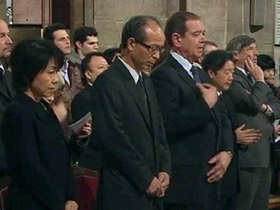 TOYCEN: Well, my first comment is yes, you’re right to a certain extent. They don’t need as much help. This is a first-world country. But, on the other hand, my experience is that most of us, or many of us at least, when somebody’s in trouble we have a sense we want to help out in some ways. And then when you think about, even I think of. say. Hurricane Katrina in the United States, how much Americans appreciated, at least that’s the feedback I got, when people from Canada and other places in the world came in and pitched in and gave, either volunteered or gave some money. So I think everybody has to make their choice, and we’re so pleased at World Vision. We’ve had so many people who want to step up and say we’re willing to help in Japan and send a message of hope.
 REV. MAGGIE IZUTSU: Thank you. It’s an honor to be here.
 IZUTSU: Yes, well, I think that may come from very early training that is part and parcel of the Confucian tradition, which was imported from China, that seeks to make every opportunity in life—in daily life, secular life, as well as spiritual life or, more pointedly, religious life—an opportunity for moral self-cultivation, and it starts at a very early age. For instance, my son in a three-year-old’s class at nursery school’s teacher would talk about how she went home every night to try to understand how she could better inculcate a sense of little Johnny’s effect on little Tommy in terms of how he was behaving. So that sensibility of commiseration or empathy or understanding how our behavior affects other people starts there at a very early age.