 |
Bumblebees bumble, butterflies dance, and dragonflies hover. But according to the conventional laws of flight, none of these high-flying insects should be able to get off the ground.
There are mathematical laws that explain how everything from luxury jets to paper gliders stay airborne, but for decades, engineers and scientists couldn’t make the rules explain how insects remain aloft.
Biologist R. McNeill Alexander of the University of Leeds in England once put it this way: “Insect flight cannot be explained by conventional aerodynamic principles.” One problem: while airplane wings don’t move, insect wings are constantly flapping, tilting, bending, and doing all sorts of complicated three-dimensional acrobatics the mathematical formulas can’t handle.
In recent years, however, McNeill and other scientists have begun to unravel the mystery of insect flight. One way they’ve done it is by building large-scale replicas of real insects, which they then “fly” in experimental wind tunnels. Cambridge University biologist Charles Ellington and colleagues, for instance, built “Flapper,” a kind of mechanical “Frankenmoth” that is ten times larger than its natural model, the hawkswing moth. By suspending “Flapper” in the wind tunnel and blowing smoke at it, they were able to see how the air swirled around the flapping wings. Photographs revealed that the wings created remarkable vortices that danced along the moth’s body, creating lift unlike that created by any high-tech jet — or predicted by any engineer. The studies also helped reveal why the hawkswing is one of the world’s fastest insects.
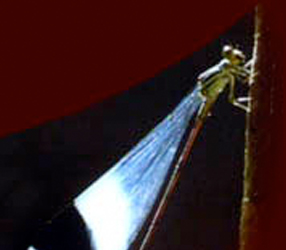
Other researchers are studying dragonflies, hoping to learn how these fast flyers are able to change direction so quickly. They too are building wind-tunnel models, in the hopes of learning secrets that will help them build more maneuverable fighter jets. But will the jets be able to stop on a dime and go backward, the way dragonflies do? Not likely, say the scientists. For the time being, insects remain champion flyers that even the most clever human engineer hasn’t figured out how to imitate.