Visit Your Local PBS Station PBS Home PBS Home Programs A-Z TV Schedules Watch Video Support PBS Shop PBS Search PBS

Encountering Sea Monsters
First Glimpses of the Giant Squid

Giant squid

There is one less mystery in the deep sea: two Japanese researchers have finally photographed a live giant squid. It’s the first time one of the world’s largest cephalopods has been documented in its ocean home.

“It is just a sensational accomplishment,” says Dr. Mark Norman, a leading squid expert who appears in NATURE’s Encountering Sea Monsters.

The giant squid has long been the stuff of legend. Mariners claimed it sank ships and plucked sailors off decks. Even scientists admit it is a very mysterious creature. Dead specimens periodically wash up on beaches, but no researchers had ever seen one alive until recently.
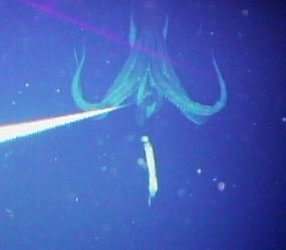
giant squid

First image of a live giant squid, known as Architeuthis.

Over the last decade, there’s been a race to change that. Some scientists have descended in submarines, hoping to catch a glimpse of one of the several known species of giant squid, which are believed to live in deep water, a thousand feet down or more, in oceans around the globe. Others have dragged camera-laden sleds across the ocean floor, hoping to take a portrait of one of these monsters, which are believed to grow up to 40 feet long.

Two Japanese researchers, Tsunemi Kubodera of Tokyo’s National Science Museum and Kyoichi Mori of the Ogasawara Whale Watching Association, had a different idea. First, they identified an area where fishing boat captains and tourists had seen sperm whales with sucker marks on their skin, indicating a confrontation with the giant squid. They rode out to the spot on a Japanese fishing boat. Then, they lowered a hook baited with a single small squid, nearly 3,000 feet down. Also attached to the line: an automated digital camera that snapped a picture every few minutes.

The two squid hunters had little luck for years. Then, on September 30, 2004, in the waters off Japan’s Ogasawara Islands, they succeeded. A squid about 25 feet long rose from the depths and took the bait. One of its arms got snagged on the hook. For more than four hours, it struggled to get free. Finally, the snagged tentacle broke off. By the time it was all over, the camera had snapped more than 500 pictures of the squid, which scientists call Architeuthis. When they pulled up the camera, the researchers retrieved the 5-foot-long tentacle tip as a souvenir. When Mori took it off the hook, he later told reporters, it was still moving. Its suckers even stuck on to the deck.
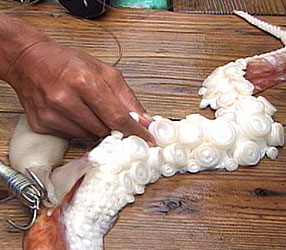
giant squid tentacle

Architeuthis’ severed tentacle

The researchers studied their photos for more than a year, then publicly released them in a scientific journal in late 2005. The team explains that the photos show the squid hovering, “flying” through the water, and aggressively wrapping its tentacles around the bait. That suggests Architeuthis is “a much more active predator than previously suspected,” perhaps used to chasing and tracking down prey rather than waiting in ambush.

The Japanese researchers “were extremely clever on every level,” says Dr. Norman, a senior curator at Museum Victoria in Australia. “My guess is that everyone is going to be breaking down their door and asking for help over the next few years.” He says the next step will be to get moving pictures of this and several other species of giant squid that live deep in the ocean.

   Print    Email    comments (13)

(19 votes)
Loading ... Loading ...
13 responses
Rachel -- July 2nd, 2008 at 8:59 pm

very exciting! I hope this full episode will be online since I will miss it on sunday!

chaunc -- July 7th, 2008 at 11:14 am

wow, thats fantastic. I hope i get to watch it

brandie -- July 11th, 2008 at 1:11 am

This is very interesting stuff. I love learning about creatures in the deep.

tulasi -- July 11th, 2008 at 3:00 am

What an awesome article on the sea monsters.

sunny -- July 11th, 2008 at 11:23 am

so cool!
scary the tentacle is alive
25 foot!!!

Jay -- July 14th, 2008 at 7:46 pm

Do they eat humans? Creepy but fantastic!

Chance -- July 25th, 2008 at 6:53 pm

I thought the giant squid was a calm creature. Instead, the old “predatorious giant squid” myth is true. Bob Cranston was pretty brave to go down deep with the humboldt squid. The creature is huge! I thought it was smaller. But no, it’s huge!!! Just thought i’d let you know. I’m a kid actually. Bye!

L. Paskowitz -- July 30th, 2008 at 1:26 pm

That’s awesome! Now there isn’t any doubt it’s real. Maybe somebody will discover a cephalopod that’s even bigger!

naoe -- August 24th, 2008 at 6:28 pm

It’s been my dream all my life to go to see deep sea creatures in their habitat. Mysterious creatures like Koumoiridako, Fusen-unagi,and so on. Daio-Ika was one of them. It’s fascinating to be able to see them in photos and videos.

Shawn -- September 21st, 2008 at 9:02 pm

Its really amazing that the tentacle was still moving even after its been removed from the body.

sumone -- October 27th, 2008 at 10:33 pm

THIS IS AWESOME.THIS IS AWESOME.THIS IS AWESOME.THIS IS AWESOME.THIS IS AWESOME.THIS IS AWESOME.THIS IS AWESOME.THIS IS AWESOME.THIS IS AWESOME.THIS IS AWESOME.THIS IS AWESOME.THIS IS AWESOME.THIS IS AWESOME.THIS IS AWESOME.THIS IS AWESOME.THIS IS AWESOME.THIS IS GAY.THIS IS AWESOME.THIS IS AWESOME.THIS IS AWESOME.THIS IS AWESOME.THIS IS AWESOME.THIS IS AWESOME.THIS IS AWESOME.THIS IS AWESOME.THIS IS AWESOME.THIS IS AWESOME.THIS IS AWESOME.THIS IS AWESOME.THIS IS AWESOME.THIS IS AWESOME.THIS IS AWESOME

Linda -- June 25th, 2009 at 4:16 pm

For the future, I hope they will find a way to photograph this creature without doing harm. Is a hook really necessary…it seems very cruel…and surely there is a better way to begin interacting with these creatures.

Santiago -- June 29th, 2009 at 9:47 pm

No wonder why fishermen and researchers have not seen this creature alive for such a long time, because they live in the very deep ocean. Imagine 3000 feet depth. I think we should leave this wonderful creature alone and not to harm them.

post a comment
Please note that the THIRTEEN editorial staff reserves the right to not post comments it deems to be inappropriate and/or malicious in nature, as well as edit comments for length, clarity and fairness. No solicitations or advertisements will be allowed. Users may link to other Web sites relevant to discussion, but most often links to commercial Web sites will not be permitted.

Produced by THIRTEEN    ©2009 Educational Broadcasting Corporation. All rights reserved.

Major corporate support for Nature is provided by SC Johnson, Canon, CPB.