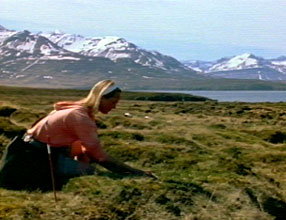
 Icelanders harvest feathers from eider ducks Icelanders harvest feathers from eider ducks |
Over the centuries, Iceland’s human inhabitants, today more than 250,000 strong, have forged close ties to the island’s wildlife. But the relationship has had its ups and downs. When settlers first arrived, for instance, Iceland was covered with stands of healthy forest. Within a century, however, the trees had been felled to provide fuel and timber to growing villages. Today, far less than 1% of the island’s original forest remains. Residents are now making efforts to replant imported trees. Similarly, humans haven’t been kind to Iceland’s thin glacial soils. For hundreds of years, they have herded sheep across their lands, harvesting valuable wool and meat. In fact, there are twice as many sheep in Iceland as people. Unfortunately, however, the woolly livestock overgrazed the thin vegetation and promoted erosion, reducing once green fields to rocky, barren lots. Up to a third of the country’s fields were seriously scarred.
Today, new management methods have reduced some of the damage. And Icelanders are increasingly aware that they bear responsibility for preserving nature, including some of the world’s most important bird nesting grounds. Near Latrabjarg, for instance, is the world’s single largest seabird-nesting cliff, while southern Iceland hosts the globe’s biggest skua colony. Iceland is also home to some of the world’s largest colonies of puffins, seabirds beloved the world around whose colorful, clown-like beaks are their most identifying feature. By protecting these remarkable natural sites, Iceland is not only helping to preserve the world’s biological heritage, it also helps promote a healthy economy. Increasingly, tourism, including bird watchers who come to see the colonies, has become one of the nation’s most important sources of income.
Protecting wildlife, however, does not always mean fencing it off from humans. For generations, some Icelanders have made a living acting as nursemaids to nesting eider ducks. As Iceland: Fire and Ice shows, the ducks benefit from the human attention, as the farmers protect the birds from predators. The humans, on the other hand, benefit from a feathery harvest: they gather the soft down that eiders use to line their nests once the feathers are no longer needed to insulate the eggs. The down eventually makes its way into some of the softest, warmest pillows and comforters around the world — souvenirs from the land of fire and ice that some sleepers may never realize they possess.