Visit Your Local PBS Station PBS Home PBS Home Programs A-Z TV Schedules Watch Video Support PBS Shop PBS Search PBS

In the Valley of the Wolves
Are Wolves at Risk?

Although the gray wolf remains an endangered — and therefore protected — species, wolves nevertheless face the same risks as any other animal species. Outside Yellowstone National Park, humans continue to be the greatest threat to the wolf; ranchers may kill wolves that attack their livestock, and hunters shoot them for sport. Despite their protected status, many people in the surrounding communities continue to harbor animosity toward the animals and view them as nothing more than a nuisance.

Within Yellowstone, wolves are shielded from these particular dangers, but “there are many other natural threats,” says biologist Mike Jimenez, the leader of the U. S. Fish and Wildlife Service’s Wolf Recovery Project. “It’s not a free ticket.” Wolves can be kicked by the elk they are hunting, be injured in fights with grizzly bears, or, most commonly, get hurt during fights with other wolves. “The main cause of death among wolves is fighting each other,” Jimenez says.

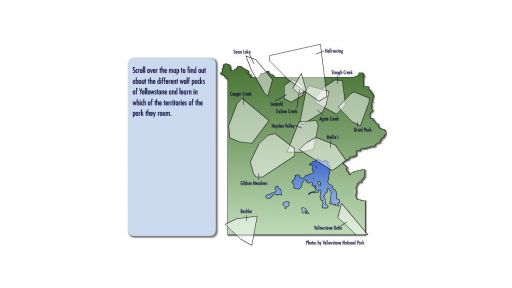
However, he notes, “this is a sign of a very stable population,” and a way for the population to preserve a sustainable size. Unlike prey species such as elk, which can exist in enormous herds of many thousands of animals, large predators such as the gray wolf have small populations spread over very large territories. For example, Yellowstone is now home to 120 to 125 wolves in about a dozen packs, spread over more than 2 million acres. This, says Jimenez, reflects the natural carrying capacity of the region. Too many wolves can throw the ecological balance of the system out of whack just as easily as no wolves at all.

Disease is also an issue for the gray wolf — albeit a very natural one. Two years ago, canine distemper ravaged much of Yellowstone’s wolf population. “That year, two-thirds of the pups, which are the most vulnerable to the disease, did not survive,” Jimenez says. Distemper is not unique to Yellowstone; in the 1990s, many wolves in Montana were afflicted with the disease, which biologists suspect may have spread from domesticated dogs. (Wolves and domesticated dogs share a similar ancestry and many of the same diseases.) Parvovirus, another common dog disease, has also cropped up in the gray wolf. Mange, a skin disease that causes animals to literally scratch off large patches of their fur, has been a problem for at least one pack within Yellowstone, and for a few of the 15-odd packs outside of the park. Although the diseases can prove fatal to the animals that are afflicted, their occurrence is “well within the norm,” Jimenez says. “The population is healthy.”
   Print    Email    comments (26)

(11 votes)
Loading ... Loading ...
26 responses
Lorena -- November 23rd, 2008 at 9:21 pm

I also enjoyed the movie and it also touched me i hope you play “The wolf that changed America” again.

James -- November 23rd, 2008 at 10:09 pm

Dear PBS,

I have enjoyed the Nature program about Sedan trying to catch Lobo.It was very moving. I request that you run “The Wolf That Changed America” every year. Thank you.

Thanks,
James

Virginia Gilstrap -- November 23rd, 2008 at 10:26 pm

11/23/2008
Dear PBS:
I thoroughly enjoyed the Nature program about Seton trying to catch Lobo. It was totally moving and enjoyable. Would you please tell me where the Currumpaw Valley is situated in New Mexico. I lived in New Mexico for many years, but do not seem familiar with it. Could it be Cimmarron Canyon area??
Thanks,
Virginia

Joanne -- November 23rd, 2008 at 11:18 pm

Dear PBS:
My family looks forward to the Nature shows every Sunday. “The Wolf That Changed America” left a lasting impression on me. I think the more people get educated and feel connected with other living species , then we can live in harmony. My daughter, who is nine years old kept hoping for a happy ending for Lobo, but as we watched, it was not to be. Thanks for airing this touching story. It makes us want to learn more about the wolves and how we can help their survival. Thanks again,
Joanne

Sally Muto -- November 23rd, 2008 at 11:44 pm

Dear PBS: I too would like to know the area that Seton spent his time with Lobo. We have been all over New Mexico and don’t know the area he was in. Have the names changed? We now live north of Yellowstone and the wolves are fantastic! Thank you for the show, Sally

Ken -- November 23rd, 2008 at 11:49 pm

The Boy Scouts of America let PBS in the organization’s Seton/Philmont museums? I thought that they were closed to researchers, like the National Scouting Museum in Texas.

bob ostrom -- November 24th, 2008 at 1:00 am

the nature program ‘the wolf that changed the world’ was great.
All dogs are decendent of the wolf, all dog lovers will love this powerful episode of nature

Gina -- November 24th, 2008 at 2:24 am

Dear PBS: Thank you so much for this show. I have always loved wolves ever since I was a little kid and have always known that they are a very misunderstood animal. I hope that you show this for years to come.

lamebear -- November 24th, 2008 at 3:02 am

As an advocate, and protector of wolves I was deeply moved by your program ‘The wolf that Changed America’. As a resident of Wyoming I hope that at least some Wyoming people, especially Ranchers, and so called Hunters got to see the program. For a short time this year, the protection for wolves in Wyoming was taken off, and at least one or two wolves were being killed everyday, until we got the protection put back on. The Wolf in Wyoming will be extinct unless they have, and keep protection! They are still being Poached for some reason!

Beth -- November 25th, 2008 at 4:13 am

I remember reading the book about Lobo when I was a child, and it touched me deeply. I read it many times, and my heart was always sad for Lobo and Blanca. I have always loved wolves, and to see that story brought to life was a very moving experience for me. I will be going to the library to get the book, and read it again. Its been fifty years since I read it the first time,and I know that it will touch my heart the same as it did then.

meagan -- February 20th, 2009 at 10:08 am

I love wolves os much.

Montana Man -- February 22nd, 2009 at 9:35 pm

Just once I would like to see PBS and the mainstream media get something right. In above opening paragraph you state “Outside Yellowstone National Park, humans continue to be the greatest threat to the wolf; ranchers may kill wolves that attack their livestock, and hunters shoot them for sport.” We hunters do NOT shoot them for sport as they are and have been listed under the endangered species list. If you are going to show the wolves as the savior of the ecosystem, the least you could do is show a true conservation side to the story, such as the devestation that the wolves are having on the elk population in Yellowstone and the Bitterrot Valley of Montana to just name two places. Report the facts and let people decide on their own, not just the one sided view of PBS.

tcprath -- February 22nd, 2009 at 9:45 pm

Why don’t you cover the wolf from the perspective of an Elk or a Moose? Or are there any left in Yellowstone? It was very sad to see that several of the wokf offspring did not make it. the bright side…hundreds of elk and moose might survive!

JW -- February 22nd, 2009 at 10:58 pm

I agree with you tcprath. I am so frustrated that wolves are still being protected. When wolves were reintroduced the goal was to have 30 breeding pairs. Now it’s estimated that there are about 100 breeding pairs!! Sure they are a fascinating animal and they might have their place but that is way to many! They are decimating the elk and moose populations around the Park. We need to start hunting them to control their numbers. It is such bull**** that you people are talking about how the wolves are in danger. How about you make a show about the elk, moose, deer and educate the public on how wolves are affecting them.

EMM -- February 22nd, 2009 at 11:39 pm

I would challenge both tcprath and JW to remember that elk populations only grew to non-natural populations sizes after wolves were removed by humans, and with wolf reintroduction, populations of ungulates are being held at reasonable carrying capacity for a functioning ecosystem that includes all trophic levels from producers to top predators. Several studies by state agencies and federal agencies stress that wolves have not decimated elk populations and only in some areas have wolves decreased herd sizes. In other areas herds are growing despite wolves. Humans have been shown to have a larger impact on game species than do wolves. Here are several points from a study in MT:
1. In the Northern Yellowstone elk herd, a continued decline in elk numbers is likely unless total predator to elk ratios decline, even if hunting pressure remains low. (probably an area with too big a herd for a functioning ecosystem, so even if it is decreasing, it is still not close to disappearing).
2. In most areas with low total predator to elk ratios, elk numbers have remained stable or have increased since wolf restoration began.
3. Wolves influence elk distribution, movements, group sizes, and habitat selection to varying degrees in different areas, but hunting activity and hunter access have a greater impact on elk distribution, movements, group sizes, and habitat selection than do wolves.
4. Elk and moose populations in northwestern Montana appear to be stable or increasing in the few areas that have sufficient data to examine long-term trends.
5. In most of northwestern Montana, it’s probable that white-tailed deer are the major prey of wolves, yet the recent decline in deer numbers there is most likely due to poor fawn survival and recruitment during the recent spate of severe winters-in combination with high antlerless harvests by hunters and wolf-predation rates.
6. Some areas in Montana are unsuitable to wolves because livestock depredations continually lead to wolf removals, preventing wolf numbers from increasing at rates similar to protected areas. In these areas, wolves are less likely to limit deer and elk populations.

In my humble opinion, hunters have thousands of prey out there. Furthermore, wolves are helping elk herds heathier, if a bit smaller in some areas, by removing weak, old, or sick animals. You can see videos of wolves running along side elk as they judge the health of an animal…all the while they could have killed it, yet did not and moved onto a weak member of the herd. Human hunters do the opposite and by harvesting the best trophy animals are in fact causing future generations to be less robust. So, if you have a complaint, it should be against human hunters, and not native wild predators.

pcw -- February 23rd, 2009 at 12:39 am

To EMM
Yes, I do agree with some of your point of view, but on the same note I will NOT feel bad about the wolves dying due to disease, that is usually nature’s way of tell you people that there is an OVER POPULATION of wolves. People and wolves are never going to get along, people have come to their land and are trying to make a living. Farmers, ranchers, etc… with their livestock so they can put food on the table for their families. Fine have the wolf, but keep the population in check and one way to do that is to hunt them. Like JW said it is illegal to hunt them. Their needs to be some balance with wolves also..I would love to see a documentary done on how the wolves have affected the other wildlife and people’s livestock that is next to the national park. Let’s get both sides of the story.

Jessy -- February 23rd, 2009 at 1:21 am

DearPbs:
I hope that you would put on another show about wovles.Because I love to learn about some packs of wolves on are Earth.
Sincerely,
Jessy
P.s. I love your shows.

Donna Beth Mitchell -- February 23rd, 2009 at 2:30 pm

To EMM
Kudos and God Bless you for defending well and defending with facts! If only there were more people like you…
To PCW and the rest:
Overpopulation-are you serious? You all are obviously the people who BELIEVED the wolf stories growing up, and have an unreasonable prejudice against a beautiful and necessary predator. Many prayers for your education and change of heart.

JW -- February 23rd, 2009 at 2:46 pm

To EMM:
“2. In most areas with low total predator to elk ratios, elk numbers have remained stable or have increased since wolf restoration began.” – Exactly, why are you talking about the elk populations being stable in areas that have LOW TOTAL PREDATOR TO ELK RATIOS?
“In my humble opinion, hunters have thousands of prey out there.” – I do not want to have a hunting season on wolves simply for the opportunity to hunt another species, I just don’t want the numbers of the other animals to suffer.
To Donna Beth Mitchell:
“Overpopulation-are you serious?” – Yes we are serious, if you have watched the PBS shows then you should have seen that certain packs are dying off. This is a result of too many wolves living close together and passing disease from one to the other.

pcw -- February 24th, 2009 at 2:16 am

To Donna Beth Mitchell: Yes, as a matter of fact I have grew up with “those” stories, and Yes I was told of the many stories of the wolves! Please, that is natures way of thinning out the wolves, its mother earth…………..nature!
Please…….I am educated, but are you? Wake up, smell the coffee.

kat -- February 24th, 2009 at 1:26 pm

yall should stop arguin!!! evrybuddy has a different view, that’s just life!!! there’s no need to argue about whose opinion is right! Cuz NOBODY IS RIGHT!!!

Toby Bridges -- March 29th, 2009 at 8:30 pm

Here’s a simple solution…Those who love wolves should watch old Walt Disney films. Those who recognize the wolf for what it is, a pestilence forced upon us by an ego driven U.S. Fish and Wildlife Service that’s now pulling down deer and elk populations, simply need to take up arms and start shooting wolves. It’s time to do what the settlers of this land did a hundred years ago, eradicate the gray wolf from the Rocky Mountains – and for the same reason…they don’t mix well with humans, pets, livestock and other wildlife. They didn’t then, and still don’t today.

Save An Elk Herd…Kill A Wolf!

Toby Bridges
LOBO WATCH

ellie -- April 21st, 2009 at 1:56 pm

how much have timber wolves decreased in yhe world

ellie -- April 21st, 2009 at 1:59 pm

toby brigdes is really mean. we should kill u

Toby Bridges -- June 29th, 2009 at 5:28 pm

ellie is really naive.

And so is anyone else who thinks there is a place in the settled regions along the Northern Rocky Mountain chain for an unchecked, unregulated population of killing machines like the gray wolf. These predators are now wiping out elk populations that took a hundred years of conservation efforts to build back from the brink of extinction. If you think otherwise, take your arguments to where only those who think the same way can read and share your thoughts. The impact wolves are now having on elk and other wildlife is being felt…and recognized. In the Bitterroot Mountains of Western Montana, biologist reported the spring 2009 cow-to-calf ratio the lowest ever…since the beginning of such record keeping. And next door in Idaho, the elk herds have already been dealt a lethal blow – with elk populations 30- to 40-percent below where they were just 8 to 10 years ago.

And in both of these areas, it would take 30 years for the herds to be rebuilt to late 1990s levels (before the impact of the wolf)…if every wolf were killed in those two states today. And that’s exactly where the sportsmen in these states will take it if the MT Fish, Wildlife and Parks; and the Idaho Dept. of Fish and Game; and the U.S. Fish and Wildlife Service continue to drag their feet and fail to get wolf management under way.

While wolf numbers continue to grow rapidly, elk numbers are in a serious nose dive. Coincidence? Only a fool would think so.

Toby Bridges
LOBO WATCH

green man -- September 17th, 2009 at 6:42 am

It’s now Sept 16,2009 And the gov. “head man” of Montana has passed a bill allowing 800 wolves to be open season Just like Sarah Pallin did in Alaska hunting them from helocopters planes shooting them from flying aircraft on the tundra of the snow with no place to run and hide .
Some sportman think this is hunting i say it just slaughter for their sick fun, puke puke.
Montana for profit just like Pallin for PROFIT IN ALASKA. THIS IS A CARRY OVER OF THE BUSCH ADMINISTRATIONS POLICIES.
This has been in the minds of Montana’s travel
industry and for profit cold blooded murder.
We have given up our duty to protest these creatures from sick hunger preditors that have had their fun at canned hunts and no are bored so they go after animals from the air and commit mass murder.
Sara Pallin we are waiting for you when you try to sneak in to the next G.O.P. running for the Whitehouse we won’t forget !!!!!!

post a comment
Please note that the THIRTEEN editorial staff reserves the right to not post comments it deems to be inappropriate and/or malicious in nature, as well as edit comments for length, clarity and fairness. No solicitations or advertisements will be allowed. Users may link to other Web sites relevant to discussion, but most often links to commercial Web sites will not be permitted.

Produced by THIRTEEN    ©2009 Educational Broadcasting Corporation. All rights reserved.

Major corporate support for Nature is provided by SC Johnson, Canon, CPB.