
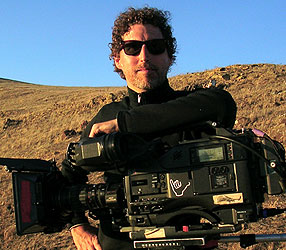
Kevin Bachar |
Send in your questions for Kevin Bachar, the producer and director of Kilauea: Mountain of Fire. After the premiere of the film on March 29, Kevin answers some of your questions here, on the NATURE Web site.
Kevin has produced several films for NATURE, including Sled Dogs: An Alaskan Epic, Tall Blondes, and What Females Want and Males Will Do. In addition to two Emmy nominations, his projects have won three Cindy Awards, three CINE Golden Eagles, a Film & Video Festival Gold Camera Award, Best Environmental Film at the Telluride Mountain Film Festival, and a Gold Jury Award from Worldfest Houston. To see Kevin and his team in action, check out the behind-the-scenes video for Kilauea: Mountain of Fire.
Submit your questions in the comments box below.
Here are some of your questions answered.
—
Quinton asks:
Mr. Bachar, I can’t wait to see the entire film. Volcanoes have always intrigued me. When I was watching the short preview clip, I noticed that this film has a very fresh perspective. How did you achieve this? Was that the greatest challenge you had in making this film?
Kevin Bachar says:
Dear Quinton,
Thank you for your comment. I hope you were able to watch the whole film on air. We did try to bring a fresh perspective by looking at the newest science used to monitor the volcano. We also tried to really put the viewer within the action with our film. The greatest challenge was trying to put ourselves in the best position to capture the volcano at its most active moments. Thanks for the question Quinton.
Kevin
—
Beth asks:
Awesome! When was this filmed?
Kevin says:
Dear Beth,
We filmed over a seven-month period from March 2008 through September 2008. Thank you for watching.
Kevin
—
Judy Brow asks:
Unbelievably awesome! I was glued to my chair, scared & fidgeting sure that you’d be boiled alive.How,if the water was so hot, could you dive in without protecting your head which was exposed!?? Judy.
Kevin says:
Dear Judy,
Thanks for the kind words. Paul Atkins the cinematographer who dove on the volcano was able to brave the hot water by beginning his dive far enough away and then approaching from deep enough under to avoid the scalding water. It also meant that he had to come up out of the water at the right spot to avoid being burnt. It was extremely dangerous. There are really only a handful of people who could do this dive and Paul is one of them.
Kevin
—
Lisa asks:
What month was the underwater filming done? That was amazing footage. Thank you for the efforts to share such a fascinating part of nature with us.
Kevin says:
Dear Lisa,
Thanks for watching. The underwater filming was done over a three-day period in March 2008. After that three-day period the ability to dive on the lava safely was lost. Luckily we were able to coordinate our shoot in time to bring back our amazing images.
Kevin
—
Jim asks:
You mentioned that the water was “scalding” hot. How hot is that? And, how far out does that super-heated water extend? When there are large differences in temperature, often an extreme current will form to exchange the heat for cooler waters. Was this the case here?
Kevin says:
Dear Jim,
From what I understand from Paul Atkins the cinematographer, the water was at least 100 degrees. I will find out from Paul how far the heated water extended. Thanks for watching and thanks for the question.
Kevin
—
Joanita Barnes asks:
What was the last name of “David” with the yellow jacket portion of the film. I worked on the Big Island years ago with him, but could not remember his last name. The film was great, kept me on the edge of my seat.
Kevin says:
Dear Joanita,
The wasp biologist’s last name was Foote, David Foote. Thanks for watching.
Kevin
—
Sharon Piscopo asks:
The VOG we have been experiencing on the island for the past year or so has become quite severe and is even a health hazard. Can you explain what has caused it.
Kevin says:
Dear Sharon,
The VOG or volcanic smog has been on the increase since the eruption of Halemaumau last year. This latest eruption on the summit of Kilauea has increased the dangerous output of VOG. It is best to consult with Hawaiian Volcano Observatory’s Web site to see what the status of VOG level is. Thanks.
Kevin
—
Patricia Graziano asks:
Fabulous job! My question is about the man who lives alone in the lone house standing from the ‘83 flow. Does he even have running water? I am assuming he has a generator for power. Does he really live with no other humans around and rely on two hour hikes to get supplies in a backpack? Are there officials that check on him periodically? Thanks again. We love the Big Island and found your documentary fascinating!
Kevin says:
Dear Patricia,
Thanks for the compliment. Jack does live alone in the house in Royal Gardens. He does have running water that he collects in cisterns on his property. He does have power through a generator and solar panels. And yes, he does do the two-hour hike for supplies when needed. People do look out for Jack, but as you can see he is more than able to look out for himself.
Kevin
—
Dante asks:
Our son is developing a love for volcanos – and earth science. We were in Hilo in 2008 with him, and visited the National Park, did hikes, and it is etched in his little 4 yr old memory. When did you start taking an interest in such things – and what can we do, to encourage and support his curiosity? This week at preschool- is “volcano art”.
Kevin says:
Dear Dante,
My only advice would be to keep on doing what you are doing. Your visit to Volcano National Park, the hikes and you watching this program are all great encouragements to your son. Thanks for watching.
Kevin