Have you always been so connected with animals?
Yes, I suppose I was one of those kids who was born a little congenital scientist or some such thing. I was obsessively drawn to other living things– often to the exclusion of all other priorities. My parents were, if not supportive, at least indulgent to my obsessions. And bless their hearts! They just laid down a linoleum floor in my bedroom, and the rule was: any critter is OK, as long as it stays in the bedroom or outside, it must be well fed and clean, and absolutely no poisonous snakes inside the house! I rarely kept my animals in cages and almost all slept with me in the bed. The list was endless. Big, small, mammal, bird or reptile. I think at one point I had a small bobcat, a gray squirrel, and a seven foot boa constrictor, all living in perfect harmony.
Where was the Florida Turkey piece filmed?
My Life as a Turkey was filmed on a large family ranch in south-central Florida. My original project was conducted adjacent to a National Forest and Wilderness Area southwest of Tallahassee in northern Florida. The ecology in the area of north Florida is very dense, swampy and jungle-like. The Ranch location was, in many ways, a very similar oak hammock ecology with sandy scrub-oak ridges. The plants and animals were basically the same with a few exceptions, however there was open “savannah/prairie” like cattle land which was much more photo-friendly. The north Florida location would have been more of a continuous wall of green. The ranch also afforded better logistic accommodations for the crew, with complete privacy for the turkeys. All the wild animals filmed in the documentary were wild residents with the exception of one or two of the snakes that were obtained from a local snake “Wrangler”.
Did you ever find out who the person was that left the eggs and do you think they were all from the same clutch?
Yes, I knew the fellow who brought me the eggs. He was actually an employee on a very large quail hunting preserve. The eggs were from two separate nests, which allowed me to immediately make discriminations between the family groups according to size, coloration and variations in subtle markings. For example, the color of the legs were distinctive at the time of hatching. Even the eggs looked slightly different in color and speckling. Overall the two family groups were quite different in appearance. And yes, I did have the experience of encountering two of my adult hens when they had 10 week old poults of their own. It was an awkward encounter in the forest where the hens recognized me and were quite unafraid, but of course their poults had never seen a human, and like all wild turkeys, were horrified at my sight and flew in panic. The mother hens were obviously confused but of course had to quickly follow their brood. A lady living miles away had one of my hens living on her place. The hen was relatively tame, would bring her young poults into her yard and garden, but again, the young poults were intolerant of the woman’s company.
Do you think the birds and especially Sweet Pea, were more vulnerable to predation being raised by a human rather than a real turkey mom? Perhaps in the way of being too trusting?
I have been very concerned about this familiarization/ habituation issue that would cause an animal that knows me to somehow be at greater risk from predation or other humans. In the case of the turkeys, I quickly found that 20 million years as a prey species has honed their survival skills to a razors edge and my proximity was essentially inconsequential in the face of any predator. As for other humans, I found that the turkeys were in fact suspicious of other people even at a great distance and could in fact ,with their keen eyes, discriminate between me and anyone else from a quarter of a mile! I have found these powers of discrimination as evident and perhaps even keener in mule deer.
Did you have a sense that the males from your two clutches of eggs might be segregating at all (i.e. hanging out more with genetic relatives)? Did you notice any traits of the males that were socially dominant?
I think Lovett Williams, et al. established or suggested that sibling male wild turkeys tend to stay fraternal throughout their lives– certainly in the first couple of years. That has been my observation as well. However, I think these bonds are somewhat tenuous and involve constant minor conflict to insure the dominance of one particular male. Mature brothers will often display beside an actively breeding dominant gobbler without ever suggesting that they would try to participate in breeding activity. I have photographed this phenomenon many times while concealed in blinds with wild spring flocks. It was not until I lived with the gobbler flock that I raised, that the more subtle dynamics of the male fraternity became obvious. These brotherly hierarchies are generally well established prior to maturity and are formed on the basis of innate individual aggressiveness as well as superior size and strength. A dominant gobbler was probably a dominant poult. Gobblers of course, rarely live to a ripe old age, and so “lone older gobblers” quickly become the norm, but it would be interesting to know how sibling gobblers would preserve their fraternity over many years. And as you probably know, old males will on occasion abstain from all Spring breeding activity and conflict, living a quiet solitary life. I have also observed on several occasions a younger “apprentice” jake, form attachments to an older lone gobbler. I don’t think a fraternal group would ever allow this, but if jake and older gobbler have each lost their family group, I think there is a mutual need for companionship that allows some sort of bond to occur. Conjecture of course.
Were you shocked that “turkey boy” attacked you or was that normal behavior for a tom turkey? Was it a territorial issue? Do you think Turkey Boy was hurt over you leaving?
Hand raised male turkeys have a history of eventually becoming aggressive towards humans. I always thought it might be a possibility– but I was still surprised that my buddy– Turkey Boy– wanted to harm me! It was not so much a territorial issue as just an unfortunate “male thing”.
Turkey Boy and I actually resolved our differences after his breeding season ended. The film had to abbreviate our rather complex relationship for the sake of time. Eventually Turkey Boy left on his own and I never saw him again, and I address this in the book in some detail. So, it was me who was hurt over HIS leaving. After all these years I still miss them. This film is hard for me to watch.
What are the top 3 surprises in your studies?
Top three surprises? Getting the eggs of course was the biggest surprise but at the top of the list would be the overwhelming complexity of these creatures that I encountered. I was already somewhat of a casual authority on these birds– but I found so many interesting surprises. In particular, an extraordinary intelligence characterized by true problem solving reason, and a consciousness that was undeniable, at all times conspicuous, and for me, humbling. It should come as no surprise to any of us, considering what we now know about the universe– the closer you look into reality, whether the microcosm or the macrocosm– whether the particle accelerator or the Hubble telescope– things don’t become less complex– and not just more complex but– infinitely more complex. Even the familiar laws of physics break down and no longer apply and we find ourselves searching for new models and paradigms to explain nature. So too with the nature of living things. We need to see the world once again, with new eyes. The wild turkeys have taught me to never see the world the same way again. You look at any living thing closely enough and sooner or later you realize the complexity is beyond comprehension.
If you could teach the turkeys a human thing, what would you teach? If you were to ask them one turkey question, what would you ask?
Wow, I don’t know of one thing wild turkeys could learn from us that would be useful or helpful. Stay away from the road? I still of course believe wild turkeys to be in many ways, a vastly superior creature. (not entirely tongue-in-cheek). One question I could ask them? What must it be like to exist in a state of complete wakefulness? To be the definition of Sentient. That’s got to be, at the very least, some serious fun!
Why do you think that people always seem surprised that animals show intelligence, reason, use tools, show affection and emotions?
As far as humans finding it difficult to recognize a higher order of experience in other creatures — First, most people honestly don’t have the contact and are not having opportunities to pay attention. We are way to busy just trying to keep it together. The good news bad news answer is, we are also “evolving” out of a darker consciousness, in which humans assumed they were completely removed from the natural world and were entitled to have absolute dominion over it. Even now, we refer to the earth as possessed of our “natural resources”– implying that the natural world is merely the repository of all things consumable by “man”. Humans are, as an evolutionary species, defined in part by an element of aggressive arrogance– highly adaptive for a small creature trying to employ reason rather than overwhelming physical prowess. Because obviously, intellegence is a double edged sword that can turn on us as we become paralyzed by recognizing our conspicuous vulnerability. The old, “none of us is getting out of this alive!” phenomenon. However, is it possible that this arrogance, as seen in the light of our very recent and now overwhelming lack of vulnerability, can and has become, more of an evolutionary artifact? Has it now become mal-adaptive and merely a highly destructive form of ignorance? The good news is, it is possible for us all to become wakeful– pay attention. I think we simply must now become a creature that is truly characterized by reason and consciousness– and perhaps we had better hurry.
What has it been like to reimmerse yourself into human society? Life with the turkeys seems so fulfilling and spiritual, I imagine it would be so difficult to be a part of the human world.
In fact it was rather difficult to re-enter my old life and culture. Living with the turkeys was a very intense emotional experience and yes, as you say, spiritual. I had some difficulty, for a year or two, trying to reintegrate and attach significance to other things. Perhaps like a touch of “PTSD”. I also experienced something very similar when I finally had to leave the mountain after several months living alone with the bighorn sheep above timberline in Wyoming. Living in a wilderness environment for months or years, tones and heightens your awareness. All the associated physical stress also raises the level of intensity. In both cases, the thought of having to return to my “normal” life and just having to be boring old me again was a dreadful notion. Who was it? Byron or someone who said, “I love not man the less but, nature more”, well it’s sort of like that I suppose.
Do you keep in contact with friends and family while doing your studies (via phone or online)?
Not really, and I have a fundamental dislike of the things– don’t know why. When I conducted the turkey study in the 90s, cell phones were not around yet. On the bighorn sheep study, cell phones would not work in a remote wilderness at that time. There is no question that a cell phone will save your life on occasion in the back country. I do carry one now in remote places, but refuse to ever turn it on, except in an emergency. Wilderness is more of a romantic notion than a reality anyway, and a fragile notion at that, so when I have a chance to fulfill the illusion, I would never choose to interrupt, or worse destroy, a magic that is so hard to achieve!
In this re-enactment, was it necessary to have a new brood of poults imprint on you and was it necessary to relive the entire year-plus experience with its intense immersion? Did you find that the “actor” birds naturally assumed the roles of the 1991 birds, one clingy, some adventurous, and so on, and finally one who hung around long enough to emphatically chase you away? Did you find that re-enacting this experience allowed you to have somewhat more detachment the second time around, knowing how the course of the project would unfold? Was the experience much changed by the presence of the cameras and camera operators?
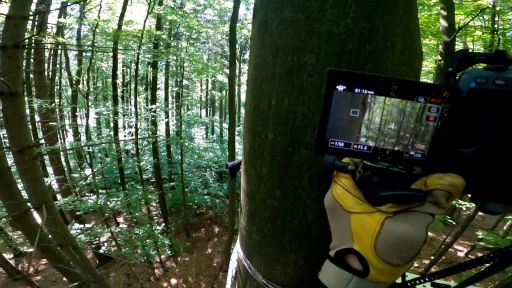
The American PBS version of the film tried to make it clear that this was a “reenactment”, as it says in the opening credits. In fact, the film was a genuine “recreation”– a complete replication of an experiment. It served as a vindication for me, in the sense that if an experiment cannot be replicated it is considered to be of no scientific merit. I of course, had no way of knowing if other young wild turkeys would behave as mine did. So, the simplified explanation is: After permitting was accomplished, the State of Florida trapped wild turkey hens, installed radio collars in Spring, robbed nests when they started laying ,and the backwoods savvy actor, Jeff Palmer incubated and began “imprinting” the eggs. (Hens, by the way, will nest a second time or even a third if they are unsuccessful on the first try.) My roll was strictly on-screen and off screen narration. The guy you see with the birds is always Jeff. They did in fact film for over a year in order to record all the development and life cycle. Wild turkey personalities vary wildly, so conveniently, there were similarities in the group that approximated a Sweet Pea and a Turkey Boy– and yes, poor Jeff got butt kicked by the Turkey Boy character. To my absolute amazement, this film crew– mostly legendary British cinematographer, Mark Smith– managed to actually recreate many events in the book that I considered impossible. He and Jeff were incredible! Jeff had to be with those poults, as I was, and my hat is off that they pulled this project off. I frankly was very pessimistic that this “recreation” was a possibility. I felt that I had been impossibly lucky in the first place and there was probably no way there luck would hold out as well. There were about a thousand things that could have gone wrong at any point along the way that would have killed the entire project. This was an heroic effort by Passion Pictures from London, PBS, BBC, and of course Jeff. And such lovely people– all. I will always be grateful.
The end of the film said you were now living with mule deer, how did you become involved with them?
Leslye and I live on an old historic ranch in Wyoming. We back up to the Wind River Mountains with unbounded wild lands surrounding us. The location is prehistoric winter range for mule deer (and so of course, mountain lions and other large predators), and our winter herd usually averages between 35 and 40 individuals. We have a number of year-round residents as well. I have been studying these deer and developing extraordinary relationships with them for over six years now. They have volunteered and chosen us, by the way. It is suggested that mule deer may have the largest brain of any deer in the world, as well as a number of other unique characteristics. They are in fact– profoundly intelligent, and capable of remarkable communication and have shown an overwhelming curiosity and willingness for human contact and interaction. We are multiple generations into this herd, they allow me to accompany them on excursions into the back country, and once again, I am being treated as just another, “perhaps rather odd”, member of the family. A book is in the works.
Are you filming your life with the bighorns?
There has been talk about a “bighorn” film. However, unlike the turkey documentary, it is a very complex story involving a large ecosystem with issues that are being studied and explored by a small army of gifted researchers. It has been suggested that a 50 minute documentary would not do justice to such a broad study. There have been rumblings about a full length feature film that could treat the subject matter more appropriately.
I personally think it would make a profoundly beautiful and timely film, with many compelling elements in a drop-dead-gorgeous place on the planet.
Are you going to have some turkey this Thanksgiving?
Well, I must say I would be a hypocrite if I disapproved of people eating turkey at Thanksgiving or any other time, as I was born into a hardcore turkey hunting family and culture. But, it’s probably obvious at this point, that I could never kill a wild turkey. And also, I must say I’m very conflicted and largely disapproving of the commercial meat industry in general. But, I live in Wyoming– defined in part by the livestock industry, and many people here don’t always rely on other people to kill their animals for them. So, as you can see, I’m skirting around the question. We are joining some friends for Thanksgiving and I’m guessing we’ll have elk tenderloin. I’ll rely heavily on the greens and cornbread!

Photo © David Allen
Photo © Joe Hutto