Visit Your Local PBS Station PBS Home PBS Home Programs A-Z TV Schedules Watch Video Support PBS Shop PBS Search PBS

Unforgettable Elephants
Interview: Filmmaker Martyn Colbeck

Award-winning filmmaker, Martyn Colbeck, has filmed wildlife for over 20 years, capturing our planet’s most incredible species with his lens. But it was Echo and her family of elephants that inspired Martyn to devote, not one, but three films to them. NATURE had the opportunity to find out how exactly this family captured his heart.

What were your first impressions among the elephants?

It was an amazing moment as I had never seen an African elephant before. In 1989, I went to Amboseli for the first time to film a segment for David Attenborough’s Trials of Life. The producer I was working with for that segment had known Cynthia Moss for some time and she had always wanted to go out with Cynthia to see her elephants.

So Cynthia took us out in the car into the park. In the middle of this herd of elephants, she stopped her car, turned off the engine and she just started to talk about this family of elephants. This was not Echo’s family by the way. But Cynthia just started describing each of these elephants. She knew each one. She just started talking to us about them as individuals. It was almost as if we were at a party and she was describing everyone to us.

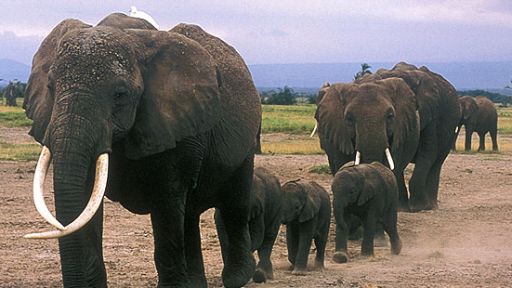
What was most amazing was that we were in the middle of Amboseli National Park. We were surrounded by Kilimanjaro. It was a stunning environment. But the individual personalities of the elephants were what stood out. It was quite a revelation to me.

How was Echo selected?

The producer’s idea was to do a film like an elephant soap opera. It would be a long-term project and was actually based on the documentary Seven up! The idea was that because elephants are so long-lived, we could follow them as the years passed.

Of course the next step was deciding who to follow. That was up to Cynthia. She was studying 53 elephant families in Amboseli. But Echo’s family came up at the top of the list, mainly because Echo was the first elephant who had been darted and radio collared back in 1972. So she was one of the first elephants studied. Also, Echo and her family were relatively predictable. And she was quite a homebody, which was a good thing. We didn’t want a family who would constantly be on the move and disappear on us through the filming. We couldn’t follow along with their life events if we lost them.

How crucial did it turn out that Cynthia had chosen Echo?

Echo is a remarkable elephant. She was an extremely good choice. She was around on a regular basis virtually every day. In order for the film to work, you just can’t go off and film a replacement family. Echo’s story is the main thread of the series.

But she was also a good choice because, over the years, the most extraordinary things happened to her and her family. For instance, in 1990, I had started to film in January and very little was happening with Echo’s family. But by February, the most incredible thing happened to Echo. She gave birth to a crippled calf. It was truly an extraordinary, very rare event. And this was the only time such a birth had been documented. And then we were able to film the most incredible events after that. We filmed them sleeping. We filmed the kidnapping.

What was Echo and her family’s perception of you?

It’s hard to know. I think there may have been an element of knowing that if we were around, there was a safety aspect. I think they accepted us as part of the family. Elephants have this extraordinary and complicated greeting display — they use this to greet each other when they’ve been apart. And occasionally, Echo actually greeted our car when we arrived. She would make a terrific greeting with the car. We spent so much time with her in that car; she must have recognized the style of the car.

Why are there misconceptions of elephants being raging creatures?

I think there is a misconception about elephants. And the incidents of elephant rage come from elephants in a disturbed population or in conflict with people. I’ve found that if you give them the benefit of the doubt, they are not generally an aggressive species. They are naturally gentle and trusting. When you betray that trust, they get aggressive. I’ve seen that with tourists. They drive fast. They rev up their engines. They act inappropriately. Some of this is to get a reaction from the elephants. And basically it just irritates the animals. Elephants are not aggressive animals. They have been made to be aggressive. Even if they are irritated with you, they will give you some warning. They are not like rhinos who just charge without warning and flatten you. If they do, there’s a historical reason — or a serious threat.

Do you think elephants can recognize people and understand their intentions?

I think they identify individuals. It is so hard to quantify though. Some scientists might be cynical. They would say you need real data. If you spend a lot of time with a particular animal — like I do with elephants — you will get a sense of what they’re thinking. There is a level of understanding with spending so much time with animals.

One of the things with filming elephants is you have to be able to anticipate behavior. You have to understand what they’re going to do. Not just acting on instinct. They are actually making a decision. I’ve seen instances of elephants having a discussion and clearly two elephants are disagreeing. And then one makes a decision and the other follows that. It is very interesting to watch. In order to know that, you have to know the individual. You have to have spent a lot of time with them.

How long are you out there shooting to document the life of an elephant family?

Each of the three Echo films took eight months to shoot. During those eight months, I would be out from dawn to dusk every day. Ideally one would film longer but budgets and other restrictions limit you. But of course, the longer amount of time you spend out there, the more likely you will capture unique events because we are actually distilling small bits of their behavior.

What was it like to be a character in this film?

It gave me the opportunity to tell people how I felt about elephants. Usually when you make a film, you have a narrator who is not involved in the film telling the story to the audience. But with this film, I had the chance to tell the story. It was quite nice to tell audiences that I’ve been with these elephants for 20 years. I’ve spent a lot of time with them. I know these animals. And this is how I feel about them. Of course it is slightly unnerving to put yourself on the line. But I had the benefit of expressing sentiments that scientists can’t.

Will there be another Echo film?

It’s an ongoing story. I don’t feel like I’ve completed the filming because these animals are so complex. I still look forward to spending time with them. We’re learning more about them all the time. They communicate on such complex levels, and we’re only scratching the surface. We’re sure to discover so much more. The more people understand about elephants, the more people understand how much they’re worth conserving.

Are elephants your favorite animals?

No doubt. They would have to be. I’ve done a lot of filming of primates as well. But elephants continue to surprise me. There is just so much more to learn.

   Print    Email    comments (19)

(29 votes)
Loading ... Loading ...
19 responses
Ted Schulze -- December 24th, 2008 at 2:29 am

Just unbeiveable. I wish I was younger and could do the same. I think we are to full of ourselves to think we are the only one’s (god whoever you belive in) loves only Humans. I belive you do not know your
god.

Marcie -- December 28th, 2008 at 11:30 pm

Thank you for this beautiful documentary. I watched in amazement and cried a couple of times – it was so touching and the filmmaker keeps the focus on the elephants, not on himself and his accomplishments. I appreciate him and PBS for making it all possible.

Natasha Maskell -- December 28th, 2008 at 11:58 pm

This film has captured my heart in seeing how intriguing these beautiful animals are. To tell the truth I’ve always considered them Intriguing, but have never had the opportunity to watch a family interact over a period of time. The 15+ years devoted by Martyn Colbeck is a generous gift of time that the majority of us would never be able to afford. What a selfless and charitable donation to bring us into the lives of these wonderful creatures that he obviously cares so much for.
To watch Echo and her growing family, the happiness and sorrow that they share, the comfort they give and the care they take with each other over their life span is remarkable. The fact that they return every year to a relative’s death site shows their emotion and thinking faculties. I became part of her family. Martyn’s commentary was absolutely necessary to understand the bonds. Really with out him doing the photography and the narrative it wouldn’t have given the depth of understanding conveyed in the film.
I thoroughly enjoyed the entrance into their lives and understanding their complexity a little more fully. What a brilliant glimpse into our Creator’s ingenuity. What a fantastic breath into their world. Thank you.

gina anson -- December 29th, 2008 at 1:07 am

I happen to fall upon your particular show and MAN, I am glad I did! I am such an animal lover and I was SO GLUED to the TV! It was such an AMAZING piece of work you did! I just don’t know how you can do it without completely breaking down when a family member dies, especially when you practically belong to them! I broke down when I watched but so loved what you reported on ~ THANK YOU for sharing! I just want to know how to purchase some of your FABULOUS photography?? Could someone email me with this information?

Walter and Hanni Kolouch -- December 29th, 2008 at 1:53 am

we have a longtime wish, to see Elephants up close, privat or with a very small group, is this possible, perhaps with Cynthia Moore???
Martyns Colbeck documentary was truly wonderful,such facinating Animals.

Thank you, Hanni Kolouch

Chad -- December 29th, 2008 at 2:09 am

I enjoyed this program, and I appreciated the insightful knowledge that can only be gained by someone who has spent many years, in the environment, gaining the trust of these great majestic, wild, animals. I can understand a viewer who would prefer that the narration is limited to simple observations, but I valued the personal experience that this filmmaker brings to this story.
We viewers could never understand the interrelations of mother and sisters assuming mothering roles with such compassion, as when death takes place, or when a calf is kidnapped, by another group, if we did not have the real life experience of the filmmaker to fill in with direct observations. I believe that those are rare or fine distinctions in understanding nature, and they evolve, that takes time, this director helps us to better understand the species, as well as these, individual animals.

We can always armchair direct what we believe the director should have done.
I am pleased that this director did it this way. If I wanted to make my own narration, I would turn down the audio. Then you can have editorial control of the story telling. Sadly, I believe you would have missed important, valuable, first hand knowledge, that is a central element of this great and moving story.

I believe it is a delicate balance, not easily achieved. Thank you, for this program.

Cheyenne Tiera -- December 29th, 2008 at 12:24 pm

Thank you, PBS, for sharing this beautiful experience with your viewers.
Martyn’s film confirm everything I know to be true about elephants and I’m so grateful for his skill and sensitivity. And to those who helped him.
How can I contact Martyn?

Sam -- December 30th, 2008 at 3:23 pm

Thank you for a great program – educational, captivating and great photography throughout the show. Your dedication, patience and understanding of elephant habits are exceptional. Plese consider a follow-up session.

Kim Biggane -- December 30th, 2008 at 8:18 pm

Well the only thing I can say is you did a wonderful job. It was the best Elephant documentary I have ever seen. i have Elephants every where in my house i just adore them from blankets to cups to cookie jars and obviously statues and pictures. They are the most wonderful animals God ever created. Thank You so much for this film.

Alison -- January 1st, 2009 at 3:26 pm

This was an amazing documentary about elephants. I have an anewed admiration for elephants and also an active interest of the current happenings of this family.

What happened to Enid’s calf after she died? Did this calf survive long after her death? Also was Echo’s son Ely ever seen again?
This documentary on Echo and her family does not feel complete, but perhaps it would never feel complete unless a life time of Echo’s existence was followed documented.

Carole -- January 3rd, 2009 at 6:53 pm

We stumbled on this just as the program was beginning and we were riveted to the TV the entire hour. I’d like to see the other two episodes on Echo and her clan. All through, I could not help thinking of an article in the NY Times Magazine about a year ago titled, “Are we making elephants crazy?” It was a staggering account of how the impact of man has unsettled these gentle creatures and how, in self defense, they have occasionally lashed out towards man. All the while, they have the same connection to us that we have with them–I’d recommend that article to anyone who loved this show, as we did.

DaveL -- January 4th, 2009 at 3:20 pm

This was an incredible documentary about one of my favorite animal species. We sat transfixed throughout the entire hour. Afterwards I immediately ran to my computer to make a donation to our local PBS station. Thank you, Martyn and everyone at PBS that helped bring this amazing film into our home.

David Thomas -- January 5th, 2009 at 2:08 am

Thank you Martyn.

Monica DeMeo -- January 5th, 2009 at 10:20 am

Moved to tears. Thank you Martyn and PBS for this most beautiful documentary.

Nancy -- January 5th, 2009 at 12:35 pm

I’ve always had a great admiration for elephant’s and this beautiful documentary says it all. Well done.

Gwen Eales -- January 6th, 2009 at 4:20 pm

Excellent documentary! I am a big fan of Cynthia Moss and purchased her earlier two films. I was very glad to view this new film on PBS. I hope Martyn does more films not only of elephants but other wildlife. I enjoyed listening to his comments.

Susan M -- January 18th, 2009 at 6:06 am

Truly inspiring film. Love the relationships depicted therein. Admired the photography. Watched some of it camera-in-hand… you’ll understand.

Andrea Cowart -- February 8th, 2009 at 9:54 pm

I love this episode and have it saved on my DVR. What a wonderful job you have, and a wonderful job you did. I am still a novice nature photographer, but this episode inspires me to do what I can to document and preserve that bit of nature in my own backyard and my community. I would love, someday to have an opportunity to go on a trip with someone like him and experience the same thing. Thank you for a beautiful story and the time you’ve given to both the elephants and us for this documentation.

Anthony Wayne -- November 16th, 2009 at 1:19 pm

Some things , you wait your whole life for . Other things make your
whole life worth waiting

post a comment
Please note that the THIRTEEN editorial staff reserves the right to not post comments it deems to be inappropriate and/or malicious in nature, as well as edit comments for length, clarity and fairness. No solicitations or advertisements will be allowed. Users may link to other Web sites relevant to discussion, but most often links to commercial Web sites will not be permitted.

Produced by THIRTEEN    ©2009 Educational Broadcasting Corporation. All rights reserved.

Major corporate support for Nature is provided by SC Johnson, Canon, CPB.