
In This Episode << SLIDE LEFT TO SEE ADDITIONAL SEGMENTS
Stem Cell Dilemmas
[MYPLAYLIST=9]
KIM LAWTON, guest anchor: New religious and ethical debates this week after President Barack Obama cleared the way for federal tax dollars to fund expanded embryonic stem cell research. Obama said funding such research is morally necessary because of the potential to find medical cures.
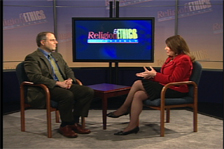
Kim Lawton and David Masci |
President BARACK OBAMA: As a person of faith, I believe we are called to care for each and work to ease human suffering. I believe we have been given the capacity and will to pursue this research and the humanity and conscience to do so responsibly.
LAWTON: The Catholic Church and several other religious groups oppose that research because it destroys the embryo, which they consider tantamount to killing an innocent human life.
Joining me with more is David Masci, senior research fellow at the Pew Forum on Religion & Public Life. David, how controversial is this within the religious community?
DAVID MASCI (Senior Fellow, Pew Forum on Religion & Public Life): Well, there are a range of different opinions in the American religious community. Jewish denominations and mainline Protestant churches, particularly more liberal mainline Protestant churches, support embryonic stem cell research. They say that embryos have intrinsic value and worth, but the incredible possibilities that stem cell research offer — cures for cancer and things like that —outweigh those concerns and considerations. On the other side, you have the Roman Catholic Church and you have more evangelical Protestant churches like the Southern Baptist Convention or the Missouri Synod Lutheran Church. These churches oppose embryonic stem cell research. They say an embryo was a person and a person has the right to life and you can’t take that life away, even for the best of reasons.
LAWTON: What about the people in the pews? Do they agree with the leadership of these institutions?
Mr. MASCI: White evangelical Protestants tend to support their churches’ positions on this, only 31 percent of evangelicals support embryonic stem cell research, so a substantial majority say no, we don’t want embryonic stem cell research. With Catholics it’s the other way around. Fifty-nine percent of American Catholics support embryonic stem cell research, which of course goes exactly against what the Church’s leadership is saying. Now when you ask Catholics who attend Mass regularly, weekly, whether they support embryonic stem cell research, that number drops to 46 percent. So people actually in the pews, people who are attending Roman Catholic services, they do — they are more likely to support their leadership’s views on this than Catholics as a whole.
LAWTON: What about the issue of adult stem cells? There are some opponents of embryonic stem cell research that say this is a way of getting the stems cells without destroying the embryo, and therefore it might be an ethical alternative. Is that indeed a viable alternative?
Mr. MASCI: It might be. I think that’s the right way to put it. Scientists tell us that they’ve made an enormous number of strides especially recently in this area. They’ve been able to reprogram skin cells, for example, to act like embryonic stem cells so that they can be used in all different kinds of ways. But scientists also say that these cells and embryonic stem cells, in both cases they’re not really ready for medical therapy yet. They haven’t reached the point where they feel confident that they can do all the things that they hope they can do. So their position—scientists are saying, you know, what we need to do is work in both areas, with adult stem cells and with embryonic stem cells. On the other hand, you have some opponents of embryonic stem cell research saying adult stem cells are clearly the way to go. They eliminate the ethical considerations, and given the advances that have been made recently it’s clear that that’s where we’re headed in terms of this therapy.
LAWTON: All right. David Masci, thank you very much.
Mr. MASCI: Thank you, Kim.


