|
|
 |
 |
| BUSH VS. GORE | |
 December 11, 2000  |
|
|
Legal scholars examine the arguments before the Supreme Court that could
decide the presidency.
|


|
|
MARGARET WARNER: And to help us decipher what we just heard, we turn to Cass Sunstein, a professor of law in political science at the University of Chicago, and two law professors who clerked for current members of this court: Heather Gerken of Harvard Law School, who clerked for Justice Souter; and John Yoo of Boalt Hall Law School at the University of California, Berkeley; he clerked for Clarence Thomas. Welcome all. |
|||||||||||||||||||
| Reading the justices | ||||||||||||||||||||
|
Cass Sunstein, what did you find most telling about the way the justices grilled these lawyers?
MARGARET WARNER: Heather Gerken, what jumped out at you?
MARGARET WARNER: And when you say the junior justices, you mean Breyer and Ginsburg and also Souter, who's not quite so junior? HEATHER GERKEN: Yes. They're not usually as active especially as on in the argument as they were today. Usually you see Justices Kennedy and O'Connor and the chief taking the lead in the argument. Today, instead, we saw Justices Ginsburg, Breyer and Souter, with Kennedy and O'Connor sort of sitting back and listening. Which suggests that the junior justices that they had a case to make for their more-senior colleagues. MARGARET WARNER: John Yoo, what jumped out at you?
The other thing I would point out was the jurisdictional argument, that's a second novel argument that was made that we didn't hear in the first case last week. That was this question whether because the Florida constitution only grants the right of review at the Florida Supreme Court, in the constitution itself, it's not part of the contest or protest statutes, whether it's actually a violation of federal law for the Florida Supreme Court to review what Judge Sauls did here and the trial court, and that as you heard on the excerpts sounded like one of the weaker arguments, but that is a novel argument and that there might be some Justices who would be interested in it because it would present a fairly clean, quick way to get out of the case for the five in the majority. |
|
|||||||||||||||||||
| Looking for unanimity | ||||||||||||||||||||
|
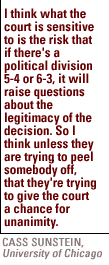
MARGARET WARNER: All right. Professor Sunstein, go back to this common standards of the lack of a common objective standard. Do you agree with Heather Gerken that some of the justices seemed to be -- looked like they were looking for a remedy that they might be able to peel off either Kennedy or O'Connor on? CASS SUNSTEIN: Absolutely. I think what the court is sensitive to is the risk that if there's a political division 5-4 or 6-3, it will raise questions about the legitimacy of the decision. So I think unless they are trying to peel somebody off, that they're trying to give the court a chance for unanimity. That's what those Justices seem interested in. MARGARET WARNER: And I noticed that Breyer, O'Connor and Souter all asked, well, what if we send it back to the circuit court and ask them to ask the secretary of state for a standard? How did you read that? CASS SUNSTEIN: Well, that I think is their very creative and intelligent effort to try to see if they can forge a compromise solution and get the court to be unanimous. The problem with that, the reason I think David Boies didn't jump at the chance, is that time is short. And if this compromise is adopted, it's a surprising partial legal victory for Gore in the sense that things continue. But it's not a terrific practical victory because the process won't easily be able to finish on time.
HEATHER GERKEN: Well, they're really hard to gauge. I mean, I think that one thing was clear from the argument, which is that they simply do not accept what Professor Yoo has called this novel jurisdictional argument. Justice Kennedy came right out at the beginning and said I just think that's a ridiculous argument. And Justice O'Connor immediately chimed in saying that she also disagreed with that view. So they're not going to accept the strong version of the Bush argument on Article II. They were a little bit fuzzier on the other questions. I thought that Justice Kennedy seemed less inclined to find any way to help Gore along in this process then Justice O'Conner, but, again, you really can't make general assessments of the justices just based on their questioning. MARGARET WARNER: I also wonder what you made of Justice O'Connor a couple of times talked about the lack or the failure of the Florida Supreme Court to respond. Now I should tell you that since we've gone on the air, the Florida Supreme Court has responded to this remand case that was sent to them by the US Supreme Court, ruling 6-1 that its earlier decision was based on long standing rules under state law, not under the state constitution. The Chief Justice Wells was the dissenter. But how did you interpret, I mean, what import did that have, her concern about that for the possible ruling? HEATHER GERKEN: I think that the United States Supreme Court is obviously concerned for an institutional reason about the idea of a state Supreme Court, effectively thumbing its nose at the United States Supreme Court. I actually don't think that's what happened here; I don't think that the state Supreme Court was acting in bad faith. I think that they probably just overlooked this problem and didn't really think about how they should deal with the question. But it upset Justice O'Connor because it seemed to her that the state Supreme Court was effectively ignoring what the United States Supreme Court said, and for institutional reasons that's a bad thing. But I don't think that's going to affect the way she evaluates the merits of the legal arguments here. She's a good justice, even if she's a little ticked off at the state Supreme Court. I think that it's unlikely that she's going to let that affect her evaluation of the merits of Bush's claims. MARGARET WARNER: Do you agree with that, John Yoo, that it didn't -- I'll just ask that -- do you agree with that, that in the end that's not an important issue?
|
|
|||||||||||||||||||
| Possible Supreme Court actions | ||||||||||||||||||||
|
MARGARET WARNER: Let me ask you, in line with that, how much authority does the US Supreme Court have to order some sweeping new solution, such as Souter was suggesting? I mean, can they bust the December 12 deadline? JOHN YOO: Well, that's the interesting thing. I think that's why in offering this compromise it's mostly a rear guard action for the four justices in the minority, because in order for them to intervene in the case in that way, to order that there actually be a more objective standard, they basically have to admit that they're not deferring to state courts interpreting stay law anymore, that this is a federal question and that federal courts have a right to intervene. So, it really is sort of a rear guard action on their part. Their ability to do it, I don't think the Supreme Court's actually going to announce a standard itself. I think that would be very surprising for this Supreme Court to do. The better action would be more to remand back to the trial court for some kind of determination. But that will, without a doubt, push it past the December 12 deadline, and then you're really going to look at this election being decided by congressional votes, which would in a way undermine the whole reason the court granted the stay in the first place.
CASS SUNSTEIN: Well, I think they'll want to do something that is as narrow and non-interventionist as possible. The qualification is that the only narrow noninterventionist decision might be narrower than a majority wants, or less legally based than a majority wants. So I think they really want, as our earlier decision showed, to take a minimal role in all this. But at this stage it's not clear they can do that. What the two other colleagues have discussed, that is the remand, would be the narrower one. But I don't know that a majority will do that in view of the fact that it extends the time. Florida might lose its electors by then in the sense that the safe harbor they got if they do it by December 12 would be lost. So that would make it pretty messy. MARGARET WARNER: Heather Gerken, how do you think the import of all this weighs on their deliberations? HEATHER GERKEN: I think it weighs very heavily on their deliberations. They have right now found themselves in the middle of partisan warfare, which is exactly the place that they don't want to be. And I think that all the Justices care deeply about their institutional legitimacy, so they're going to do everything they can to try to reach unanimity, or to the extent that they can reach unanimity, how to give you a very sound legal argument, so that even their critics, when they look at that decision can say, yes, that decision was rendered in good faith. I can accept that. I think that's just critical to the court in terms of the role it's going to play now and in the future. MARGARET WARNER: Do you see it that way, John Yoo? JOHN YOO: I actually think it's a little different. I think what the court has recognized is that probably are going to take a short term hit in terms of legitimacy. But I think they balanced that against whether they think it's in the best interest of the country to be able to end this tomorrow. I think they probably will issue a decision tomorrow, because if they issue one tomorrow, they still allow one of the candidates to meet the December 12 deadline, and I think they've made that cost-benefit analysis. And I think you've seen that in other cases, for example, the Casey abortion case and other cases like that. They've made similar cost benefit analyses and weighed that in favor of trying to heal national divisions instead of worrying about their short-term legitimacy. MARGARET WARNER: All right. Well, professors all three, thanks again. |
|
|||||||||||||||||||




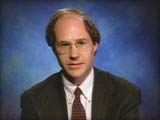 CASS
SUNSTEIN: There were two really striking things. One is the court was
going along two different tracks. One was whether the Florida court
had changed the law. I think there O'Connor and Kennedy indicated real
interest in that point of view. The other thing, even more of a surprise
I think, was the court's general interest in the equal protection argument,
which is a new and really inventive argument that would have broad implications
for the future. Even the justices who disagreed with the stay seemed
quite interested in that argument. And that was a bit of a surprise.
CASS
SUNSTEIN: There were two really striking things. One is the court was
going along two different tracks. One was whether the Florida court
had changed the law. I think there O'Connor and Kennedy indicated real
interest in that point of view. The other thing, even more of a surprise
I think, was the court's general interest in the equal protection argument,
which is a new and really inventive argument that would have broad implications
for the future. Even the justices who disagreed with the stay seemed
quite interested in that argument. And that was a bit of a surprise.
 HEATHER
GERKEN: I have to agree with Cass that the interest in the equal protection
argument was what most surprised me. And what was interesting about
it were two things. One, I thought it was one of Bush's weaker claims,
so I was surprised to see it get any interest from the justices. But
the second part that was interesting was that's where the junior justices
were heading. They were talking to the middle, talking to Justice O'Connor,
talking to Justice Kennedy, and they were using the equal protection
argument as a means to try to reach a compromise ground. Now, you can
never predict from the questions what they're going to do, but I thought
that was quite intriguing, because my guess is that the Gore camp --
if they could leave here with a loss on the equal protection argument
but a demand for further counting under some uniform standard, they
would consider that a big win in their case.
HEATHER
GERKEN: I have to agree with Cass that the interest in the equal protection
argument was what most surprised me. And what was interesting about
it were two things. One, I thought it was one of Bush's weaker claims,
so I was surprised to see it get any interest from the justices. But
the second part that was interesting was that's where the junior justices
were heading. They were talking to the middle, talking to Justice O'Connor,
talking to Justice Kennedy, and they were using the equal protection
argument as a means to try to reach a compromise ground. Now, you can
never predict from the questions what they're going to do, but I thought
that was quite intriguing, because my guess is that the Gore camp --
if they could leave here with a loss on the equal protection argument
but a demand for further counting under some uniform standard, they
would consider that a big win in their case.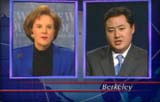 JOHN
YOO: I was really struck by both this question of what objective standard
would you use to count the votes. I interpreted it a little differently.
I thought that the four justices in the dissent were trying to reach
out and offer that out as a compromise. But I didn't see much interest
on the part of Justices O'Connor and Kennedy to bite on that as a compromise.
And, in fact, you might argue that Mr. Boies missed a big opportunity
when Justice Souter was asking him to give a standard that could be
objective and uniformly applied, and Mr. Boies just responded that that
was a really hard question.
JOHN
YOO: I was really struck by both this question of what objective standard
would you use to count the votes. I interpreted it a little differently.
I thought that the four justices in the dissent were trying to reach
out and offer that out as a compromise. But I didn't see much interest
on the part of Justices O'Connor and Kennedy to bite on that as a compromise.
And, in fact, you might argue that Mr. Boies missed a big opportunity
when Justice Souter was asking him to give a standard that could be
objective and uniformly applied, and Mr. Boies just responded that that
was a really hard question.  MARGARET
WARNER: Heather Gerken, what would be your -- what was your assessment,
if you took all the different issues, everything from whether the Florida
Supreme Court had made new law to the question of the standards, about
where Kennedy and O'Connor were?
MARGARET
WARNER: Heather Gerken, what would be your -- what was your assessment,
if you took all the different issues, everything from whether the Florida
Supreme Court had made new law to the question of the standards, about
where Kennedy and O'Connor were?  JOHN
YOO: Well, I think it actually is an important issue. I think that there
was some concern amongst the justices in their questioning today --
that the Florida Supreme Court did not take cognizance of some of the
hint that the Supreme Court tried to give them last time, one of them
being don't interpret state election laws to bump up into the December
12 deadline, and this was actually the one -- one of the few times you
heard Chief Justice Rehnquist ask questions, where he seemed slightly
incredulous that the Florida Supreme Court would actually think that
with all the appeals you could have and the recounts, that the Florida
Supreme Court honestly believed you could meet the December 12 deadline.
JOHN
YOO: Well, I think it actually is an important issue. I think that there
was some concern amongst the justices in their questioning today --
that the Florida Supreme Court did not take cognizance of some of the
hint that the Supreme Court tried to give them last time, one of them
being don't interpret state election laws to bump up into the December
12 deadline, and this was actually the one -- one of the few times you
heard Chief Justice Rehnquist ask questions, where he seemed slightly
incredulous that the Florida Supreme Court would actually think that
with all the appeals you could have and the recounts, that the Florida
Supreme Court honestly believed you could meet the December 12 deadline.
 MARGARET
WARNER: Cass Sunstein, comment on that if you would like, but this is
all involved with the remedy of question. This is the first time what
the US Supreme Court has ever been faced with a decision that could
choose the next President of the United States, and how do you think
that affects their deliberations and their search for a remedy?
MARGARET
WARNER: Cass Sunstein, comment on that if you would like, but this is
all involved with the remedy of question. This is the first time what
the US Supreme Court has ever been faced with a decision that could
choose the next President of the United States, and how do you think
that affects their deliberations and their search for a remedy?