
Breathing Exercises to Help Calm Young Children


Scream. Stomp. Slam. Quiet.
A fun morning of fort-building with her brother descended into a fight over duct tape, and my daughter fled to her room in tears. While I left her alone for a moment, I remembered a conversation I had with Dr. Marc Brackett, Director of the Yale Center for Emotional Intelligence. While adults often need wide space to recover when they are in a bad mood, he said, you always have to follow up with kids. They are still learning how to understand and manage their emotions, and it is a parent’s “moral obligation to know what your child is feeling and to support them in developing healthy strategies.”
When I knocked and walked into my daughter’s room, all of her pillows and stuffed animals had been thrown to the floor. It was a good reflection of what was happening on the inside: an emotional storm was passing through! I knew once the storm passed — and it did — I could help her talk through what had happened.
So how do we support our kids during these storms? And what can we do during calm moments to strengthen their emotional toolkit?
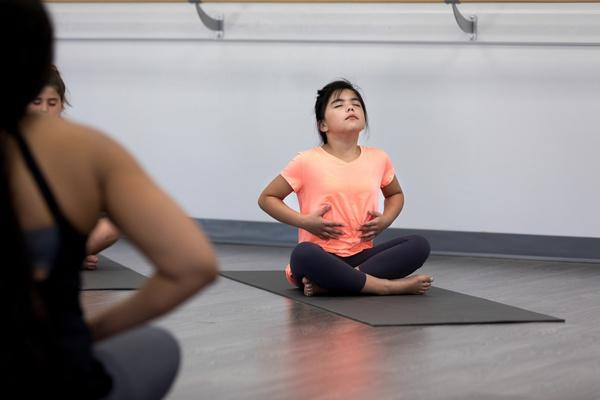
The most foundational technique is deep breathing. When we are stressed or upset, our heart rate increases and our breath becomes more rapid and shallow. We enter “fight or flight” mode. And all parents know that it’s almost impossible to reason with kids when they are in this mode!
But when we take deep breaths, we send a message back to the brain: It’s okay to settle down. Mindful breathing can calm the storm a little faster.
Life’s stressful moments give us an opportunity to teach our kids mindfulness strategies — and practice these strategies with them. All children have times when they become overwhelmed, overloaded or overstimulated. Think of mindfulness as a method of pressing the “pause button,” allowing kids to regroup and eventually re-enter a situation with greater calm.
Here are 10 tips for helping kids practice breathing and emotional mindfulness:
- In calm moments, lie down together and practice belly breathing — outlined step-by-step here. Along with Elmo on Sesame Street, sing this catchy song to work on belly breathing to relax.
- With your child, try pretending your fingers are birthday candles and blow them out one by one. This prompts them to take a breath in and then breathe out forcefully through the mouth.
- Try using a “breathing buddy” with your child: Lay on your back, put a favorite stuffed animal on your tummy, and watch that animal slowly move up and down as you inhale and exhale. Do this together — it’s playful and helpful for the whole family.
- Learn songs to help remember strategies! Watch Daniel Tiger's Neighborhood together, and then use the strategy song, “When you feel so mad that you want to roar, take a deep breath and count to four.” Here’s another helpful Daniel Tiger strategy song for calming down: “Give a squeeze, nice and slow… Take a deep breath, let it go.” Watch how Daniel uses this song to learn to be calm on the trolley.
- Counting can help young kids focus their mind on breathing and distract them from stressors. Try “square breathing”: Breath in to the count of four. Hold the breath to the count of four. Breath out to the count of four. Then hold to the count of four. Repeat. You can also practice counting backwards from five — a strategy Peg from Peg + Cat uses to help her when she’s “totally freaking out.”
- Make a glitter jar to practice being calm! When things become too much for your little one, pull out this mindfulness jar, shake it up, and watch the glitter settle together.
- When your child’s emotional glitter settles, practice naming the emotions they were feeling and identifying what prompted them. For example, “My friend took my toy, and that’s why I got mad” or “A big dog came close to me and I got scared.”
- During calm times, read books about emotions to increase your child’s emotions vocabulary. And then create your own “Feelings Word Book.”
- As parents, we can also get curious about what leads up to meltdowns — and model this strategy for our kids. Try asking these four questions: Is my child hungry? Is my child tired? Is my child overstimulated? Does my child need to move their body or engage in a calming activity? Help them see the connection between taking care of their body and their emotions. You might say, “Sometimes when I’m tired, I can get cranky” or “Sometimes when I feel frustrated, it’s my body telling me I need a snack” or “I feel good when I move my body!”
- Remind kids that all emotions are normal. Everyone feels mad sometimes. Everyone feels sad sometimes. Everyone feels scared sometimes. And adults are always here to help when they have big feelings.
 Author: