
Celebrate Earth Day With Nature Cat’s Daisy’s Garden


Earth Day is this month, and we will do our part! Around the world, on April 22, people often celebrate Earth Day by planting trees, picking up litter, or heading outdoors to visit a nearby park or another natural place. Some even make long-term Earth Day goals to take action over time to help the environment.
Those long-term goals are what we strive to portray in Nature Cat’s world. We see our characters routinely learning about and looking for ways to minimize their impact on the natural world and all of the living things it supports. In our Earth Day two-parter (see “Earth Day Today” and “Earth Day Every Day”), the gang discovers the harmful effects of plastic bags on the environment and starts a campaign for using reusable bags. The message: Finding ways to celebrate and protect the Earth every day is a satisfying and attainable goal for even our youngest viewers. (Learn how to make a reusable bag from a t-shirt.)
With that in mind, here are some ideas to learn about gardening and recycling through the lens of Daisy’s garden from Nature Cat.
Onward and garden-ward!
A garden — whether it’s in a window box or a backyard plot — is a home, a food factory, a recycling center and an energy producer. For three to four seasons a year, a working garden bustles with activity. Even when it’s quiet, or dormant, it is still a living ecosystem waiting for warmer weather to return, while providing a safe habitat for hibernating insects (or their eggs), reptiles, amphibians and many other living things.
For those who grow vegetables, this is the time of year when peas, radishes, spinach and other hardy spring vegetables are growing. Young children love to see these plants push up through the soil — keep an eye on the plants as they mature into food they can eat right from the ground. For anyone who has not planted this year, try celebrating Earth Day by growing sprouts in a mason jar. Children will be fascinated as they watch the beans sprout and grow in the jar without any soil. And they will likely discover a joy in eating homegrown food that makes wasting it feel especially wrong.
Where does our food come from?
Many children think their food comes from the store. But did the food grow at the store? This is a good time to help children think about more of the food’s journey.
For example, some children love to drink a glass of milk. They might know milk comes from a cow, but who raises the cow and provides her with food and water? Who milks the cow and then bottles the milk? And then who trucks the milk to the store for purchase? These are just a few steps that illustrate the hard work and energy expended for the glass of milk. Another Earth Day activity: Diagram milk’s journey from farm to glass.
Where does food go that isn’t eaten?
In the United States, as much as 40 percent of all food produced is discarded. Food is being wasted at home, in restaurants, supermarkets, on the farm and in school cafeterias. Young children are already learning about matching portion sizes with what their stomachs can handle. They are also ready to learn how food gets onto their plates and where their unfinished food goes when they put it in the trash, helping to motivate less wasteful eating habits.
Though composting — collecting organic matter like banana peels, coffee grounds, vegetable scraps into a container and either letting it turn into soil nutrients — is becoming more common, most of food waste heads for the landfill. So not only is the food not being eaten by people, it’s also not being eaten by animals or turned into a source of organic nutrients for the soil.
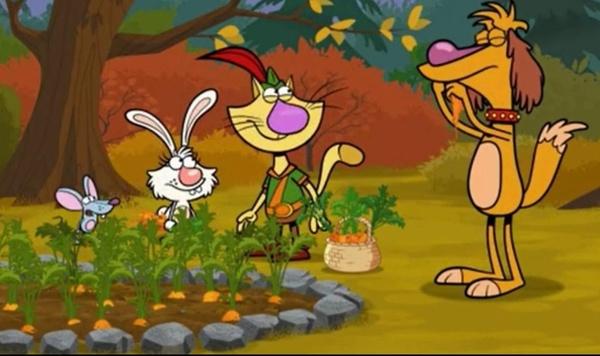
Let’s return to Daisy’s garden. When Nature Cat’s Daisy’s plants wither in the winter, she leaves them to decompose and feed the soil and next spring’s generation of plants. She also composts. A compost makes it possible for organic material to decompose and turn into humus, also known as the organic matter in soil. Humus can then be mixed in with the soil of houseplants or in a garden. Check out our Nature Cat DIY compost activity, which shows children the process first hand and is a stepping stone to incorporating composting into daily routines.
What about imperfect produce?
There is another component to food waste: imperfect produce. In the aisles of the supermarket, the fruits and vegetables we see are nearly perfect, with shiny skins and uniform shapes. Children (and adults) often come to expect that this is how all produce should look. But what about produce that doesn’t meet these perfection standards? In the best-case scenarios, it feeds livestock, or is composted, chopped up and used in prepared foods, donated to food pantries or turned over to feed the soil for next year’s crops. In the worst case, it heads for the landfill.
Back to Daisy’s garden: In our episode “Imperfect Produce,” we see that plants can produce their fruits and vegetables in a variety of shapes and sizes with flaws that may impact appearance, but not taste!
Thinking about Earth Day projects through the lens of Daisy’s garden allows children to participate in thoughtful discussions and take the opportunity to examine their own behaviors around food — an important experience as we become comfortable developing sustainable behaviors and embracing the “Earth Day is every day” concept.
 Author:
Dive into the great outdoors with Nature Cat and his fun-loving crew of animal pals.