
Celebrating Lunar New Year With Family Traditions


Every year, my family rings in the new year twice — once on Jan. 1, and again a month later, for Lunar New Year.
Lunar New Year follows the lunar calendar — in 2022 it landed on Feb. 1st — and is celebrated by millions of people around the globe, particularly in Asian countries such as China, Korea, and Vietnam. Growing up, my Chinese American family’s traditions included cleaning the house before new year’s day. We’d “sweep out” the past year’s bad luck so we could welcome in the coming year’s good luck. It’s a superstition that I’ve continued with my kids — providing some motivation to pick up their toys.
My family’s practices reflect just one way to usher in the new year. I reached out to five Asian American children’s book authors and asked them to share how they celebrate. As we ring in the new year, you can incorporate these fun customs into your festivities.
Enjoy family time.
Jane Park, author of Juna's Jar and the forthcoming Juna and Appa, recalls waking up early to do sehbeh, a formal bow and greeting done by Koreans. “It had to be the first thing you do on the first day of the New Year,” Park said. “So I'd wake up, put on my hanbok, and do the formal bows to my grandmother and to my parents. Our family friends would also come by in the mornings to bow and give New Year greetings to my grandmother.”
As a child, Bao Phi, author of A Different Pond and the upcoming You Are Life, celebrated Tet, the Vietnamese Lunar New Year, with his family and the Vietnamese community. Sometimes, they’d rent out a large space. “There would be music, skits, dance, and poetry recitals,” he said.
Bring in good luck.
Oranges symbolize good luck in Chinese custom. Round and bright, the fruit resembles gold, which is why you’ll see a lot of oranges during Lunar New Year. One of Andrea Wang’s favorite memories as a child was when her mom would save the orange peels and scatter them in her bath. “What I really loved was the way the air and water were fragrant from the orange oils,” said Wang, author of The Nian Monster, The Many Meanings of Meilan and Watercress.
Growing up in a Filipino American family, Mae Respicio’s parents had superstitious rituals around the house, which she has carried on with her family. “We usually keep a bowl of round fruit on the table, we don’t spend money on New Year’s day, and I make my kids open all of the doors and windows to let in good luck and prosperity,” said Respicio, author of childrens' books, including The House That Lou Built, which won an Asian Pacific American Libraries Association Honor Award.
Not everyone in Thailand observes the Lunar New Year, said author and illustrator Dow Phumiruk. But millions of people in Thailand are of Chinese heritage, including Phumiruk’s father's family, so they celebrate both Lunar New Year and Songkran, the Thai New Year, in April. On Lunar New Year, “one of the princesses of Thailand will visit a temple to make merit, which is like praying for good luck,” said Phumiruk, who wrote Mela and the Elephant, a new Thai fable. “Other people will go to the temple as well to do the same.”
Spread the wealth.
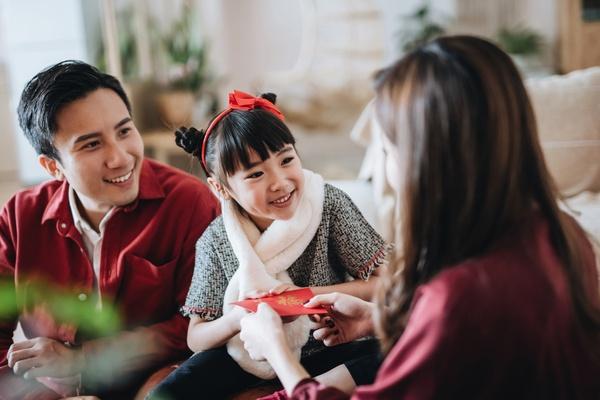
In the episode “Curious George and the Dragon Dance” in “Curious George,” George’s friend Lily receives a red envelope with money from her mother. Phumiruk’s husband is from Hong Kong, so their family passes out red envelopes, too. “The oldest members give the red envelopes to the younger members,” she said.
Feast on food.
“We prepare pancit, which is a Chinese-influenced, Filipino long-noodle dish to help usher in good health and long life,” said Respicio. “There are different versions of this dish, but I stir fry mine with a lot of thinly sliced vegetables and try to prepare it with love — the way my mom did! It tastes like home and childhood to me.”
Wang grew up in Ohio, where traditional Chinese foods were hard to come by at the time. For Lunar New Year, her mother would make red bean buns, also known as dou shao bao. A time-consuming process, her mother would soak and mash the beans, then mix in sugar to form a paste. Wang would roll out dough, and fill it with the paste. Nowadays, red bean buns bring a wave of nostalgia. “They remind me of my parents,” she said.
Phi also remembers his mother’s cooking. His mom made bánh chưng, a square, cake-like Vietnamese dish made of sticky rice and layers of mung bean and salted pork. “My mom used to make really good ones,” he said. “She'd wrap it up and put it in a giant thin-walled steamer on the stove.”
Park prepares tteok mandu guk, rice cake and dumplings soup, for her kids. “My mom still asks if we ate tteokguk on New Year’s Day and I didn't realize until recently that even asking that question is a Korean tradition: How many bowls of tteokguk have you had?” she said. “This is because in Korea your age changes on New Year's Day, not on your birthday, after you've eaten your bowl of tteokguk.”
Watch the parade.
Today, the Lunar New Year Parade is held in cities across the United States, featuring lion and dragon dancers, acrobats, and music. Curious George takes part when he helps Lily perform the dragon dance for the Chinese New Year parade. And in “Let’s Go Luna!,” the crew travels to Beijing, where they perform the dragon dance — and help Andy find some good luck. “My favorite childhood memories of Lunar New Year are going to San Francisco to watch the festival and parade,” said Respicio. “I remember being enthralled by all of the colors, sounds, music, dancers, and crowds — something interesting to look at from every direction. We’d spend the day in Chinatown and it always felt like a special time with family.”
Explore More
Learn more about Lunar New Year and continue your celebration by making a paper lantern, a dragon puppet, or a rattle drum.
 Author: