



On "Sesame Street:" Embracing Mistakes and Not Giving Up


One of the greatest joys of parenting is taking the time when your young children invite you to join in their play. As you follow their lead and enrich their learning through play, you get a front row seat into how your child thinks, creates, and responds to challenges or mistakes.
One of my fondest memories of playing with my son, Lucas, was when he was 3 years old, and we would build corrals and houses for his large collection of plastic animals. Lucas loved playing with his animals and making different structures using blocks, plastic tiles, and cardboard. As he gathered his animals of different sizes, he thought about which animals would go together, where he would place them, and what structures he would build. Throughout his play, he talked out loud, giving me insight into his plans — how he was using the different materials to build with, what he hoped to build for each set of animals, and how he was feeling when he couldn’t get it just right or when a structure collapsed. With each attempt, I observed (and at times heard) how he was thinking about each placement, only to learn that a certain animal would not fit or that the wall was not stable. At first, he took these failed attempts in stride, but after a series of mishaps, his frustration would grow to the point where he was ready to give up.
As we developed the curriculum for Sesame Street’s Season 50, The Power of Possibilities: Embracing Oops and Aha’s, we learned the importance of building children’s confidence as learners by encouraging them to be independent problem-solvers and to persevere when making mistakes or facing challenges. Through play, children can experience the joys of learning through failed attempts while building core school readiness skills such as focused attention on a task, shifting their attention when needed to think about other possible solutions, and resiliency skills by persevering and not giving up.
Yes, I could have swooped in and helped Lucas build the structure, but if I did so, he would rely on me every time he faced a challenge or made a mistake. As parents, we need to foster and build our children’s resiliency skills by letting them know that it’s OK to make mistakes or to be unsuccessful at a task at first. Thinking positively (taking risks in your thinking, trying new things), persevering (not giving up, continuing to try), and reflecting on what was learned with each attempt or mistake contributes to a child’s self-confidence as a learner and builds a positive attitude towards learning.
Children need to feel safe and secure, so as you play together, encourage your child to keep trying and let them know that even if they cannot do it yet, with further trial and error and practice, they will be successful. And at that moment of success, when your child says, “I did it!” or “I did it all by myself,” their expression of pride and joy is priceless. Each of these moments builds your child’s confidence as a learner and develops a positive attitude toward learning new things sparked by their wonder and curiosity.
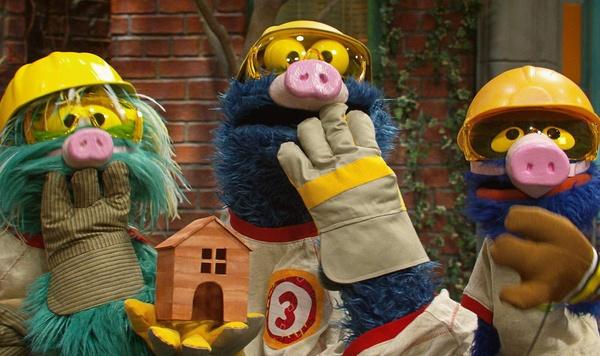
In one of the Sesame Street episodes, “Pigs for Another Day,” Grover, Cookie Monster, and Rosita fill in at the Three Pigs Construction Company to build a doghouse for Chris’ dog friend, Virgil. As inexperienced builders, they make lots of mistakes. First, they don’t follow the design plan, then they build it without a door, and then it is too small for Virgil’s size. With each failure, Grover is ready to give up, but Rosita reminds him that mistakes happen when building things, and we must keep trying! In the end, they build a doghouse just the right size, the team is proud of their accomplishment, and Chris and Virgil are delighted!
With encouragement, a child can learn perseverance, self-confidence, and positive thinking. So, the next time your child faces a challenge or makes a mistake, model positive approaches to learning by using the following phrases of encouragement:
- Keep trying!
- You can do it!
- Don’t give up!
- It’s OK to make mistakes.
- I have an idea. What if…
- You did it!
Here are some ideas for modeling a positive mindset:
- When the elephants and giraffes don’t fit in the house (the mistake), you can suggest, “What if we use these blocks to measure how wide and tall these animals are, and then we can build the right size house for them?”
- When you make a mistake, narrate out loud what you did (the mistake) and then what you learned from the mistake. An example of this is if you leave out an ingredient while cooking or baking. You might say, “Oh, I was making blueberry muffins, but I forgot to put in the blueberries. Next time, I will follow the recipe.”
- When frustration builds because mistakes or failures keep happening when learning a new skill, it’s OK to take a break and focus on a different activity to manage the big feeling. You can say, “How about you take a break, and you can try again later when you are less frustrated?”
Here are some resources to help your child develop perseverance and positive thinking:
- Sing:
- “Oops, Whoops, Wait, Ah Ha!” from Maren Morris on Sesame Street
- “Don’t Give Up” from Bruno Mars on Sesame Street
- Read:
- Bouncing Back with Big Bird: A book about resilience.
- Keep Trying with Abby: A book about persistence.
- Beautiful Oops, by Barney Saltzberg: A book about making a mistake and having something beautiful come out of it.
- The Big Orange Splot, by Daniel Pinkwater: A book about figuring out that a mistake can lead to a positive outcome.
In time, your children will have a positive mindset (I can’t do it yet, but I will if I keep trying) and you will get to witness a change in their attitude and approaches to learning!
 Author: