
“Rosie’s Rules” Combines Culture, Curiosity, and Comedy


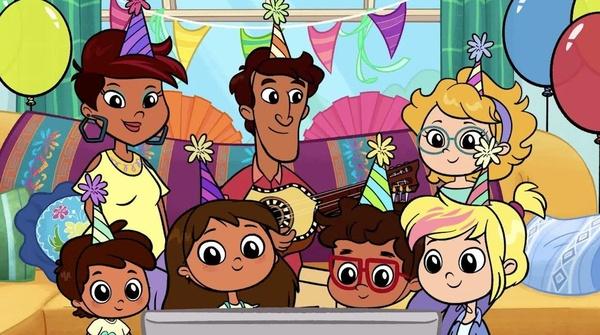
“Rosie’s Rules,” a new animated series on PBS KIDS, welcomes preschoolers and parents into a vibrant community where Rosie Fuentes, a spunky five-year-old, is learning the world's rules, one preschool adventure (and sometimes, misstep) at a time. “Rosie’s Rules” invites young kids to explore how they fit into their families, local communities and broader worlds by featuring dynamic, diverse characters and (my kids’ favorite) lots of laughs!
As a parent, I immediately fell in love with how well Rosie embodies the funny, endearing quirks of a determined, curious young child who wants to learn (and do) things themselves. Raising four kids has taught me that preschoolers are a curious (and energetic!) bunch who often find themselves wanting to know more. Young children tend to get into hilarious hijinks — just like Rosie, a bilingual Mexican American girl from suburban Texas who is just beginning to learn about how the world around her works.
To get a behind-the-scenes look at what makes Rosie, her family, and their relationships and adventures so relatable (and what sets them apart, too), I talked with show creator and executive producer Jennifer Hamburg (whose work experience includes “Daniel Tiger’s Neighborhood,” “Super Why!,” “Pinkalicious & Peterrific.” and “Doc McStuffin”) and executive producer Mariana Díaz-Wionczek, Ph.D., (who has worked on shows like “Dora the Explorer,” “Go Diego Go!,” and “Alma’s Way”).
“Rosie’s Rules” is a family-centered show.
“Jennifer and I always like to talk about the family,” Díaz-Wionczek says. “It was very important to us to depict and develop a family that felt very true, complex, and layered so that all families watching could relate — because all families are complex and layered.”
As a child , Díaz-Wionczek didn’t see herself represented much on TV. Now a parent, she hopes many children, including her own, will see themselves in Rosie’s family (and their racially and ethnically diverse community members). “Seeing yourself and aspects of your reality on TV builds self-esteem and a sense of identity as you're developing as a child,” Díaz-Wionczek says.
“Rosie’s Rules” helps all kids to see how big the world is. Díaz-Wionczek says that representation benefits everyone, reminding young children that “there are realities that are around them that they might not be that aware of. So they're going to be seeing things that are part of our world that they might not have immediate contact with.”
“Rosie’s Rules” honors blended family cultures.
Rosie is emerging bilingual (she speaks Spanish and English) and bicultural (her mom hails from rural Wisconsin, and her dad Papá is originally from Mexico City). To round out the family, we get to meet Tía Margarita, Rosie’s aunt, who is a chef and owns a restaurant, and Javi, who is Rosie’s cousin.
While Rosie and her parents (and younger brother Iggy and older half sister Crystal) live in suburban Texas, Rosie regularly video calls Abuela (her grandma), who lives in Mexico City. We get to see glimpses of Abuela living her active lifestyle — and even Abuela’s friends who are inspired by people in Díaz-Wionczek’s life.
“There's a lot of me in the show,” Díaz-Wionczek says. “In every single episode, we touch base with Rosie's Abuela, who lives in Mexico City, which provides a window into where I grew up.”
To make the show authentic and as culturally representative as possible, Díaz-Wionczek merges her life experience with her cultural, educational, and bilingual expertise in “Rosie’s Rules.” “We use and reuse catchphrases in both English and Spanish, so the kids watching get to learn the meaning of those phrases,” Díaz-Wionczek. “Some of these phrases are quite common in Mexico.”
For example, when Abuela and Rosie end their video calls, Abuela’s go-to send off is, “Adiós, granito de arroz.” Rosie’s response? “Chao, bacalao.” Viewers will also get familiar with Rosie’s “¡Vamos a ver!,” which she exclaims when she’s ready to figure out a solution to a problem. And when she thinks something is awesome, she shouts,”¡órale!”
The show invites children to meet Rosie's neighbors from various backgrounds and cultures, too. Kind, civically-minded neighbors like Baker Calvin, Maya, and Mr. and Mrs. Liu are highly involved in the community and sometimes play a role in helping Rosie figure things out.
“Rosie’s Rules” contains laugh-out-loud comedy
Emmy Award-winning writer and children’s book author Hamburg is a veteran of the children’s television industry. She has approached “Rosie’s Rules” a bit like she would a sitcom.
In fact, comedy is a key ingredient of “Rosie’s Rules.”
Hamburg calls Rosie’s misunderstandings (like thinking she can put stamps on her cat to send it in the mail or that food magically appears in the refrigerator) comic chaos. “I wanted to incorporate joyfulness and a sense of humor,” she says, “Rosie’s not afraid to get messy, make mistakes, and take a step back to say, ‘Oh, maybe that wasn’t the best idea.’ She’s resilient.”
Hamburg and Díaz-Wionczek have a tough time choosing their most beloved episodes but agree that Rosie’s adventure in learning about family roles and dynamics is an instant favorite for them both. When Rosie finds out that there’s a surprise happening for a “sister” in the family, she assumes it’s for Crystal, her 12-year-old sister. Many antics ensue, and at the end of the episode, Rosie is shocked to discover that moms can be sisters, too!
She hopes that kids will be able to relate to Rosie’s antics — and that humor will grab children’s attention and engage young viewers, helping them learn how social studies is a part of their daily lives.
“Rosie’s Rules” provides engaging learning moments
It’s not just fun (though there is plenty of it!) — the curriculum on “Rosie’s Rules” sets it apart. “Rosie’s Rules” explores what preschoolers think they know about the way the world works and then guides them to answer their own questions through curiosity and discovery. For example, when Rosie wants to send mail to Abuela, she realizes she isn’t quite sure how the mail system works. By asking questions — and through trial and error — she figures out that mail is not delivered by a wizard and you definitely cannot mail a cat to Mexico!
“The bigger picture is once you know the little things, you can extend your learning,” Hamburg says. “Keeping it authentic and real is key.”
Rosie experiences a lot of trial and error as she figures out the answers to the questions she finds captivating and mystifying. Rosie’s a-ha moments (and the rules she turns her discoveries into) can help shed light on things kids watching might be wondering about, too. “We treat these as mini discoveries and build full stories, meeting the kids where they are with what they do and do not know, ” Hamburg says.
Rosie’s home, also inspired by Díaz-Wionczek’s home, is also filled with reminders that social studies is all around us. In the show, viewers can spy elements like maps on the walls or an address on the door to help young children connect social studies concepts to their daily lives.
Music is part of every episode, too. Rosie sings her catchy “I’ve Gotta Know” song to begin each story and ends with a celebration tune summarizing what she’s learned.
Young kids are figuring out how things work — and why. You can almost see the wheels in their head turning as they learn what the world is like beyond their immediate families and circumstances — and this inquisitiveness is something Rosie embodies so well. Both Hamburg and Díaz-Wionczek are excited to introduce families to Rosie and the engaging (and comical) cast of characters on “Rosie’s Rules:” “I hope that they love it — and that they laugh,” Díaz-Wionczek says.
 Author: