
Tips for Doing Math Around Your Home


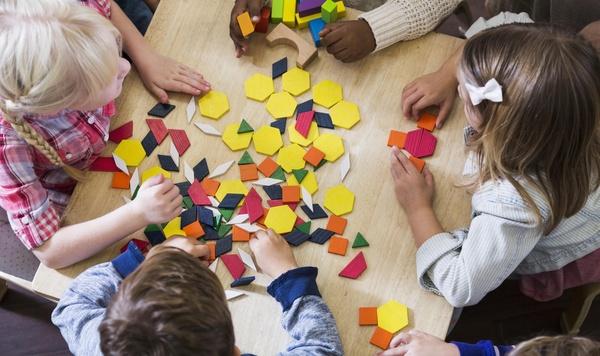
Your child is a budding mathematician — full of wonder about how the world works, noticing patterns around them, and solving problems. Parents and caregivers play an important role by helping your child learn math, even before they start school!
Math is all around us, whether we are playing a game outside, cooking in the kitchen, pushing a shopping cart through the grocery store, or even playing with toys at home. There are many things you can do, both inside and outside, with everyday objects or things you see around you to foster your child’s love of math. By talking about math together through play and conversations you are helping build the foundation for lifelong learning, discovery, and curiosity.
1 Play with numbers.
You may have noticed your child is able to count to 10. Perhaps even to 100 or counting by 10s. But have you ever wondered if they have a deeper understanding of what numbers and quantities represent? One way to play with numbers is to represent them in different ways. Instead of holding up 5 fingers with one hand, try holding up two on one and three on another and asking, “How many fingers do I have up?” This helps children start manipulating numbers and recognizing that numbers can appear in many different ways. Then ask them to do the same, “Can you show me another way to make 5 with your hands?”
Play with numbers:
- George’s Busy Day: Count flowers in the garden with Curious George in this game.
- Count Ladybug Spots With Your Child: Create this hands-on activity to explore counting while creating art.
- Vegetable Harvest: For older kids, play this digital game about counting vegetables and then matching the quantity.
2 Find patterns around us.
There are many types of patterns from things we see, like colors and shapes, to sounds and movements we make. Noticing and creating patterns is a skill that your child can work on as you play together. Repeating different shapes (circle, square, square, circle, square, square) or colors (purple, yellow, purple, yellow) are a great way to explore patterns. Try gathering up some small objects around the house (rubber bands, paper clips, crayons, bottle caps, etc.) and make a pattern. Ask your child to identify what the repeating pattern is based on the shape or color of the objects you use. Then have them cover their eyes and take one thing away. Now have them open their eyes. Can they identify the missing part of the pattern? Patterning skills are linked to math development.
Play with patterns:
- Practice Patterns With Blocks: Use blocks to practice patterning with your preschooler. Start simple and then add more challenges as your child gets better at making patterns.
- Create and Crack Codes for Pattern Practice: Your child can practice cracking codes and tricky patterns with the Odd Squad in this activity.
- Chicken Dance: Identify the dance pattern, shape, and color that comes next in this game.
3 Discover the secrets of shapes.
You may have seen shape sorter toys or puzzles with different geometric shapes. They all present standard or typical forms of shapes. One thing that can help promote conversation and spatial learning is encountering unusual or atypical shapes. To help promote early geometric knowledge, talk about the properties of different shapes. “What is a triangle? It has three corners, and three sides.” Look around the house or outside for different shapes and pretend to be detectives, guiding your child’s discovery of hidden shapes. For a craft idea, you can use everyday objects like extra boxes or flyers, then cut up shapes into various shapes and sort them into different categories, such as put all of the triangles together or all of the pentagon shapes together.
Play with shapes:
- Hide and Seek With Shapes: Play this version of hide and seek to practice recognizing shapes.
- Build Paper Polyhedrons: Fold and glue paper to build 3D shapes while learning math vocabulary in this hands-on activity.
4 Guide spatial skills.
Spatial skills help us visualize and navigate our world. We use them when we plan how to put a key into the door with the grooves in the right position to unlock it. One thing that helps children develop these skills is through hearing and using spatial language that describes how things relate to each other. Examples of relational spatial language include under, above, between, up, in, on, down, behind, below, middle, in front of, next to, on top of, and upside down.
Research has found that spatial skills are linked to math in the early years. You can help your child develop spatial skills through playing with their favorite toy at home like a teddy bear. Try moving it somewhere in the house and asking your kid to find where it is located. Or your child can take a turn hiding the teddy bear for you to find. The goal here is to engage in spatial language together. When you both talk about it, use spatial language like “the bear is under the bed” or “the bear is in front of the door”.
Play with spatial skills:
- Peg + Cat Treasure Hunt: Count, measure, and practice spatial vocabulary while having fun with a game of Peg + Cat treasure hunt.
- Exploring Space by Hunting for Treasure: This treasure hunt activity uses spatial vocabulary to help build foundational math skills.
 Author: