Flashback: What the Enron Scandal Revealed About Financial Regulation in the ‘90s
The cozy collaboration between Enron and its accounting firm was far from an anomaly at the time, the 2002 documentary ‘Bigger Than Enron’ reported. It’s now streaming on YouTube for the first time.
October 27, 2026
Share
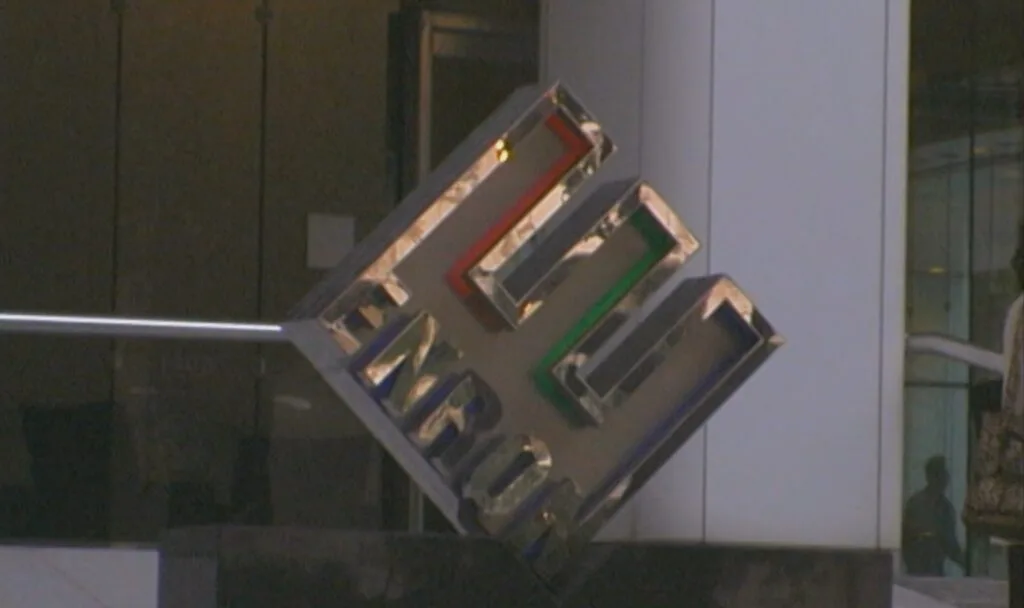
Enron’s spectacular collapse in the early 2000s was then the biggest financial scandal in U.S. history.
But as Pulitzer Prize-winning journalist Hedrick Smith reported in the 2002 FRONTLINE documentary Bigger Than Enron, the scandal didn’t happen in a vacuum — and it revealed systemic problems far beyond a single company.
“Where were the watchdogs who were supposed to warn us when companies were playing fast and loose with their books — the stock analysts, lawyers, bankers, Securities and Exchange Commission?” Smith asked in the documentary. “Above all, where were the accountants?”
Bigger Than Enron explored those questions in detail, offering an in-depth look at where the U.S. financial regulation landscape stood in June 2002, six months after Enron’s collapse. The documentary is now available to stream on FRONTLINE’s YouTube channel for the first time, as part of an effort to make the series’ multi-decade archive of reporting widely accessible.
In the film, experts told Smith that what happened at Enron — a cozy collaboration between the company and its accounting firm, Arthur Andersen, that enabled Enron to overstate its profits — was far from anomalous. Smith reported that in what’s described as the “go-go ‘90s,” the drive for profits was in full swing, and big accounting firms regularly worked hand-in-glove with clients and Wall Street to find loopholes in accounting rules that made companies look more successful than they really were.
“This is day-to-day business operations in accounting firms and on Wall Street,” Lynn Turner, a former Wall Street partner at an accounting firm before becoming the SEC’s chief accountant, said of such practices at the time. “There is nothing extraordinary, nothing unusual in that respect, with respect to Enron.”
Bigger Than Enron examined three specific cases involving Andersen auditors where misleading or fraudulent accounting practices caused enormous investor losses — at Sunbeam, Waste Management, and finally, Enron — and explored the downfall of Andersen, a firm that had previously built its reputation on rock-ribbed integrity.
The documentary also looked at how, in the decade leading up to Enron, accounting and financial industry lobbyists achieved key successes on Capitol Hill in the fight over stock options, and the war over a SEC attempt to rein in conflicts of interest by forcing accounting firms to separate their auditing and consulting practices.
“Where were the watchdogs who were supposed to warn us when companies were playing fast and loose with their books — the stock analysts, lawyers, bankers, Securities and Exchange Commission? Above all, where were the accountants?”
Since the film aired, there have been a number of legislative and regulatory changes impacting accounting practices and how accounting firms and clients interact, including 2002’s Sarbanes-Oxley Act and, several years later, the closure of a stock options loophole explored in the documentary.
There have also been developments in the lawsuits the film covered.
At the time Bigger Than Enron was released, a SEC fraud case against former Sunbeam CEO Al Dunlap was ongoing. That September, Dunlap settled with the SEC, admitting no guilt or wrongdoing and agreeing to pay a fine of $500,000. As part of the settlement, he was barred from ever serving as a CEO of a publicly traded company again. The SEC’s fraud case against Philip Harlow — an Andersen auditor to Sunbeam accused of blessing bad books and destroying documents, he said by accident — was also ongoing when the documentary was released. The following year, in 2003, Harlow settled with the SEC, admitting no guilt or wrongdoing; he was barred from serving as an accountant for a public company for three years.
Just before the documentary aired in 2002, a jury convicted Arthur Andersen of obstruction of justice in connection with the shredding of Enron-related documents; the firm soon dissolved. In 2005, the Andersen conviction was unanimously overturned by the U.S. Supreme Court, which found that the judge’s instructions to the jury about the shredded documents had been flawed. With Andersen already defunct, the federal government opted not to pursue a re-trial.
After the firm’s conviction was overturned, an individual obstruction of justice charge against David Duncan, the Andersen lead on Enron’s account, was dismissed. Duncan ultimately settled with the SEC over broader conduct involving Enron in 2008, not admitting guilt or wrongdoing, and agreed to a permanent suspension from serving as an accountant.
Bigger Than Enron ended by exploring the approach of then-new SEC chair Harvey Pitt, who appeared to be taking a less aggressive posture to policing corporate America than his predecessor, Arthur Levitt. After 18 months on the job, Pitt resigned amid scandals related to public perception that he wasn’t being tough enough on corporate wrongdoing.
Ultimately, the documentary’s warning that Enron could be “just the tip of the iceberg” turned out to be prescient. In the decade after Enron’s implosion came multiple additional accounting scandals at public companies including WorldCom, Freddie Mac, AIG and Lehman Brothers — whose 2008 collapse helped to usher in the Great Recession.
Watch the Full Documentary | Bigger Than Enron
Additional documentaries from FRONTLINE’s archives will be released on YouTube in the coming weeks. Subscribe now so you don’t miss an episode.
Journalism powered by your support — and accessible to all.
Watching our “Scammed” documentary revealing how the global scam industry operates? Exposing the truth is where accountability begins. Help keep reporting like this paywall-free for everyone with a gift of $5 or $10 today.
Senior Digital Writer, FRONTLINE
Support provided by:
Learn More
Related Documentaries





Latest Documentaries


Explore
Policies
Teacher Center

Jon and Jo Ann Hagler on behalf of the Jon L. Hagler Foundation
Corey David Sauer
Koo and Patricia Yuen
FRONTLINE is a registered trademark of WGBH Educational Foundation. Web Site Copyright ©1995-2025 WGBH Educational Foundation. PBS is a 501(c)(3) not-for-profit organization.
Funding for FRONTLINE is provided through the support of PBS viewers and by the Corporation for Public Broadcasting, with major support from Ford Foundation, and Fialkow Family Foundation. Additional funding is provided the Abrams Foundation, John D. and Catherine T. MacArthur Foundation, Park Foundation, Heising-Simons Foundation, and the FRONTLINE Trust, with major support from Jon and Jo Ann Hagler on behalf of the Jon L. Hagler Foundation, and Corey David Sauer, and additional support from Koo and Patricia Yuen. FRONTLINE is a registered trademark of WGBH Educational Foundation. Web Site Copyright ©1995-2026 WGBH Educational Foundation. PBS is a 501(c)(3) not-for-profit organization.