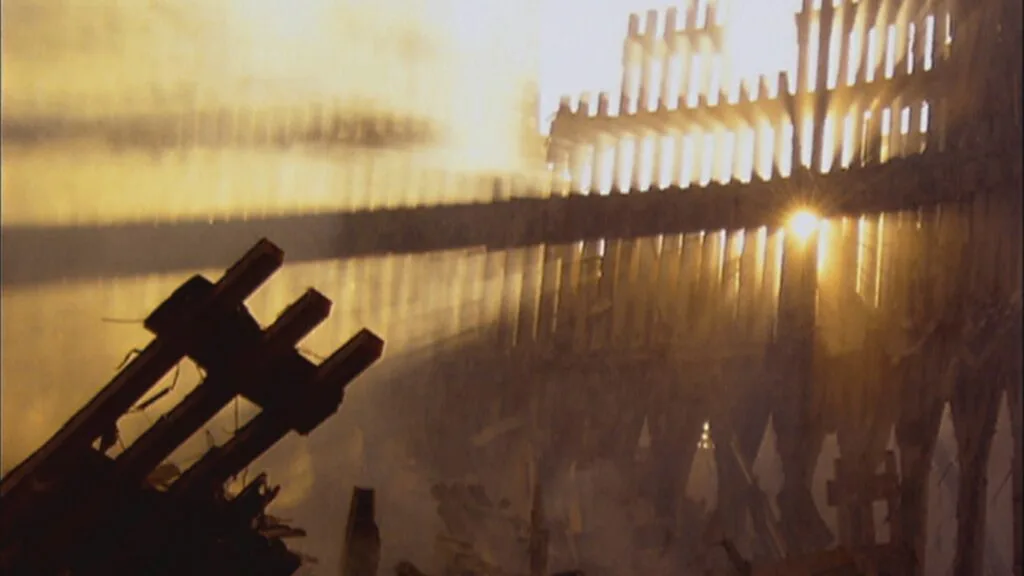
Faith and Doubt at Ground Zero: Investigating 9/11’s Spiritual Aftershocks
For many Americans, Sept. 11, 2001, didn’t only prompt questions about national security, terrorism and foreign policy. The attacks also sparked profound spiritual questions about God’s presence — or absence — that day, the nature of good and evil, and the potential for both within religion itself.
September 2, 2026
Share
When Al Qaeda hijackers crashed commercial planes into the Twin Towers, the Pentagon and a Pennsylvania field on Sept. 11, 2001, writer Marian Fontana’s firefighter husband, Dave, was among the thousands of people killed.
A year later, a grieving Fontana continued to grapple with profound spiritual questions about her husband’s death in the worst terror attack on the U.S. in history.
“I couldn’t believe that this God that I’d talked to in my own way for 35 years turned this loving man into bones, and now I can’t bring myself to speak to him anymore because I feel so abandoned,” she told FRONTLINE in the 2002 documentary Faith and Doubt at Ground Zero.
Fontana was far from the only person whose anguish took on spiritual dimensions in the wake of 9/11. As Faith and Doubt at Ground Zero explored, the attacks sparked widespread questions among Americans about God’s presence — or absence — that day, the nature of good and evil, and the potential for both within religion itself.
“Since Sept. 11, people keep asking me, ‘Where was God?’ And they think because I’m a rabbi, I have answers,” Orthodox Rabbi Brad Hirschfield, then the vice president of the National Jewish Center for Learning and Leadership in New York City, said in the documentary. “And I actually think that my job as a rabbi is to help them live with those questions.”
An intimate and profound investigation of the spiritual aftershocks of 9/11, Faith and Doubt at Ground Zero is now available to stream on YouTube for the first time. Through interviews with victims’ families and World Trade Center survivors, priests, rabbis, Islamic scholars, atheists and agnostics, writers and thinkers, this two-hour documentary from producer Helen Whitney examined how the religious beliefs — and unbelief — of Americans had been challenged since the events of Sept. 11.
Kanan Makiya, an atheist and professor of Middle Eastern studies at Brandeis University, said the attacks shook his belief in the human race: “That does leave you very, very isolated, not knowing where to turn,” he said. “You can’t hope any more the same way.”
Meanwhile, Khaled El Fadl, a professor of Islamic law at UCLA, said he found himself “fighting for the soul and identity of Islam itself.”
“I really don’t think that you can hold your head high and have a sense of dignity about yourself if you can’t clearly confront the fact that this remarkable amount of ugliness was committed in the name of the faith that you believe in,” El Fadl said, warning of the dangers of people thinking “they speak authoritatively and decisively for God.”
In the documentary, other religious leaders and scholars also found themselves confronting such thinking and the potential for violence within their own religious traditions. Monsignor Lorenzo Albacete, a Catholic priest and professor of theology at St. Joseph’s Seminary in New York, told FRONTLINE that from the first moment he saw the “explosion of horror” on 9/11, he recognized “an old companion.”
“Look, I am a priest for over 30 years. Religion is my life. It’s my vocation. It’s my existence …. Therefore, I know it,” said Albacete, who died in 2014. “The same passion that motivates religious people to do great things is the same one that that day brought all that destruction.”
Hirschfield, the rabbi, echoed Albacete: “It’s amazing how good religion is at mobilizing people to do awful, murderous things,” he said. “There is this dark side to it, and anyone who loves religious experience, including me, better begin to own there is a serious shadow side to this thing.”
But in the wake of the attacks, religion also offered unique solace.
“I was raised Irish Catholic, but over the years, I really grew disillusioned with the church until the horror of Sept. 11,” said attorney Terry McGovern, whose mother, Ann, died in the attacks. “When you have this kind of unimaginable horror happen to somebody that you love, you do have to find a way to connect and hope for something much deeper because otherwise, I think your mind could kind of snap, really.”
And for some, there were moments in the human response to the tragedy that suggested transcendence.
In the documentary’s concluding minutes, film participants reflected on a famous photograph from 9/11 of two people holding hands as they leapt to their deaths.
“I keep coming back to his hand in her hand, nestled in each other with such extraordinary, ordinary, naked love,” author Brian Doyle said, referencing an essay he wrote about the moment. “It’s the most powerful prayer I can imagine, the most eloquent, the most graceful. It’s everything we’re capable of against horror and loss and tragedy.”
Watch the Full Documentary | Faith and Doubt at Ground Zero
Additional documentaries from FRONTLINE’s archives will be released on YouTube in the coming weeks. Subscribe now so you don’t miss an episode.
Journalism powered by your support — and accessible to all.
Watching our “Scammed” documentary revealing how the global scam industry operates? Exposing the truth is where accountability begins. Help keep reporting like this paywall-free for everyone with a gift of $5 or $10 today.
Senior Digital Writer, FRONTLINE
Support provided by:
Learn More
Related Documentaries
Latest Documentaries
Explore
Policies
Teacher Center

Jon and Jo Ann Hagler on behalf of the Jon L. Hagler Foundation
Corey David Sauer
Koo and Patricia Yuen
FRONTLINE is a registered trademark of WGBH Educational Foundation. Web Site Copyright ©1995-2025 WGBH Educational Foundation. PBS is a 501(c)(3) not-for-profit organization.
Funding for FRONTLINE is provided through the support of PBS viewers and by the Corporation for Public Broadcasting, with major support from Ford Foundation, and Fialkow Family Foundation. Additional funding is provided the Abrams Foundation, John D. and Catherine T. MacArthur Foundation, Park Foundation, Heising-Simons Foundation, and the FRONTLINE Trust, with major support from Jon and Jo Ann Hagler on behalf of the Jon L. Hagler Foundation, and Corey David Sauer, and additional support from Koo and Patricia Yuen. FRONTLINE is a registered trademark of WGBH Educational Foundation. Web Site Copyright ©1995-2026 WGBH Educational Foundation. PBS is a 501(c)(3) not-for-profit organization.