Flashback: How the SARS Outbreak — and the Fight Against It — Unfolded
COVID-19 wasn't the first time the world experienced an outbreak of a never-before-seen type of coronavirus.
August 11, 2026
Share
The COVID-19 pandemic wasn’t the first time the world experienced an outbreak of a never-before-seen type of coronavirus.
In the short documentary Hong Kong: Chasing the Virus, reporter and producer Renata Simone went inside an earlier outbreak of a coronavirus that also originated in mainland China and spread globally: SARS.
“The SARS virus attaches to a healthy cell, penetrates it and replicates,” Simone said in the 2003 report. Cell by cell, the respiratory virus was damaging victims’ lungs — and the race to stop it was on.
Chasing the Virus originally aired as part of FRONTLINE/World, a special FRONTLINE series that ran from 2002-2010 and was developed in partnership with GBH in Boston and KQED in San Francisco. The report is now streaming on FRONTLINE’s YouTube channel for the first time as part of an effort to make the series’ multi-decade archive of reporting widely accessible.
Simone, who had previously covered the spread of AIDS around the world, traveled to Hong Kong as the SARS outbreak played out. The virus had first appeared in mainland China’s densely populated Guangdong province, where it’s believed to have crossed the species barrier from animals to people. It spread to the rest of the world after a man from Guangdong attended a wedding in Hong Kong and unknowingly infected nine other guests at the hotel where he was staying.
Simone documented how Hong Kong’s port city, usually a bustling hub of commerce, had been brought to a virtual standstill. A thousand flights a day at the airport became 40. At one multistory apartment complex she visited, more than 320 residents had gotten sick from the virus and 42 died.
“We had to stay here in isolation,” a man who lived in the building told Simone. “And then we were sent to a quarantine camp.”
Adding to the fear gripping Hong Kong: There was no cure or proven treatment for SARS.
“When the medication could not relieve my suffering, I thought I was going to die,” said the Rev. Simon Yeung, who contracted the virus while visiting a sick parishioner at the hospital. “As a priest, I know death is not a negative thing, but I kept struggling.”
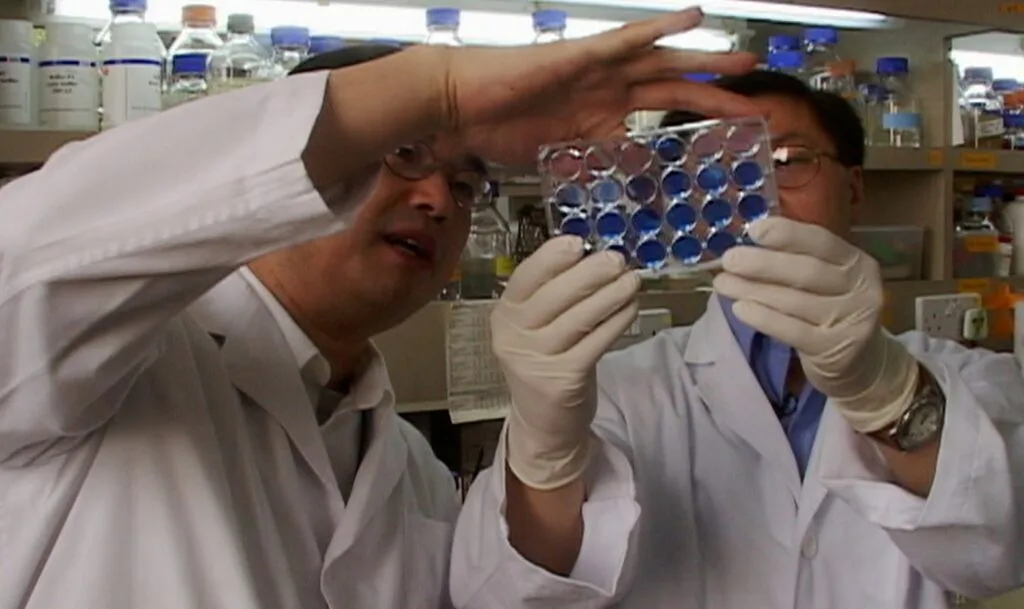
As the sense of urgency mounted, Simone filmed with an international group of researchers who were teaming up at the University of Hong Kong to try to combat SARS. The team included Dr. David Ho, a world-renowned AIDS researcher based at Columbia University in New York who hoped his expertise would be transferable.
“It’s sort of like you see a fire in the next town, and you’re very anxious,” Ho said in the documentary. “But if people, folks over there, say, ‘Please come and help us,’ you definitely cannot say no. And so here we are, in our fireman outfits.”
As the documentary chronicled, Ho’s idea, based on an AIDS treatment, was to design peptides that could stop the virus from attaching to healthy cells. Early results in the lab showed promise, but Ho “knows that science is a long and unpredictable journey,” Simone said in the 2003 documentary.
By the time the SARS epidemic ultimately wound down that same year, contained through public health measures like testing, quarantine and isolation, close to 800 people had died. There have been no new cases since 2004.
But just over a decade-and-a-half later, a different coronavirus would emerge and exact a far greater toll.
When SARS-CoV-2 — also known as COVID-19 — hit, Ho once again became involved in the response. Drawing on past experience with AIDS and SARS, he researched antibody therapies, compounds for antiviral drugs, and how some COVID-19 variants eluded immune system defenses and caused breakthrough infections. More than 7 million people have died in the COVID-19 pandemic.
Ho has called for vigilance about whatever pandemic comes next.
“Each time we’ve learned a lesson and then become gradually complacent,” Ho said in a 2022 Columbia University feature. “Then we forget the lesson and have to relearn it once more.”
Watch the Full Documentary | Hong Kong: Chasing the Virus
Additional documentaries from FRONTLINE’s archive are being released on YouTube throughout the summer. Subscribe now so you don’t miss an episode.
Journalism powered by your support — and accessible to all.
Watching our “Scammed” documentary revealing how the global scam industry operates? Exposing the truth is where accountability begins. Help keep reporting like this paywall-free for everyone with a gift of $5 or $10 today.

Senior Digital Writer, FRONTLINE
Support provided by:
Learn More
Related Documentaries




Latest Documentaries




Explore
Policies
Teacher Center

Jon and Jo Ann Hagler on behalf of the Jon L. Hagler Foundation
Corey David Sauer
Koo and Patricia Yuen
FRONTLINE is a registered trademark of WGBH Educational Foundation. Web Site Copyright ©1995-2025 WGBH Educational Foundation. PBS is a 501(c)(3) not-for-profit organization.
Funding for FRONTLINE is provided through the support of PBS viewers and by the Corporation for Public Broadcasting, with major support from Ford Foundation, and Fialkow Family Foundation. Additional funding is provided the Abrams Foundation, John D. and Catherine T. MacArthur Foundation, Park Foundation, Heising-Simons Foundation, and the FRONTLINE Trust, with major support from Jon and Jo Ann Hagler on behalf of the Jon L. Hagler Foundation, and Corey David Sauer, and additional support from Koo and Patricia Yuen. FRONTLINE is a registered trademark of WGBH Educational Foundation. Web Site Copyright ©1995-2026 WGBH Educational Foundation. PBS is a 501(c)(3) not-for-profit organization.