Boeing’s Fatal Flaw
March 12, 2024
54m
As new questions arise about Boeing’s troubled 737 Max jet, FRONTLINE and The New York Times update an award-winning investigation about the crashes that killed 346 people
Boeing’s Fatal Flaw
Boeing's Fatal Flaw (2024)
March 12, 2024
54m
NOW PLAYING
Boeing's Fatal Flaw (2021)
September 14, 2021
54m
Share
As new questions arise about Boeing’s troubled 737 Max jet, FRONTLINE and The New York Times update an award-winning investigation into the design, oversight and production of a plane that was involved in two crashes that killed 346 people.
An updated version of this documentary was released March 12, 2024, and is now streaming above.
Directed by
Produced by
In partnership with:

Transcript
Credits
Journalistic Standards
Support provided by:
Learn More
Most Watched







The FRONTLINE Newsletter

How Boeing’s Flawed 737 Max Made It Into the Air
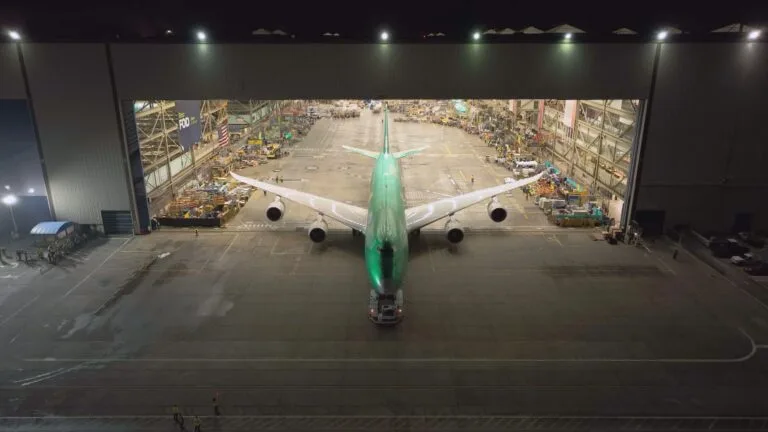
Boeing’s Safety Culture Faulted by F.A.A. in New Report
What Has Happened to Boeing Since the 737 Max Crashes
Related Stories

Watch 2024’s 10 Most-Streamed New FRONTLINE Documentaries
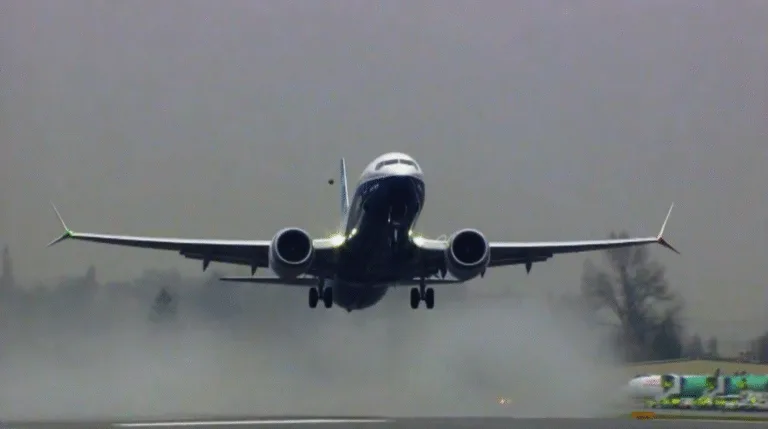
As Boeing Agrees to Plead Guilty to Fraud, a Look Back at What Led Up to the 737 Max Crashes That Killed 346 People

Watch FRONTLINE’s 5 Most-Streamed Documentaries of 2024 (So Far)
What Has Happened to Boeing Since the 737 Max Crashes
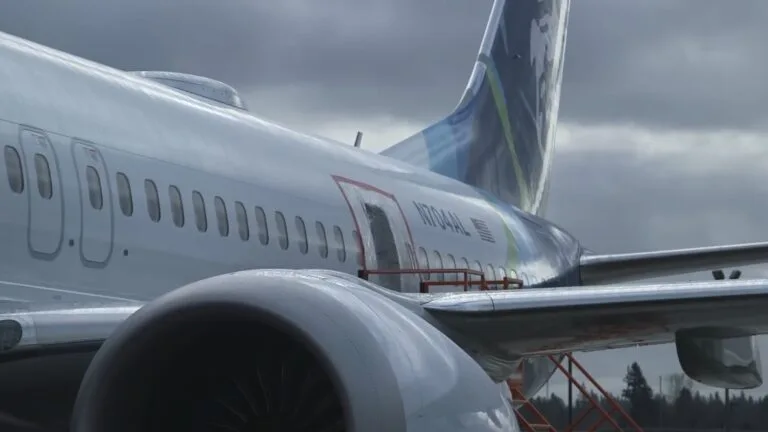
Alaska Airlines Flight Was Scheduled for Safety Check on Day Panel Blew Off
F.A.A. Audit of Boeing’s 737 Max Production Found Dozens of Issues
Boeing’s Safety Culture Faulted by F.A.A. in New Report
Boeing 737 Max Official Is Out as Questions Linger on Mishap
Facing Another Boeing Crisis, the F.A.A. Takes a Harder Line
Boeing, Still Recovering From Max 8 Crashes, Faces a New Crisis
‘Not Where We Need to Be’: Boeing to Make Changes in Quality Control
The Troubled History of Boeing’s 737 Max Jet

FRONTLINE Wins 4 News & Documentary Emmy Awards

Watch 2021’s 10 Most-Streamed New FRONTLINE Documentaries
Senate Whistleblower Report: After Boeing 737 Max Crashes, Problems with FAA Oversight Continue
How Boeing’s Flawed 737 Max Made It Into the Air

Former Boeing 737 Max Pilot Pleads Not Guilty to Federal Grand Jury Indictment

Boeing’s Fatal Flaw
In 737 Max Crashes, Boeing Pointed to Pilot Error — Despite a Fatal Design Flaw
Boeing Is Under FAA Scrutiny Over Reports That It May Hamper Oversight
Before Deadly Crashes, Boeing Pushed for Law That Undercut Oversight
The Roots of Boeing’s 737 Max Crisis: A Regulator Relaxes Its Oversight
Boeing Built Deadly Assumptions Into 737 Max, Blind to a Late Design Change
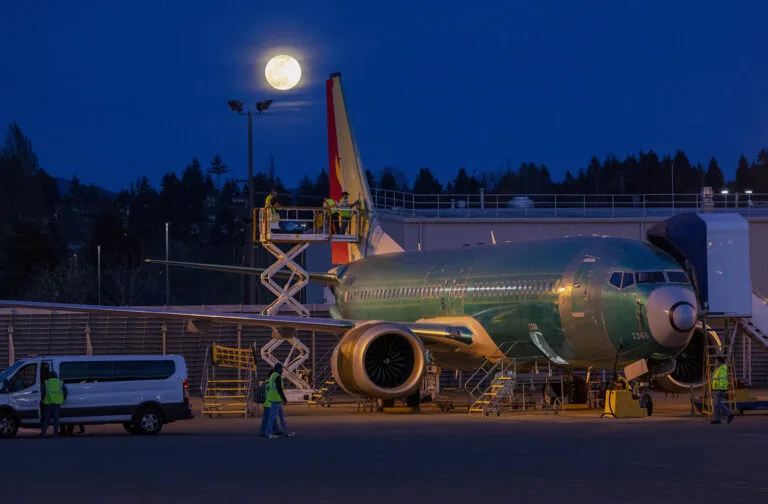
Boeing Was ‘Go, Go, Go’ to Beat Airbus With the 737 Max
Related Stories
Watch 2024’s 10 Most-Streamed New FRONTLINE Documentaries
As Boeing Agrees to Plead Guilty to Fraud, a Look Back at What Led Up to the 737 Max Crashes That Killed 346 People
Watch FRONTLINE’s 5 Most-Streamed Documentaries of 2024 (So Far)
What Has Happened to Boeing Since the 737 Max Crashes
Alaska Airlines Flight Was Scheduled for Safety Check on Day Panel Blew Off
F.A.A. Audit of Boeing’s 737 Max Production Found Dozens of Issues
Boeing’s Safety Culture Faulted by F.A.A. in New Report
Boeing 737 Max Official Is Out as Questions Linger on Mishap
Facing Another Boeing Crisis, the F.A.A. Takes a Harder Line
Boeing, Still Recovering From Max 8 Crashes, Faces a New Crisis
‘Not Where We Need to Be’: Boeing to Make Changes in Quality Control
The Troubled History of Boeing’s 737 Max Jet
FRONTLINE Wins 4 News & Documentary Emmy Awards
Watch 2021’s 10 Most-Streamed New FRONTLINE Documentaries
Senate Whistleblower Report: After Boeing 737 Max Crashes, Problems with FAA Oversight Continue
How Boeing’s Flawed 737 Max Made It Into the Air
Former Boeing 737 Max Pilot Pleads Not Guilty to Federal Grand Jury Indictment
Boeing’s Fatal Flaw
In 737 Max Crashes, Boeing Pointed to Pilot Error — Despite a Fatal Design Flaw
Boeing Is Under FAA Scrutiny Over Reports That It May Hamper Oversight
Before Deadly Crashes, Boeing Pushed for Law That Undercut Oversight
The Roots of Boeing’s 737 Max Crisis: A Regulator Relaxes Its Oversight
Boeing Built Deadly Assumptions Into 737 Max, Blind to a Late Design Change
Boeing Was ‘Go, Go, Go’ to Beat Airbus With the 737 Max
Boeing’s Fatal Flaw (2024 version)
This is an update of a program that aired September 14, 2021.
Jakarta, Indonesia
October 2018
GERRY SOEJATMAN, Indonesian aviation analyst:
On the morning of Oct. 29 I was woken up by a colleague who alerted me that a Lion aircraft crashed. He said, “It’s the Max.” And I was surprised, because it was a new aircraft.
My company provided the air data for aircraft flying around the Jakarta area. So I went to the computer and looked at the data. It was immediately apparent that, OK, something was wrong.
The plane went up to about 2,000 feet just over a minute after takeoff, and the plane had a bit of a dive. And then the plane climbed to about 5,000 feet. But then, at 5,000 feet, the plane was fluctuating up and down. And then the plane just started diving. It just didn’t make sense. You don’t see planes diving on departure. I was baffled. Why did it go down?
FEMALE NEWSREADER:
Lion Air Flight JT610 went missing from radar—
NARRATOR:
One hundred eighty-nine people were killed in the crash of Lion Air Flight 610.
MALE NEWSREADER:
The Boeing 737 Max 8—
NARRATOR:
The plane was a new Boeing 737 Max—
FEMALE NEWSREADER:
What do we know about this 737 Max 8?
NARRATOR:
—the fastest-selling jet in Boeing history, just introduced the year before.
MALE NEWSREADER:
We don’t yet know what caused this crash.
MALE REPORTER:
A breakthrough this evening, the flight data recorder. It holds many of the keys—
NARRATOR:
The data from the black box quickly got to FAA engineers in the United States.
Seattle, Washington
JOE JACOBSEN, FAA engineer, 1995-2021:
There is a purity of this data. It comes directly from the black boxes. So it’s recording airspeed, altitude.
NARRATOR:
The data showed what appeared to be a glitch, something repeatedly moving part of the plane’s tail, controlling its pitch.
JOE JACOBSEN:
It didn’t take long—just a couple of minutes—to see that there was rapid movement of the horizontal stabilizer. It’s probably the fastest way to kill yourself in an airplane is to have the stabilizer malfunction.
New York City
JAMES GLANZ, The New York Times:
My spine literally tingled when I saw the traces from the black box. The plane continually tried to push the nose down, and the pilots were trying over and over again to stop the plane. And in the end, they lose that battle.
NARRATOR:
What Boeing had not told airlines or their pilots was that it had put a powerful software system on the new airplane.
JAMES GLANZ:
In the Lion Air crash, this system was receiving incorrect information, and that made the plane dive straight downward and destroy itself.
NARRATOR:
Inside Boeing, they quickly diagnosed the problem and began working on a fix. But they stood by the Max as hundreds of them took to the air around the world, carrying thousands of passengers.
The company alerted pilots about handling a potential malfunction.
MALE NEWSREADER:
Boeing and the FAA today warned airlines that sensors on 737 Max 8 jets can malfunction.
FEMALE NEWSREADER:
Boeing are calling this a formal advisory, and it’s been issued to the pilots.
NATALIE KITROEFF, The New York Times:
The reporting showed Boeing knew that it was risky, but their response was to blame the pilots.
MALE NEWSREADER:
Pilots did not hit two cut-off switches. Boeing says that action was part of well-established protocols for all 737s.
NATALIE KITROEFF:
And that led to a series of decisions that kept the plane in the air. And then we got another crash.
Addis Ababa, Ethiopia
March 2019
FEMALE NEWSREADER:
Breaking news out of Ethiopia, where a plane went down—
NARRATOR:
It was Ethiopian Airlines Flight 302, on its way to Nairobi from Addis Ababa.
FEMALE NEWSREADER:
—where a new 737 Max 8 jetliner crashed minutes after taking off.
NARRATOR:
Two crashes, the same plane; 346 people killed; an iconic American company’s reputation in tatters.
The story of the Boeing 737 Max would end up exposing corporate deception and a broken regulatory process. But at the center was a software system supposed to keep people safe that instead led to their deaths.
FEMALE NEWSREADER:
The black boxes from the Ethiopian crash have been recovered.
MALE NEWSREADER:
It’s the second disaster within five months involving the Boeing 737 Max.
MALE NEWSREADER:
That’s the same kind of aircraft that crashed back in October in Indonesia.
MALE NEWSREADER:
One hundred and fifty-seven people, including passengers and crew members on board, all dead.
QUINDOS KARANJA, Relative of crash victims:
The first thing you get to see at the site is a very big hole. And then to only imagine this is the place that they were last alive.
NADIA MILLERON, Mother of crash victim:
We learned that there were no survivors on the plane. And then our objective was to go and bring my daughter’s body home.
QUINDOS KARANJA:
Now you’re in close proximity. You’re able to see the fine details. You’re able to maybe think these are personal effects belonged to Carol, my sister, or my mom. This bone, whose bone is this?
NADIA MILLERON:
They told us that there was no part of a human that was bigger than a femur that was left.
TOR STUMO, Brother of crash victim:
That whole experience is just a jumble of images and painful thoughts and blankness to me. I don’t really—I can’t really make sense of it.
NARRATOR:
The crash of Ethiopian Flight 302 in 2019 was the second time in five months that a Boeing 737 Max had gone down. As families gathered at the crash site, across the world, reporters at The New York Times were investigating what had been going wrong with Boeing’s new commercial jet.
NATALIE KITROEFF:
Statistically speaking, the likelihood that these two accidents were not in some way connected was extremely low. It suggested that there was something going on with the plane, and obviously we were determined to find out.
DAVID GELLES, The New York Times:
It was clear from the get-go that Boeing was in full crisis mode.
March 18, 2019
DENNIS MUILENBURG, CEO, Boeing:
As the facts from the accident become available and we understand the necessary next steps, we’re taking action to fully reassure airlines and their passengers of the safety of the 737 Max.
DAVID GELLES:
This was going to be an existential crisis for the company if these two events were related.
NATALIE KITROEFF:
China grounds the plane first. Other international regulators ground the plane. Then the European Union grounds the plane.
MALE NEWSREADER:
But in the U.S., the FAA says it’s not grounding the plane.
DAVID GELLES:
Boeing and the FAA all were saying that they were sort of waiting for the facts before they rushed to judgment and grounded such an important new plane.
NARRATOR:
But for months, the Times was reporting there was something wrong with the 737 Max itself: the software system that pilots had not known existed.
JAMES GLANZ:
The Maneuvering Characteristics Augmentation System, or MCAS.
The function of this previously undisclosed system was to save the plane when it believed that the plane might go into a stall and fall out of the sky. And so this system was designed then to sort of take over the stabilizer and push that nose back down in case the pilot gets in trouble.
NARRATOR:
Then, a major setback for the company: Radar showed the two planes’ flight patterns were eerily similar.
DAVID GELLES:
Days after the rest of the world had reached the same conclusion, they finally grounded the plane.
NARRATOR:
For the New York Times reporters, all the signs pointed to MCAS.
NATALIE KITROEFF:
We knew that MCAS was the beginning and we knew that we needed to start with this system.
JACK NICAS, The New York Times:
This was a really problematic software system in the way it was designed. OK, well, then how the hell did it end up in the plane this way?
NARRATOR:
Boeing declined to be interviewed for this film. In a statement, the company said safety is its top priority and it has worked closely with regulators, investigators and stakeholders “to implement changes that ensure accidents like these never happen again.”
June 20, 2011
DAVID GELLES:
This story really begins in 2011.
MALE NEWSREADER:
The 2011 Paris Air Show officially opened Monday.
DAVID GELLES:
Boeing and Airbus had been going head-to-head for at least a decade. But Airbus had been quickly catching up and really nipping at Boeing’s heels.
TOM ENDERS, CEO, Airbus:
It’s the best air show ever for Airbus in terms of aircraft numbers sold.
DAVID GELLES:
In 2010, Airbus introduced the A320neo, a more fuel-efficient version of its stalwart A320.
SCOTT HAMILTON, Aviation consultant:
The A320 is the direct competitor to the Boeing 737. Airlines wanted an airplane that was more fuel efficient than the airplanes then in service. Airbus chose to re-engine the A320 into what they call the neo, the “new engine option.”
MALE NEWSREADER:
It’s a record 200 orders for its A320neo.
SCOTT HAMILTON:
It was one of the fastest-selling programs of aviation history.
DAVID GELLES:
And it placed enormous pressure on Boeing to respond.
Boeing frankly was caught flat-footed. Within a couple of weeks, Airbus and American Airlines have the preliminary workings of what would become the first deal for American to buy Airbus planes in more than a decade.
Gerard Arpey, the CEO of American Airlines, calls Jim McNerney, the CEO of Boeing. It’s a courtesy call at this point, just letting their longtime supplier of airplanes know they’re going to go with the competition.
NATALIE KITROEFF:
And that is essentially a dagger in the heart of Boeing.
SCOTT HAMILTON:
And within 48 hours, Boeing had decided to pull the trigger on launching the re-engined 737, which later became branded as the Max.
NATALIE KITROEFF:
From the very beginning, from its birth, it was marked by competitive pressure.
NARRATOR:
Within days of the second 737 Max crash, another investigation was underway in Washington, D.C.
DOUG PASTERNAK, Dir., Investigations, House Transportation Cmte.:
We started getting information in from whistleblowers, from people, both current and former FAA and Boeing employees.
NARRATOR:
Doug Pasternak was leading a congressional investigation. This is his first interview about what he found.
DOUG PASTERNAK:
As soon as the second accident occurred, we started our investigation, and our focus was on the design, development and certification of the Max. We got hundreds of thousands of pages of documents from Boeing.
One of the things that really struck me from speaking to a lot of Boeing employees was that they were so excited to go to work at Boeing. Boeing is a tremendous engineering company and a technical marvel, but almost without failure, they point to a degradation of that mindset and that safety suffered as a result. Looking backwards, I think you can clearly see the trajectory to tragedy along the way at Boeing.
NARRATOR:
Boeing publicly said the Max went through a deliberate six-year development process. But in their first stories, the New York Times reporters found insiders who said that Boeing executives had been putting the pressure on to design the new 737 quickly and cheaply.
JACK NICAS:
One specific engineer we spoke to was Rick Ludtke. He helped design the cockpit in the Max, and he talked a lot about how there was an obsession in limiting changes.
New York Times interview with
Rick Ludtke
RICK LUDTKE:
This program was a much more intense pressure cooker than I’ve ever been in. The company was trying to avoid costs—minimum change to simplify the training differences, and to get it done quickly.
DAVID GELLES:
It put what had happened in the context of this broader corporate narrative.
JACK NICAS:
Yeah.
New York Times interview with
Rick Ludtke
RICK LUDTKE:
Speed was what they seemed to desire. There was a lot of decision-making that was somewhat arbitrary and didn’t involve as much of the—of what engineering considers healthy debate. The challenge to the Boeing designers was that any designs we create would not drive any new training that required a simulator.
NARRATOR:
In his recorded interview with the Times, Ludtke said Boeing management was so determined to avoid the expense of new training they made a bold promise.
New York Times interview with
Rick Ludtke
RICK LUDTKE:
Sales had made a commitment with Southwest that for any airplane they delivered that had a new Level D differences training, Boeing would pay the company $1 million per every airplane delivered.
DAVID GELLES:
If the Max required simulator training, it would rebate Southwest a million dollars per plane. And there’s that incentive. That’s why it was so important to Boeing that pilot training be kept to a minimum.
NATALIE KITROEFF:
All of this comes out of trying to give airlines the most fuel-efficient version of a plane that they can spend as little money training their pilots on.
JACK NICAS:
That meant Boeing had to do a number of things to make this plane fly like the old one, and that was because the Max had much bigger engines on it to make them more fuel efficient.
DAVID GELLES:
But because the 737 was a 50-year-old airplane at this time, practically, when it came time for Boeing to put those engines on the wings, the engines were so darn big they had to mount them further forward on the wings.
JACK NICAS:
They were testing in this wind tunnel, and they were discovering the plane was handling just a little bit differently. But they didn’t even have a plane built yet, so this wasn’t happening in real flight. This is something you have to fix. And they leaned on a system that they had used once before, in a military tanker. It was designed as a system on the plane to really just smooth out the way the plane handled.
NARRATOR:
It was MCAS.
JACK NICAS:
It was designed for these extremely unusual maneuvers. Situations that hopefully the plane would never get in. And to prevent the nose from getting too high, the system would move the stabilizer on the back of the plane to push the nose back down.
NARRATOR:
But inside Boeing, there were early signs of trouble.
DOUG PASTERNAK:
One of the first documents we found was from November of 2012. A Boeing test pilot was flying the Max in a flight simulator and trying to respond to an activation of MCAS. And that resulted in what he described as a “catastrophic” event. It showed that if that had been in real life, he could have lost the airplane. They realize from that moment on even a Boeing test pilot may have trouble responding to MCAS.
NARRATOR:
The company kept quiet about the simulator experience and appeared to have discounted the test results. Still, in the following months, some Boeing employees suggested simply removing all references to MCAS from training manuals.
DOUG PASTERNAK:
Boeing from almost the very beginning realized the significance of MCAS and the significance MCAS would have on pilot simulator training. [Reading document] “If we emphasize MCAS is a new function, there may be a greater certification and training impact. Recommended action: investigate deletion of MCAS nomenclature.”
What that meant was that if they said MCAS was a new function, the FAA was going to scrutinize it a lot more.
NARRATOR:
Boeing told Congress it kept the FAA informed about MCAS’s development and final configuration.
But Boeing has a complex and close relationship with the agency that oversees it.
NATALIE KITROEFF:
The airplanes are part of the story, but so are the regulators. The FAA regulated Boeing, in part, with a handful of Boeing employees whose paychecks came from Boeing but whose jobs were to represent the interests of the FAA.
NARRATOR:
It’s a decades-old arrangement known as “delegation” that allows federal agencies to give oversight powers to the companies they regulate.
NATALIE KITROEFF:
In the beginning there was a really good reason for this. The FAA was certifying things that made no sense to have them certify—every single exit sign or bathroom sign or paint. The issue that many of the FAA employees that we talked to had was that it went way beyond bathroom signs.
Over time, Congress passed laws that pushed the FAA to hand over the responsibility for more and more tasks to the company, to Boeing.
DAVID GELLES:
With this level of delegation between the company and the FAA, it became hard to understand who was working for who.
NARRATOR:
In the design of the 737 Max, many things would be delegated to Boeing. That included MCAS.
NATALIE KITROEFF:
Under the impression that this was a relatively benign system, the FAA agreed to delegate it, as is the custom with the FAA and Boeing. And that’s what happened in this case. It handed it over.
NARRATOR:
In a statement, the FAA blamed ineffective coordination and said it had not focused on MCAS when it certified the Max because Boeing had not identified MCAS as significant. Under orders from Congress, the FAA has since made changes to the delegation process.
January 29, 2016
NARRATOR:
After years of going through design and development, the 737 Max prototype was rolled out of Boeing’s Renton factory for its maiden flight.
MALE REPORTER:
Look at all the excited faces. They wouldn’t miss it.
JACK NICAS:
Ed Wilson is in the cockpit—he’s the new chief pilot—and he takes off.
FEMALE REPORTER:
And let’s just take a listen as this airplane gets ready for its very first takeoff.
JACK NICAS:
A short time after this first maiden flight, Ed Wilson, he and his co-pilots start to realize that the 737 Max is not handling as smoothly as it should in certain low-speed situations. It’s shortly after takeoff. It’s still climbing to ascent. It’s not going full speed.
NARRATOR:
Boeing engineers had an idea for how to deal with this.
JACK NICAS:
They know about MCAS and they know that MCAS was actually used for a similar situation in these high-speed maneuvers and so theoretically MCAS could also be used in these other situations to also smooth out the handling.
Crucially, it’s already been created, it’s already been approved and it’s something that we could just apply to a different phase of flight. It’s actually a pretty easy fix.
This ends up being an extremely fateful decision. They enable the stabilizer to move much more—actually four times as much. Now the system’s designed for low-speed situations like just after takeoff. And after takeoff is when the plane is still only a few thousand feet over the ground. That means you have much less room for error. It’s happening in an automated fashion and a repeated fashion. This fundamentally changes MCAS. It makes it much more aggressive, much more risky. It’s a far more dangerous system.
NARRATOR:
Boeing was doubling down on the system, expanding it despite the earlier catastrophic result in a simulator test.
The Times’ reporting on MCAS focused on a former Boeing pilot.
NATALIE KITROEFF:
I started to hear about a pilot at Boeing whose name was Mark Forkner, the chief technical pilot for the 737.
DAVID GELLES:
He was this key liaison between the company and the FAA.
NATALIE KITROEFF:
He was the person who personally emailed the FAA asking for MCAS to be removed from the pilot manual. That was an important piece of this, because we understood that the FAA really didn’t know that MCAS became more powerful.
DAVID GELLES:
He was speaking, absolutely, on behalf of the company. This was not some low-level employee. And he was asking for something that was really quite substantial: that a new piece of software that made the plane behave in ways that it previously hadn’t be concealed from the pilots.
This is where the commercial pressures from the executive level come right down to the development of the airplane.
DOUG PASTERNAK:
Mark Forkner certainly was not a lone actor in what he did. He was following through on a policy by Boeing to ensure that the program did not have to put pilots in a flight simulator.
DAVID GELLES:
It got to the point where Mark Forkner got an award for keeping training on the 737 Max to a minimum.
NARRATOR:
Nearly eight months after requesting that MCAS be removed from pilot training manuals, Forkner texted a colleague with a shocking realization.
NATALIE KITROEFF:
This appears to be the moment where Mark Forkner learns that MCAS has been expanded. He writes in that message, “I basically lied to the regulators, unknowingly.”
DAVID GELLES:
But he never went back and corrected the record. He never went back and fixed the error.
NARRATOR:
Mark Forkner wouldn’t speak to us. He was indicted for lying to FAA investigators about MCAS, but later found not guilty of all charges in federal court. His lawyer told the Times reporters that his communications with the FAA were honest and that “he would never jeopardize the safety of other pilots or their passengers.”
When Boeing engineers expanded the MCAS system, they included a feature that would make it particularly dangerous.
DAVID GELLES:
Planes have millions of parts in them. And there’s one little one on the 737 that sticks out of the fuselage.
MALE REPORTER:
See that little black circle there? That is called—
DAVID GELLES:
The angle-of-attack sensor.
NARRATOR:
On the 737 Max, it had the power to trigger MCAS.
JAMES GLANZ:
It’s the AOA sensor that is one of the crucial parameters to the computer to tell the plane that it’s in a perilous condition.
JACK NICAS:
The angle-of-attack sensor would activate MCAS by telling the system that the plane’s nose was too high and then MCAS would try to push the nose down.
DAVID GELLES:
But if this sensor is broken, for whatever reason, MCAS never realizes and so it keeps pushing the nose of the plane down over and over again.
NARRATOR:
Congressional investigators would later find documents showing that Boeing engineers had raised this very concern.
DOUG PASTERNAK:
An engineer asked, “What if we have a faulty AOA sensor?” Because AOA sensors are known to be faulty. What happens to the airplane? So you have those concerns raised and the response is again, from Boeing engineers, was to essentially dismiss those.
May 2017
FEMALE VOICE:
Three, two, one.
NARRATOR:
Boeing began delivering the new 737 Max in mid-2017.
JACK NICAS:
At the outset, 737 Max was arguably one of Boeing’s biggest successes. It had become its best-selling jet ever.
NARRATOR:
Advanced sales were estimated at $370 billion. American had orders for 100, Southwest Airlines for 200. Boeing had focused especially hard on selling to developing markets in Asia, where Lion Air’s parent company became the first customer to fly the 737 Max, signing an agreement worth more than $20 billion.
JACK NICAS:
Airlines loved it. There was a yearslong waiting list to get one.
DAVID GELLES:
But Boeing’s signature new jet had a fatal flaw.
MALE NEWSREADER:
Breaking news. The search for wreckage is underway after a passenger jet with 189 people on board crashed.
FEMALE NEWSREADER:
A Lion Air Boeing 737.
MALE NEWSREADER:
A nearly brand-new 737 Max.
NARRATOR:
Investigators from the U.S. National Transportation Safety Board contributed to an analysis of what led to the Lion Air crash.
DANA SCHULZE, Dir., Office of Aviation Safety, NTSB:
Leading up to the Lion Air accident, the angle-of-attack probe itself was miscalibrated. The maintenance crew was not able to properly identify this miscalibration.
MALE NEWSREADER:
—an angle-of-attack sensor sent bad data to MCAS.
MALE NEWSREADER:
The plane thought it was in a stall because of bad information.
DANA SCHULZE:
And as a consequence of this angle-of-attack data error, the MCAS activated when it really shouldn’t have.
DAVID GELLES:
Five months later, almost the exact same thing happens halfway across the world.
FEMALE NEWSREADER:
—new 737 Max 8 jetliner crashed today.
FEMALE NEWSREADER:
Investigators say that flight had similar problems to the Lion Air crash.
DAVID GELLES:
Once again the angle-of-attack sensor is malfunctioning.
MALE NEWSREADER:
There is this question now about systems within the aircraft.
DAVID GELLES:
If MCAS hadn’t been on those planes, those planes wouldn’t have crashed. It’s that simple.
FEMALE NEWSREADER:
The world mourns 157 people killed in the Sunday crash.
QUINDOS KARANJA:
On the flight of 737 Max crash we lost five of our family members. We had our mom, Anne Karanja; our dear sister, Carolyne Karanja; her three kids, Ryan Njoroge, Kelli Wanjiiku and Rubi Wangui.
It’s not like there is a manual of how you need to react. You’re just there. It’s like motionless. You just feel infuriated by anyone and everyone at that point.
I remember the Boeing Company blaming what they call the “foreign pilots” and deflecting blame to them, saying they are the cause.
DENNIS MUILENBURG:
All of us at Boeing are deeply sorry for the loss of life in the Ethiopian Airlines Flight 302 and Lion Air Flight 610 accidents.
NARRATOR:
Boeing CEO Dennis Muilenburg latched onto findings that inexperience and lack of training were part of a chain of events that led to the crashes. It was a controversial position.
DENNIS MUILENBURG:
Understand that these airplanes are flown in the hands of pilots, and in some cases our system safety analysis includes not only the engineering design but also the actions that pilots would take as part of a failure scenario.
JAMES GLANZ:
Boeing’s contention from the beginning was that even though the pilots did not know that MCAS existed, that they did not need to know that.
DENNIS MUILENBURG:
—and in some cases those procedures were not completely followed.
JAMES GLANZ:
Boeing believed that the pilot should have been able to realize that it was very similar to a runaway stabilizer situation.
NARRATOR:
Runaway stabilizer is an aviation term for a malfunctioning stabilizer. After the Lion Air crash, Boeing had issued a directive to pilots to be aware of this possibility and told them what to do if it happened.
NATALIE KITROEFF:
When that part of the tail was not acting the way that it should be, you take manual control of it.
MALE NEWSREADER:
The pilots could have stopped their rollercoaster ride by turning these two switches off.
JACK NICAS:
To shut off power to the stabilizer, you stop it from moving on its own. And then you start cranking a wheel in the cockpit that literally will manually move the stabilizer back to where you want it to move.
NATALIE KITROEFF:
The issue was, were there things happening inside the cockpit that might have made that harder to do? That’s what we were asking.
DAVID GELLES:
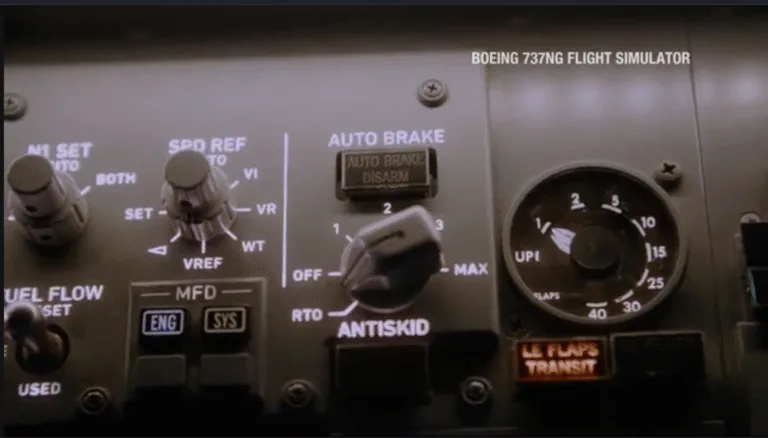
When we finally got the preliminary black box data from the Ethiopian crash, we called up Dennis Tajer, an American Airlines 737 pilot, and sent him the data, and we read through it together.
DENNIS TAJER, Spokesperson, Allied Pilots Assoc.:
My mission was to provide them, “I’m in the cockpit, I see what’s happening now.” So we walk through each line, and I had no idea what was in it. I knew that the crew had an experienced captain and a lesser experienced first officer.
DAVID GELLES:
We go, second by second, through the few minutes of this flight.
Boeing 737NG Flight Simulator
NATALIE KITROEFF:
Going through the steps that the pilots had taken and saying, “Yep, I would have done that. Yep, I would have done that.”
DENNIS TAJER:
And as soon as they lift off the ground, all these different alerts started popping up: the airspeed was unreliable, the altitude was showing unreliable. There were alerts related to that, but they bring the gear up and they continue to climb out.
Boeing 737NG Flight Simulator
NARRATOR:
Two minutes into the flight, based on faulty data from the AOA sensor, MCAS kicked in and began pushing the nose down.
COCKPIT ALERT VOICE:
Don’t sink. Pull up.
DENNIS TAJER:
And I have a very clear memory of noting a time mark where the first officer is quoted as saying, “Stab trim cutout switches,” which takes the weapon away from MCAS, which is what Boeing told us to do. And I have to confess, I probably swore, I said, “The kid got it right. The kid got it right.”
NATALIE KITROEFF:
What had happened was the pilots did do what they were supposed to do. They had cut the electricity off.
COCKPIT ALERT VOICE:
Don’t sink. Pull up.
NATALIE KITROEFF:
They hit these switches, and they tried to take manual control.
DENNIS TAJER:
The first officer is reaching to this large wheel on his left—
COCKPIT ALERT VOICE:
Pull up.
DENNIS TAJER:
—and that’s the manual trim wheel, and trying to turn it. It’s like lifting up a 10-ton bucket of cement out of a deep well.
COCKPIT ALERT VOICE:
Don’t sink.
NATALIE KITROEFF:
The problem was, at that point the plane was going so fast that even after they took manual control they could not physically get the plane to right itself. They shouldn’t have been going that fast.
COCKPIT ALERT VOICE:
Too low, terrain.
DENNIS TAJER:
And they’re continuing to accelerate towards the ground.
COCKPIT ALERT VOICE:
Pull up.
DENNIS TAJER:
The ground is approaching them.
NARRATOR:
Then, with no apparent recourse, the pilots reached for the stabilizer switches.
DENNIS TAJER:
I’m yelling into the cockpit, “Don’t do that!” But I don’t know what they’re facing.
COCKPIT ALERT VOICE:
Caution: terrain.
NARRATOR:
MCAS was reactivated.
COCKPIT ALERT VOICE:
Pull up. Pull up.
DENNIS TAJER:
MCAS says, “Hey, I’m back on. Here we go—Zzz-zzz,” and now the airplane is in near full nose-down trim, and you can pull back forever and there’s not enough metal in the back of the airplane to make that airplane come up to a nose-up.
COCKPIT ALERT VOICE:
Terrain. Terrain. Pull up. Pull up. Pull up.
NADIA MILLERON:
She died when she was 24. It’s unbearable that she’s not with us. And the only thing I can do is try to prevent this for other people.
NARRATOR:
About four months after the Ethiopian Airlines crash, the family of Samya Stumo was about to receive news they would find bewildering.
NADIA MILLERON:
We were eating dinner and I hadn’t looked at my phone for a long time. And it was blowing up.
FEMALE NEWSREADER:
The Federal Aviation Administration now in the hot seat in Washington over its certification of Boeing’s 737 Max planes.
SEN. SUSAN COLLINS, R-ME:
We are joined today by Ali Bahrami, the associate administrator for aviation safety.
ALI BAHRAMI:
We continue to evaluate Boeing’s software modification to the MCAS. In addition—
NARRATOR:
FAA official Ali Bahrami had been called before Congress, where he was questioned about revelations the FAA had known there was a risk of another Max crashing after Lion Air.
SUSAN COLLINS:
If the agency’s own analysis found MCAS to be an unacceptable risk, why did the FAA not take immediate action to address those risks?
NADIA MILLERON:
The families hadn’t known that before. They didn’t know that the safety agency gambled with passenger lives.
ALI BAHRAMI:
We knew that eventual solution would be to have the modification. And based on our risk assessment, we felt that this—we had sufficient time to be able to do the modification and get the final fix.
NARRATOR:
After the Lion Air crash, the FAA had conducted an analysis of the likelihood of another 737 Max crashing. The worst-case scenario was grim.
DOUG PASTERNAK:
They looked at the probability that there could be another crash of a 737 Max if the FAA didn’t do anything to MCAS and just let the plane keep flying. And what that assessment showed was that FAA predicted there could potentially be 15 more fatal accidents of 737 Max aircraft over the lifespan of the fleet, about one crash every other year.
NARRATOR:
But in explaining its decision not to ground the plane, the FAA said in its statement that the actual risk at the time, considering the number of planes in the air, was as close to zero as their calculations allowed. The agency had given Boeing 150 days to fix MCAS and issued official directives to pilots.
DOUG PASTERNAK:
They were gambling. They were betting against time that they would have a fix to MCAS before the next crash happened. And, unfortunately, they lost that bet.
NARRATOR:
Not everyone within the FAA agreed with the agency’s gamble.
JOE JACOBSEN:
People too quickly jumped to that conclusion: that the pilot should have been able to figure out what’s going wrong and be able to intervene properly.
NARRATOR:
FAA engineer Joe Jacobsen examined the data from the Lion Air crash and quickly raised concerns about the safety of the Max. This is his first on-camera interview.
JOE JACOBSEN:
I was pointing out a design flaw. It was purposely designed and certified to use only one AOA input to drive MCAS, to move the horizontal stabilizer at a high rate.
I talked to three managers, said this a design flaw. They were skeptical, not really buying in, saying the pilot should have been able to intervene.
It’s a failure. Our job is aviation safety and when airplanes go down we feel a real personal sense of loss and remorse and failure, and it affects a lot of people.
NARRATOR:
In the fall of 2019, with the Max having been grounded for seven months, congressional investigators released internal communications they found during their investigation.
FEMALE NEWSREADER:
Test pilots working for Boeing write about problems with the MCAS system two years before the first fatal crash in Indonesia.
NARRATOR:
It was further evidence of the company’s attempt to avoid pilot training for the Max.
REP. PETER DeFAZIO, D-OR, Chair, House Transportation Cmte.:
Did that ever cross their minds, that they were going to let something go into the air that could potentially kill people?
NARRATOR:
Boeing CEO Dennis Muilenburg appeared before Congress.
FEMALE NEWSREADER:
Boeing’s CEO is expected to acknowledge that his company made mistakes—
NATALIE KITROEFF:
And here’s the first time this guy’s in the hot seat.
NARRATOR:
By then he’d become the face of the 737 Max crisis.
PETER DeFAZIO:
I have been on this a committee a long time. We have never undertaken an investigation of this magnitude.
We intentionally put the families close to the witness. They’re the victims here, and it should be like a trial in court, where you get to face the person who committed a violent act against you.
NARRATOR:
The committee confronted Muilenburg with an array of internal Boeing documents.
REP. SHARICE DAVIDS, D-KS:
—the next slide. This shows that Boeing became aware that the disagree alert wasn’t working.
REP. TOM MALINOWSKI, D-NJ:
It does appear from this that Boeing understood how important the crew training—
REP. COLIN ALLRED, D-TX:
That pilots didn’t know about this is unacceptable.
SHARICE DAVIDS:
Boeing’s marketing representatives emphasized to potential customers that FAA had reduced the length of pilot training that—
PETER DeFAZIO:
—”a slow reaction time scenario, 10 seconds, found the failure to be catastrophic.”
NATALIE KITROEFF:
For those families, the pain of this was accentuated because this evidence that was going up on the screen was information that they felt that Mr. Muilenburg could have used to inform his decision about keeping the plane in the air or not.
PETER DeFAZIO:
We do know that Boeing engineers actually proposed placing a MCAS annunciator in the cockpit.
‘‘Are we vulnerable to single AOA sensor failure with the MCAS?”
Now, as you emphasized, flight control will now compare inputs from both AOA sensors. And I guess the question is, why wasn’t it that way from Day One?
DENNIS MUILENBURG:
Mr. Chairman, we’ve asked ourselves that same question over and over. And if back then we knew everything that we know now, we would have made a different decision.
NATALIE KITROEFF:
Nadia Milleron, she was radiating with anger over this.
NADIA MILLERON:
It’s come to the point where you’re not the person anymore to solve the situation. I want to say it to you directly, because I don’t think you understand what we’re saying.
NATALIE KITROEFF:
She was right in front of him. And here you have the CEO of what is one of the most important American companies, one of the most important companies in the world—
DENNIS MUILENBURG:
In the end, it’s about safety, and I—
NADIA MILLERON:
Even if you’re not capable of doing that?
NATALIE KITROEFF:
—looking in the eyes of the mother of a young woman who died on his airplane.
NADIA MILLERON:
I know that she wasn’t afraid of flying at all, until the last six minutes of her life. That’s just a horrible betrayal that Boeing and the FAA caused for this person, the last moments of their life, and it kills me that that trust was betrayed.
MALE NEWSREADER:
Boeing’s really kind of stuck in a hard spot here.
MALE NEWSREADER:
Dennis Muilenburg was blasted on Capitol Hill.
NARRATOR:
Two months later, with the company’s stock plummeting—
FEMALE NEWSREADER:
Boeing stock has been dropping all day.
FEMALE NEWSREADER:
—but it’s down 22% since the 737 Max jet was first grounded back in—
NARRATOR:
—and the Max still grounded, Dennis Muilenburg was out.
In March of 2021, families gathered in Washington, D.C., for the second anniversary of the crash of Ethiopian Airlines Flight 302. Boeing had recently settled a criminal charge of conspiracy to defraud the United States brought by the Department of Justice.
MALE NEWSREADER:
We have some breaking news on Boeing.
NARRATOR:
In the settlement, Boeing admitted to “misleading statements, half-truths and omissions” about MCAS. It agreed to pay $2.5 billion—$500 million to the families of the victims and most of the rest to compensate the airlines.
After 20 months of being grounded, the 737 Max was approved by the FAA to fly again.
January 5, 2024
FEMALE VOICE [cockpit flight recording]:
We’re about to go down. 1282, we’re declaring emergency. We’re descending down to 10,000. We have 177 passengers.
NARRATOR:
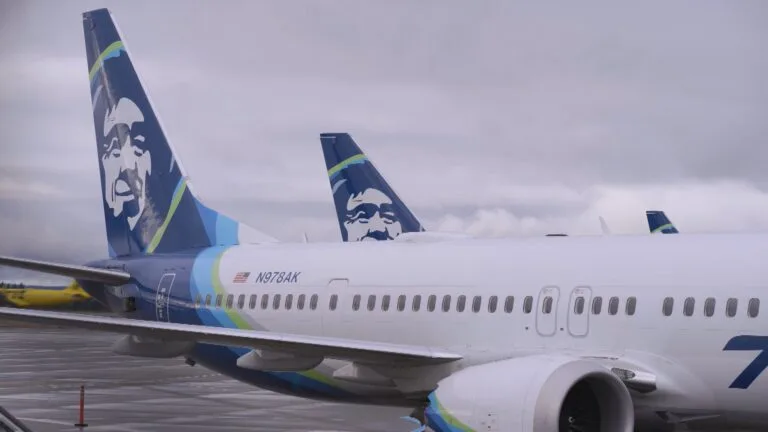
A 737 Max, flown by Alaska Airlines, had taken off from Portland, Oregon, about seven minutes earlier
NIRAJ CHOKSHI, The New York Times:
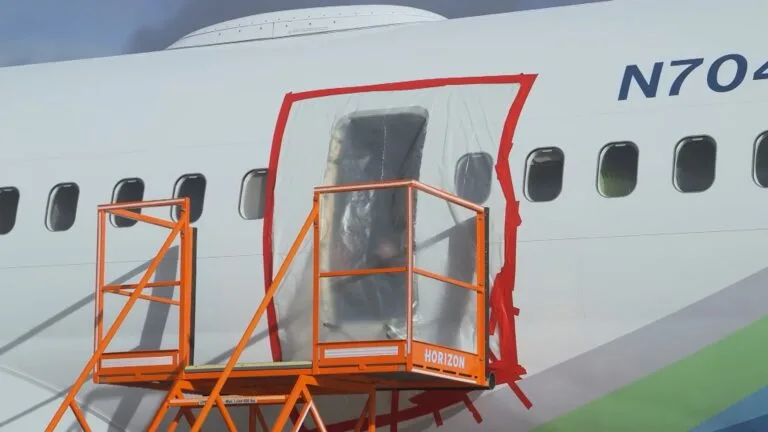
At an altitude of 16,000 feet, there’s a very loud bang. A piece of the plane’s body is blown out at row 26.
HUY TRAN, Alaska Airlines passenger:
I opened my eyes to a giant hole in the plane, and I could see the city lights.
MALE VOICE:
Your son is OK.
FEMALE VOICE:
OK.
NIRAJ CHOKSHI:
There’s a deafening wind howling through the plane. The cockpit door flies open. One of the pilots loses her headset. Another pilot almost loses his after his head slams into a display. There’s just chaos.
FEMALE VOICE:
His shirt was pulled off of him.
EVAN SMITH, Alaska Airlines passenger:
A boy’s shirt was sucked off him and out of the plane. And his mother was holding onto him.
CUONG TRAN, Alaska Airlines passenger:
I saw half of his body was getting sucked out, and then I was like, “Oh, my God.”
VI NGUYEN, Alaska Airlines passenger:
I look over and there’s a hole on the side of the plane, and in that moment I’m just like, “Oh, God, I’m going to die.”
FEMALE VOICE [cockpit voice recording]:
Yes, we are emergency. We are depressurized. We do need to return back to you. We have 177—
NARRATOR:
The plane was able to make an emergency landing back in Portland.
FEMALE PASSENGER:
Whoa!
NARRATOR:
But the incident resurrected concerns about Boeing and the Max.
JOE JACOBSEN:
We were very fortunate we didn’t have a third crash on Jan. 5.
FEMALE FLIGHT CREW VOICE:
We need everyone to remain seated with their seatbelts fastened right now.
NARRATOR:
Joe Jacobsen has continued to monitor the Max since retiring from the FAA in 2021.
JOE JACOBSEN:
Alaska 1282 could have very easily been a fatal crash. Higher altitudes, some passengers may have lost consciousness. Pilots could have lost consciousness.
NARRATOR:
This time, the FAA immediately grounded similar Max 9s so that each plane could be inspected.
FEMALE NEWSREADER:
Hundreds of flights are canceled across the U.S.
FEMALE NEWSREADER:
Boeing 737 Max 9 planes now—
MALE NEWSREADER:
—pulled out of service, forcing hundreds—
FEMALE NEWSREADER:
—around the world.
DAVID GELLES:
I honestly wasn’t surprised when I saw the news. It had direct echoes of everything we had been reporting on years ago as we tried to unpack what happened during the Max crisis.
NARRATOR:
At the New York Times, a new team was picking up the reporting on the Max and what it meant for Boeing.
SYDNEY EMBER, The New York Times:
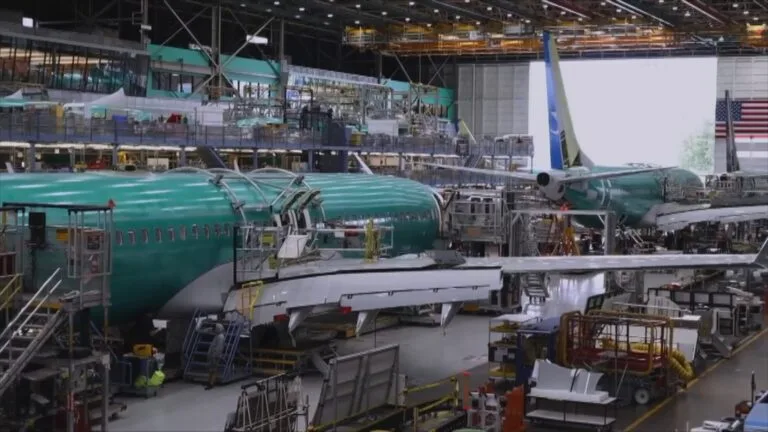
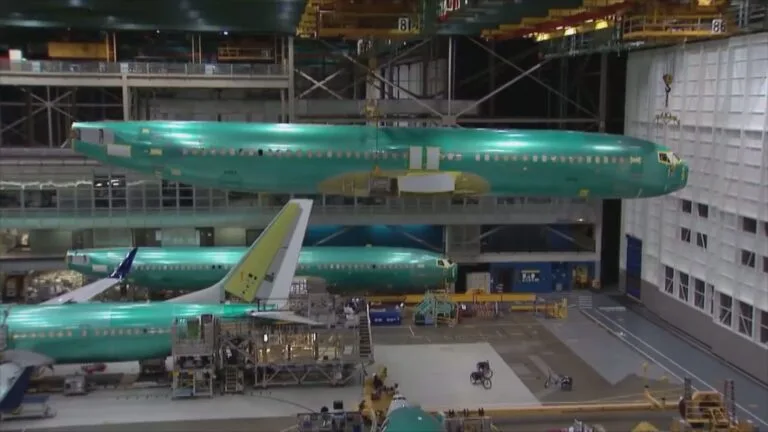
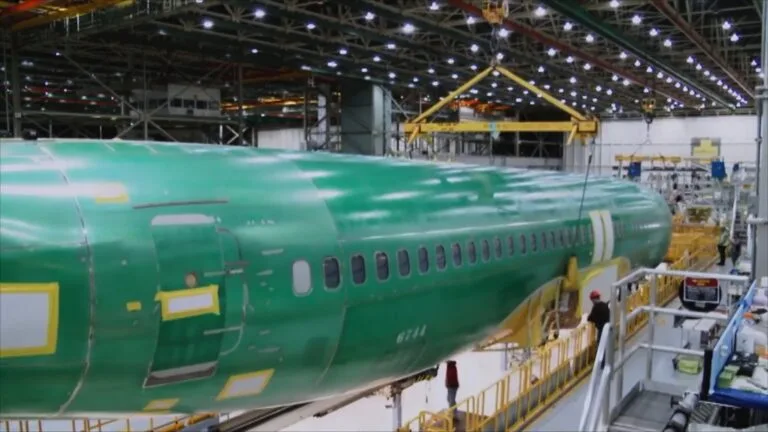
The real bombshell moment comes in early February when the National Transportation Safety Board releases its preliminary report on the incident. What the NTSB’s report makes clear is this was a problem on Boeing’s factory floor. This was Boeing’s problem.
NARRATOR:
The NTSB focused on a piece of the plane that replaced an unused emergency exit, called a door plug. Boeing workers had failed to install four bolts that secured it to the plane. The company later said it had no documentation of the work.
MARK WALKER, The New York Times:
Where was the oversight? Where was the redundant checks for someone to come back to make sure that the most critical pieces to it were there?
NIRAJ CHOKSHI:
Nothing in plane design or plane production is done without several layers of redundancy, without frequent inspections, without frequent checks. And the idea that something as important as a part of the plane’s body could leave the factory without the bolts needed to hold it in place is shocking.
SYDNEY EMBER:
This was supposed to be one of the most highly scrutinized planes in the world. And here you are with another incident that was risking passengers’ lives.
NARRATOR:
Boeing CEO Dave Calhoun was quick to own the failure in a series of appearances.
DAVID CALHOUN, CEO, Boeing:
We’re going to approach this, number one, acknowledging our mistake.
I want everybody, everybody on every airplane to know that Boeing owns it.
Boeing is accountable for what happened. An event like this simply must not happen.
We own it. There’s no other answer I can give you.
NARRATOR:
The door plug was a production failure; MCAS was a design flaw. But both raised questions about Boeing’s safety culture and the FAA’s oversight.
JOE JACOBSEN:
The shocking thing about the Max is the sheer number of problems—design problems, manufacturing problems.
NARRATOR:
Joe Jacobsen is now working with families of the victims of the 737 Max 8 crashes to bring other safety concerns to the FAA.
JOE JACOBSEN:
And this is after the supposedly most comprehensive recertification in the history of aviation.
DAVID GELLES:
I think what’s most scary is that you have both kinds of accidents happening at the same company. That to me reveals a culture inside the company. I know we keep coming back to this word “culture,” but it’s right at the root of what happened in both sets of accidents.
NARRATOR:
In a statement, Boeing said it is dedicated to transparency and it is implementing a comprehensive plan to strengthen safety and quality.
Less than seven weeks after the Alaska Air incident, the executive running the Max program was out.
In early March, the FAA said it had found multiple quality control issues with the Max. The agency also released a report that found Boeing’s safety culture has been “inadequate” and “confusing.”
And now the Justice Department is investigating the company.
DAVID GELLES:
Cultural change doesn’t happen overnight, especially at big corporations like this. And it doesn’t happen just because you got slapped with a fine. It’s the product of millions of decisions, whatever it might mean in terms of lost profits that impact the share price in the short term. But if Boeing wants to get back to that place of grandeur where it was for so long one of the most important American companies, it’s going to take not four years, but it might take 14.
NARRATOR:
More than 170 Max 9s were grounded by the FAA after the Alaska Airlines incident.
Nearly all are now back in service.
Boeing’s Fatal Flaw (2021 version)
Jakarta, Indonesia
October 2018
GERRY SOEJATMAN, Indonesian aviation analyst:
On the morning of Oct. 29, I was woken up by a colleague who alerted me that a Lion aircraft crashed. He said, “It’s the Max,” and I was surprised, because it was a new aircraft.
My company provided the air data for aircraft flying around the Jakarta area. So I went to the computer and looked at the data. It was immediately apparent that, OK, something was wrong.
The plane went up to about 2,000 feet, just over a minute after takeoff, and the plane had a bit of a dive. And then the plane climbed to about 5,000 feet. But then, at 5,000 feet, the plane was fluctuating up and down. And then the plane just started diving. It just didn’t make sense. You don’t see planes diving on departure. I was baffled. Why did it go down?
NEWSREADER:
Lion Air Flight JT610 went missing from radar—
NARRATOR:
One hundred eighty-nine people were killed in the crash of Lion Air Flight 610.
NEWSREADER:
The Boeing 737 Max 8—
NARRATOR:
The plane was a new Boeing 737 Max—
NEWSREADER:
What do we know about this 737 Max 8?
NARRATOR:
—the fastest-selling jet in Boeing history, just introduced the year before.
NEWSREADER:
We don’t yet know what caused this crash.
NEWSREADER:
A breakthrough this evening, the flight data recorder. It holds many of the keys—
NARRATOR:
The data from the black box quickly got to FAA engineers in the United States.
Seattle, Washington
JOE JACOBSEN, FAA engineer, 1995-2021:
There is a purity of this data. It comes directly from the black boxes. So it’s recording airspeed, altitude.
NARRATOR:
The data showed what appeared to be a glitch, something repeatedly moving part of the plane’s tail, controlling its pitch.
JOE JACOBSEN:
It didn’t take long—just a couple of minutes—to see that there was rapid movement of the horizontal stabilizer. It’s probably the fastest way to kill yourself in an airplane is to have the stabilizer malfunction.
New York City
JAMES GLANZ, The New York Times:
My spine literally tingled when I saw the traces from the black box. The plane continually tried to push the nose down, and the pilots were trying over and over again to stop the plane. And in the end, they lose that battle.
NARRATOR:
What Boeing had not told airlines or their pilots was that it had put a powerful software system on the new airplane.
JAMES GLANZ:
In the Lion Air crash, this system was receiving incorrect information, and that made the plane dive straight downward and destroy itself.
NARRATOR:
Inside Boeing, they quickly diagnosed the problem and began working on a fix. But they stood by the Max as hundreds of them took to the air around the world, carrying thousands of passengers.
The company alerted pilots about handling a potential malfunction.
NEWSREADER:
Boeing and the FAA today warned airlines that sensors on 737 Max 8 jets can malfunction.
NEWSREADER:
Boeing are calling this a formal advisory, and it’s been issued to the pilots.
NATALIE KITROEFF, The New York Times:
The reporting showed Boeing knew that it was risky, but their response was to blame the pilots.
NEWSREADER:
Pilots did not hit two cut-off switches. Boeing says that action was part of well-established protocols for all 737s.
NATALIE KITROEFF:
And that led to a series of decisions that kept the plane in the air. And then we got another crash.
Addis Ababa, Ethiopia
March 2019
NEWSREADER:
Breaking news out of Ethiopia, where a plane went down—
NARRATOR:
It was Ethiopian Airlines Flight 302, on its way to Nairobi from Addis Ababa.
NEWSREADER:
—where a new 737 Max 8 jetliner crashed minutes after taking off.
NARRATOR:
Two crashes, the same plane; 346 people killed; an iconic American company’s reputation in tatters.
The story of the Boeing 737 Max would end up exposing corporate deception and a broken regulatory process. But at the center was a software system supposed to keep people safe that instead led to their deaths.
NEWSREADER:
The black boxes from the Ethiopian crash have been recovered.
NEWSREADER:
It’s the second disaster within five months involving the Boeing 737 Max.
NEWSREADER:
That’s the same kind of aircraft that crashed back in October in Indonesia.
NEWSREADER:
One hundred and fifty-seven people, including passengers and crew members on board, all dead.
QUINDOS KARANJA, Relative of crash victims:
The first thing you get to see at the site is a very big hole. And then to only imagine this is the place that they were last alive.
NADIA MILLERON, Mother of crash victim:
We learned that there were no survivors on the plane. And then our objective was to go and bring my daughter’s body home.
QUINDOS KARANJA:
Now you’re in close proximity. You’re able to see the fine details. You’re able to maybe think these are personal effects belonged to Carol, my sister, or my mom. This bone, whose bone is this?
NADIA MILLERON:
They told us that there was no part of a human that was bigger than a femur that was left.
TOR STUMO, Brother of crash victim:
That whole experience is just a jumble of images and painful thoughts and blankness to me. I don’t really—I can’t really make sense of it.
NARRATOR:
The crash of Ethiopian Flight 302 was the second time in five months that a Boeing 737 Max had gone down. As families gathered at the crash site, across the world, reporters at The New York Times were investigating what had been going wrong with Boeing’s new commercial jet.
NATALIE KITROEFF, The New York Times:
Statistically speaking, the likelihood that these two accidents were not in some way connected was extremely low. It suggested that there was something going on with the plane, and obviously we were determined to find out.
DAVID GELLES, The New York Times:
It was clear from the get-go that Boeing was in full crisis mode.
March 18, 2019
DENNIS MUILENBURG, CEO, Boeing:
As the facts from the accident become available and we understand the necessary next steps, we’re taking action to fully reassure airlines and their passengers of the safety of the 737 Max.
DAVID GELLES:
This was going to be an existential crisis for the company if these two events were related.
NATALIE KITROEFF:
China grounds the plane first. Other international regulators ground the plane. Then the European Union grounds the plane.
NEWSREADER:
But in the U.S., the FAA says it’s not grounding the plane.
DAVID GELLES:
Boeing and the FAA all were saying that they were sort of waiting for the facts before they rushed to judgment and grounded such an important new plane.
NARRATOR:
But for months, the Times was reporting there was something wrong with the 737 Max itself: the software system that pilots had not known existed.
JAMES GLANZ, The New York Times:
The Maneuvering Characteristics Augmentation System, or MCAS.
The function of this previously undisclosed system was to save the plane when it believed that the plane might go into a stall and fall out of the sky. And so this system was designed then to sort of take over the stabilizer and push that nose back down in case the pilot gets in trouble.
NARRATOR:
Then, a major setback for the company: Radar showed the two planes’ flight patterns were eerily similar.
DAVID GELLES:
Days after the rest of the world had reached the same conclusion, they finally grounded the plane.
NARRATOR:
For the New York Times reporters, all the signs pointed to MCAS.
NATALIE KITROEFF:
We knew that MCAS was the beginning and we knew that we needed to start with this system.
JACK NICAS, The New York Times:
This was a really problematic software system in the way it was designed. OK, well, then how the hell did it end up in the plane this way?
NARRATOR:
Boeing declined to be interviewed for this film. In a statement, the company said safety is its top priority and it has worked closely with regulators, investigators and stakeholders “to implement changes that ensure accidents like these never happen again.”
June 20, 2011
DAVID GELLES:
This story really begins in 2011.
NEWSREADER:
The 2011 Paris Air Show officially opened Monday.
DAVID GELLES:
Boeing and Airbus had been going head-to-head for at least a decade. But Airbus had been quickly catching up and really nipping at Boeing’s heels.
TOM ENDERS, CEO, Airbus:
It’s the best air show ever for Airbus in terms of aircraft numbers sold.
DAVID GELLES:
In 2010, Airbus introduced the A320neo, a more fuel-efficient version of its stalwart A320.
SCOTT HAMILTON, Aviation consultant:
The A320 is the direct competitor to the Boeing 737. Airlines wanted an airplane that was more fuel efficient than the airplanes then in service. Airbus chose to re-engine the A320 into what they call the neo, the “new engine option.”
NEWSREADER:
It’s a record 200 orders for its A320neo.
SCOTT HAMILTON:
It was one of the fastest-selling programs of aviation history.
DAVID GELLES:
And it placed enormous pressure on Boeing to respond.
SCOTT HAMILTON:
About 40% of the profits for the entire Boeing Company came from the 737.
DAVID GELLES:
The 737 was the best-selling commercial airplane of all time.
NEWSREADER:
The ten thousandth 737 aircraft is going to roll off the assembly line today.
DAVID GELLES:
More than 10,000 of these airplanes have been used by hundreds of airlines all over the globe.
NEWSREADER:
The official 737 christening ceremony took place in the new final assembly building.
DAVID GELLES:
What always amazed me is that the 737 was first introduced when the Beatles were still together.
JACK NICAS:
Right. Jan. 17, 1967, flight attendants christened the first Boeing 737 by smashing champagne bottles over the wing.
SCOTT HAMILTON:
It was designed to be very low to the ground. Now by the 1980s, Boeing had to upgrade the 737, and they created what was called 737 Classic, which had a new engine on it.
NEWSREADER:
—the first brand new Boeing 737-500—
SCOTT HAMILTON:
In the 1990s you had the 737 Next Generation, which had a new wing on it and some fuselage stretches.
DAVID GELLES:
And so here we are in 2011 with the Paris Airshow with the A320neo, and Boeing frankly was caught flat-footed.
Within a couple of weeks, Airbus and American Airlines have the preliminary workings of what would become the first deal for American to buy Airbus planes in more than a decade.
Gerard Arpey, the CEO of American Airlines, calls Jim McNerney, the CEO of Boeing. It’s a courtesy call at this point, just letting their longtime supplier of airplanes know they’re going to go with the competition.
NATALIE KITROEFF:
And that is essentially a dagger in the heart of Boeing.
SCOTT HAMILTON:
And within 48 hours, Boeing had decided to pull the trigger on launching the re-engined 737, which later became branded as the Max.
NATALIE KITROEFF:
From the very beginning, from its birth, it was marked by competitive pressure.
SCOTT HAMILTON:
You need to understand what was going on with Boeing at the time that the Max program was launched. Boeing was billions of dollars over budget on its 787 program, on its 747-8 program. Airlines were thoroughly ticked off at Boeing over the delays. And Boeing was looking at the Max to restore its own credibility.
NARRATOR:
Within days of the second 737 Max crash, another investigation was underway in Washington, D.C.
DOUG PASTERNAK, Dir., Investigations, House Transportation Cmte.
We started getting information in from whistleblowers, from people, both current and former FAA and Boeing employees.
NARRATOR:
Doug Pasternak was leading a congressional investigation. This is the first time he is speaking publicly about what he found.
DOUG PASTERNAK:
As soon as the second accident occurred, we started our investigation, and our focus was on the design, development and certification of the Max. We got hundreds of thousands of pages of documents from Boeing.
One of the things that really struck me from speaking to a lot of Boeing employees was that they were so excited to go to work at Boeing. Boeing is a tremendous engineering company and a technical marvel, but almost without failure, they point to a degradation of that mindset and that safety suffered as a result. Looking backwards, I think you can clearly see the trajectory to tragedy along the way at Boeing.
NARRATOR:
Boeing publicly said the Max went through a deliberate six-year development process. But in their first stories, the New York Times reporters found insiders who said that Boeing executives had been putting the pressure on to design the new 737 quickly and cheaply.
JACK NICAS:
One specific engineer we spoke to was Rick Ludtke. He helped design the cockpit in the Max, and he talked a lot about how there was an obsession in limiting changes.
New York Times Interview With
Rick Ludtke
RICK LUDTKE:
This program was a much more intense pressure cooker than I’ve ever been in. The company was trying to avoid costs—minimum change to simplify the training differences, and to get it done quickly.
DAVID GELLES:
It put what had happened in the context of this broader corporate narrative.
JACK NICAS:
Yeah.
New York Times Interview With
Rick Ludtke
RICK LUDTKE:
Speed was what they seemed to desire. There was a lot of decision-making that was somewhat arbitrary and didn’t involve as much of the—of what engineering considers healthy debate. The challenge to the Boeing designers was that any designs we create would not drive any new training that required a simulator.
NARRATOR:
In his recorded interview with the Times, Ludtke said Boeing management was so determined to avoid the expense of new training they made a bold promise.
New York Times Interview With
Rick Ludtke
RICK LUDTKE:
Sales had made a commitment with Southwest that for any airplane they delivered that had a new Level D differences training, Boeing would pay the company $1 million dollars for every airplane delivered.
DAVID GELLES:
If the Max required simulator training, it would rebate Southwest a million dollars per plane. And there’s that incentive. That’s why it was so important to Boeing that pilot training be kept to a minimum.
NATALIE KITROEFF:
All of this comes out of trying to give airlines the most fuel-efficient version of a plane that they can spend as little money training their pilots on.
JACK NICAS:
That meant Boeing had to do a number of things to make this plane fly like the old one, and that was because the Max had much bigger engines on it to make them more fuel efficient.
DAVID GELLES:
But because the 737 was a 50-year-old airplane at this time, practically, when it came time for Boeing to put those engines on the wings, the engines were so darn big they had to mount them further forward on the wings.
JACK NICAS:
They were testing in this wind tunnel, and they were discovering the plane was handling just a little bit differently. But they didn’t even have a plane built yet, so this wasn’t happening in real flight. This is something you have to fix. And they leaned on a system that they had used once before, in a military tanker. It was designed as a system on the plane to really just smooth out the way the plane handled.
NARRATOR:
It was MCAS.
JACK NICAS:
It was designed for these extremely unusual maneuvers. Situations that hopefully the plane would never get in. And to prevent the nose from getting too high, the system would move the stabilizer on the back of the plane to push the nose back down.
NARRATOR:
But inside Boeing, there were early signs of trouble.
DOUG PASTERNAK:
One of the first documents we found was from November of 2012. A Boeing test pilot was flying the Max in a flight simulator and trying to respond to an activation of MCAS. And that resulted in what he described as a catastrophic event. It showed that if that had been in real life, he could have lost the airplane. They realize from that moment on even a Boeing test pilot may have trouble responding to MCAS.
NARRATOR:
The company kept quiet about the simulator experience and appeared to have discounted the test results. Still, in the following months, some Boeing employees suggested simply removing all references to MCAS from training manuals.
DOUG PASTERNAK:
Boeing from almost the very beginning realized the significance of MCAS and the significance MCAS would have on pilot simulator training. “If we emphasize MCAS is a new function, there may be a greater certification and training impact. Recommended action: investigate deletion of MCAS nomenclature.”
What that meant was that if they said MCAS was a new function, the FAA was going to scrutinize it a lot more.
NARRATOR:
Boeing told Congress it kept the FAA informed about MCAS’s development and final configuration.
But Boeing has a complex and close relationship with the agency that oversees it.
NATALIE KITROEFF:
The airplanes are part of the story, but so are the regulators. The FAA regulated Boeing, in part, with a handful of Boeing employees whose paychecks came from Boeing but whose jobs were to represent the interests of the FAA.
NARRATOR:
It’s a decades-old arrangement known as “delegation” that allows federal agencies to give oversight powers to the companies they regulate.
NATALIE KITROEFF:
In the beginning there was a really good reason for this. The FAA was certifying things that made no sense to have them certify every single exit sign or bathroom sign or paint. The issue that many of the FAA employees that we talked to had was that it went way beyond bathroom signs.
Over time, Congress passed laws that pushed the FAA to hand over the responsibility for more and more tasks to the company, to Boeing.
DAVID GELLES:
With this level of delegation between the company and the FAA, it became hard to understand who was working for who.
There was one key person inside the FAA: Ali Bahrami.
FAA video
ALI BAHRAMI:
I’m Ali Bahrami. My job at the FAA is to lead and manage aviation safety organization.
NARRATOR:
In the midst of a long career at the FAA, Ali Bahrami had left to spend four years as a lobbyist for the Aerospace Industries Association.
DAVID GELLES:
While he’s in that lobbying role, he says, “We urge the FAA—”
ALI BAHRAMI:
We urge the FAA to allow greater use of delegation not only to take full advantage of industry expertise but to increase the collaboration that improves aviation safety.
DAVID GELLES:
So here’s the guy who would ultimately lead the FAA’s safety operation encouraging the FAA to let industry do as much of its certification work as possible.
NARRATOR:
Neither Ali Bahrami nor the FAA would agree to an interview, but former FAA administrator Michael Huerta spoke to us about delegation and the relationship between the agency and Boeing.
MICHAEL HUERTA, Administrator, FAA, 2013-18:
There are those that believe it is the fox guarding the henhouse. Here is why it’s not. The company has an organization whose responsibility is to ensure that it is in compliance with the standards that are set by the FAA, and it has a level of independence from the entities that they’re overseeing.
What that gets back at is the issue of trust and transparency, because the whole regulatory framework and the whole delegation process is premised upon a notion that everyone is going to share their knowledge and their expertise with one another.
NARRATOR:
In the design of the 737 Max, many things would be delegated to Boeing. That included MCAS.
NATALIE KITROEFF:
Under the impression that this was a relatively benign system, the FAA agreed to delegate it, as is the custom with the FAA and Boeing. And that’s what happened in this case. It handed it over.
NARRATOR:
In a statement, the FAA blamed ineffective coordination and said it had not focused on MCAS when it certified the Max because Boeing had not identified MCAS as significant. Congress has ordered the agency to revise the delegation process.
January 29, 2016
NARRATOR:
After years of going through design and development, the 737 Max prototype was rolled out of Boeing’s Renton factory for its maiden flight.
REPORTER:
Look at all the excited faces. They wouldn’t miss it.
JACK NICAS:
Ed Wilson is in the cockpit—he’s the new chief pilot—and he takes off.
REPORTER:
And let’s just take a listen as this airplane gets ready for its very first takeoff.
JACK NICAS:
A short time after this first maiden flight, Ed Wilson, he and his co-pilots start to realize that the 737 Max is not handling as smoothly as it should in certain low-speed situations. It’s shortly after takeoff. It’s still climbing to ascent. It’s not going full speed.
NARRATOR:
Boeing engineers had an idea for how to deal with this.
JACK NICAS:
They know about MCAS and they know that MCAS was actually used for a similar situation in these high-speed maneuvers and so theoretically MCAS could also be used in these other situations to also smooth out the handling.
Crucially, it’s already been created, it’s already been approved, and it’s something that we could just apply to a different phase of flight. It’s actually a pretty easy fix.
This ends up being an extremely fateful decision. They enable the stabilizer to move much more—actually four times as much. Now the system’s designed for low-speed situations like just after takeoff. And after takeoff is when the plane is still only a few thousand feet over the ground. That means you have much less room for error. It’s happening in an automated fashion and a repeated fashion. This fundamentally changes MCAS. It makes it much more aggressive, much more risky. It’s a far more dangerous system.
NARRATOR:
Boeing was doubling down on the system, expanding it despite the earlier catastrophic result in a simulator test.
The Times’ reporting on MCAS focused on a former Boeing pilot.
NATALIE KITROEFF:
I started to hear about a pilot at Boeing whose name was Mark Forkner. He came up through the Air Force Academy. He flew for Alaska Airlines. And he became the chief technical pilot for the 737. He had played a definitive role in making sure that there was minimal pilot training on the Max.
DOUG PASTERNAK:
Boeing released to our committee instant messages and emails from Mark Forkner and some of his colleagues. In one of these emails that Mark Forkner sent out, he says, “I want to stress the importance of holding firm that there will not be any type of simulator training required to transition to Max.” And he said, quote, “Boeing will not allow that to happen.”
DAVID GELLES:
He was this key liaison between the company and the FAA.
NATALIE KITROEFF:
He was the person who personally emailed the FAA asking for MCAS to be removed from the pilot manual. That was an important piece of this, because we understood that the FAA really didn’t know that MCAS became more powerful.
DAVID GELLES:
He was speaking, absolutely, on behalf of the company. This was not some low-level employee. And he was asking for something that was really quite substantial: that a new piece of software that made the plane behave in ways that it previously hadn’t be concealed from the pilots.
This is where the commercial pressures from the executive level come right down to the development of the airplane.
DOUG PASTERNAK:
Mark Forkner certainly was not a lone actor in what he did. He was following through on a policy by Boeing to ensure that the program did not have to put pilots in a flight simulator.
DAVID GELLES:
It got to the point where Mark Forkner got an award for keeping training on the 737 Max to a minimum.
NARRATOR:
Nearly eight months after requesting that MCAS be removed from pilot training manuals, Forkner texted a colleague with a shocking realization.
NATALIE KITROEFF:
This appears to be the moment where Mark Forkner learns that MCAS has been expanded. He writes in that message, “I basically lied to the regulators, unknowingly.”
DAVID GELLES:
But he never went back and corrected the record. He never went back and fixed the error.
NARRATOR:
Mark Forkner wouldn’t speak to us, but his lawyer told the Times reporters that his communications with the FAA were honest and that “he would never jeopardize the safety of other pilots or their passengers.”
When Boeing engineers expanded the MCAS system, they included a feature that would make it particularly dangerous.
DAVID GELLES:
Planes have millions of parts in them. And there’s one little one on the 737 that sticks out of the fuselage.
REPORTER:
See that little black circle there? That is called—
DAVID GELLES:
The angle of attack sensor.
NARRATOR:
On the 737 Max, it had the power to trigger MCAS.
JAMES GLANZ:
It’s the AOA sensor that is one of the crucial parameters to the computer to tell the plane that it’s in a perilous condition.
JACK NICAS:
The angle of attack sensor would activate MCAS by telling the system that the plane’s nose was too high and then MCAS would try to push the nose down.
DAVID GELLES:
But if this sensor is broken, for whatever reason, MCAS never realizes and so it keeps pushing the nose of the plane down over and over again.
NARRATOR:
Congressional investigators would later find documents showing that Boeing engineers had raised this very concern.
DOUG PASTERNAK:
An engineer asked, “What if we have a faulty AOA sensor?” Because AOA sensors are known to be faulty. What happens to the airplane? So you have those concerns raised and the response is again, from Boeing engineers, was to essentially dismiss those.
May 2017
FEMALE VOICE:
Three, two, one.
NARRATOR:
Boeing began delivering the new 737 Max in mid-2017.
JACK NICAS:
At the outset, 737 Max was arguably one of Boeing’s biggest successes. It had become its best-selling jet ever.
NARRATOR:
Advanced sales were estimated at $370 billion. American had orders for 100, Southwest Airlines for 200. Boeing had focused especially hard on selling to developing markets in Asia, where Lion Air’s parent company became the first customer to fly the 737 Max, signing an agreement worth more than $20 billion.
JACK NICAS:
Airlines loved it. There was a yearslong waiting list to get one.
DAVID GELLES:
But Boeing’s signature new jet had a fatal flaw.
NEWSREADER:
Breaking news. The search for wreckage is underway after a passenger jet with 189 people on board crashed.
NEWSREADER:
A Lion Air Boeing 737.
NEWSREADER:
A nearly brand-new 737 Max.
NARRATOR:
Investigators from the U.S. National Transportation Safety Board contributed to an analysis of what led to the Lion Air crash.
DANA SCHULZE, Dir., Office of Aviation Safety, NTSB:
Leading up to the Lion Air accident, the angle of attack probe itself was miscalibrated. The maintenance crew was not able to properly identify this miscalibration.
NEWSREADER:
—an angle of attack sensor sent bad data to MCAS.
NEWSREADER:
The plane thought it was in a stall because of bad information.
DANA SCHULZE:
And as a consequence of this angle of attack data error, the MCAS activated when it really shouldn’t have.
DAVID GELLES:
Five months later, almost the exact same thing happens halfway across the world.
NEWSREADER:
—new 737 Max 8 jetliner crashed today.
NEWSREADER:
Investigators say that flight had similar problems to the Lion Air crash.
DAVID GELLES:
Once again the angle of attack sensor is malfunctioning.
NEWSREADER:
There is this question now about systems within the aircraft.
DAVID GELLES:
If MCAS hadn’t been on those planes, those planes wouldn’t have crashed. It’s that simple.
NEWSREADER:
The world mourns 157 people killed in the Sunday crash.
QUINDOS KARANJA:
On the flight of 737 Max crash we we lost five of our family members. We had our mom, Anne Karanja; our dear sister, Carolyne Karanja; her three kids, Ryan Njoroge, Kelli Wanjiiku and Rubi Wangui.
It’s not like there is a manual of how you need to react. You’re just there. It’s like motionless. You just feel infuriated by anyone and everyone at that point.
I remember the Boeing Company blaming what they call the “foreign pilots” and deflecting blame to them, saying they are the cause.
DENNIS MUILENBURG:
All of us at Boeing are deeply sorry for the loss of life in the Ethiopian Airlines Flight 302 and Lion Air Flight 610 accidents.
NARRATOR:
Boeing CEO Dennis Muilenburg latched onto findings that inexperience and lack of training were part of a chain of events that led to the crashes. It was a controversial position.
DENNIS MUILENBURG:
Understand that these airplanes are flown in the hands of pilots, and in some cases our system safety analysis includes not only the engineering design but also the actions that pilots would take as part of a failure scenario.
JAMES GLANZ:
Boeing’s contention from the beginning was that even though the pilots did not know that MCAS existed, that they did not need to know that.
DENNIS MUILENBURG:
—and in some cases those procedures were not completely followed.
JAMES GLANZ:
Boeing believed that the pilot should have been able to realize that it was very similar to a runaway stabilizer situation.
NARRATOR:
Runaway stabilizer is an aviation term for a malfunctioning stabilizer. After the Lion Air crash, Boeing had issued a directive to pilots to be aware of this possibility and told them what to do if it happened.
NATALIE KITROEFF:
When that part of the tail was not acting the way that it should be, you take manual control of it.
NEWSREADER:
The pilots could have stopped their rollercoaster ride by turning these two switches off.
JACK NICAS:
To shut off power to the stabilizer, you stop it from moving on its own. And then you start cranking a wheel in the cockpit that literally will manually move the stabilizer back to where you want it to move.
NATALIE KITROEFF:
The issue was were there things happening inside the cockpit that might have made that harder to do? That’s what we were asking.
DAVID GELLES:
When we finally got the preliminary black box data from the Ethiopian crash, we called up Dennis Tajer, an American Airlines 737 pilot, and sent him the data, and we read through it together.
DENNIS TAJER, Spokesperson, Allied Pilots Assoc.:
My mission was to provide them, “I’m in the cockpit, I see what’s happening now.” So we walk through each line, and I had no idea what was in it. I knew that the crew had an experienced captain and a lesser experienced first officer.
DAVID GELLES:
We go, second by second, through the few minutes of this flight.
Boeing 737NG Flight Simulator
NATALIE KITROEFF:
Going through the steps that the pilots had taken and saying, “Yep, I would have done that. Yep, I would have done that.”
DENNIS TAJER:
And as soon as they lift off the ground, all these different alerts started popping up: the airspeed was unreliable, the altitude was showing unreliable. There were alerts related to that, but they bring the gear up and they continue to climb out.
Boeing 737NG Flight Simulator
NARRATOR:
Two minutes into the flight, based on faulty data from the AOA sensor, MCAS kicked in and began pushing the nose down.
COCKPIT ALERT VOICE:
Don’t sink. Pull up.
DENNIS TAJER:
And I have a very clear memory of noting a time mark where the first officer is quoted as saying, “Stab trim cutout switches,” which takes the weapon away from MCAS, which is what Boeing told us to do. And I have to confess, I probably swore, I said, “The kid got it right. The kid got it right.”
NATALIE KITROEFF:
What had happened was the pilots did do what they were supposed to do. They had cut the electricity off.
COCKPIT ALERT VOICE:
Don’t sink. Pull up.
NATALIE KITROEFF:
They hit these switches, and they tried to take manual control.
DENNIS TAJER:
The first officer is reaching to this large wheel on his left—
COCKPIT ALERT VOICE:
Pull up.
DENNIS TAJER:
—and that’s the manual trim wheel, and trying to turn it. It’s like lifting up a 10-ton bucket of cement out of a deep well.
COCKPIT ALERT VOICE:
Don’t sink.
NATALIE KITROEFF:
The problem was, at that point the plane was going so fast that even after they took manual control they could not physically get the plane to right itself. They shouldn’t have been going that fast.
COCKPIT ALERT VOICE:
Too low, terrain.
DENNIS TAJER:
And they’re continuing to accelerate towards the ground.
COCKPIT ALERT VOICE:
Pull up.
DENNIS TAJER:
The ground is approaching them.
NARRATOR:
Then, with no apparent recourse, the pilots reached for the stabilizer switches.
DENNIS TAJER:
I’m yelling into the cockpit, “Don’t do that!” But I don’t know what they’re facing.
COCKPIT ALERT VOICE:
Caution: terrain.
NARRATOR:
MCAS was reactivated.
COCKPIT ALERT VOICE:
Pull up. Pull up.
DENNIS TAJER:
MCAS says, “Hey, I’m back on. Here we go—Zzz-zzz,” and now the airplane is in near full nose-down trim, and you can pull back forever and there’s not enough metal in the back of the airplane to make that airplane come up to a nose-up.
COCKPIT ALERT VOICE:
Terrain. Terrain. Pull up. Pull up. Pull up.
NADIA MILLERON:
She died when she was 24. It’s unbearable that she’s not with us. And the only thing I can do is try to prevent this for other people.
NARRATOR:
About four months after the Ethiopian Airlines crash, the family of Samya Stumo was about to receive news they would find bewildering.
NADIA MILLERON:
We were eating dinner and I hadn’t looked at my phone for a long time. And it was blowing up.
SEN. SUSAN COLLINS, R-ME:
We are joined today by Ali Bahrami, the associate administrator for aviation safety.
ALI BAHRAMI:
Chairman Collins, Ranking Member—
NADIA MILLERON:
There were families from Kenya, from Ethiopia, from all over saying, “Who is this Ali Bahrami?”
ALI BAHRAMI:
We continue to evaluate Boeing’s software modification to the MCAS.
NARRATOR:
The FAA’s Ali Bahrami had been called before Congress, where he was questioned about revelations the FAA had known there was a risk of another Max crashing after Lion Air.
SUSAN COLLINS:
If the agency’s own analysis found MCAS to be an unacceptable risk, why did the FAA not take immediate action to address those risks?
NADIA MILLERON:
The families hadn’t known that before. They didn’t know that the safety agency gambled with passenger lives.
ALI BAHRAMI:
We knew that eventual solution would be to have the modification. And based on our risk assessment, we felt that this—we had sufficient time to be able to do the modification and get the final fix.
NARRATOR:
After the Lion Air crash, the FAA had conducted an analysis of the likelihood of another 737 Max crashing. The worst-case scenario was grim.
DOUG PASTERNAK:
They looked at the probability that there could be another crash of a 737 Max if the FAA didn’t do anything to MCAS and just let the plane keep flying. And what that assessment showed was that FAA predicted there could potentially be 15 more fatal accidents of 737 Max aircraft over the lifespan of the fleet, about one crash every other year.
NARRATOR:
But in explaining its decision not to ground the plane, the FAA said in its statement that the actual risk at the time, considering the number of planes in the air, was as close to zero as their calculations allowed. The agency had given Boeing 150 days to fix MCAS and issued official directives to pilots.
DOUG PASTERNAK:
They were gambling. They were betting against time that they would have a fix to MCAS before the next crash happened. And, unfortunately, they lost that bet.
NARRATOR:
Not everyone within the FAA agreed with the agency’s gamble.
JOE JACOBSEN, FAA engineer, 1995-2021:
People too quickly jumped to that conclusion: that the pilot should have been able to figure out what’s going wrong and be able to intervene properly.
NARRATOR:
FAA engineer Joe Jacobsen examined the data from the Lion Air crash and quickly raised concerns about the safety of the Max. This is his first on-camera interview.
JOE JACOBSEN:
I was pointing out a design flaw. It was purposely designed and certified to use only one AOA input to drive MCAS, to move the horizontal stabilizer at a high rate.
I talked to three managers, said this a design flaw. They were skeptical, not really buying in, saying the pilot should have been able to intervene.
It’s a failure. Our job is aviation safety and when airplanes go down we feel a real personal sense of loss and remorse and failure, and it affects a lot of people.
NARRATOR:
In the fall of 2019, with the Max having been grounded for seven months, congressional investigators released internal communications they found during their investigation.
NEWSREADER:
Test pilots working for Boeing write about problems with the MCAS system two years before the first fatal crash in Indonesia.
NARRATOR:
They offered further evidence of the company’s attempt to avoid pilot training for the Max.
NATALIE KITROEFF:
Then we got the messages, and I remember where I was in my kitchen, because it was Mark Forkner.
NARRATOR:
In one document, the former Boeing pilot who had written notes assuring MCAS would not be put in training manuals joked about swaying regulators with “Jedi mind-tricking.” Other documents, released later, even showed Forkner dismissing the idea of pilot training for Lion Air.
DAVID GELLES:
When Lion Air, the airline that ultimately flew the first plane that crashed, was asking for simulator training, he was disparaging them to his colleagues, calling them stupid.
REP. PETER DeFAZIO, D-OR, Chair, House Transportation Cmte:
I mean, seriously? Did that ever cross their minds, that they were going to let something go into the air that could potentially kill people?
NARRATOR:
Boeing CEO Dennis Muilenburg appeared before Congress.
NEWSREADER:
Boeing’s CEO is expected to acknowledge his company made mistakes—
NATALIE KITROEFF:
And here’s the first time this guy’s in the hot seat.
NARRATOR:
By then he’d become the face of the 737 Max crisis.
PETER DeFAZIO:
I have been on this a committee a long time. We have never undertaken an investigation of this magnitude.
We intentionally put the families close to the witness. They’re the victims here, and it should be like a trial in court, where you get to face the person who committed a violent act against you.
NARRATOR:
The committee confronted Muilenburg with an array of internal Boeing documents.
REP. SHARICE DAVIDS, D-KS:
—the next slide. This shows that Boeing became aware that the disagree alert wasn’t working.
REP. TOM MALINOWSKI, D-NJ:
It does appear from this that Boeing understood how important the crew training—
REP. COLIN ALLRED, D-TX:
That pilots didn’t know about this is unacceptable.
SHARICE DAVIDS:
Boeing’s marketing representatives emphasized to potential customers that FAA had reduced the length of pilot training that—
PETER DeFAZIO:
—slow reaction time scenario, 10 seconds, found the failure to be catastrophic.
NATALIE KITROEFF:
For those families, the pain of this was accentuated because this evidence that was going up on the screen was information that they felt that Mr. Muilenburg could have used to inform his decision about keeping the plane in the air or not.
PETER DeFAZIO:
We do know that Boeing engineers actually proposed placing a MCAS annunciator in the cockpit.
‘‘Are we vulnerable to single AOA sensor failure with the MCAS?”
Now, as you emphasized, flight control will now compare inputs from both AOA sensors. And I guess the question is, why wasn’t it that way from Day One?
DENNIS MUILENBURG:
Mr. Chairman, we’ve asked ourselves that same question over and over. And if back then we knew everything that we know now, we would have made a different decision.
NATALIE KITROEFF:
Nadia Milleron, she was radiating with anger over this.
NADIA MILLERON:
It’s come to the point where you’re not the person anymore to solve the situation. I want to say it to you directly, because I don’t think you understand what we’re saying.
NATALIE KITROEFF:
She was right in front of him. And here you have the CEO of what is one of the most important American companies, one of the most important companies in the world—
DENNIS MUILENBURG:
In the end, it’s about safety, and I—
NADIA MILLERON:
Even if you’re not capable of doing that?
NATALIE KITROEFF:
—looking in the eyes of the mother of a young woman who died on his airplane.
NADIA MILLERON:
I know that she wasn’t afraid of flying at all, until the last six minutes of her life. That’s just a horrible betrayal that Boeing and the FAA caused for this person, the last moments of their life, and it kills me that that trust was betrayed.
NEWSREADER:
Boeing’s really kind of stuck in a hard spot here.
NEWSREADER:
Dennis Muilenburg was blasted on Capitol Hill.
NARRATOR:
Two months later, with the company’s stock plummeting—
NEWSREADER:
Boeing stock has been dropping all day.
NEWSREADER:
—but it’s down 22% since the 737 Max jet was first grounded back in—
NARRATOR:
—and the Max still grounded, Dennis Muilenburg was out.
Near the one-year anniversary of the second 737 Max crash, New York Times reporters Natalie Kitroeff and David Gelles flew to St. Louis.
St. Louis, Missouri
NARRATOR:
By then, Boeing was recommending pilot training and retooling the MCAS software with a second AOA input as a fail-safe. They’d been invited to Boeing’s offices there by the new CEO.
DAVID CALHOUN, CEO, Boeing:
Welcome.
NATALIE KITROEFF:
Thank you for having us. We’re happy to be here.
NARRATOR:
The interview was recorded.
DAVID CALHOUN:
Glad you’re here.
DAVID GELLES:
We got a lot of questions.
DAVID CALHOUN:
Yeah.
DAVID GELLES:
We have a lot of catching up to do.
NARRATOR:
He had been on the company board of directors throughout the 737 Max program and described himself as the company’s “backup plan” to Dennis Muilenburg’s handling of the crisis.
DAVID CALHOUN:
Boards are invested in their CEOs until they’re not. We had a backup plan. I think this board was incredibly well prepared. I am the backup plan.
DAVID GELLES:
David Calhoun had been on the board of Boeing for several years. He laid the blame squarely at the feet of Dennis Muilenburg.
NARRATOR:
He was in the midst of damage control.
DAVID CALHOUN:
It’s more than I imagined it would be, honestly. And it speaks to the weaknesses of our leadership.
NATALIE KITROEFF:
He was shooting straight from the hip. It was kind of disarming to hear from the CEO of Boeing.
NARRATOR:
He told the reporters the company had indeed made a “fatal mistake,” which was assuming all pilots could counteract a misfire of MCAS.
DAVID CALHOUN:
We made a decision in December to recommend simulator training everywhere in the world because of the regulators and the pilots in the developing world. Not because the U.S. airlines needed it. They probably don’t.
DAVID GELLES:
There is this narrative that some foreign pilots are not as good as American pilots. And Boeing seemed to be suggesting as much. We pressed Calhoun on this issue.
Do you believe that if U.S. pilots had encountered the MCAS malfunction that Lion Air and Ethiopian 302 experienced, would they have been able to deal with it, in your estimation?
DAVID CALHOUN:
And I’m not going to let you write this down. Do you agree you’re not going to write it down?
DAVID GELLES:
No.
DAVID CALHOUN:
All right, forget it. You can guess the answer.
DAVID GELLES:
That interview was essentially the last Boeing story that we did.
To this day, I think Boeing doesn’t accept full responsibility for these crashes. There’s always the implication that if the pilots had acted appropriately, those 346 people would still be alive today.
NARRATOR:
In March of 2021, families gathered in Washington, D.C., for the second anniversary of the crash of Ethiopian Airlines Flight 302. Boeing had recently settled a criminal charge of conspiracy to defraud the United States brought by the Department of Justice.
NEWSREADER:
We have some breaking news on Boeing.
NARRATOR:
In the settlement, Boeing admitted to “misleading statements, half-truths and omissions” about MCAS. It agreed to pay $2.5 billion—$500 million to the families of the victims and most of the rest to compensate the airlines.
The FAA retested and approved the 737 Max. It is once again flying passengers around the world.
Boeing’s Fatal Flaw (2024 version)
WRITTEN AND DIRECTED BY Thomas Jennings
PRODUCERS Vanessa Fica Kate McCormick
ADDITIONAL PRODUCING Anya Bourg
REPORTED BY David Gelles James Glanz Natalie Kitroeff Jack Nicas Niraj Chokshi Sydney Ember Mark Walker
SENIOR PRODUCER Frank Koughan
CONSULTING PRODUCERS, THE NEW YORK TIMES David Gelles Natalie Kitroeff
SUPERVISING PRODUCER, THE NEW YORK TIMES Jason Stallman
ADDITIONAL REPORTING Vanessa Fica Kate McCormick Thomas Jennings Rebecca Blandon
EDITORS Geoff O’Brien Fanny Lee
ADDITIONAL EDITING Jane Jo Chris O’Coin
DIRECTOR OF PHOTOGRAPHY Jeremy Gould
NARRATOR Will Lyman
EXECUTIVE IN CHARGE Stuart Fero
ADDITIONAL PHOTOGRAPHY Nikki Bramley Michael Cormier Thomas Jennings Paul Mailman Wes Morin Jaron Berman Paul Mailman
CAMERA Eric Koraganie Katherine McNamara Sara Mustelin
ASSISTANT CAMERA Sam Bradley Ryan Brown Dan Kerrigan
SOUND Andre Artis Scott Clementson Mike Frank Adam Grass Bernie Ozol Adam Grass
ASSOCIATE PRODUCER Rebecca Blandon
SENIOR ARCHIVAL PRODUCER Megan Robertson
ARCHIVAL RESEARCHER Brett Joffe.
LOCAL PRODUCERS Fira Abdurachman Hemal Shah
CONSULTANT PRODUCER Julie Rasquin
PRODUCTION MANAGER Emily Malley
ORIGINAL MUSIC Griffin Jennings
ONLINE EDITOR/COLORIST David Bigelow Joey Mullin
SOUND MIX Jim Sullivan Christopher D. Anderson, C.A.S.
POST PRODUCTION SUPERVISORS Danielle Pruden Gregory Littauer Nicole O’Donnell
RIGHTS & CLEARANCES SUPERVISOR Rose Donnelly
RIGHTS & CLEARANCES COORDINATOR Erica Sarmiento
LEAD ASSISTANT EDITOR Stephen Cleary
ASSISTANT EDITORS Peter Korovesis Rebecca Blandon Steve Bono Dominic Dickson
GRAPHICS Shon Kim Craig Williams David Lanese
ARCHIVAL MATERIALS Alamy AP Archive/Press Association CBC News: The National C-SPAN Getty Images Jeremy Gonzalez Aerial Cinematography Norebbo Pond5 Screenocean/Reuters Shutterstock VectorStock
ADDITIONAL MATERIALS 9 News AIRBOYD AFP TV Africa News – The Morning Call Akino33 Aviation Video Channel Al Jazeera Aviation International News Berita Satu Tv CBS CBS Chicago CBC News CNA CNBC CNN Dallas Business Journal Daniel Tay DW Videos EuroNews Flight Fox News Gilang Wardhana Huy Tran Ian Teo Jacaranda FM KATU KTLA King 5 Seattle KompasTV Nadia Milleron NBC Nightly Business Report NPR NYC Flyer Quindos Karanja PBS Newshour SABC News Salon du Bourget / Paris Air Show Sam Chui The Seattle Times Smart Fusion Stephanie King The New York Times Triple7Diehard4ever TRT VOA News Vi Nguyen The Wall Street Journal Wichita Eagle Wired WKRN WVEC
FOR THE NEW YORK TIMES
Hannah Beech Erik Borenstein Adrienne Carter Keith Collins Sam Dolnick Mika Gröndahl Joe Kahn Josh Keller Ellen Pollock Stephanie Preiss Ashwin Seshagiri Michael Slackman Muktita Suhartono Archie Tse Zach Wichter
FOR LEFT/RIGHT DOCS
PRODUCED BY Kevin Vargas
CHIEF CONTENT OFFICER Anneka Jones
EVP, POST PRODUCTION Michael Mezaros
VP, POST PRODUCTION Susan Naples
EXECUTIVE PRODUCERS Ken Druckerman Banks Tarver
ORIGINAL PRODUCTION FUNDING PROVIDED BY Corporation for Public Broadcasting, Ford Foundation, Abrams Foundation, John D. and Catherine T. MacArthur Foundation, Park Foundation, FRONTLINE Journalism Fund with major support from Jon and Jo Ann Hagler and additional support from Laura DeBonis & Scott Nathan and the Charina Endowment Fund.
FOR FRONTLINE
EDITOR & POST PRODUCTION COORDINATOR Tim Meagher
SENIOR EDITOR Barry Clegg
EDITOR Brenna Verre
EDITORS Christine Giordano Alex LaGore Joey Mullin
PRODUCTION ASSISTANT Stevie Jones Julia McCarthy
FOR GBH OUTPOST
SENIOR DIRECTOR OF PRODUCTION TECHNOLOGY Tim Mangini
SERIES MUSIC Mason Daring Martin Brody
EXECUTIVE ASSISTANT Ellen O’Neill
OPERATIONS SPECIALIST Will Farrell
DIRECTOR OF IMPACT AND EXTERNAL RELATIONS Erika Howard
SENIOR DIGITAL WRITER Patrice Taddonio
PUBLICITY & AUDIENCE ENGAGEMENT COORDINATOR Julia Heffernan
DIGITAL PRODUCER / EDITOR Tessa Maguire
ASSOCIATE DIRECTOR OF PUBLICITY, COMMUNICATIONS & AWARDS Anne Husted
PODCAST PRODUCER Emily Pisacreta
ARCHIVES & RIGHTS MANAGER John Campopiano
BUSINESS ASSOCIATE Sean Gigliotti
FOR GBH LEGAL Eric Brass Suzy Carrington Jay Fialkov
SENIOR CONTRACTS MANAGER Gianna DeGiulio
BUSINESS MANAGER Sue Tufts
BUSINESS DIRECTOR Mary Sullivan
SENIOR DEVELOPER Anthony DeLorenzo
LEAD, DIGITAL DESIGN & INTERACTIVE Dan Nolan
FRONTLINE/COLUMBIA JOURNALISM SCHOOL FELLOWSHIPS TOW JOURNALISM FELLOW Kaela Malig
GOGGIN JOURNALISM FELLOW Inci Sayki
FRONTLINE/NEWMARK JOURNALISM SCHOOL AT CUNY FELLOWSHIP TOW JOURNALISM FELLOW Max Maldonado
FRONTLINE/MISSOURI SCHOOL OF JOURNALISM FELLOWSHIP MURRAY JOURNALISM FELLOW Kelsey Rightnowar
ARCHIVAL PRODUCER Coral C. Salomón Bartolomei
EDITORIAL CONSULTANTS Lauren Prestileo Callie T. Wiser
SENIOR DIGITAL PRODUCER / EDITOR Miles Alvord
SENIOR DOCUMENTARY EDITOR & PRODUCER Michelle Mizner
DIGITAL EDITOR Priyanka Boghani
STORY EDITOR & COORDINATING PRODUCER Katherine Griwert
POST COORDINATING PRODUCER Robin Parmelee
SENIOR EDITOR AT LARGE Louis Wiley Jr.
FOUNDER David Fanning
SPECIAL COUNSEL Dale Cohen
DIRECTOR OF AUDIENCE DEVELOPMENT Maria Diokno
SENIOR PRODUCERS Dan Edge Frank Koughan
SENIOR EDITOR & DIRECTOR, LOCAL JOURNALISM Erin Texeira
SENIOR SERIES PRODUCER Nina Chaudry
SENIOR EDITOR INVESTIGATIONS Lauren Ezell Kinlaw
MANAGING DIRECTOR Janice Hui
MANAGING EDITOR Andrew Metz
EXECUTIVE PRODUCER & EDITOR IN CHIEF Raney Aronson-Rath
A FRONTLINE production with The New York Times and Left/Right Docs
FRONTLINE is a production of GBH which is solely responsible for its content.
In memory of our friend and colleague
David Bigelow 1969-2024
© 2021, 2024 WGBH Educational Foundation All Rights Reserved
Boeing’s Fatal Flaw (2021 version)
WRITTEN AND DIRECTED BY Thomas Jennings
PRODUCERS Vanessa Fica Kate McCormick
REPORTED BY David Gelles James Glanz Natalie Kitroeff Jack Nicas
SENIOR PRODUCER Frank Koughan
CONSULTING PRODUCERS, THE NEW YORK TIMES David Gelles Natalie Kitroeff
SUPERVISING PRODUCER, THE NEW YORK TIMES Jason Stallman
ADDITIONAL REPORTING Vanessa Fica Kate McCormick Thomas Jennings Rebecca Blandon
EDITORS Geoff O’Brien Fanny Lee
DIRECTOR OF PHOTOGRAPHY Jeremy Gould
NARRATOR Will Lyman
EXECUTIVE IN CHARGE Stuart Fero
ADDITIONAL PHOTOGRAPHY Nikki Bramley Michael Cormier Thomas Jennings Paul Mailman Wes Morin
CAMERA Eric Koraganie Katherine McNamara Sara Mustelin
ASSISTANT CAMERA Sam Bradley
SOUND Andre Artis Scott Clementson Mike Frank Adam Grass Bernie Ozol
ASSOCIATE PRODUCER Rebecca Blandon
LOCAL PRODUCERS Fira Abdurachman Hemal Shah
CONSULTANT PRODUCER Julie Rasquin
PRODUCTION COORDINATOR Emily Malley
ORIGINAL MUSIC Griffin Jennings
ONLINE EDITOR/COLORIST David Bigelow
SOUND MIX Jim Sullivan
VP, POST PRODUCTION Susan Naples
POST PRODUCTION SUPERVISOR Nicole O’Donnell
POST PRODUCTION MANAGER Danielle Pruden
RIGHTS & CLEARANCES SUPERVISOR Rose Donnelly
MANAGER, DELIVERABLES & MUSIC ADMINISTRATION Jeraldine Santos
ASSISTANT EDITORS Stephen Cleary Peter Korovesis Rebecca Blandon
GRAPHICS Shon Kim Craig Williams
ARCHIVAL MATERIALS Alamy Associated Press CBC News: The National C-SPAN Getty Images Jeremy Gonzalez Aerial Cinematography Pond5 Screenocean/Reuters Shutterstock
ADDITIONAL MATERIALS 9 News AIRBOYD AFP TV Africa News – The Morning Call Akino33 Aviation Video Channel Al Jazeera Aviation International News Berita Satu Tv Business Traveller CBS CBC News Classic Airliners & Vintage Pop Culture CNA CNBC CNET CNN WHITNEY CURTIS/The New York Times Dallas Business Journal Daniel Tay DW Videos EuroNews Flight Fox News Gilang Wardhana Ian Teo Jacaranda FM King 5 Seattle KompasTV NBC Nightly Business Report PBS Newshour Ryan Bomar SABC News St. Louis Business Journal Salon du Bourget / Paris Air Show Sam Chui The Seattle Times Skies Magazine Smart Fusion The New York Times Triple7Diehard4ever TRT VOA News The Wall Street Journal Wen Arto Wichita Eagle Wired
FOR THE NEW YORK TIMES
Hannah Beech Erik Borenstein Adrienne Carter Keith Collins Sam Dolnick Mika Gröndahl Joe Kahn Josh Keller Ellen Pollock Stephanie Preiss Ashwin Seshagiri Michael Slackman Muktita Suhartono Archie Tse Zach Wichter
FOR LEFT/RIGHT DOCS
PRODUCED BY Kevin Vargas EVP, DEVELOPMENT & CURRENT PRODUCTION Anneka Jones SVP, POST PRODUCTION Michael Mezaros EXECUTIVE PRODUCERS Ken Druckerman Banks Tarver Original funding for this program was provided by public television stations, Corporation for Public Broadcasting, Ford Foundation, Abrams Foundation, John D. and Catherine T. MacArthur Foundation, Park Foundation, FRONTLINE Journalism Fund with major support from Jon and Jo Ann Hagler and additional support from Laura DeBonis & Scott Nathan and the Charina Endowment Fund.
FOR FRONTLINE
DIRECTOR OF POST PRODUCTION Megan McGough Christian
SENIOR PROMOTION PRODUCER Missy Frederick
SENIOR EDITOR Barry Clegg
EDITOR Brenna Verre
EDITOR Joey Mullin
ASSISTANT EDITOR Tim Meagher
PRODUCTION ASSISTANT Stevie Jones
FOR GBH OUTPOST SENIOR DIRECTOR OF PRODUCTION TECHNOLOGY Tim Mangini
INTERN Juliana Torres
FRONTLINE / EMMA BOWEN FELLOW Maya Chadda
SERIES MUSIC Mason Daring Martin Brody
EXECUTIVE ASSISTANT Will Farrell
OUTREACH SPECIALIST Joshua Rae
IMPACT PRODUCER Erika Howard
DIGITAL WRITER & AUDIENCE DEVELOPMENT STRATEGIST Patrice Taddonio
AUDIENCE ENGAGEMENT EDITOR Anahita Pardiwalla
DATA ANALYST Ben Abrams
ASSISTANT EDITOR, DIGITAL Tessa Maguire
SERIES PUBLICITY MANAGER Anne Husted
ARCHIVES & RIGHTS MANAGER John Campopiano
FOR GBH LEGAL Eric Brass Jay Fialkov Janice Flood
SENIOR CONTRACTS MANAGER Gianna DeGiulio
BUSINESS MANAGER Sue Tufts
BUSINESS DIRECTOR Mary Sullivan
SENIOR DEVELOPER Anthony DeLorenzo
LEAD DESIGNER FOR DIGITAL Dan Nolan
FRONTLINE/COLUMBIA JOURNALISM SCHOOL FELLOWSHIP
FRONTLINE/NEWMARK JOURNALISM SCHOOL AT CUNY FELLOWSHIPS TOW JOURNALISM FELLOW Paula Moura
FRONTLINE/FIRELIGHT INVESTIGATIVE JOURNALISM FELLOWS Cristina Ibarra Ursula Liang
EDITORIAL CONSULTANTS Lauren Prestileo Callie T. Wiser
REPORTER Marcia Robiou
DIGITAL PRODUCER/EDITOR Miles Alvord
HOLLYHOCK FILMMAKER IN RESIDENCE Abby Ellis
SERIES PRODUCER AND EDITOR Michelle Mizner
INVESTIGATIVE PRODUCER Daffodil J. Altan
DEPUTY DIGITAL EDITOR Priyanka Boghani
DIGITAL EDITOR Jennifer Wehunt
EDITORIAL COORDINATING PRODUCER Katherine Griwert
POST COORDINATING PRODUCER Robin Parmelee
SENIOR EDITOR AT LARGE Louis Wiley Jr.
FOUNDER, EXECUTIVE PRODUCER AT LARGE David Fanning
SPECIAL COUNSEL Dale Cohen
SPECIAL PROJECTS EDITOR Philip Bennett
DIRECTOR OF AUDIENCE DEVELOPMENT Maria Diokno
SENIOR PRODUCER FOR SPECIAL PROJECTS & INNOVATION Carla Borrás
SENIOR PRODUCERS Dan Edge Frank Koughan
SENIOR EDITOR Lauren Ezell Kinlaw
SERIES SENIOR EDITOR Sarah Childress
MANAGING DIRECTOR Janice Hui
MANAGING DIRECTOR Jim Bracciale
MANAGING EDITOR Andrew Metz
EXECUTIVE PRODUCER Raney Aronson-Rath
A FRONTLINE production with The New York Times and Left/Right Docs
© 2021 WGBH Educational Foundation All Rights Reserved
FRONTLINE is a production of GBH which is solely responsible for its content.
Explore
Policies
Teacher Center

Jon and Jo Ann Hagler on behalf of the Jon L. Hagler Foundation
Corey David Sauer
Koo and Patricia Yuen
FRONTLINE is a registered trademark of WGBH Educational Foundation. Web Site Copyright ©1995-2025 WGBH Educational Foundation. PBS is a 501(c)(3) not-for-profit organization.
Funding for FRONTLINE is provided through the support of PBS viewers and by the Corporation for Public Broadcasting, with major support from Ford Foundation, and Fialkow Family Foundation. Additional funding is provided the Abrams Foundation, John D. and Catherine T. MacArthur Foundation, Park Foundation, Heising-Simons Foundation, and the FRONTLINE Trust, with major support from Jon and Jo Ann Hagler on behalf of the Jon L. Hagler Foundation, and Corey David Sauer, and additional support from Koo and Patricia Yuen. FRONTLINE is a registered trademark of WGBH Educational Foundation. Web Site Copyright ©1995-2026 WGBH Educational Foundation. PBS is a 501(c)(3) not-for-profit organization.