Haiti Deportation Crisis
October 20, 2026
53m
The rising fear of deportation for hundreds of thousands of Haitians who fled to the U.S
Haiti Deportation Crisis
October 20, 2026
53m
Share
In 2026, as part of its immigration crackdown, the Trump administration ended an immigration program that provided temporary legal status for hundreds of thousands of Haitians who had fled violence and upheaval for the U.S. The administration said Haiti was now safe enough for them to return home. But what is the reality on the ground?
In Haiti Deportation Crisis, with rare access, filmmakers Adam Desiderio and Sebastian Walker go inside Haiti in search of answers. The documentary offers a vivid, up-close look at the extent and impact of gang violence in Haiti, the efforts to combat it, and the rising fears among Haitians in the U.S. of being deported.
Directed by
Produced by
Correspondent
Transcript
Credits
Journalistic Standards
Support provided by:
Learn More
Most Watched




The FRONTLINE Newsletter
Status: Venezuelan
The Deportation Project: Major Stories from Partners
Related Stories
‘Like Being Put on a Death Row’: Where to Watch FRONTLINE’s Documentary on the Haiti Deportation Crisis
‘Nobody Has Safety’: What a Gang Attack Reveals About Life in Haiti Today
Related Stories
‘Like Being Put on a Death Row’: Where to Watch FRONTLINE’s Documentary on the Haiti Deportation Crisis
‘Nobody Has Safety’: What a Gang Attack Reveals About Life in Haiti Today
This program contains content which may not be suitable for all audiences. Viewer discretion is advised.
SEBASTIAN WALKER, Correspondent:
Is there any part of the city for civilians where they can be safe?
NARRATOR:
From on the ground in Haiti—
SEBASTIAN WALKER:
Why are you hiding your identity? Are you worried about safety here?
NARRATOR:
—to the risk of deportation in the United States.
FEMALE NEWSREADER:
More than 300,000 Haitians lost their Temporary Protected Status—
MARKWAYNE MULLIN, Sec. of Homeland Security:
Temporary Protected Status was just that: temporary.
JONATHAN FAHEY, Fmr. senior advisor, DHS:
Of course it’s better for them to get to stay, but is it better for the American people?
VILES DORSAINVIL, Haitian Support Center:
For many families, it is the difference between unity and separation.
NARRATOR:
Correspondent Sebastian Walker investigates.
SEBASTIAN WALKER:
Are you afraid of being targeted?
VILES DORSAINVIL:
I do not let fear dominate me, but as a human being, I have fear as everybody else.
NARRATOR:
Now on FRONTLINE: Haiti Deportation Crisis.
Cap-Haitien, Haiti
SEBASTIAN WALKER, Correspondent:
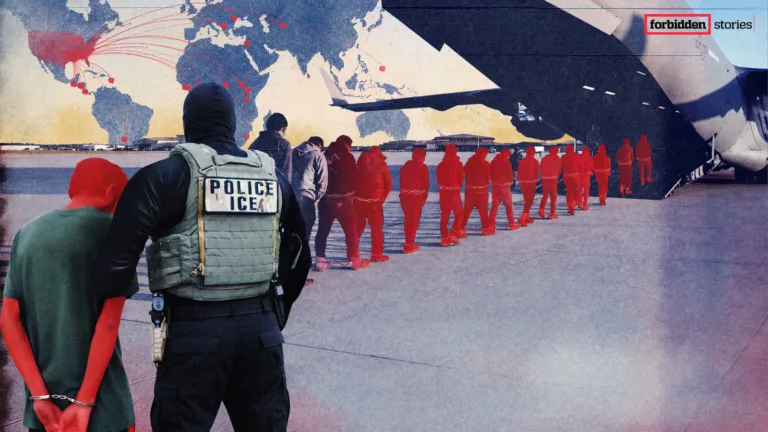
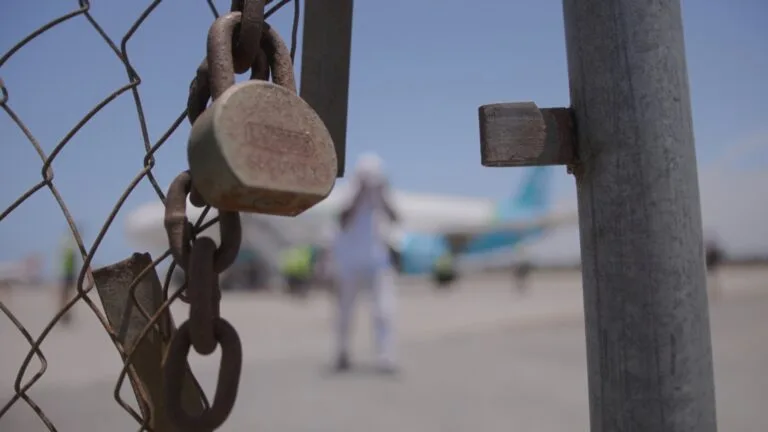
It’s August 2026, and an ICE deportation flight has just arrived from Miami.
Among the people getting off the plane are some who, until a few weeks ago, had held Temporary Protected Status in the U.S.—TPS, an immigration program that had just been ended by the Trump administration.
Many are hiding their identities out of fear of being targeted for kidnapping by the armed gangs who now control large parts of this country.
DEPORTEE 1:
I remember like in 2024, they kidnapped my nephew. We paid a lot of money to let him go, because over there it’s not safe.
SEBASTIAN WALKER:
This man said he’d been living in Toledo, Ohio, when TPS ended.
When was the last time you were in Haiti?
DEPORTEE 1:
In 2014.
SEBASTIAN WALKER:
Where are you from?
DEPORTEE 1:
I’m from Saint-Marc.
SEBASTIAN WALKER:
So would you try to get back there? Do you have any family there, or—?
DEPORTEE 1:
No, I don’t know nobody here. All my brothers, my sister, they are in the U.S., you know? I lost my father, my mom. I don’t know what I can do.
DEPORTEE 2:
I’ve been in America since I was 5 years old. I did 17 years in prison. They didn’t give me a chance to rehabilitate, so they got me in this weird island that I don’t even know.
SEBASTIAN WALKER:
The Department of Homeland Security said there were 15 “dangerous criminals” among the roughly 160 deportees.
Others we spoke to said they had no criminal records and had left young children behind in the U.S.
DEPORTEE 3:
I have a 17-month-old, a 6-year-old and my husband.
SEBASTIAN WALKER:
Oh, my God. Do they know where you are?
DEPORTEE 3:
So, as of today, they know where I am. I’ve not seen my family since I was picked up.
I was moved five times. So when the lawyer filed the motion, every single time they had to file a new motion to a new location.
I was in the United States for 20 years, went to school, graduated high school and college, earned a doctoral degree. TPS status ended, and as a pharmacist, I ended up losing my job,
SEBASTIAN WALKER:
You were a pharmacist professionally for how long?
DEPORTEE 3:
For nine years in the state of Florida. I was earning a six-figure, paying my taxes.
I’ve left this country at 14 years old. I’m not really sure what I’m going to do. This is like foreign land to me.
SEBASTIAN WALKER:
The U.S. government first granted TPS to Haitians in 2010, after a devastating earthquake destroyed much of the country’s infrastructure. Since then, successive U.S. administrations have renewed and expanded it, as Haiti faced widespread hunger, the assassination of its president and escalating gang violence.
The Trump administration now says the situation is safe enough for Haitians to return home.
MARKWAYNE MULLIN, Sec. of Homeland Security:
TPS is just that: It’s temporary. It was never designed to be permanent. We encourage everybody to go home. Your country needs you. That’s where you should be headed. If you want to rebuild your country, go back and rebuild it.
SEBASTIAN WALKER:
But Haitians here and in the U.S. warn their country is more dangerous than ever.
FEMALE SPEAKER:
When people say that we should go back home, I don’t think they think about what home looks like for us.
SEBASTIAN WALKER:
Three days after that deportation flight, we were riding with a newly established international military mission that’s helping fight gang violence here.
SEBASTIAN WALKER:
It is called the Gang Suppression Force and it’s backed by the U.N. and supported by many countries, including the U.S. We were the first foreign journalists to see them in action.
Their mandate is to bring security to Haiti after years of instability. Criminal gangs now control most of the capital, Port-au-Prince.
GSF HELICOPTER PILOT:
Last week, they killed three police officers in that area.
SEBASTIAN WALKER:
Just last week?
GSF HELICOPTER PILOT:
Yes, I think last week.
SEBASTIAN WALKER:
Do you have gangs present in every part of the city right now?
GSF HELICOPTER PILOT:
My personal assumption is that 95, 98% of the city is infected with gangs.
SEBASTIAN WALKER:
How does it compare with other places that you’ve operated in?
GSF HELICOPTER PILOT:
So, I operate in Mali. The problem there was terrorism. Here, the problem is, one: you don’t know who’s who. Here it’s difficult to localize, where is the danger?
That side, the mountains, there is a town called Kenscoff. Dangerous, really dangerous. They shoot aircraft over there.
SEBASTIAN WALKER:
So you’ve been attacked even on these air reconnaissance missions?
GSF HELICOPTER PILOT:
Three times.
SEBASTIAN WALKER:
Three times?
GSF HELICOPTER PILOT:
Yes, sir.
SEBASTIAN WALKER:
And is there any part of the city for civilians where they can be safe?
GSF HELICOPTER PILOT:
If you go to the town, you will see like normal activities, like kids going to school, like market. Everything looks normal. But all of sudden, everything can change.
SEBASTIAN WALKER:
These GSF soldiers are from Chad. They took us on patrol through neighborhoods in Port-au-Prince where the Haitian police have almost completely withdrawn.
Moving around in heavy armored personnel carriers, they said they rarely come under direct fire.
But there are signs of gang presence everywhere.
Down these roads when you have a blockade, this is from the gangs?
GSF CHADIAN SOLDIER:
Yes, sure. They don’t want APC or all security vehicle to come in. They put this barricade. Everybody is afraid because of this gang have control of this area. They are up, they are watching us.
SEBASTIAN WALKER:
They’re watching us right now?
GSF CHADIAN SOLDIER:
Yes, we know. They are here.
SEBASTIAN WALKER:
The GSF aims to establish a visible presence in areas where residents have been pushed out. But fear of the gangs, who often use kidnapping to extort locals, is still preventing many from coming back.
The soldiers told us they’d cleared this neighborhood, but it was still a ghost town.
The UN says nearly 1.5 million people have been displaced across the country due to the fighting.
GSF CHADIAN SOLDIER:
First operation was conducted here. This area was occupied that we got information through so many sources, occupied by gangs.
SEBASTIAN WALKER:
The school? The area around the school?
GSF CHADIAN SOLDIER:
Yes, the school. Because they put so many barricade, you cannot come with APC. So with that reason that we dismounted patrol around 300 meters. We come, we send our guys by foot. We catch six gangs here. They were sleeping.
SEBASTIAN WALKER:
Shortly after we arrived in Haiti, one gang attack near the capital sent shockwaves through the country—and exposed the enormity of the challenge.
FEMALE NEWSREADER:
Violence in Haiti has left 47 people dead and 22 injured.
FEMALE NEWSREADER:
Dozens of people have been killed by an armed gang just outside the capital of Haiti.
FEMALE NEWSREADER:
The day after the gunfire, the people of Kenscoff are in mourning. Bodies lie where they fell, beneath blood-stained sheets.
FEMALE NEWSREADER:
Survivors found bodies of friends and relatives lying in the streets after armed men raided the community overnight.
SEBASTIAN WALKER:
A powerful coalition of gangs trying to expand its control took more than 50 hostages, then posted videos and demanded ransoms from their families.
When we reached the community of Kenscoff, many were still being held, including 17-year-old “Nelly” Noel, who can be seen in this video.
Her father, Estrel, was left trying to negotiate her release.
ESTREL NOEL:
[Speaking Haitian Creole] We didn’t have time to say final words because there were three small children, my wife and a young woman with us. We just said, “Nelly, let’s go, thugs are upon us.” Then I heard her screaming that the thugs had already grabbed her. But us, we couldn’t go back.
SEBASTIAN WALKER:
This is her?
ESTREL NOEL:
Yeah. [Cries]
[Speaking Haitian Creole] She’s someone who loves music because she actually wants to learn to sing so that, one day, she could be one of the country’s stars.
SEBASTIAN WALKER:
She’s got a great voice.
So then, you’ve seen her in videos that have been filmed by the gang members?
ESTREL NOEL:
Yeah. I see, I see. [Speaking Haitian Creole] Yeah, I saw my child. They made me talk to her while they were beating her up.
SEBASTIAN WALKER:
Did they let you talk to her?
ESTREL NOEL:
Yes.
SEBASTIAN WALKER:
The gang let you talk to her?
ESTREL NOEL:
Yes.
SEBASTIAN WALKER:
What did you say? What did you tell her?
ESTREL NOEL:
[Speaking Haitian Creole] Your father is waiting for you. You should come.
SEBASTIAN WALKER:
The GSF doesn’t yet have a presence in Kenscoff. Instead, a local militia helps provide security. The police give them weapons and other equipment.
Patrique Saint-Hilaire is the group’s leader.
Three days after the massacre, he took us through the areas that had been attacked.
PATRIQUE SAINT-HILAIRE:
[Speaking Haitian Creole] This is where the attack took place.
This was an attack targeting either the police station or the town hall and everybody in the town. Everyone had to run. A lot of gunshots.
The stench. There was a corpse here. There was a corpse here.
So, this is where the carnage took place. The gangs killed seven young people who were coming from a party.
SEBASTIAN WALKER:
[Speaking French] Seven?
PATRIQUE SAINT-HILAIRE:
[Speaking Haitian Creole] And they kidnapped many others.
SEBASTIAN WALKER:
[Speaking French] Seven in total?
PATRIQUE SAINT-HILAIRE:
[Speaking Haitian Creole] Seven in total. They were coming from a pool party and they ran straight into the gang members.
SEBASTIAN WALKER:
[Speaking French] Executed?
PATRIQUE SAINT-HILAIRE:
[Speaking Haitian Creole] Executed.
SEBASTIAN WALKER:
[Speaking French] In the head?
PATRIQUE SAINT-HILAIRE:
[Speaking Haitian Creole] Yes.
SEBASTIAN WALKER:
All executed.
PATRIQUE SAINT-HILAIRE:
[Speaking Haitian Creole] They burned that house and they also killed a woman here.
SEBASTIAN WALKER:
[Speaking French] Inside?
PATRIQUE SAINT-HILAIRE:
[Speaking Haitian Creole] They killed her in her bedroom, with her child.
SEBASTIAN WALKER:
[Speaking French] How old?
PATRIQUE SAINT-HILAIRE:
[Speaking Haitian Creole] Seven months old.
SEBASTIAN WALKER:
[Speaking French] Seven months?
PATRIQUE SAINT-HILAIRE:
[Speaking Haitian Creole] Yes.
This is, we had a shelter here. There were about 35 families who were already displaced.
SEBASTIAN WALKER:
[Speaking French] Displaced, because of violence?
PATRIQUE SAINT-HILAIRE:
[Speaking Haitian Creole] Because of the violence. We sheltered them here.
KENSCOFF WOMAN 1:
[Speaking Haitian Creole] They beat me up. They tied me up. The child was in the middle of the five of them on the floor. They kicked him back and forth.
MALE VOICE [off-screen]:
[Speaking Haitian Creole] How old is the child?
KENSCOFF WOMAN 1:
[Speaking Haitian Creole] Five months old. I told them I couldn’t take hits. I had a C-section, have mercy. They asked, “Where do you have your C-section?” They used a knife and tore my clothes. He said, “I am going to shoot you five times where you had your C-section.” One of them said, “Don’t kill the lady, she has a baby.”
SEBASTIAN WALKER:
What’s it like trying to bring up a family in Haiti right now with the security situation?
KENSCOFF WOMAN 2:
[Speaking Haitian Creole] We don’t have any hope.
KENSCOFF ELDER:
[Speaking Haitian Creole] There’s no hope right now. There’s nothing at all, there’s no hope.
KENSCOFF WOMAN 2:
[Speaking Haitian Creole] The kids are traumatized, because they can’t sleep. When they’re sleeping they get up in the middle of the night.
KENSCOFF WOMAN 3:
[Speaking Haitian Creole] They’re calling the dead people’s names. So the kids are traumatized. They’re not in their right minds. They’re not in their right minds because people were killed right in front of them.
SEBASTIAN WALKER:
On the night of the attack, many residents, including children, took refuge in a church. Armed gang members forced their way in and started killing them.
PATRIQUE SAINT-HILAIRE:
[Speaking Haitian Creole] They came through from above.
VLADIMIR, Victim’s son:
[Speaking Haitian Creole] You can see the space right here. That’s where I found my father.
SEBASTIAN WALKER:
You weren’t here yourself, you were outside?
VLADIMIR:
Yes, I was outside. When I called my father he said, so, I can not do anything. I just pray God. I already leave my house.
SEBASTIAN WALKER:
Because of the violence.
VLADIMIR:
Yes. I come to this place to move, for work.
SEBASTIAN WALKER:
Because there was more peace, more—
VLADIMIR:
Yes, more peace, more security. It’s more safe.
SEBASTIAN WALKER:
And then this happened.
VLADIMIR:
Then this happened. [Sighs] Nobody is safety. Nobody is safety in this country. Nobody.
PRESIDENT DONALD TRUMP:
On Day 1, I will launch the largest deportation program in American history to get the criminals out.
SEBASTIAN WALKER:
President Trump came into office promising mass deportations—
DONALD TRUMP:
I will rescue every city and town that has been invaded and conquered.
SEBASTIAN WALKER:
—and a key part of that was ending Temporary Protected Status for people from more than a dozen countries, including around 350,000 Haitians.
DONALD TRUMP:
Absolutely, I’d revoke it, and I’d bring them back to their country.
SEBASTIAN WALKER:
But his effort to eliminate TPS for the Haitians was blocked by a federal court.
MALE NEWSREADER:
The move to end TPS for Haitians is paused for now.
A government official has confirmed that they are planning to appeal.
SEBASTIAN WALKER:
When we first started reporting on this story back in the spring of 2026, the TPS case had just been referred to the Supreme Court.
We’d come to the city which had become ground zero for the issue: Springfield, Ohio.
Following the rapid arrival of around 15,000 Haitian immigrants since 2020, residents were sharply divided on whether they should be allowed to stay.
MALE NEWSREADER:
Tensions are running high for an estimated 15,000 Haitians in Springfield.
SEBASTIAN WALKER:
The Supreme Court was due to issue a decision in the coming months.
VILES DORSAINVIL, Haitian Support Center:
[Speaking Haitian Creole] For I was hungry, and you gave me food. I was thirsty, and you gave me drink.
SEBASTIAN WALKER:
Viles Dorsainvil is a pastor and community leader in Springfield. He was granted TPS after coming to the United States in 2020.
VILES DORSAINVIL:
[Speaking Haitian Creole] I was a stranger, and you took me in.
SEBASTIAN WALKER:
He runs a community center that supports Haitian families.
VILES DORSAINVIL:
Hey, good morning. I’m the executive director for the Haitian Support Center here in Springfield, Ohio.
I see every day the human consequences of policies.
[Speaking Haitian Creole] I’ll need the list of the five people to distribute food for today.
[Speaking English] We have families calling our office, and they tell us what they are in need of. Sometimes it’s diapers for the baby. Sometimes it’s food. Sometimes they need a ride to come to our office to apply for asylum.
They are still in a mode of panic or uncertainty because they do not know what the verdict will be.
SEBASTIAN WALKER:
In the uncertainty around TPS, he said many Haitians in Springfield were afraid to leave their homes for fear of being picked up by ICE.
VILES DORSAINVIL:
[Speaking Haitian Creole] Let’s see what’s in these.
SEBASTIAN WALKER:
He and his team were delivering food and other basic supplies to families who were sheltering in their homes.
VILES DORSAINVIL:
[Speaking Haitian Creole] Add some packs of spaghetti to them.
[Speaking English] Temporary Protected Status is not simply a legal designation.
The lives of thousands of families are in danger.
[Speaking Haitian Creole] Do you think you can lift that?
MALE VOICE:
It’s heavy, bro. [Laughter]
SEBASTIAN WALKER:
With the future of their status in question, he said some TPS holders had lost their jobs; others have been unable to renew their driver’s licenses.
VILES DORSAINVIL:
For the Haitian, knowing that if TPS ends, they can be deported or whatever, it’s like being put on a death row.
We have the moral and ethical responsibility to fight on their behalf.
MALE SPEAKER:
[Speaking Haitian Creole] Can I take these?
VILES DORSAINVIL:
[Speaking Haitian Creole] You can take them. No problem.
[Speaking English] We are not fighting for Haitian alone. We are fighting for the community of Springfield.
The beautiful things about Springfield is that folks from all walk of life rally in solidarity to the community.
MALE SPEAKER:
What’s up, Carl?
PASTOR CARL RUBY, Central Christian Church:
Hey, Mike.
SEBASTIAN WALKER:
Carl Ruby is the pastor of Central Christian Church, where Viles Dorsainvil also worships.
CARL RUBY:
I’m nervous about the outcome.
SEBASTIAN WALKER:
He started a coalition of churches and local groups known as the G92 that advocates for Haitian immigrants in Springfield.
MALE SPEAKER:
OK. Good morning, everyone.
CARL RUBY:
I really think that if most Americans really understood what’s going on in Haiti, their hearts would change. But they just, they don’t—they don’t realize how bad it is.
FEMALE SPEAKER:
Carl and Viles, thank you very much to the two of you for being out front and leading.
CARL RUBY:
There are growing pains when you have thousands of new people enter a community this size, but there are also benefits.
Springfield was a declining Rust Belt city. And then just like that, Haitians started arriving, There are factories relocating here, and businesses are expanding their business because we’ve got this labor force who are willing to work. They work hard.
FEMALE NEWSREADER:
Urgent requests regarding the increase of Haitian immigrants from Springfield Mayor Rob Rue are now getting federal attention.
MAYOR ROB RUE:
This has overwhelmed our safety services and caused great concern for our community.
SEBASTIAN WALKER:
Initially, the arrival of around 15,000 people to a city of only 60,000 strained housing, schools and hospitals.
BRYAN HECK, Springfield City Manager:
It’s taxing our infrastructure, it’s taxing public safety, it’s taxing our schools, it’s taxing healthcare. It’s taxing our housing.
MALE NEWSREADER:
Emotions continue to run high tonight after a child was killed in a school bus crash less than 24 hours ago.
SEBASTIAN WALKER:
In 2023, a fatal accident involving a Haitian immigrant driving without a valid license inflamed tensions—
MALE SPRINGFIELD RESIDENT 1:
We’re supposed to accept them here? No, I don’t.
SEBASTIAN WALKER:
—leading to a series of heated arguments at city council meetings.
FEMALE SPRINGFIELD RESIDENT 1:
Haitians are occupiers in Springfield.
MALE SPRINGFIELD RESIDENT 2:
Things are going to get ugly. I don’t know if you want to see that happen.
SPRINGFIELD PARENT:
My son, Aidan Clark, was not murdered. He was accidentally killed by an immigrant from Haiti. … But don’t spin this towards hate.
September 10, 2024
SEBASTIAN WALKER:
Then Donald Trump weighed in, seizing on a false rumor that had been circulating in Springfield.
DONALD TRUMP:
In Springfield, they’re eating the dogs, the people that came in. They’re eating the cats. They’re eating—they’re eating the pets of the people that live there.
CARL RUBY:
That moment set off an explosion.
MALE NEWSREADER:
Bomb threats tied to a baseless rumor spread by Donald Trump.
FEMALE NEWSREADER:
More than 30 bomb threats—
FEMALE NEWSREADER:
—against City Hall and local schools.
FEMALE NEWSREADER:
Each one has been investigated and has been found to be a hoax.
WOMAN IN CAR:
Hate has no home here!
WHITE SUPREMACIST PROTESTER:
Haitians have no home here!
CARL RUBY:
All of a sudden we have white supremacy groups descending upon our city.
FEMALE NEWSREADER:
The Proud Boys were seen marching through the streets over the weekend.
SEBASTIAN WALKER:
The city was now a flashpoint in the national debate about immigration.
MALE SPRINGFIELD RESIDENT 3:
Nazis marching in Springfield. What brought Nazis to Springfield?
KEN SEELIG:
I kept saying, “Guys, Springfield is a tinderbox right now. All this stuff and people keep throwing matches. One of them is going to light.”
SEBASTIAN WALKER:
Ken Seelig describes himself as a street pastor. He and his friend Mark Sanders are Springfield residents who’ve advocated against TPS.
So you would say most people in Springfield are in favor of the policy of ending TPS?
MARK SANDERS:
Yes.
KEN SEELIG:
Overwhelmingly.
MARK SANDERS:
Clark County has never, ever voted such a high Republican vote as they did in 2024, based
upon not—It was almost 70% voted for Donald Trump in Clark County.
SEBASTIAN WALKER:
This issue being a factor, this issue of Haitian TPS policy?
KEN SEELIG:
Absolutely. It has divided our city. Unbelievable.
Nationally, man, I mean, the immigration thing, Springfield, yeah, we’re a model. We’re the perfect model of how it can go bad.
MARK SANDERS:
Of what not to do.
KEN SEELIG:
Of what not to do.
SEBASTIAN WALKER:
What about for these Haitian families who are now facing going back to a place that is incredibly dangerous right now.
KEN SEELIG:
Is it?
SEBASTIAN WALKER:
What’s your perspective on that?
MARK SANDERS:
They don’t have to go back to Haiti. They can go anywhere else. They can go to Chile. They
can go to Brazil. You know the old saying at the bar, “You don’t have to go home, but you can’t stay here”? We have given 16 years of benevolence.
April 29, 2026
SEBASTIAN WALKER:
As the Supreme Court weighed the TPS case, community members from Springfield gathered in Washington.
Viles Dorsainvil attended the hearing and addressed demonstrators outside the court.
VILES DORSAINVIL:
So the question before the court is not just a legal one. It is a moral one about who we are as a nation and how we treat people who have rallied in our communities.
June 25, 2026
SEBASTIAN WALKER:
On the morning of June 25, advocates gathered at Carl Ruby’s church to await the court’s ruling.
FEMALE ACTIVIST 1:
Were living in the upside down.
FEMALE ACTIVIST 2:
There. This is it.
CARL RUBY:
This is bad. Dial Geoff Pipoly.
Voice of Geoff Pipoly
Lead counsel for TPS holders
GEOFF PIPOLY [on phone]:
It’s a complete and total loss.
CARL RUBY:
So does that mean that deportations could begin now?
GEOFF PIPOLY [on phone]:
Yep.
CARL RUBY:
And they lose their ability to work now?
GEOFF PIPOLY [on phone]:
Yep. TPS is over.
SEBASTIAN WALKER:
The ruling said the courts didn’t have a legal basis to stop the Trump administration from ending TPS. Conditions in Haiti were not a factor in the decision.
CARL RUBY:
I’m so sorry.
VILES DORSAINVIL:
For me, today was the saddest day since I’ve been here, because for what I knew about the U.S., it’s a country where justice and human dignity would always be upheld. But unfortunately this is not the case.
CARL RUBY:
Geoff, everyone is waiting to hear your take on what just happened.
GEOFF PIPOLY [on video call]:
The Supreme Court’s decision means that many, many people are going to die violent, needless deaths. That’s the bottom line.
FEMALE REPORTER:
Do you expect the administration to deport anyone who loses TPS status as a result of this ruling?
STEPHEN MILLER:
Of course. If you no longer have status in this country, then you’re supposed to be deported. And in particular, in the case of the Haitians—
SEBASTIAN WALKER:
That same day in Washington, White House adviser Stephen Miller was publicly defending the decision to end TPS.
MALE REPORTER:
Does the administration consider Haiti a safe country?
STEPHEN MILLER:
For Haitians? Absolutely. … The fact that there might be pockets of Haiti where there’s higher crime rates. Guess what? There’s pockets of Chicago with crime rates just as high, right? There’s pockets of cities like St. Louis with crime just as high. Pockets of Los Angeles with crime just as high. It has never been the case that having communities that have high crime rates is a basis for asylum. Never has been. Never will be. Thank you all. Have a great day.
SEBASTIAN WALKER:
Neither Stephen Miller nor anyone else from the administration would agree to an interview with us. In a statement, a White House spokeswoman said that TPS had “been abused by Democrats as a de facto amnesty program to allow foreigners to remain in the country forever,” and that the president would continue to “put Americans first.”
Jonathan Fahey was a senior DHS and ICE official during the first Trump administration.
So if you were to sum up the Trump administration’s reasoning for ending TPS for Haiti now, what would it be?
JONATHAN FAHEY, Fmr. senior advisor, DHS:
Well, the reason for it to begin with is over. Right now, I believe we have about 7% of Haiti’s population lives in the United States. I think there’s about 850,000 Haitians living here. They’ve been living here for a long time. If we have these processes like TPS, if temporary just means “permanent,” then what is the—the statute doesn’t mean what it’s supposed to mean. So they have to adhere to the statute.
SEBASTIAN WALKER:
Haitians say their country is more dangerous now than ever. Shouldn’t that be a consideration?
JONATHAN FAHEY:
Should it be a consideration? Maybe. I mean, I think Haiti has always been a really dangerous place, and it’s not a desirable place to go back to. Again, the people that have gotten the Temporary Protective Status, you would hope they would be appreciative of the fact they have gotten to live in this country for years, even decades. Earn money, get skills. But there is the fact, when you look at overall—not just TPS, but overall immigration policy, immigration law—the primary beneficiaries of it should be the American citizens, not what’s best for Haitians forever and ever.
Of course, it’s better for them to get to stay, but the question is, is it better for the American people? Not just for them, but for everyone.
PROTESTERS:
[Singing] I’m going to stand with the immigrants, down by the riverside, down by the riverside, down by the riverside.
SEBASTIAN WALKER:
By early August, federal agents were starting to detain Haitians in Springfield during daily patrols, but the widespread ICE raids that many feared had not yet materialized.
Instead, hundreds of TPS holders were summoned to ICE offices near Springfield.
MALE VOICE:
[Speaking Haitian Creole] All these people are here to support you.
CARL RUBY:
Would you like to receive communion this morning?
SEBASTIAN WALKER:
Viles Dorsainvil and Carl Ruby were offering communion to those heading inside.
VILES DORSAINVIL:
[Speaking Haitian Creole] These guys are going into the center. I ask you, God, to protect them, because you know how scared they are. I know, God of goodness—
CARL RUBY:
May Christ go with you.
VILES DORSAINVIL:
[Speaking Haitian Creole] May God be with you.
PROTESTERS [chanting]:
Shame on ICE. Shame on ICE. Shame on ICE.
SEBASTIAN WALKER:
When they emerged, many were wearing GPS ankle monitors.
DHS has said that the monitors are an “alternative” to detention and that they are used “on a case-by-case basis” for “supervision.” But the fear here was that they were a precursor to deportation.
MALE SPEAKER:
Help him up.
MALE SPEAKER:
[Speaking Haitian Creole] Let’s go. Let’s go. Let’s go.
MALE SPEAKER:
[Speaking Haitian Creole] Let’s stand up. We are men. You understand what I’m saying? Let’s stand up, we have to be strong.
MALER:
[Speaking Haitian Creole] After everything I experienced, I’m feeling humiliated. I’m going to die. I’m going to die.
CARL RUBY:
These are all clergy to support you.
PHILIPPE VIL:
Thank you so much.
SEBASTIAN WALKER:
Philippe Vil and his wife, Vicky, had been living in Springfield since 2023. He had been working regular shifts at a warehouse.
PHILIPPE VIL:
My wife got the watch, but me, I got the monitor on my knee.
SEBASTIAN WALKER:
She was pregnant, so the device was placed on her wrist.
PHILIPPE VIL:
Frustrated. Confused. You know, because I’m not a—
VICKY:
Criminal.
PHILIPPE VIL:
I don’t know what’s going to happen in my work. Like, someone might look at me, this guy is criminal. Like, discrimination. But, it’s OK. I’m going to work. Do my work and enjoy my life after. I don’t know what happens next, but I want to—
VILES DORSAINVIL:
[Speaking Haitian Creole] If they don’t change it yet—
PHILIPPE VIL:
[Speaking Haitian Creole] The court?
VILES DORSAINVIL:
[Speaking Haitian Creole] Yeah, yeah.
SEBASTIAN WALKER:
A few days later, he was at the support center trying to get answers.
VILES DORSAINVIL:
[Speaking Haitian Creole] What’s your wife’s name again?
PHILIPPE VIL:
[Speaking Haitian Creole] Vicky.
VILES DORSAINVIL:
[Speaking Haitian Creole] Vicky?
Now, what’s happened is that since TPS is suspended, everyone has become vulnerable.
PHILIPPE VIL:
[Speaking Haitian Creole] That’s what I wanted to understand, if they do some type of screening, or do they simply type into the computer and a list of names comes up.
[Speaking English] The officer, she said to me the government have a program about self-deportation. The government is going to pay the ticket for you, $2,600.
SEBASTIAN WALKER:
They were trying to get you to self-deport?
PHILIPPE VIL:
Yeah, self-deportation.
SEBASTIAN WALKER:
They were offering you this option?
PHILIPPE VIL:
Yes.
If you don’t accept your deportation, so you take the ankle monitor. You don’t have any other options.
I said if I go to Haiti I’m going to be dead, because where I’m from is dangerous.
SEBASTIAN WALKER:
He told us that since he left Haiti, gangs have taken over his neighborhood.
PHILIPPE VIL:
It’s a big question in my head: If I’m deported, what’s going to happen with my daughter? She’s a baby. She’s a baby.
SEBASTIAN WALKER:
His 3-year-old daughter was born in the U.S.
PHILIPPE VIL:
What color it is?
PHILIPPE’S DAUGHTER:
Green.
PHILIPPE VIL:
Green?
I’m supposed to give her a good education. I work hard to give her a good life. But now Haiti don’t offer this life.
SEBASTIAN WALKER:
And your daughter’s American.
PHILIPPE VIL:
Yeah. Yes, she’s born here in Springfield.
SEBASTIAN WALKER:
Are you thinking of maybe not taking her?
PHILIPPE VIL:
Yes. That’s my fear. I’m scared about that.
Before I enter in USA, an immigration officer give me a paper and they said, “Welcome to the USA.” Me and wife made all the steps. I came here, I work, I pay my taxes. I just want to work and get a good life for my family.
SEBASTIAN WALKER:
The threat of deportation was hitting home for everyone we spoke to.
Are you afraid of being targeted for speaking out and being a leader of the community?
VILES DORSAINVIL:
I do not let fear dominate me, but as a human being, I have fear as everybody else. But I am a TPS holder and asylum seeker. I am on the same boat as everybody else.
BERNITO DORSAINVIL, Viles’s brother:
[Speaking Haitian Creole] Raise your hands and shout, hallelujah!
CHURCH CONGREGATION:
[Speaking Haitian Creole] Hallelujah!
BERNITO DORSAINVIL:
[Speaking Haitian Creole] Can’t we hear what the word says? The word says, “Blessed be the Lord.”
SEBASTIAN WALKER:
This was the church where Viles Dorsainvil was the pastor before fleeing Haiti. His older brother Bernito now delivers the sermons.
BERNITO DORSAINVIL:
[Speaking Haitian Creole] Lord, give us … in the name of Jesus Christ. Strong God, capable God, mighty God, sovereign God. Lord, we come before you this morning.
Clap your hands for the Lord.
SEBASTIAN WALKER:
Both he and another brother, Rony, said they were following the news from Springfield and were concerned about Viles getting deported.
Do you worry about your brother Viles?
RONY DORSAINVIL:
[Speaking Haitian Creole] Yes. Since he doesn’t have legal status in the U.S. we are very worried because he is defending many other compatriots who are in difficult situations that he himself hasn’t managed to escape.
SEBASTIAN WALKER:
What would you say to those who might think it’s safe to send Haitian families back to Haiti right now?
BERNITO DORSAINVIL:
[Speaking Haitian Creole] The actual reality on the ground right now, they don’t understand it. Because the reality they see in the news is not really it. Because people are dying every day. People are being kidnapped every day. People are being raped every day, and people are sleeping in the streets. There’s no electricity. So the situation is completely chaotic.
SEBASTIAN WALKER:
Back in Kenscoff, we checked in on the father of the kidnapped teenager, Nelly Noel. He was now staying in a guarded compound with other families whose homes were attacked.
He told us the gangs had demanded more money.
Have you heard anything?
ESTREL NOEL:
[Speaking Haitian Creole] Yes, we talked. “Dad, don’t lose hope. They neither hit nor mistreated me. They are waiting for the money so they can set me free.” That means that no matter what, I need to get the money, give it to them and they’ll send her back to me. But, the offer they made me is a bit harsh. When the kidnapper informs you that the money you sent was intended to feed the victim, and then they tell you to go find the $300,000 they asked you for. Then you have to make it available to them, with only five days to get the money.
They are putting you in an awkward position because how will you find the U.S. dollars? How will you get it?
SEBASTIAN WALKER:
Do you know where the place is that she’s being held, generally? Like which part of the mountain?
ESTREL NOEL:
[Speaking Haitian Creole] Belot. The victims are being held hostage in Belot.
Belot is located in that direction, where the fog is.
SEBASTIAN WALKER:
[Speaking French] Are the gang members present there?
ESTREL NOEL:
[Speaking Haitian Creole] Yes, everywhere.
SEBASTIAN WALKER:
[Speaking French] Everywhere?
ESTREL NOEL:
[Speaking Haitian Creole] Everywhere, yes.
This is very hard. We used to live in peace, but now we’re under gang rule.
SEBASTIAN WALKER:
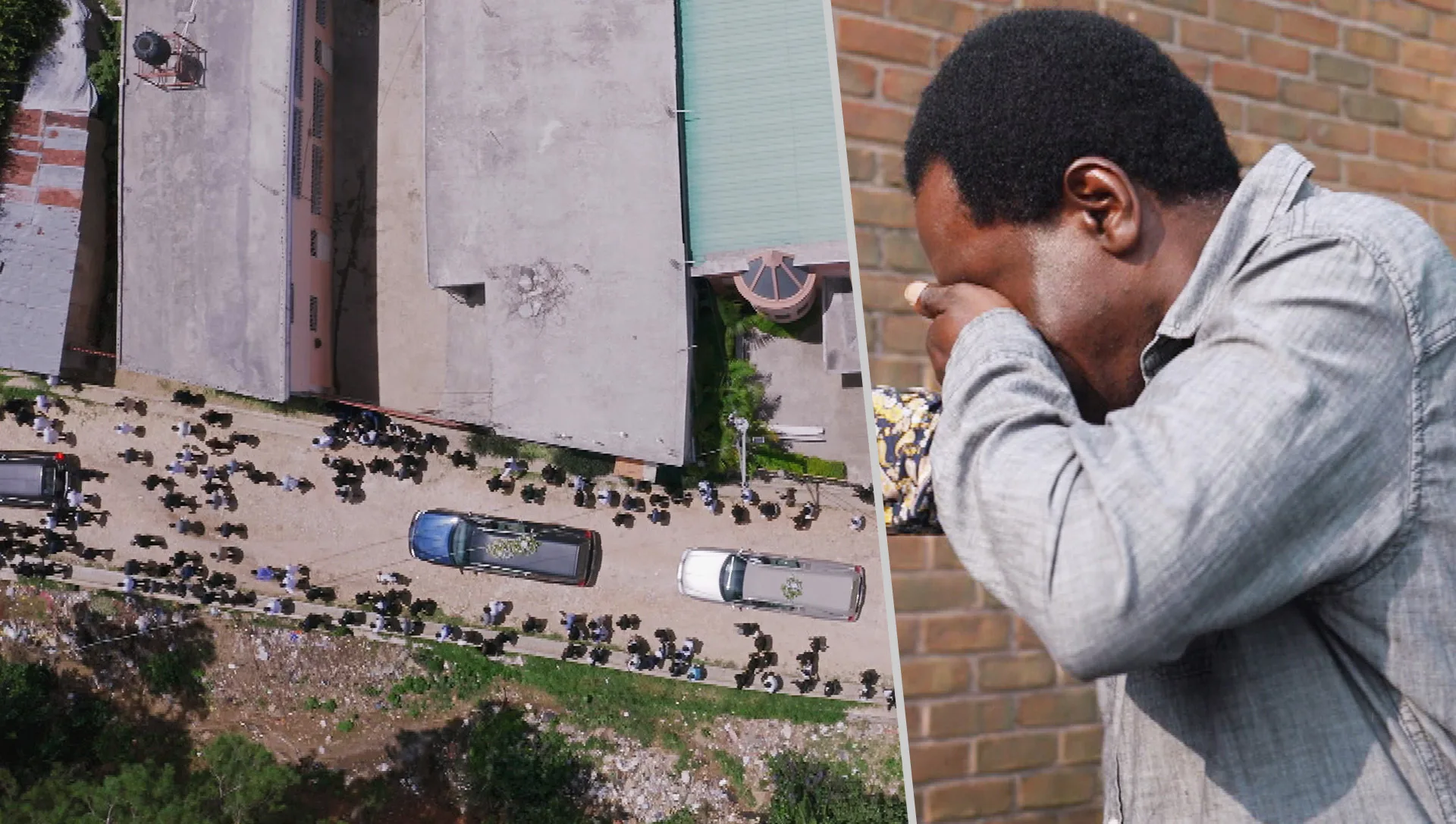
While Estrel Noel waited for another phone call, other families were burying their loved ones. There were funerals taking place every day we were here. One of the mourners was the young man whose father was killed hiding in the church.
PASTOR:
[Speaking Haitian Creole] We don’t know how to express ourselves in front of these five coffins. This is the first time the church is commemorating the passing of five people.
VLADIMIR:
[Speaking Haitian Creole] I will do everything in my power to follow in my father’s footsteps, walking the path I was raised on, the education he gave to me. And I want to issue a call to all authorities, to everyone of you here. Today, it’s time we take responsibility. Today, it’s Kenscoff. Tomorrow, who will be the next victim? Today, it’s Justin. It’s Steve. It’s Dieujuste. Tomorrow, who will it be?
SEBASTIAN WALKER:
The scale of the massacre in Kenscoff reverberated beyond Haiti and would highlight a tension in the Trump administration’s deportation policy.
On Aug. 28, at an emergency United Nations Security Council meeting, a U.S. representative to the U.N. decried the security situation in Haiti.
JENNIFER LOCETTA, U.S. Representative to the U.N.:
This attack, which follows months of ongoing deadly violence, is another reminder of the dire state of Haiti’s security crisis. For months, terrorist gangs have murdered civilians, terrorized communities, burned homes and destroyed families.
SEBASTIAN WALKER:
The U.S. ambassador to the U.N. later underscored the point.
MIKE WALTZ, U.S. Ambassador to the U.N.:
Now we have a situation where the gangs have taken over. They’ve gotten stronger, Haitian institutions weaker, and everyday people in Haiti and in the region … and even in our country, have paid the price.
SEBASTIAN WALKER:
I asked Jonathan Fahey, the former Trump DHS official, about the apparent contradiction of sending people back to a country the administration was describing in such dire terms.
JONATHAN FAHEY:
You know, the United States has taken on this responsibility for 16 years. We have a very large number of prosperous nations that could also step in at any time and say, “We’ll take these people. We’ll bring them into Switzerland. We’ll bring them into Finland.” To the extent there is a moral obligation, the United States has certainly more than met our obligation.
The United States has done far more than anyone to address this—not only humanitarian aid, but other types of things to make the lives better for the Haitians in Haiti, but also the Haitians in America.
DHS footage
SEBASTIAN WALKER:
By late August, deportation flights carrying former TPS holders were starting to land in Haiti on a weekly basis.
Viles Dorsainvil was giving his brothers regular updates on the situation in Springfield.
VILES DORSAINVIL:
[Speaking Haitian Creole] Things are starting to get complicated here with this monitor thing, the thing they’re putting on people, the ankle monitors. It’s starting to have a big impact on the community.
RONY DORSAINVIL:
[Speaking Haitian Creole] Of those two flights that came in, were there a lot of people from Ohio?
VILES DORSAINVIL:
[Speaking Haitian Creole] I think there were only two people on our list who were on the flights to Haiti.
This morning a parent came in with—with bad news. His son, who had just graduated from high school with a diploma, who was already preparing to go to university to get a degree. They called the guy, and they put the monitor on his leg. When he went back to school, the kids bullied him so much. They were calling him a criminal. He killed himself.
RONY DORSAINVIL:
[Speaking Haitian Creole] It’s like chains. It’s like—It’s like being chained. It’s like you’re becoming a slave again.
VILES DORSAINVIL:
Yeah.
SEBASTIAN WALKER:
They were talking about a young man named Pierre Damas Bel. He was 20 years old. Just hours before this call, he had taken his own life.
YOLA LAMARRE, Friend of Pierre Damas Bel:
This is him starting school. His last post—his last post was five days ago starting—
He was excited to start school, and I think he was a student athlete. There’s a picture of him on the field and he’s like, “How am I supposed to practice with this thing on my leg?”
SEBASTIAN WALKER:
ICE had fitted him with an ankle monitor after TPS ended. Around a month later, just after starting college as an honor student studying neuroscience, he parked his car on the highway and stepped in front of a semi truck.
FEMALE VOICE [on phone]:
How many children do they have?
VILES DORSAINVIL:
Three. Now two.
FEMALE VOICE [on phone]:
They had three.
VILES DORSAINVIL:
Yeah. Now they have two.
SEBASTIAN WALKER:
He’d been posting on social media about the “shame and humiliation” of wearing the GPS monitor.
YOLA LAMARRE:
Every day he was posting depressing stuff. The last thing I saw in his post, he was posting ICE just all over Springfield arresting people.
SEBASTIAN WALKER:
Throughout this time, ICE had been ramping up its presence in Springfield, making arrests at gas stations, in shopping plazas and outside homes.
Like many former TPS holders in Springfield, Philippe Vil and his family were trying to restrict their movements as much as possible.
PHILIPPE VIL:
[Speaking Haitian Creole] The atmosphere is not good at all, because when I try to go out, the streets are empty. You don’t see Haitians out in the streets. Everyone is staying home. Every Haitian is worried about someone coming after them.
I’m terrified. Well, in the meantime, there’s nothing we can really do about it, except stay home. For Haitians to keep taking extra precautions and wait for this moment to pass so we can have some hope again.
SEBASTIAN WALKER:
At a press conference near Springfield, Homeland Security Secretary Markwayne Mullin defended ICE actions in the city.
MARKWAYNE MULLIN, Sec. of Homeland Security:
TPS is just that: It’s temporary. It was never designed to be permanent. TPS was granted to these Haitians after an earthquake that took place over 15 years ago. And we’ve made 380 arrests in Springfield. We’re going to continue to push. We encourage everybody to go home.
SEBASTIAN WALKER:
He was asked about the death of Pierre Damas Bel.
MARKWAYNE MULLIN:
I have a tremendous amount of sympathy as a father of six kids in this situation. But I also know enough about suicide that that is mental illness. … It breaks my heart for the parents. But we were following our procedures. We did our job. What happened when he went home? He wasn’t in our custody. We’re not responsible for that.
SEBASTIAN WALKER:
Pierre’s death would become a flashpoint in the controversy over TPS. Vigils took place in Columbus, in Dayton and in Springfield.
The Republican governor of Ohio, Mike DeWine, also spoke out.
GOV. MIKE DEWINE, (R) Ohio:
This was a horrible, horrible tragedy.
You’ve heard me talk a lot about what I consider to be a very misguided and wrong policy, in regard to mass deporting people from this country.
SEBASTIAN WALKER:
DeWine has been a vocal critic of the Trump administration’s decision to end TPS.
How do you explain the decision to deport people to Haiti at this time?
MIKE DEWINE:
I can’t explain it. It’s not in our best interest as a country. It’s certainly not in our best interest here in the state of Ohio. You know, I think when people look at the issue of immigration, they can be conflicted. I think the average Ohioan would say, “Look, the southern border needs to be dealt with.” Which the president has done. I think they’ll say, “Look, if you’re a violent criminal, we want you out of here.” Go pick them—pick you up. ICE should be after the violent criminals. We don’t want them here. Either lock them up or get them out of the country.
But then if you switch that over and ask the average Ohioan, well, what about this person who’s been here for a couple years, or maybe 5 years, or maybe 10 years, or maybe even longer? They’re productive members of society. They’re raising their family here. They belong to this church. They work here. Should we yank them up and get rid of them? And I think most people would say that’s not in our best interest.
SEBASTIAN WALKER:
Is there anything that you are you actively doing about it, with the deportations that are happening already in communities?
MIKE DEWINE:
Well, there is really nothing as governor of the state of Ohio that I can do about the decisions that are being made by ICE or whoever’s making the decisions and picking people up.
SEBASTIAN WALKER:
Do you want to see ICE out of Springfield?
MIKE DEWINE:
Look, I’ll go back again to the policy. I think the policy is wrong. Members of ICE are carrying out what their duties are. I’m not going to be critical of anybody in ICE. The policy is what is wrong. The policy, I think, is a mistake.
SEBASTIAN WALKER:
On Oct. 3, Pierre Damas Bel was buried in Springfield.
VILES DORSAINVIL:
[Speaking Haitian Creole] Today we stand together, Haitians and Americans. Let this be a place of peace. Let this be a place of truth. Let this be a moment when we hold one another close.
DONALD TRUMP:
This is in honor of Springfield, Ohio.
SEBASTIAN WALKER:
That same day, 25 miles away, President Trump was holding a campaign rally. He doubled down on his rhetoric about Springfield.
DONALD TRUMP:
Idyllic. It was an idyllic place. “Was” is the better word. Not anymore, but it will soon be. They’re all being brought back to their country.
SEBASTIAN WALKER:
So far, activists who track the deportations estimate that several hundred former TPS holders have been sent back to Haiti, at least half a dozen from Springfield.
In Haiti, thousands more GSF troops are expected to arrive in the coming months to deal with the continuing violence.
Some of the hostages from Kenscoff, including Nelly Noel, were eventually freed, but others remain unaccounted for.
In Springfield, Philippe Vil is still waiting to hear whether he will be deported.
Viles Dorsainvil is trying to continue his work.
VILES DORSAINVIL:
Since the ICE raids have been escalating in Springfield, I have not been going to church.
I knew from the get-go that anything could happen. Policies have a real impact on people’s daily lives.
SEBASTIAN WALKER:
What do you do? You just wait?
VILES DORSAINVIL:
Actually, this is the option we have: to wait. We cannot do any other thing. So that’s the reality for so many of our Haitian brothers and sisters being here in Springfield. I’m not sure that they have any other option than to wait and see what will be happening.
WRITTEN, PRODUCED and DIRECTED BY Adam Desiderio & Sebastian Walker
CORRESPONDENT Sebastian Walker
SENIOR PRODUCER Dan Edge
EDITORS Andrew Pattison, A.C.E. Shilpi Gupta
DIRECTOR OF PHOTOGRAPHY Javier Manzano
ASSOCIATE PRODUCER Kristina Abovyan
ADDITIONAL CAMERA Steven Bognar Rodrigo Galdós-Tangüis Adam Desiderio Timothy Grucza Srdjan Stojiljkovic Alex Rosen Eli Hiller Anna Lavatelli
ADDITIONAL EDITING Chris O’Coin
HEAD OF PRODUCTION Belinda Morrison
ARCHIVE PRODUCER Izze Gibson
ASSISTANT EDITORS Hinako Barnes Jenna Bloom Thomas Crosby Christine Giordano Julia McCarthy Jill Poisson
RESEARCHER Leo Miranda
ORIGINAL MUSIC Louis Dodd
COMPOSER ASSISTANT Dora Kmezić
ONLINE EDITOR / COLORIST Joey Mullin SOUND MIX Jon Day
FIELD PRODUCER, HAITI Jérémie Dupin
FIELD PRODUCER, SPRINGFIELD Steven Bognar
SECURITY Sharbil Nammour Michael Buddle
TRANSLATION Saga Translations Boston Language Hub HappyScribe
ARCHIVAL MATERIAL ABC News Videosource Associated Press Fox News Archives Getty Images Oliya Scootercaster / Freedomnews.tv PBS NewsHour Peter Hambrecht / Freedomnews.tv WKEF / Sinclair Broadcast Group
ADDITIONAL MATERIAL ABC7 Los Angeles Al Jazeera BBC News CBS News Channel 4 MSNBC NewsNation WDTN WFAA The Ohio Channel United Nations
ORIGINAL PRODUCTION FUNDING PROVIDED BY the Corporation for Public Broadcasting, Ford Foundation, Fialkow Family Foundation, Abrams Foundation, John D. and Catherine T. MacArthur Foundation, Park Foundation, Heising-Simons Foundation, FRONTLINE Trust with major support from Jon and Jo Ann Hagler through the Jon L. Hagler Foundation, and Corey David Sauer, with additional support from Koo & Patricia Yuen. Corporate funding from The Economist.
FOR FRONTLINE
POST PRODUCTION MANAGER Tim Meagher
SENIOR EDITOR Barry Clegg
EDITOR Brenna Verre
EDITORS Christine Giordano Joey Mullin
ASSISTANT EDITORS Hinako Barnes Thomas Crosby Julia McCarthy Jill Poisson
PRODUCTION ASSISTANT Jenna Bloom
FOR GBH OUTPOST
SENIOR POST PRODUCTION MANAGER Beth Godlin Lillis
SENIOR DIRECTOR OF PRODUCTION TECHNOLOGY Tim Mangini
INTERNS Nicholas Doyle Katrina Cheng-Slater Hayley Jones Matan Josephy Nicole Ramos Summer Tan
SERIES MUSIC Mason Daring Martin Brody
EXECUTIVE ASSISTANT Ellen O’Neill
DIRECTOR OF IMPACT AND EXTERNAL RELATIONS Erika Howard
SENIOR DIGITAL WRITER Patrice Taddonio
PUBLICITY & AUDIENCE ENGAGEMENT COORDINATOR Julia Heffernan
SOCIAL MEDIA MANAGER Kyle Russo
ASSISTANT DIGITAL EDITOR Ambika Kandasamy
ASSOCIATE DIGITAL EDITOR Mackenzie Wright
DIGITAL PRODUCER / EDITOR Tessa Maguire
ARCHIVES & RIGHTS MANAGER John Campopiano
PRODUCTION FINANCE ASSOCIATE Emma Obregon Dominguez
PRODUCTION FINANCE MANAGER Sean Gigliotti
FOR GBH LEGAL Eric Brass Suzy Carrington Jay Fialkov
SENIOR CONTRACTS MANAGER Gianna DeGiulio
DIRECTOR, PRODUCTION FINANCE Sue Tufts
SENIOR DIRECTOR, BUSINESS & OPERATIONS Mary Sullivan
SENIOR DEVELOPER Anthony DeLorenzo
LEAD, DIGITAL DESIGN & INTERACTIVE Dan Nolan
FRONTLINE/COLUMBIA JOURNALISM SCHOOL FELLOWSHIP TOW JOURNALISM FELLOW Alonso Vidal
FRONTLINE/NEWMARK JOURNALISM SCHOOL AT CUNY FELLOWSHIP TOW JOURNALISM FELLOW Leo Miranda
FRONTLINE/MISSOURI SCHOOL OF JOURNALISM FELLOWSHIP MURRAY JOURNALISM FELLOW Aminah Jenkins
AUDIO STRATEGY DIRECTOR Joel Patterson
ARCHIVAL PRODUCER & VISUALS EDITOR Kelsey Belrose
SENIOR ARCHIVAL PRODUCER & VISUALS EDITOR Coral C. Salomón Bartolomei
SENIOR PRODUCER, DIGITAL VIDEO & STRATEGY Whitney Leaming
SENIOR DIGITAL PRODUCER / EDITOR Miles Alvord
SENIOR DOCUMENTARY EDITOR & PRODUCER Michelle Mizner
DIGITAL EDITOR Priyanka Boghani
STORY EDITOR & COORDINATING PRODUCER Katherine Griwert
SENIOR SUPERVISING PRODUCER & EDITOR Robin Parmelee
SENIOR EDITOR AT LARGE Louis Wiley Jr.
FOUNDER David Fanning
SENIOR SPECIAL COUNSEL Dale Cohen
SENIOR DIRECTOR, DIGITAL MEDIA Nicki DeMarco
SENIOR PRODUCERS Dan Edge Frank Koughan
SENIOR EDITOR & DIRECTOR, LOCAL JOURNALISM Erin Texeira
SENIOR SERIES EDITOR Lauren Ezell Kinlaw
MANAGING EDITOR Andrew Metz
EXECUTIVE PRODUCER & EDITOR-IN-CHIEF Raney Aronson-Rath
A FRONTLINE production with Mongoose Pictures
© 2026 WGBH Educational Foundation All Rights Reserved
FRONTLINE is a production of GBH/Boston, which is solely responsible for its content.
Explore
Policies
Teacher Center

Jon and Jo Ann Hagler on behalf of the Jon L. Hagler Foundation
Corey David Sauer
Koo and Patricia Yuen
FRONTLINE is a registered trademark of WGBH Educational Foundation. Web Site Copyright ©1995-2025 WGBH Educational Foundation. PBS is a 501(c)(3) not-for-profit organization.
Funding for FRONTLINE is provided through the support of PBS viewers and by the Corporation for Public Broadcasting, with major support from Ford Foundation, and Fialkow Family Foundation. Additional funding is provided the Abrams Foundation, John D. and Catherine T. MacArthur Foundation, Park Foundation, Heising-Simons Foundation, and the FRONTLINE Trust, with major support from Jon and Jo Ann Hagler on behalf of the Jon L. Hagler Foundation, and Corey David Sauer, and additional support from Koo and Patricia Yuen. FRONTLINE is a registered trademark of WGBH Educational Foundation. Web Site Copyright ©1995-2026 WGBH Educational Foundation. PBS is a 501(c)(3) not-for-profit organization.