
 Birds of paradise are found almost exclusively in New Guinea. Spanning over 300,000 square miles, the island is blanketed in thick tropical forests, providing a perfect home for these strange, remarkable birds.
 During a display, the King bird of paradise will puff up his plumes and flick his two wire-like tail quills from side to side.
 Greater birds of paradise often display in groups, inviting the females to choose the most impressive from a wide assortment of males. This is known as lek-mating.
 The Parotia bird of paradise is also known as the Six-plumed bird of paradise because of his six head quills.
 Parotia’s have some of the most complex courtship displays in the animal kingdom. During his hypnotic dance, the male adjusts his flank plumes to resemble a tutu before performing a series of movements on a cleared patch of forest floor.
 To impress the female, the Magnificent bird of paradise gently pulses, puffing out his emerald breast feathers.
 The Magnificent bird of paradise has two curlicue feathers sprouting from its tail.
 One of the defining features of the Wilson’s bird of paradise is his lack of head plumes, revealing a bright blue skin tone.
 Some males completely transform themselves during their displays. The Superb bird of paradise snaps his breast and back plumes forward until his head is surrounded by a giant black and blue ellipse.
 Bird of paradise plumes are highly valued by the New Guinea people and adorn the spectacular headdresses used in traditional dances and religious ceremonies.
 More than simply decorative, the plumes are treated as currency in many tribal communities.
 The Blue bird of paradise is a soloist, preferring to display without other males nearby. During his display, the Blue Bird hangs upside down and fans out his blue and violet flank plumes.
 When approached by a female, the male bird of paradise releases a soft and low buzzing sound.
 New Guinea houses the third largest rainforest in the world, after the Amazon and Congo.
 By tracking what plumes are most popular among the locals, conservationists can better assess what birds of paradise are most in need of protection.
Features
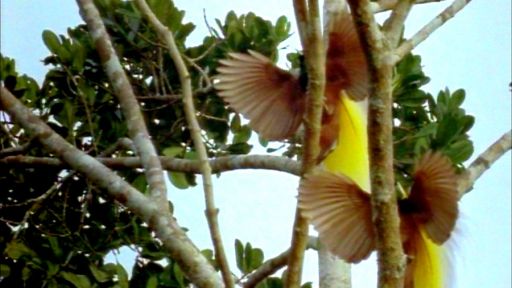
Blue Bird of Paradise
A Blue bird of paradise displays for conservationist Miriam Supuma.

Interview: Miriam Supuma
An interview with biologist and conservationist Miriam Supuma.

Additional Resources
Additional resources about birds of paradise.
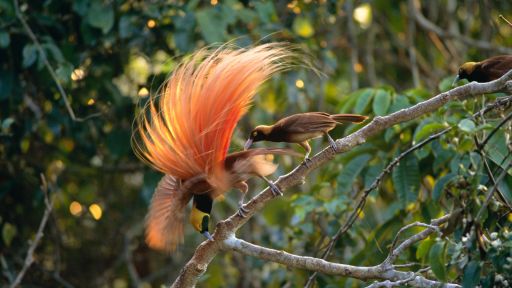
Birds of Paradise and Sexual Selection
How a group of picky females created the beautiful and bizarre males of the Paradisaeadie...

Making of Birds of the Gods
A behind-the-scenes look at Birds of the Gods.

Bird of Paradise Facts
Information on New Guinea's birds of paradise.

Birds of the Gods
Deep in New Guinea live spectacular birds that exist nowhere else.
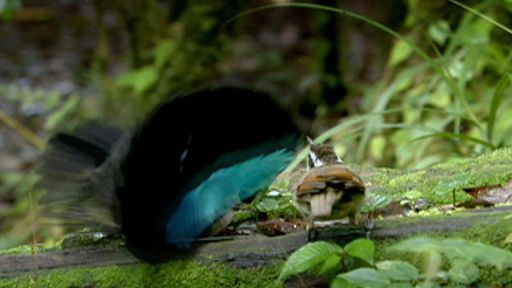
Superb Bird of Paradise
The bizarre and elaborate courtship display of the Superb bird of paradise.
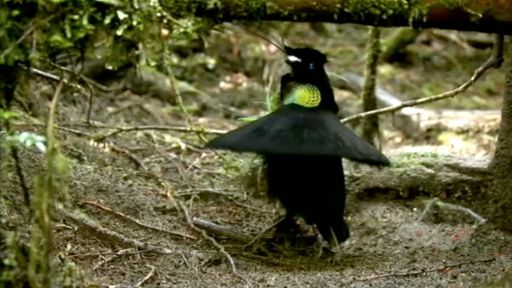
Lawes's Parotia
A male intruder interrupts another Lawes's Parotia's courtship display.
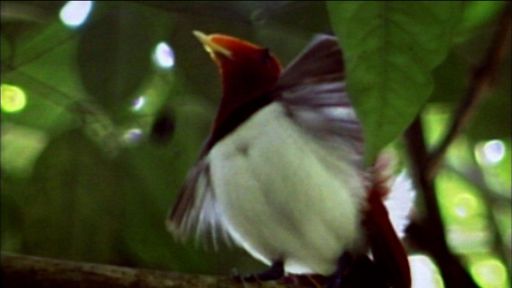
King Bird of Paradise
The courtship displays of the red and white King bird of paradise.

Magnificent Bird of Paradise
A magnificent bird of paradise displays for a nearby female.
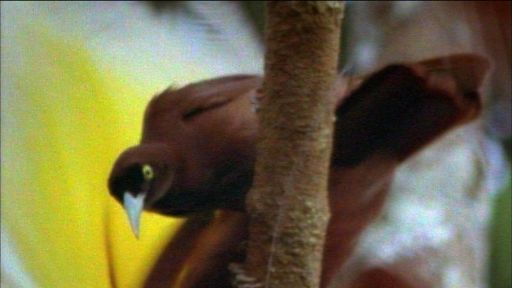
Greater Bird of Paradise
The lek-mating displays of the Greater birds of paradise.
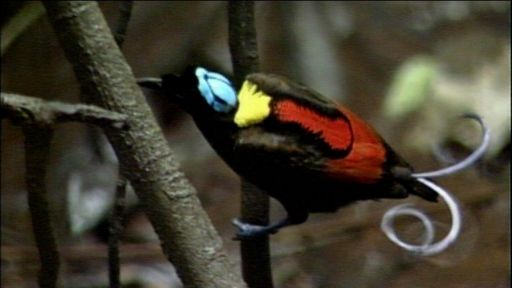
Wilson's Bird of Paradise
The commonalities between Wilson's bird of paradise and Magnificent bird of paradise.
You May Also Like

An Original DUCKumentary
Take a fascinating look at one of our most familiar birds.
Woodpeckers: The Hole Story
Get an intimate look at what makes woodpeckers so special. Narrated by Paul Giamatti.

Penguins: Spy in the Huddle - Part 1
Airs Wednesday, September 24, 2014 at 8:00 p.m. ET/PT. Check your local listings.