
I am a Guatemalan biologist who has worked in conservation for 19 years and currently serve as the Country Director for the Wildlife Conservation Society (WCS) in Guatemala. But my journey began as a girl growing up between farms—with cows, horses, yellow-naped parrots, and birds of prey—and beaches with sea turtles and dolphins on Guatemala’s Pacific coast when not in Guatemala City.
From an early age, I was drawn to the beauty and perfection of nature, and I developed a particular sensitivity to environmental problems in Guatemala and around the world such as deforestation, wildlife trafficking, and species extinction—issues that were already being taught to children 40 years ago. I found my path by studying biology at Universidad del Valle.
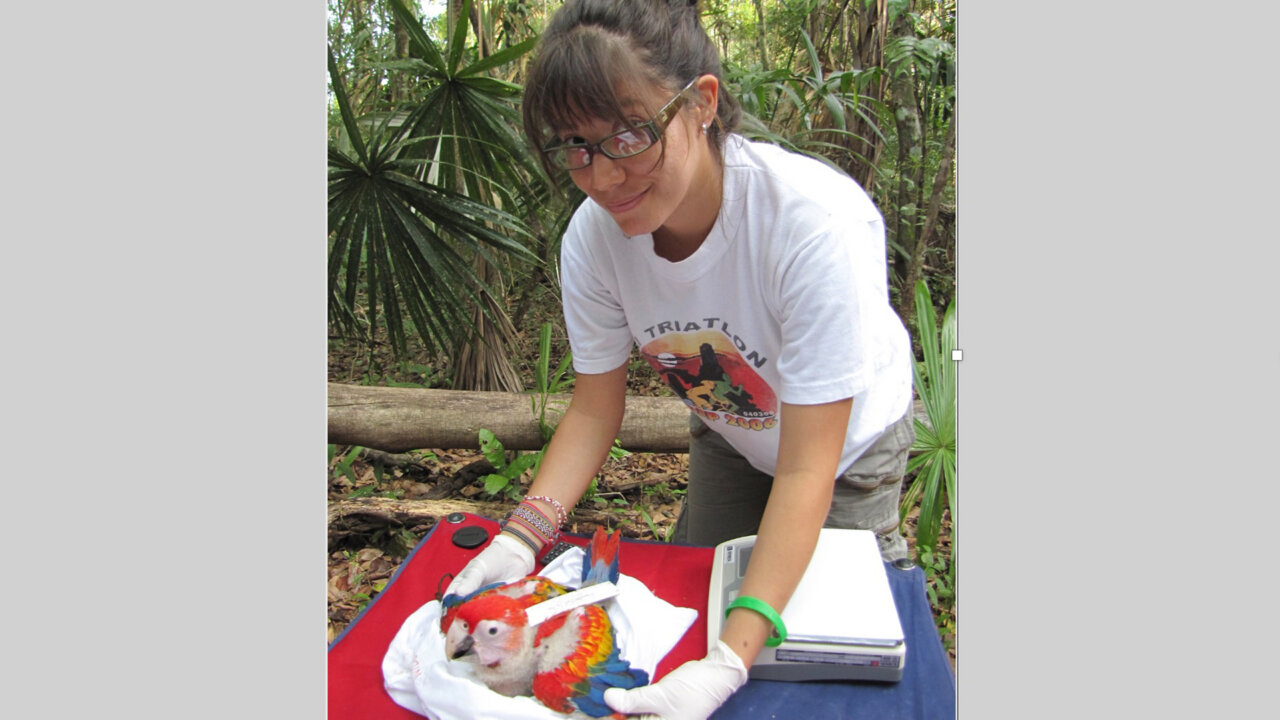
Scarlet macaw chick review in 2009, Laguna del Tigre National Park. Photo credit: ©️WCS Guatemala.
By the end of my degree, I had become interested in understanding ecological processes like the interactions between monkeys and dung beetles in seed dispersal. This interest led me to work in Tikal National Park, an iconic place for Guatemala and the world. There I saw firsthand the work involved in protecting natural and cultural resources, managing protected areas, and understanding the relationship between people and natural landscapes.
I carried out my undergraduate research in Tikal, and I also had the opportunity to meet the WCS Guatemala team. At that time, I met Roan McNab and Rony García, without knowing that I would later share my journey at WCS with them as friends and colleagues in the work of conservation.
From Tikal, my academic path took me to Mexico to pursue a master’s degree in environmental biology at the National Autonomous University of Mexico (UNAM), where I had the opportunity to work with excellent researchers such as Alfredo Cuarón and Ellen Andresen, who guided me through my research in the Lacandon Forest.
As I continued my studies, I began to better understand the importance of connecting scientific learning with conservation action to address the challenges facing the landscapes where I worked. The support of my family and the scholarships I received during my university and professional training years were very important.
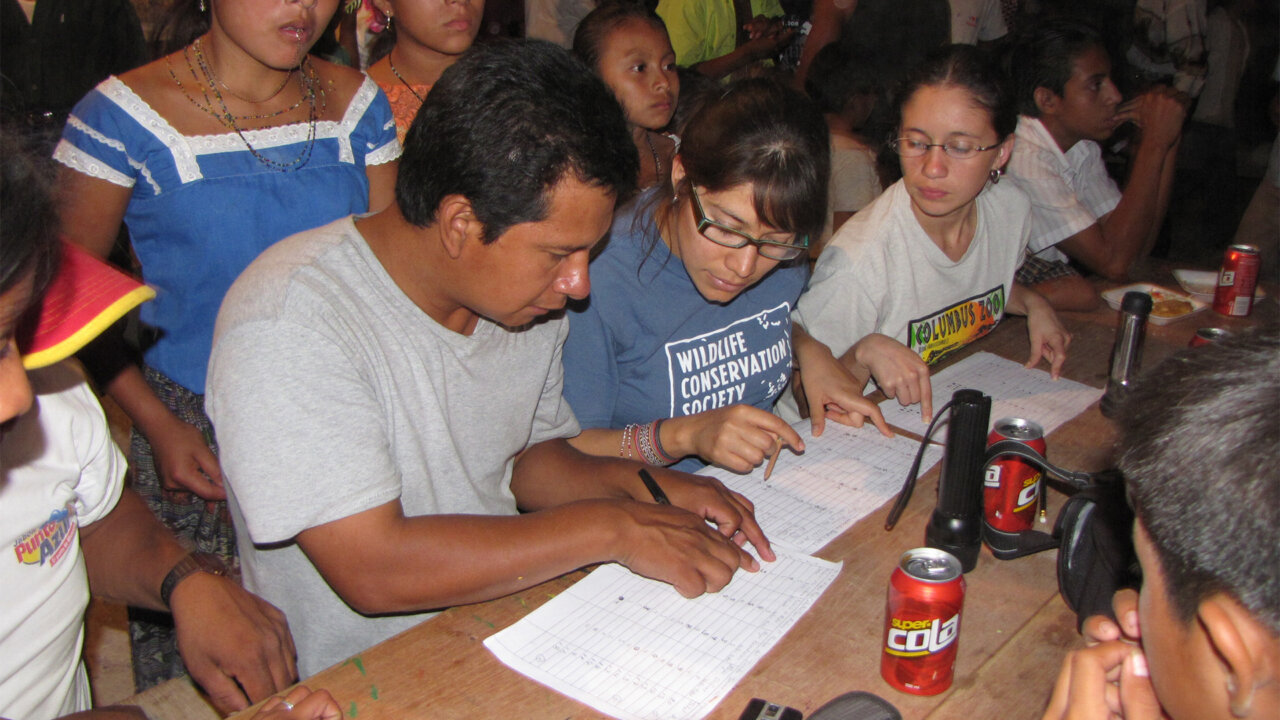
Paso Caballos Community Festival, 2010, where Gabriela was part of the judging panel for the best costume competition. Photo credit: ©️WCS Guatemala.
They allowed me to participate in exchanges outside Guatemala, meet professionals and specialists, and gradually find my own path. I had the privilege of joining WCS in 2007 as a field biologist, working on scarlet macaw and jaguar conservation projects. This enabled me to contribute to WCS’s conservation strategy in Guatemala and, eventually to become Country Director of the WCS Guatemala Program.
As I moved from being a field biologist to leading a conservation program, I learned that conservation is no longer only about understanding species and ecosystems. It is also about listening, building trust, working with communities and people, and helping connect many different pieces.
Over the years, I have had the opportunity to see WCS Guatemala’s work grow beyond northern Guatemala and the magnificent Maya Forest—with its tropical forests, macaws, and toucans—to include the forests of the Trifinio region in southeastern Guatemala and to the Pacific coast and the beaches where I grew up.
My perspective is broader now. I have come to understand that local communities are part of these landscapes and depend on them and need to be active participants in the conservation strategies that shape their future. My professional and personal growth has helped me see myself as just one part of a mechanism made up of many gears. If I can do my part to help that work move forward, I will have fulfilled my purpose.
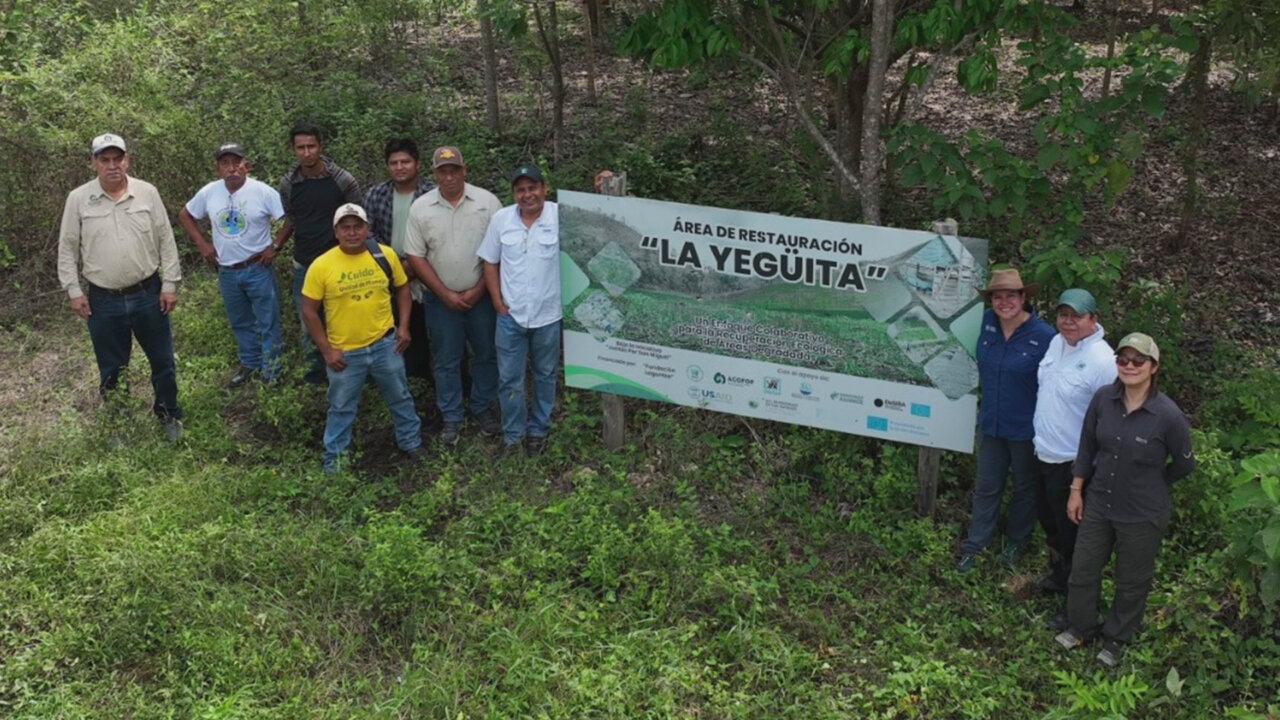
La Yeguita restoration area with community leaders from San Miguel La Palotada, the Minister and Vice Minister of Agriculture, the Director of the Multiple Use Zone of the Maya Biosphere Reserve, and the WCS team—all engaged in a collective restoration effort in the Maya Biosphere Reserve. Photo credit: ©️WCS Guatemala.
Throughout this journey, I have been fortunate to collaborate with people who have been important references for me—people from whom I have learned so much and continue to learn. I’m pleased now to support young people who likewise want to make a difference and give them the same opportunities I had.
Many of these younger conservationists now work for WCS, but they can also be found in partner institutions and in the communities where we work. I feel proud, fortunate, and grateful to be part of this conservation community.
Today, when I return to the beaches where I grew up or walk through the Maya Forest, I understand that my own story is also connected to these landscapes. I have learned that conservation is something we build together, and that part of our responsibility is to help a new generation find its own place within it.